Tây Ninh Holy See
Tây Ninh Holy See: the Divine Eye ordering a living Cao Đài cosmos
Understand sacred places, explore living traditions, and learn how to engage respectfully with Pilgrim Map.
Access has not been verified. Check current local guidance before planning a visit.
Hòa Thành, Tây Ninh, Vietnam
Read the sources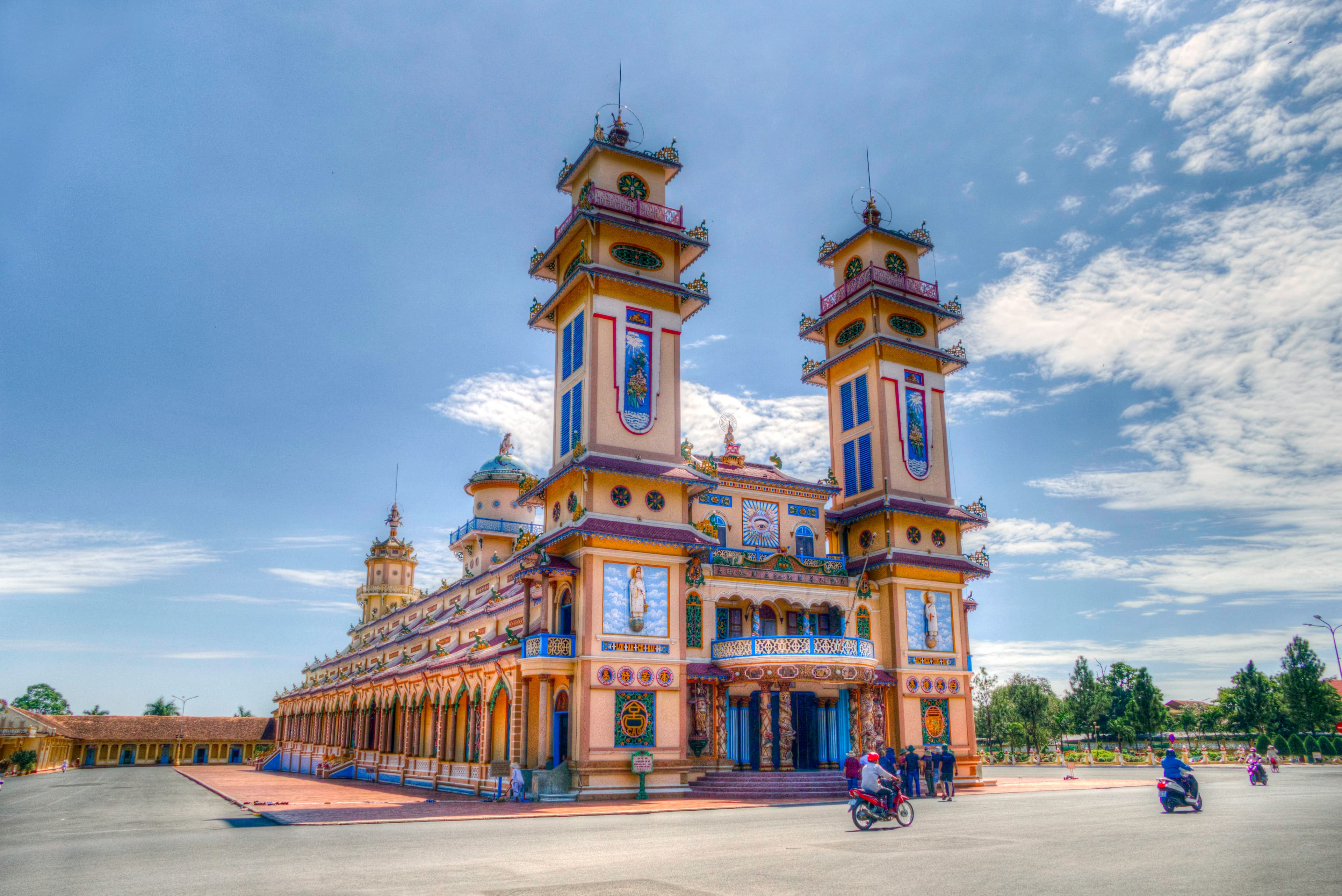
Tây Ninh Holy See in Hòa Thành, Tây Ninh, Vietnam. Image source · CC BY-SA 4.0
Visit essentials
A quick read before you go
- Duration
- Allow time for waiting, orientation, and a complete period of observation without leaving…
- Access
- The strong Places record lists the Holy See on Phạm Hộ Pháp in Hòa Thành.
Overview
The Holy See makes Cao Đài religious unity visible through an exact ceremonial order. The Divine Eye does not function as decoration; it symbolizes Đức Chí Tôn and orients the long prayer hall. Dignitaries and worshippers take assigned places, movement follows processional discipline, and music accompanies formal daily prayer. Visitors often first notice color and architectural synthesis, but the interior is best understood by watching how bodies align toward the sacred focus.
Caodaism draws different religious inheritances into a Vietnamese revelatory tradition without reducing them to a tourist-friendly mixture. The Holy See is therefore both a house of worship and the institutional center of a living community.
Why this place is sacred
A strong sense of order distinguishes the Holy See from a hall visited only for visual symbolism. Color, columns, emblems, dress, and position work together during worship. The Divine Eye gathers those elements around the presence of Đức Chí Tôn, while the congregation's disciplined formation embodies hierarchy and unity. Visitors may feel intensity or harmony during prayer, but those reactions remain personal and are not proof of a supernatural force.
The supported sacred claim is that repeated worship and institutional stewardship make the complex the central Cao Đài precinct.
Followers built the Holy See as the principal ceremonial and administrative center of the religion founded in 1926.
The precinct continues to organize worship, teaching, administration, major holy days, and carefully managed public observation.
Experience and orientation
Arrive before prayer if you hope to observe, because late movement can distract from a highly ordered rite. Custodial rules keep observers outside the central formation and direct them to the appropriate entrance. As worship begins, attend to orientation: the Divine Eye above, ranks of dignitaries and worshippers below, music in its ceremonial place, and a collective rhythm of bowing and prayer. Avoid roaming for a better angle. The meaning becomes clearer from disciplined stillness than from collecting interior details.
Locate the Divine Eye, central congregational axis, visitor boundary, directed entrances, and any administrative area closed to the public.
Context and lineage
Official Cao Đài and provincial sources describe followers building the Holy See as the principal center of the Vietnamese religion founded in 1926. The record supports a living revelatory institution centered on Đức Chí Tôn. It does not require speculative stories about hidden design powers.
Identity review found the strong Tây Ninh Holy See Places match approximately fifteen metres from production UUID 9686e6f1-d966-4d1a-bb30-633e6fef673c, named Cao Dai Temple and lacking site content; this page is intended for that existing entity rather than a new duplicate.
Caodaism is a Vietnamese revelatory religion whose own institutions and teachings should lead interpretation of the Holy See.
Đức Chí Tôn
supreme divine focus symbolized by the Divine Eye
Traditions and practice
Daily prayers follow a defined order in which position, entrance, clothing, music, and gesture matter. Major holy days may enlarge that pattern through larger attendance and ceremonial responsibilities. A visitor may observe from the designated margin but should never join the central formation without an explicit invitation and instruction.
The Holy See remains an active place of prayer, religious administration, teaching, service, and community gathering.
During prayer, choose one fixed position and observe how the Divine Eye organizes attention across the entire hall.
Caodaism
ActiveThe Holy See is the principal Cao Đài center, oriented toward Đức Chí Tôn through the Divine Eye.
Formal daily prayer, incense, sacred music, ranked processions, moral cultivation, service, and major holy days shape the precinct.
Perspectives and open questions
Cao Đài theology, institutional history, ceremonial architecture, moral discipline, and public observation each reveal a distinct dimension.
Scholarly perspective
The Holy See can be studied as the institutional center of a Vietnamese religion founded in 1926 and as an architectural expression of religious unity. Such analysis should preserve Cao Đài categories rather than treating the tradition as a collage assembled for novelty. Prayer order demonstrates that synthesis operates within disciplined authority.
Living and traditional perspectives
Within Caodaism, the Divine Eye signifies Đức Chí Tôn; worship joins revelation with self-cultivation, service, and the aspiration toward religious unity.
Open questions
No vision, energy, healing, or other metaphysical outcome is promised to observers, and personal impressions are not independent verification.
Plan your visit
Access and arrival
The strong Places record lists the Holy See on Phạm Hộ Pháp in Hòa Thành. Map availability does not override ceremonial closures, so verify current entry and prayer observation locally.
Use licensed accommodation in Tây Ninh unless an official Cao Đài program provides different arrangements.
Respectful visit
Choose modest clothing appropriate to the principal sanctuary of an active religion.
Photograph only from the visitor area, without flash or movement that distracts the prayer order.
Use only forms accepted by Holy See custodians; quiet observation is preferable to an invented offering.
Do not cross ceremonial lines, enter administrative rooms, obstruct processions, or reposition sacred or ritual objects.
Do not call Caodaism a casual blend of other faiths or improvise a prayer sequence based on visible gestures.
Current practical details
Address
Phạm Hộ Pháp, Long Hoa, Tây Ninh 80606, Vietnam
Hours
Hours, fees, and access can change — verify on the official source before you travel. Practical details last checked Jul 2026.
Location
Map loads as you approach this section.
Pilgrim reflections
A portrait of encounter, not a score
Pilgrims describe what they felt, how present they could become, and whether the place would shape a journey. There are no stars and no ranking of traditions.
No reviewed reflections yet
The first pilgrims can help describe the character of being here.
Share a reflection
Available after an account-backed “Been there.” Every reflection is reviewed before publication.
Nearby sacred places
Explore other sacred places in the region. Proximity does not establish access or travel time; check each place’s guidance.

References
Sources consulted for this page. Source categories describe the publication, not a guarantee that every claim is verified. Traditional accounts and outside interpretations may differ.
- 01The Sacerdotal Council of Caodaism — Cao Đài Holy SeeSource contextInstitutional Cao Đài source for living worship and the Holy See.
- 02Tòa thánh Tây Ninh — Tây Ninh Tourism AuthorityofficialProvincial source for the Holy See's completion, dedication, and religious role.
- 03Great Divine Temple — Wikipedia — Wikipedia contributorsacademicCorroborates canonical identity and location.
- 04Cao Dai Is Dai Dao — Cao Đài community authorsspiritualPublished Cao Đài explanation of theology and Holy See worship.
- 05Google Maps listing for Tây Ninh Holy See — Google MapsSource contextUsed only for strong-match coordinates and practical fields.
Photo gallery
3 curated photos
Share a photo
Help visitors recognize Tây Ninh Holy See. Every submission is reviewed before publication.