Beopjusa Temple
A sourced encounter with Beopjusa Temple
Understand sacred places, explore living traditions, and learn how to engage respectfully with Pilgrim Map.
Access has not been verified. Check current local guidance before planning a visit.
Boeun-gun, Chungcheongbuk-do, South Korea
Read the sources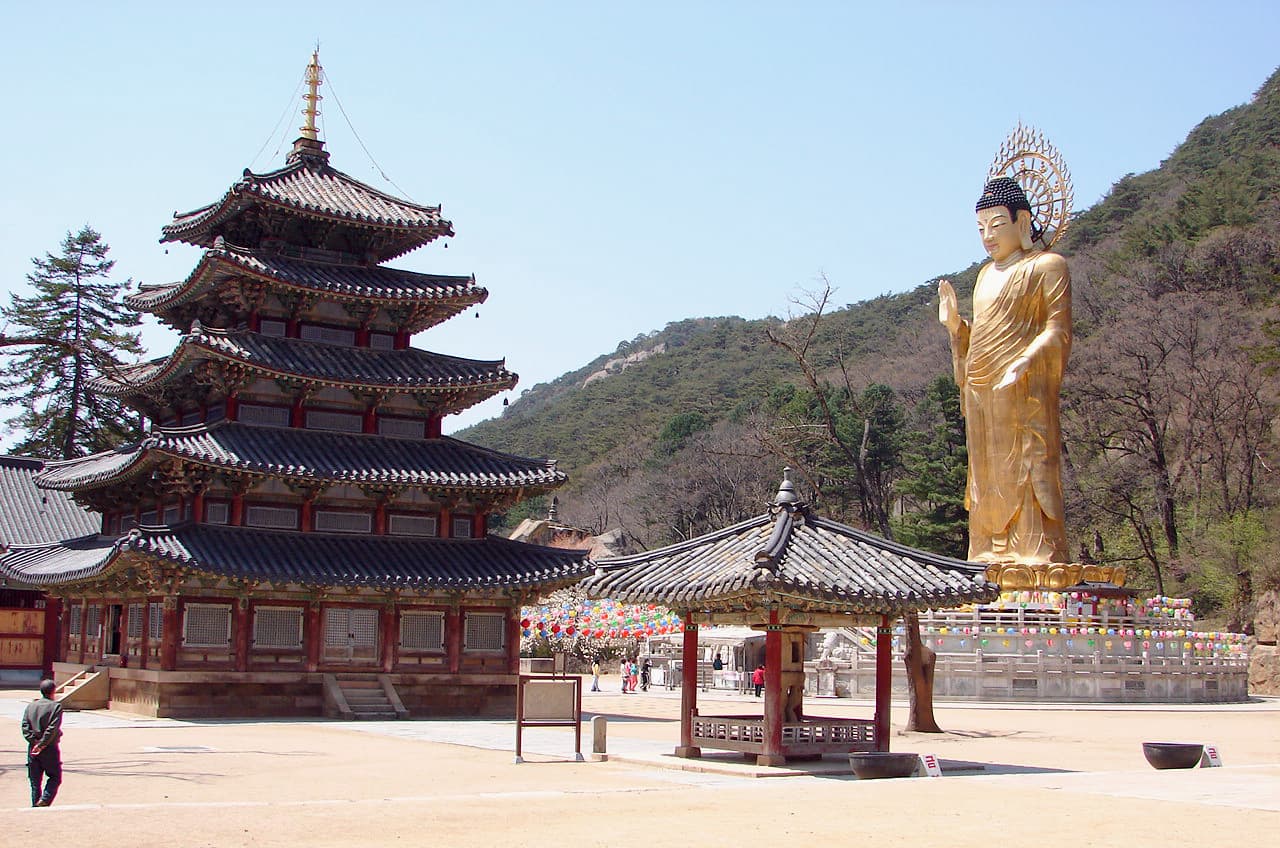
Beopjusa Temple in Boeun, North Chungcheong, South Korea. Image source · CC BY-SA 3.0
Visit essentials
A quick read before you go
- Duration
- Allow an unhurried circuit appropriate to Beopjusa Temple.
- Access
- 405 Beopjusa-ro, Songnisan-myeon, Boeun-gun, Chungcheongbuk-do, South Korea
Overview
Beopjusa lies within Songnisan National Park in Boeun, where a long forest approach opens into an unusually expansive temple compound. The monastery has historic connections with Beopsang Buddhist thought and devotion to Maitreya, the future Buddha. Its large Maitreya image and Mireukjeon express that emphasis, while Palsangjeon rises as Korea's surviving historic five-story wooden pagoda. As a Jogye Order head temple, bells, services, resident movement, teaching, and maintenance keep the complex in religious use.
Sculpture, timber construction, forest ecology, and living Buddhist practice belong in one frame, not as scenery.
Why this place is sacred
Beopjusa's sacred character rests in Buddhist expectation, discipline, and communal continuity rather than a promised sensation. Maitreya devotion directs thought toward a future Buddha and the conditions of a future age; it should not be reduced to wish fulfillment before a giant statue. Songnisan also shapes arrival through rock peaks, forest, water, and distance from dense settlement. The mountain can support reflection without being described as a measurable spiritual battery.
UNESCO's Sansa framework is useful because it recognizes the interaction of monastic layout and natural setting while affirming that religious functions continue. The selected records support a narrower conclusion: Beopjusa's monumental scale serves documented monastic and devotional functions.
Beopjusa developed as a Songnisan monastery where Beopsang teaching and expectation of Maitreya shaped religious life.
Rebuilding, Palsangjeon's surviving timber form, modern Maitreya imagery, and active Jogye administration mark different historical layers.
Experience and orientation
Begin Beopjusa with the approach through Songnisan rather than rushing toward the largest image. Inside the compound, locate Palsangjeon, the principal worship areas, and the monastic circulation routes before choosing a camera position. Large courtyards may host ceremonies and crowd patterns can change quickly. Stand away from ritual axes, do not stage portraits in front of people bowing, and obey restrictions around painted timber and altar spaces. National-park conditions affect footwear, weather exposure, and transport.
The dated strong Places record should be rechecked for current hours, while ceremonial access remains subject to the temple's own announcements.
Locate worship halls and monastic circulation on the precinct map before choosing a viewpoint in the broad courtyards.
Context and lineage
Beopjusa's foundation is traditionally placed in the sixth century and associated with the monk Uisin, but the present precinct embodies many later periods. War, fire, reconstruction, royal patronage, and twentieth-century projects all shaped what survives. Palsangjeon's five levels and painted Buddhist narrative program make it a central architectural document, while the Maitreya structures express another strand of the temple's identity. UNESCO inscribed Beopjusa in 2018 as a component of Sansa, Buddhist Mountain Monasteries in Korea.
That status concerns the complete monastic landscape and its continued functions, not one isolated masterpiece. A careful account distinguishes early foundation tradition from the dates of extant buildings and avoids implying that every visible object has stood unchanged since the beginning.
Beopjusa Temple belongs within Korean Buddhism.
Traditions and practice
Prayer, prostration, chanting, offerings, teaching, and monastic observance give Beopjusa its present religious life. Devotion before Maitreya imagery belongs to a Buddhist doctrinal and ritual setting; visitors should not invent promises of prosperity, healing, or guaranteed future benefit. Enter open halls only after checking shoe and photography rules. Leave the space nearest an altar to practitioners, and never strike a bell, drum, or wooden instrument without explicit permission.
A nonparticipating guest can compare how the wooden pagoda and Maitreya image organize attention, then step aside when congregational activity begins.
Prayer, prostration, chanting, teaching, and monastic routines keep Beopjusa religiously active within Songnisan National Park.
Study Palsangjeon's timber stories from a permitted position, then consider how nearby Maitreya imagery changes the precinct's devotional scale.
Korean Buddhism
ActiveBeopjusa gives Maitreya-centered Buddhist devotion a monumental mountain setting sustained by active worship, monastic administration, and heritage care.
Maitreya devotion, chanting, bows, offerings, teaching, and ordinary monastic observance proceed under Beopjusa's resident community.
Perspectives and open questions
Maitreya belief, Beopsang history, Palsangjeon, Songnisan ecology, and living monastic authority should be read together.
Scholarly perspective
Beopjusa can be understood through Maitreya devotion, Korean monastic history, wooden architecture, sculpture, and national-park stewardship. A devotional interpretation asks what future awakening means within Buddhist teaching. An architectural reading follows Palsangjeon's structure and narrative images. UNESCO considers the monastery as one component in a wider Korean pattern of mountain Buddhism, while environmental management must also protect Songnisan from concentrated visitation. These perspectives are complementary but not interchangeable.
Heritage designation does not authorize entry into every religious space, and personal awe does not prove a paranormal property. Beopjusa's documented significance is already substantial without either claim.
Living and traditional perspectives
In Beopjusa's Buddhist setting, Maitreya signifies the future Buddha; the devotion is not a promise of personal prosperity.
Open questions
Foundation traditions and private devotional experiences remain attributed; no guaranteed healing or supernatural effect is asserted.
Plan your visit
Access and arrival
405 Beopjusa-ro, Songnisan-myeon, Boeun-gun, Chungcheongbuk-do, South Korea
No accommodation claim was verified for Beopjusa Temple.
Respectful visit
Wear modest, practical clothing suitable for Beopjusa Temple.
Ask before photographing hall interiors or practitioners, and never pose between a devotee and a Maitreya altar.
Use only temple-designated places for incense, donations, food, or petitions; monumental imagery does not invite improvised rites.
Do not strike bells, drums, or wooden instruments, and remain outside residential or temporarily closed monastic areas.
Never improvise rites or offerings at Beopjusa Temple.
Current practical details
Address
405 Beopjusa-ro, Songnisan-myeon, Boeun-gun, Chungcheongbuk-do, South Korea
Phone
Hours, fees, and access can change — verify on the official source before you travel. Practical details last checked Jul 2026.
Location
Map loads as you approach this section.
Pilgrim reflections
A portrait of encounter, not a score
Pilgrims describe what they felt, how present they could become, and whether the place would shape a journey. There are no stars and no ranking of traditions.
No reviewed reflections yet
The first pilgrims can help describe the character of being here.
Share a reflection
Available after an account-backed “Been there.” Every reflection is reviewed before publication.
Nearby sacred places
Explore other sacred places in the region. Proximity does not establish access or travel time; check each place’s guidance.

References
Sources consulted for this page. Source categories describe the publication, not a guarantee that every claim is verified. Traditional accounts and outside interpretations may differ.
- 01Sansa, Buddhist Mountain Monasteries in Korea — UNESCO World Heritage CentreofficialAuthoritative World Heritage property record, dossier 1562; component scope preserved.
- 02Beopjusa Temple — World Heritage nomination dossier — State Party of the Republic of Korea / UNESCOofficialPrimary nomination documentation for UNESCO property 1562, including serial-component identity, mapping, and heritage context.
- 03Beopjusa — Wikipedia — Wikipedia contributorsacademicCorroborates identity, location, and general historical context; key claims require higher-tier support.
- 04Beopjusa — Wikidata — Wikidata contributorsSource contextCommunity-maintained structured identity and coordinate cross-check; not treated as scholarship or an official custodian record.
- 05Beopjusa Temple — Google Maps place record — GoogleSource contextStrong identity match used only for current practical fields and coordinates.
Share a photo
Help visitors recognize Beopjusa Temple. Every submission is reviewed before publication.