Woljeongsa Temple
Fir-shadowed arrival to an octagonal center
Understand sacred places, explore living traditions, and learn how to engage respectfully with Pilgrim Map.
Access has not been verified. Check current local guidance before planning a visit.
Pyeongchang-gun, Gangwon-do, South Korea
Read the sources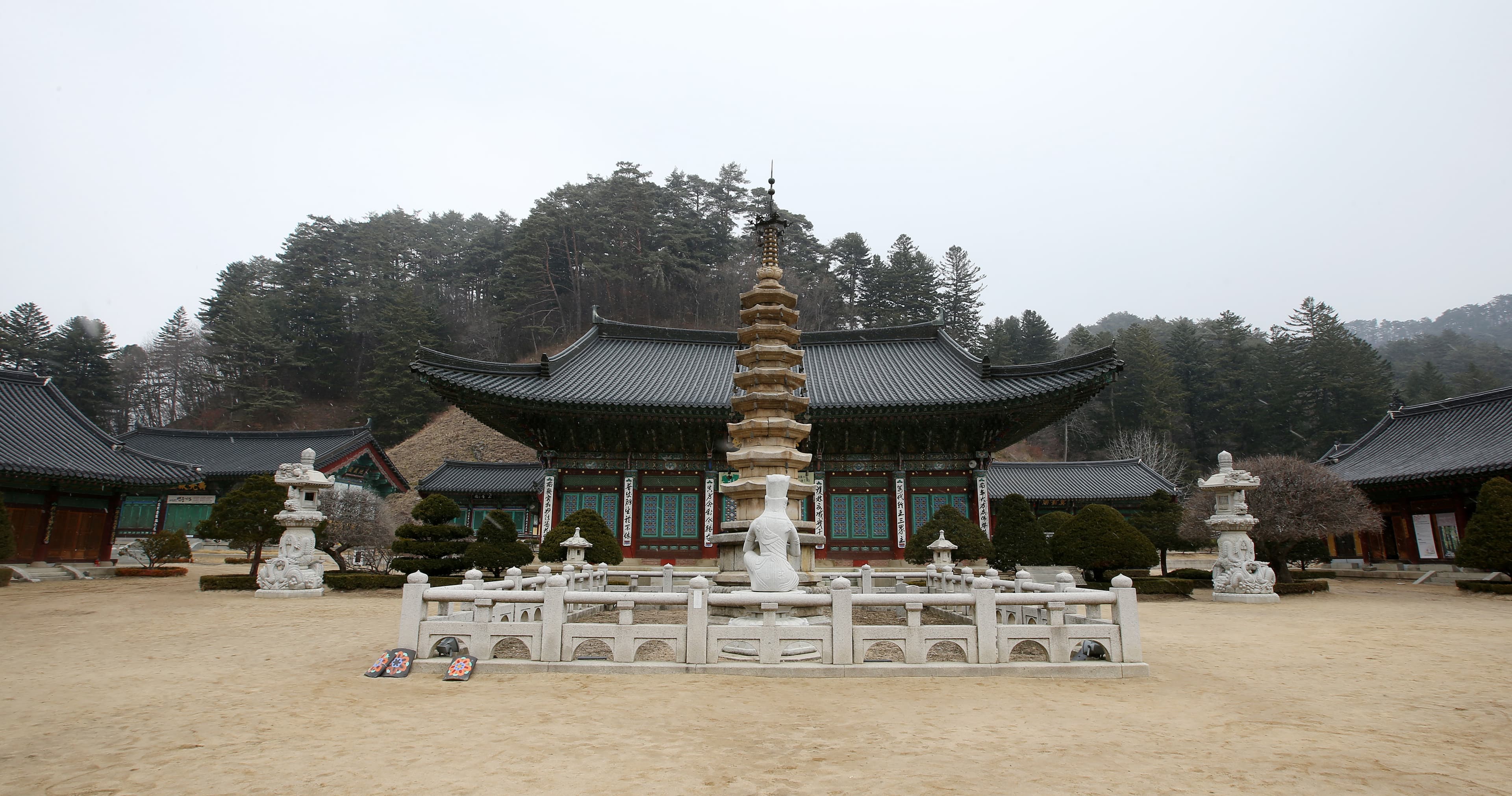
Woljeongsa Temple in Pyeongchang, Gangwon State, South Korea. Image source · CC BY-SA 2.0
Visit essentials
A quick read before you go
- Duration
- Allow two hours for the fir road and main court, longer for a separately planned Seonjaegil…
- Access
- A July 2026 KTO feature lists continuous year-round access and woljeongsa.org, but explicitly…
Overview
Official sources differ on the trail’s measured length—some describe the celebrated section as one kilometre, while a current feature speaks of a longer route from Iljumun to Geumganggyo. The count of more than 1,700 firs is also a visitor-oriented description rather than a timeless total. These changing measurements do not weaken the place. They remind us that a forest is alive and that practical information must be dated.
Woljeongsa’s sacred continuity rests in the practiced route, the central pagoda, worship in rebuilt halls, and its role within Odaesan Buddhist life. A careful page keeps seasonal beauty and religious purpose joined without promising that walking among the trees automatically produces peace.
Why this place is sacred
Repetition changes across the approach. No two trunks are identical, though their height creates a common rhythm. The pagoda’s octagonal plan then turns repetition into formal geometry, with each level rising around a stable center. This offers a grounded contemplative structure: multiplicity need not become disorder, and focus need not erase difference. The idea comes from visible relationships rather than an assertion about forest energy.
Buddhist practice gives the analogy ethical weight through patient return—breath after breath, bow after bow, season after season—while conservation keeps both trees and stone available to future communities.
Woljeongsa’s Silla-period foundation tradition places the Odaesan precinct within Korean Buddhist monastic practice.
War damage and reconstruction altered the halls, while the pagoda, forest route, museum, and retreat programs continue to organize the contemporary monastery.
Experience and orientation
Begin at Iljumun and let the intervals between trunks establish a walking cadence. Winter snow reveals branch and bark; autumn brings color and crowds; summer deepens shade and humidity. At Geumganggyo, notice the transition from woodland path to built precinct. Circle the pagoda only if the route and local conduct permit, observing how its faces change while the center remains unseen. The main court can be busy, so choose a position that leaves ritual lines and museum traffic open.
The forest and pagoda should be experienced sequentially rather than compressed into one scenic photograph.
Check park weather, temple notices, and whether the full forest path is open before committing to a longer walk.
Context and lineage
The temple is traditionally associated with the Silla monk Jajang and the establishment of Buddhist practice in Odaesan. Later destruction, including the Korean War, means much of the visible complex is rebuilt. The octagonal nine-story stone pagoda provides a different material chronology and remains the court’s defining cultural asset. Current KTO information also emphasizes meditation and Templestay, showing how the monastery translates inherited discipline into supervised programs for modern participants.
Woljeongsa is a major Jogye Order temple in Odaesan and supervises a wider network of mountain Buddhist sites.
Traditions and practice
Prayer and offerings focus on the temple’s halls and sacred objects; any movement around the pagoda should follow the direction and boundaries indicated locally.
Meditation programs and Templestay create explicit schedules for instruction, meals, rest, and communal responsibility.
Count eight changes of viewpoint around the pagoda from a respectful distance, pairing each with one unhurried breath.
Korean Buddhism
ActiveJogye mountain practice connects Odaesan’s living forest with a court centered on Buddhist memory and form.
Prayer, meditation, offerings, careful walking, communal routine, and organized retreat.
Perspectives and open questions
Forest ecology, architectural history, and Buddhist repetition offer complementary readings of Woljeongsa.
Scholarly perspective
A dated trail count, reconstructed halls, and pagoda chronology should be documented separately rather than blended into a timeless monastery image.
Living and traditional perspectives
The approach supports recollection and composure before entering a precinct ordered around Dharma and communal practice.
Open questions
Promotional descriptions of automatic inner peace are not treated as verified psychological effects.
Plan your visit
Access and arrival
A July 2026 KTO feature lists continuous year-round access and woljeongsa.org, but explicitly advises rechecking changing information.
Meditation stays require official booking; no independent lodging recommendation is included.
Respectful visit
Dress modestly in layers suitable for Odaesan’s rapid temperature changes.
Tripods and portraits must not obstruct the fir path, bridge, pagoda, or hall entrances.
Use formal donation or devotional stations inside the temple; leave nothing on trees or stones.
Protected platforms, museum objects, residential compounds, and temporarily closed forest sections are off limits.
Do not carve trees, leave ribbons, step onto the pagoda platform, or claim that the forest itself heals illness.
Current practical details
Address
374-8 Odaesan-ro, Jinbu-myeon, Pyeongchang-gun, Gangwon-do, South Korea
Phone
Hours
Hours, fees, and access can change — verify on the official source before you travel. Practical details last checked Jul 2026.
Location
Map loads as you approach this section.
Pilgrim reflections
A portrait of encounter, not a score
Pilgrims describe what they felt, how present they could become, and whether the place would shape a journey. There are no stars and no ranking of traditions.
No reviewed reflections yet
The first pilgrims can help describe the character of being here.
Share a reflection
Available after an account-backed “Been there.” Every reflection is reviewed before publication.
Nearby sacred places
Explore other sacred places in the region. Proximity does not establish access or travel time; check each place’s guidance.
References
Sources consulted for this page. Source categories describe the publication, not a guarantee that every claim is verified. Traditional accounts and outside interpretations may differ.
- 01Woljeongsa Temple and Needle Fir Forest — Korea Tourism OrganizationofficialLive official tourism record used for site identity, heritage context, and visitor logistics; time-sensitive details require rechecking.
- 02Korea Heritage Service public heritage search — Korea Heritage ServiceofficialAuthoritative national search portal retained as a verification route; not used alone for site-specific claims.
- 03Woljeongsa Temple and Odaesan Fir Trail — Korea Tourism OrganizationofficialCurrent official tourism feature for the fir approach, 1,700 trees, octagonal nine-story pagoda, meditation programs, address, hours, and contact.
- 04Woljeongsa Temple — Google Maps place record — GoogleSource contextStrong identity match used only for current practical fields and coordinates.
Pilgrim glossary
- Dharma
- The teachings of the Buddha; also the universal law underlying them.
Share a photo
Help visitors recognize Woljeongsa Temple. Every submission is reviewed before publication.