Samhwasa Temple
Medicine Buddha and rites for the forgotten at Mureung Valley
Understand sacred places, explore living traditions, and learn how to engage respectfully with Pilgrim Map.
Access has not been verified. Check current local guidance before planning a visit.
Donghae-si, Gangwon-do, South Korea
Read the sources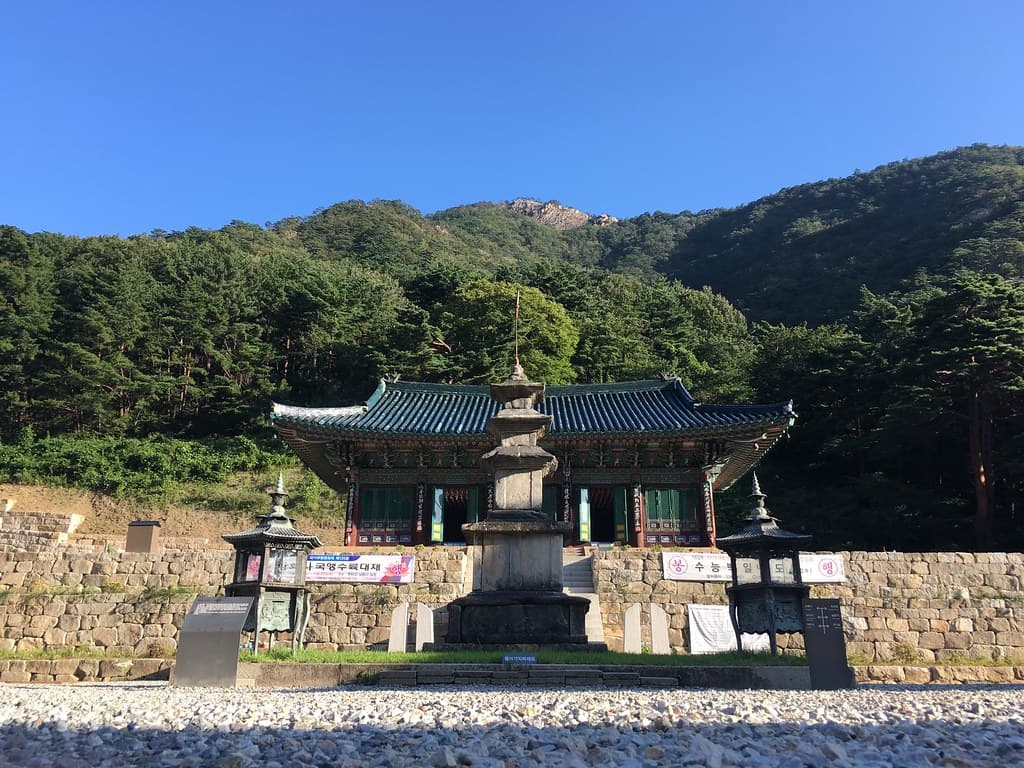
Samhwasa Temple in Donghae, Gangwon State, South Korea. Image source · CC BY 2.0
Visit essentials
A quick read before you go
- Duration
- Allow one hour for the temple, adding separate time for Mureung Valley trails and waterfalls.
- Access
- KTO lists sunrise-to-sunset access, year-round opening, samhwasa.or.kr, and parking at the…
Overview
The valley entrance places Samhwasa between destination and passage. Hikers may see it as one stop among waterfalls and inscribed rocks, while Buddhists inherit a monastery with changing names and recurring ritual obligations. Its current name, commonly interpreted through harmony, belongs to a later chapter than the received foundation as Geukryeondae. The temple’s national Suryuk rite gives this layered identity an ethical center. Elaborate offerings are prepared not for spectacle but for beings imagined as hungry, displaced, or forgotten.
Alongside devotion to Bhaisajyaguru, the rite makes care a communal action while keeping religious claims within Buddhist tradition.
Why this place is sacred
Medicine Buddha devotion addresses suffering through vow, image, prayer, and disciplined attention. Suryukjae addresses another vulnerability: the fear that the dead may have no family line or community to remember them. Together they widen the meaning of refuge without guaranteeing medical recovery or proving the existence of wandering spirits. The Mureung landscape intensifies awareness of water, exposed rock, and human inscriptions, but it is the ritual response—not an invisible property of the valley—that makes Samhwasa sacred.
Prepared food, recited teaching, protected sculpture, and repeated memorial action turn compassion into labor.
Temple tradition places Jijang at the 642 foundation of Geukryeondae, an earlier name in Samhwasa’s institutional memory.
The monastery passed through the name Samgongam before becoming Samhwasa and now combines worship, education, retreat, and Suryukjae safeguarding.
Experience and orientation
Enter from the Mureung route and notice how quickly a recreational path becomes a religious court. Yaksajeon’s focus differs from the wider valley’s famous rock and water. Look for the iron Buddha and pagoda as protected objects with specific histories, not generic signs of antiquity. During Suryukjae, color, sound, paper, food, and ceremonial movement may fill spaces that seem quiet on another day.
Observe from the assigned area and resist isolating a photogenic gesture from the sequence that gives it meaning. Outside festival time, let the contrast between compact precinct and expansive valley sharpen awareness of scale.
Confirm whether a ceremony, class, or retreat is underway before crossing from the public valley route into inner temple space.
Context and lineage
KTO gives the received account that Jijang founded Geukryeondae in 642. The name changed to Samgongam in 864 and later to Samhwasa during the Goryeo founding era. The current complex includes Yaksajeon, Geungnakjeon, Birojeon, a three-story pagoda, and a historic iron seated Buddha. Modern temple schooling and Templestay coexist with Samhwasa Gukhaeng Suryukdaejae, a nationally protected ritual tradition that requires its own sources and should not be confused with UNESCO World Heritage inscription.
Samhwasa is a Korean Buddhist temple under Woljeongsa’s supervision, with strong Medicine Buddha and Suryuk ritual associations.
Traditions and practice
Bhaisajyaguru devotion belongs to Buddhist approaches to suffering; Suryukjae invites and nourishes beings described within the ritual cosmology.
A Buddhist school and Templestay provide organized learning, while heritage bodies and ritual bearers sustain the major ceremony.
Reflect on one person who risks being forgotten, then consider a practical act of remembrance rather than asking the site for a private sign.
Korean Buddhism
ActiveKorean Buddhism at Samhwasa joins healing devotion with ritual responsibility toward beings outside ordinary remembrance.
Prayer, chanting, offerings, Suryukjae, study, retreat, and stewardship of sacred objects.
Perspectives and open questions
Samhwasa can be read through medicine devotion, memorial ethics, ritual arts, and the history of a named institution.
Scholarly perspective
Ritual performance and protected artifacts can be documented without deciding the truth of cosmological claims or flattening the ceremony into folklore.
Living and traditional perspectives
Medicine Buddha and Suryuk practice both respond to suffering, one through healing vows and the other through inclusive remembrance.
Open questions
Claims about cures or contact with spirits remain matters of belief and are not independently verified.
Plan your visit
Access and arrival
KTO lists sunrise-to-sunset access, year-round opening, samhwasa.or.kr, and parking at the Mureung Valley lot. Recheck seasonal valley hours.
Templestay exists through official booking; valley accommodation is not assessed here.
Respectful visit
Wear subdued clothes suited to temple floors and changeable conditions beside mountain water.
Ask specifically about the iron Buddha, interiors, ritual specialists, offerings, and memorial participants.
Use temple-authorized forms; never add food, coins, or paper to a Suryuk arrangement.
Protected sculpture, pagoda fabric, altars, preparation rooms, and monastic areas remain inaccessible without permission.
Religious healing language must not replace medical care, and ceremonial food or paper should never be touched.
Current practical details
Address
584 Samhwa-ro, Donghae-si, Gangwon-do, South Korea
Phone
Hours, fees, and access can change — verify on the official source before you travel. Practical details last checked Jul 2026.
Location
Map loads as you approach this section.
Pilgrim reflections
A portrait of encounter, not a score
Pilgrims describe what they felt, how present they could become, and whether the place would shape a journey. There are no stars and no ranking of traditions.
No reviewed reflections yet
The first pilgrims can help describe the character of being here.
Share a reflection
Available after an account-backed “Been there.” Every reflection is reviewed before publication.
Nearby sacred places
Explore other sacred places in the region. Proximity does not establish access or travel time; check each place’s guidance.

References
Sources consulted for this page. Source categories describe the publication, not a guarantee that every claim is verified. Traditional accounts and outside interpretations may differ.
- 01Korea Heritage Service public heritage search — Korea Heritage ServiceofficialAuthoritative national search portal retained as a verification route; not used alone for site-specific claims.
- 02Samhwasa Temple — Korea Tourism OrganizationofficialOfficial tourism record for the Mureung Valley setting, received 642 foundation, historical names, sacred buildings and objects, Templestay, hours, and address.
- 03Samhwasa Temple — Google Maps place record — GoogleSource contextStrong identity match used only for current practical fields and coordinates.
Share a photo
Help visitors recognize Samhwasa Temple. Every submission is reviewed before publication.