Wat Mahathat, Sukhothai
Lotus-bud architecture makes Sukhothai's Buddhist centre visible
Understand sacred places, explore living traditions, and learn how to engage respectfully with Pilgrim Map.
Access has not been verified. Check current local guidance before planning a visit.
Mueang Kao, Sukhothai, Thailand
Read the sources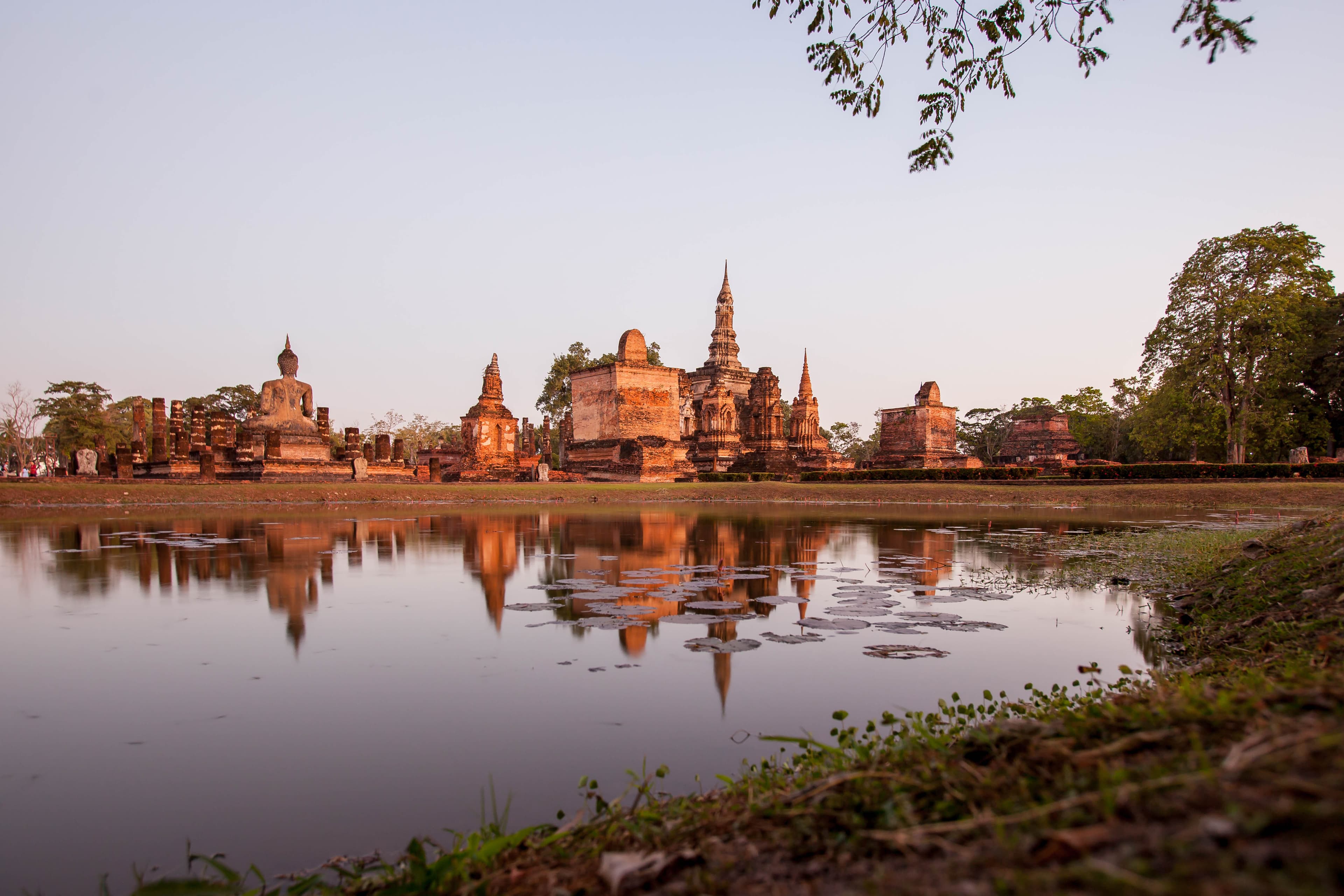
Wat Mahathat, Sukhothai in Mueang Kao, Sukhothai, Thailand. Image source · CC BY 4.0
Visit essentials
A quick read before you go
- Etiquette
- Keep off platforms, stucco, inscriptions, and foundations; use offerings only where authorized.
Overview
Here sacred order was expressed by accumulation without losing a centre. A lotus-bud chedi rises from a shared base with towers drawing on Sri Lankan and Srivijayan forms, while stucco disciples move in reverence around its lowest level. Beyond it, scores of stupas, halls, image niches, ponds, and inscriptions turn the compound into a condensed history of Sukhothai Buddhist patronage. The largest bronze Buddha once stood east of the mahathat before being moved to Bangkok and named Phra Sri Sakyamuni.
Its absence matters: the surviving bases should be read as traces of ceremonies, teachings, images, and relic devotion rather than as a complete frozen ensemble.
Why this place is sacred
The lotus-bud form became emblematic of Sukhothai art because it joined local design with a wider Buddhist world. Spatial centrality also carried cosmological meaning: the principal reliquary ordered many smaller monuments around it. An inscription quoted by Fine Arts records a miraculous account associated with repair of the great relic stupa. This page treats that as historical religious testimony, not independently verified supernatural action.
The surviving site can still support contemplation through proportion, repetition, and the imagined movement of devotees, but weather, silence, or sunrise do not prove that the masonry emits an energy. Conservation makes evidence available; it does not revive undocumented rites.
Experience and orientation
Stand far enough away to understand the central chedi and its satellites before entering the tighter field of bases and images. Look for the line of praying disciples near the principal monument and compare that represented reverence with the paths available today. Empty platforms once held important images, so absence should guide interpretation rather than invite climbing. Morning and evening light may clarify reliefs, but access rules and park hours take precedence over photography plans.
The compound is large; select one chedi group and one hall for close study instead of cutting across foundations. Yield quietly if visitors bow or place attention toward surviving Buddhas.
Context and lineage
Fine Arts identifies Wat Mahathat as Sukhothai's largest and most important monastery, rooted in the kingdom's early period and repeatedly developed. Inscriptions record major work, image installation, and later religious patronage. The great bronze Buddha commissioned under Li Thai was celebrated in the fourteenth century and eventually transferred by Rama I to Wat Suthat in Bangkok. Excavations uncovered several inscriptions, while restoration campaigns in the twentieth century stabilized the extensive ruins.
UNESCO's 1991 inscription links Sukhothai with Si Satchanalai and Kamphaeng Phet as one serial property whose urban planning, art, and Buddhist culture influenced later Thai states.
Traditions and practice
Historical practice centred relic homage, worship before Buddha images, listening to teachings, monastic residence, and royal merit. Present stewardship asks visitors to learn from structure and inscription without improvising ancient ceremony. Keep feet off image platforms, never attach offerings to stucco, and avoid touching disciple reliefs. A quiet bow toward a Buddha image may be appropriate, but candles and incense belong only where park custodians explicitly provide safe facilities.
The site has no verified current monastic body governing recurring worship, so it remains classified as archaeological rather than active pilgrimage. Sacred respect and archaeological restraint are the appropriate contemporary practices.
Theravada Buddhism
HistoricalHistoric Theravada practice joined relic homage, Buddha images, teaching, monastic life, and royal merit.
Heritage stewardship
ActivePark stewardship keeps the lotus-bud ensemble and its dispersed inscriptions legible across a very large ruin field.
Perspectives and open questions
Epigraphy, iconography, urban religion, art history, and conservation illuminate separate layers.
Scholarly perspective
Religious history emphasizes relics, Buddha images, sangha life, and the merit attached to royal building. Art history studies the lotus-bud chedi and the blending of regional forms into a recognizably Sukhothai language. Epigraphy supplies dated voices but requires careful translation and context. Conservation records reveal how excavation and repair shape today's appearance. UNESCO situates the temple inside a serial urban property rather than isolating one iconic silhouette.
A responsible account distinguishes the inscription's miracle narrative from modern verification while acknowledging why such testimony mattered to builders and devotees. This is a strong multi-source page, not a claim that every lost ritual can be reconstructed.
Plan your visit
Strong Places supports the exact park component; dynamic visitor controls need current confirmation.
Respectful visit
Keep off platforms, stucco, inscriptions, and foundations; use offerings only where authorized.
Current practical details
Address
2P83+QF4, Mueang Kao, Mueang Sukhothai District, Sukhothai 64210, Thailand
Hours
Hours, fees, and access can change — verify on the official source before you travel. Practical details last checked Jul 2026.
Location
Map loads as you approach this section.
Pilgrim reflections
A portrait of encounter, not a score
Pilgrims describe what they felt, how present they could become, and whether the place would shape a journey. There are no stars and no ranking of traditions.
No reviewed reflections yet
The first pilgrims can help describe the character of being here.
Share a reflection
Available after an account-backed “Been there.” Every reflection is reviewed before publication.
Nearby sacred places
Explore other sacred places in the region. Proximity does not establish access or travel time; check each place’s guidance.


References
Sources consulted for this page. Source categories describe the publication, not a guarantee that every claim is verified. Traditional accounts and outside interpretations may differ.
- 01Wat Mahathat, Sukhothai — Fine Arts Department, Sukhothai Historical ParkofficialExact-site layout, central chedi, images, inscriptions, and historical phases.
- 02Inner-city monuments: Wat Mahathat — Fine Arts Department, Sukhothai Historical ParkofficialDetailed official monument inventory and inscription history.
- 03Historic Town of Sukhothai and Associated Historic Towns — UNESCO World Heritage CentreofficialAuthoritative inscription, property scope, criteria, and management context.
- 04Wat Mahathat — Google Maps — Google PlacesSource contextStrong name, country, locality, and coordinate match; used only for practical visitor data and identity corroboration.
Pilgrim glossary
- Stupa
- A dome-shaped Buddhist monument that holds relics or marks a sacred place.
- Sangha
- The community of Buddhist practitioners, traditionally monks and nuns.
Share a photo
Help visitors recognize Wat Mahathat, Sukhothai. Every submission is reviewed before publication.