Wat Rong Khun
A contemporary artist turns white surfaces and popular imagery into a Buddhist moral passage
Understand sacred places, explore living traditions, and learn how to engage respectfully with Pilgrim Map.
Access has not been verified. Check current local guidance before planning a visit.
Mueang Chiang Rai, Chiang Rai, Thailand
Read the sources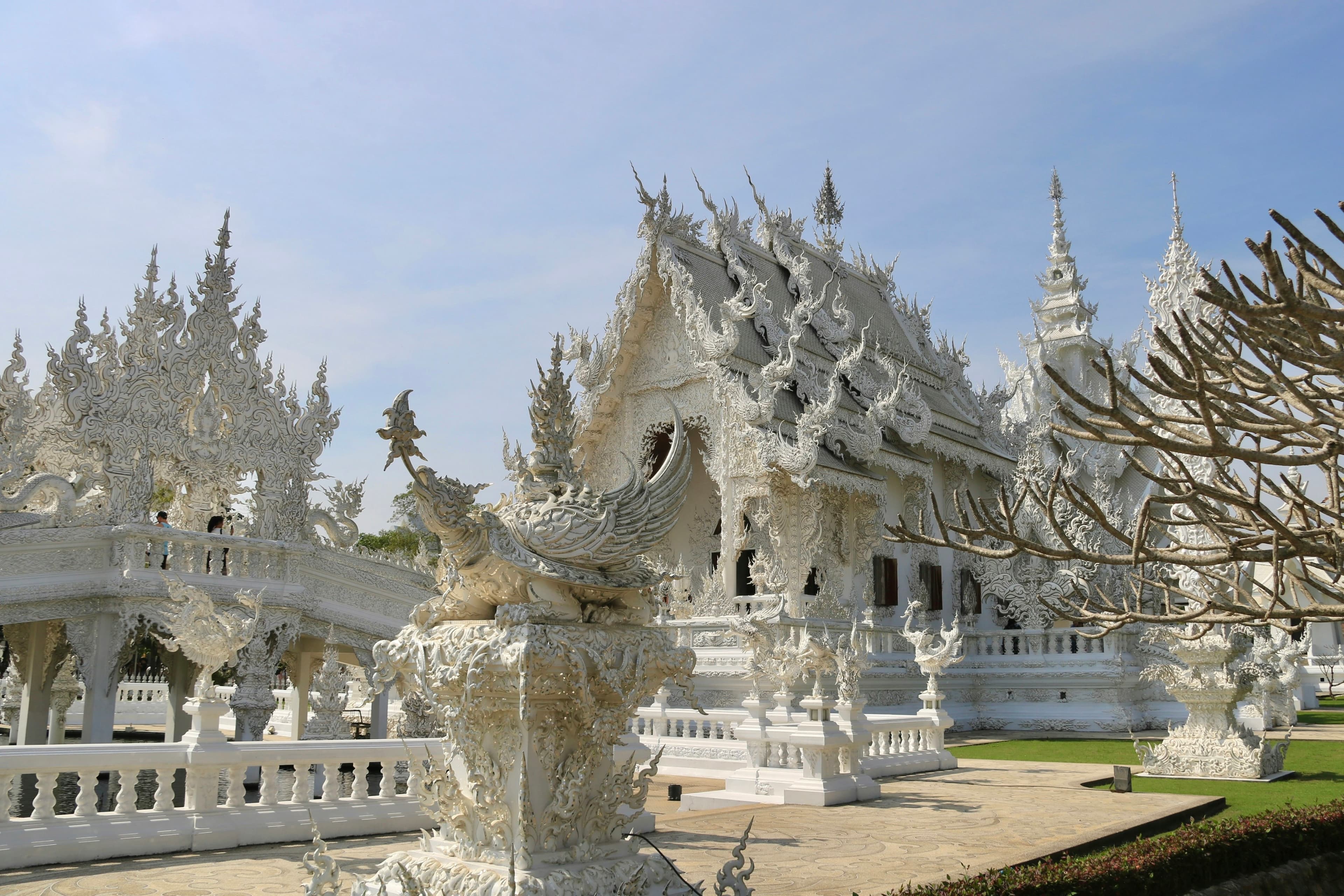
Wat Rong Khun and its reflecting pool. Image source · Unsplash License
Visit essentials
A quick read before you go
- Etiquette
- Interior camera rules, one-way movement, sculpture barriers, and the dignity of Buddhist imagery…
Overview
The approach to the white ubosot is deliberately sequential. Hands rise below the bridge, desire and suffering are placed underfoot, guardians mark a threshold, and the bright building ahead suggests purification. Inside, murals combine Buddhist themes with figures from mass media and modern crisis. The contrast is intentional: contemporary attachment and violence enter a space directed toward awakening. Yet Wat Rong Khun's status requires precision.
It is a privately owned, ongoing artistic project in temple form, not a preserved medieval wat. Visitors encounter Buddhist symbolism through Chalermchai Kositpipat's authored visual argument.
Why this place is sacred
White paint and embedded glass manipulate sunlight so strongly that atmosphere can feel immaterial. That sensory effect is designed, not proof of an energy field. The deeper threshold lies in the route from grasping hands toward the ubosot and in the collision between popular imagery and Buddhist moral reflection. Because the project is unfinished and author-led, change is part of its identity. New buildings and images do not dilute an ancient original; they extend a contemporary program.
Respect still matters because Buddhist forms and teachings are being presented, even when the site also functions as an art destination.
Experience and orientation
Follow the prescribed bridge route without stopping where others cannot pass, leaning over rails, or treating the field of hands as a comic prop. Inside the ubosot, current photography restrictions must be obeyed; published images do not grant permission. Take time to identify how modern figures are used within a larger Buddhist narrative rather than collecting references like an entertainment quiz. Other colored buildings and exhibition spaces belong to the same evolving complex but serve different functions.
Heat and glare can be intense on white surfaces, while crowds can make the moral procession feel hurried.
Context and lineage
The older Wat Rong Khun was in poor condition when Chiang Rai-born artist Chalermchai Kositpipat undertook a radical rebuilding with his own resources. The redesigned site opened to visitors in 1997 and has continued to expand. Chalermchai conceived the project as an offering and as a vehicle for Buddhist teaching through contemporary Thai art. An earthquake in 2014 damaged the complex and prompted inspection and repair, but work continued.
Since completion is projected across a long horizon, no visit captures a final historical state. Artist, workshop, custodians, and visitors all encounter a work still being made.
Traditions and practice
Visitors should not assume that visual symbolism creates a participatory rite. The bridge is an authored moral passage, while actual Buddhist homage belongs at recognized sacred focal points and under current site guidance. Move steadily, dress for a temple environment, and respect interior prohibitions. Donations or purchases support an artist-run project only through official channels. Do not place coins, offerings, or written wishes on sculptures unless explicitly invited.
Personal contemplation of desire, suffering, and conduct is appropriate; claims that crossing the bridge purifies karma automatically are not established and should not be promoted.
Theravada Buddhism
ActiveContemporary Thai Buddhist symbolism frames the ubosot, moral bridge, murals, offerings, and artist's stated religious intention.
Perspectives and open questions
Contemporary art, Buddhist symbolism, spectacle, and tourism pressure should be analyzed without mislabeling the site as ancient.
Scholarly perspective
Contemporary-art criticism asks how Chalermchai combines Thai ornament, Buddhist cosmology, spectacle, and global popular culture. Religious interpretation asks whether the route and images successfully direct attention toward Buddhist ethics. Tourism analysis notes the pressures created by intense visitation and instantly recognizable surfaces. Those questions differ from heritage study of an ancient monastery. The artist supplies many symbolic explanations, but no visitor is guaranteed spiritual purification or merit merely by completing the route.
Such outcomes remain matters of intention and religious interpretation, not measurable effects of the white architecture.
Plan your visit
Glare, heat, heavy visitor flow, repairs, and a still-evolving layout can change how the art complex is encountered.
Respectful visit
Interior camera rules, one-way movement, sculpture barriers, and the dignity of Buddhist imagery all require restraint.
Current practical details
Address
Pa O Don Chai, Mueang Chiang Rai District, Chiang Rai 57000, Thailand
Phone
Hours
Hours, fees, and access can change — verify on the official source before you travel. Practical details last checked Jul 2026.
Location
Map loads as you approach this section.
Pilgrim reflections
A portrait of encounter, not a score
Pilgrims describe what they felt, how present they could become, and whether the place would shape a journey. There are no stars and no ranking of traditions.
No reviewed reflections yet
The first pilgrims can help describe the character of being here.
Share a reflection
Available after an account-backed “Been there.” Every reflection is reviewed before publication.
Nearby sacred places
Explore other sacred places in the region. Proximity does not establish access or travel time; check each place’s guidance.

References
Sources consulted for this page. Source categories describe the publication, not a guarantee that every claim is verified. Traditional accounts and outside interpretations may differ.
- 01Wat Rong Khun — Tourism Authority of ThailandofficialOfficial attraction page reviewed for current identity and visitor context; exact-entity sources support artist, date, symbolism, and status.
- 02Wat Rong Khun — Wikipedia — Wikipedia contributorsacademicCorroborates identity, location, and basic historical context; key claims require higher-tier corroboration.
- 03Q496543 — Wikidata — Wikidata contributorsacademicStructured identity and coordinate corroboration; not used alone for spiritual or historical claims.
- 04Wat Rong Khun — Google Maps — Google PlacesSource contextStrong name, country, locality, and coordinate match; used only for practical visitor data and identity corroboration.
Photo gallery
10 curated photos
Share a photo
Help visitors recognize Wat Rong Khun. Every submission is reviewed before publication.