Wat Phra Si Rattana Mahathat Chaliang
A relic prang joins ancient Chaliang with living royal-temple worship
Understand sacred places, explore living traditions, and learn how to engage respectfully with Pilgrim Map.
Access has not been verified. Check current local guidance before planning a visit.
Si Satchanalai, Sukhothai, Thailand
Read the sources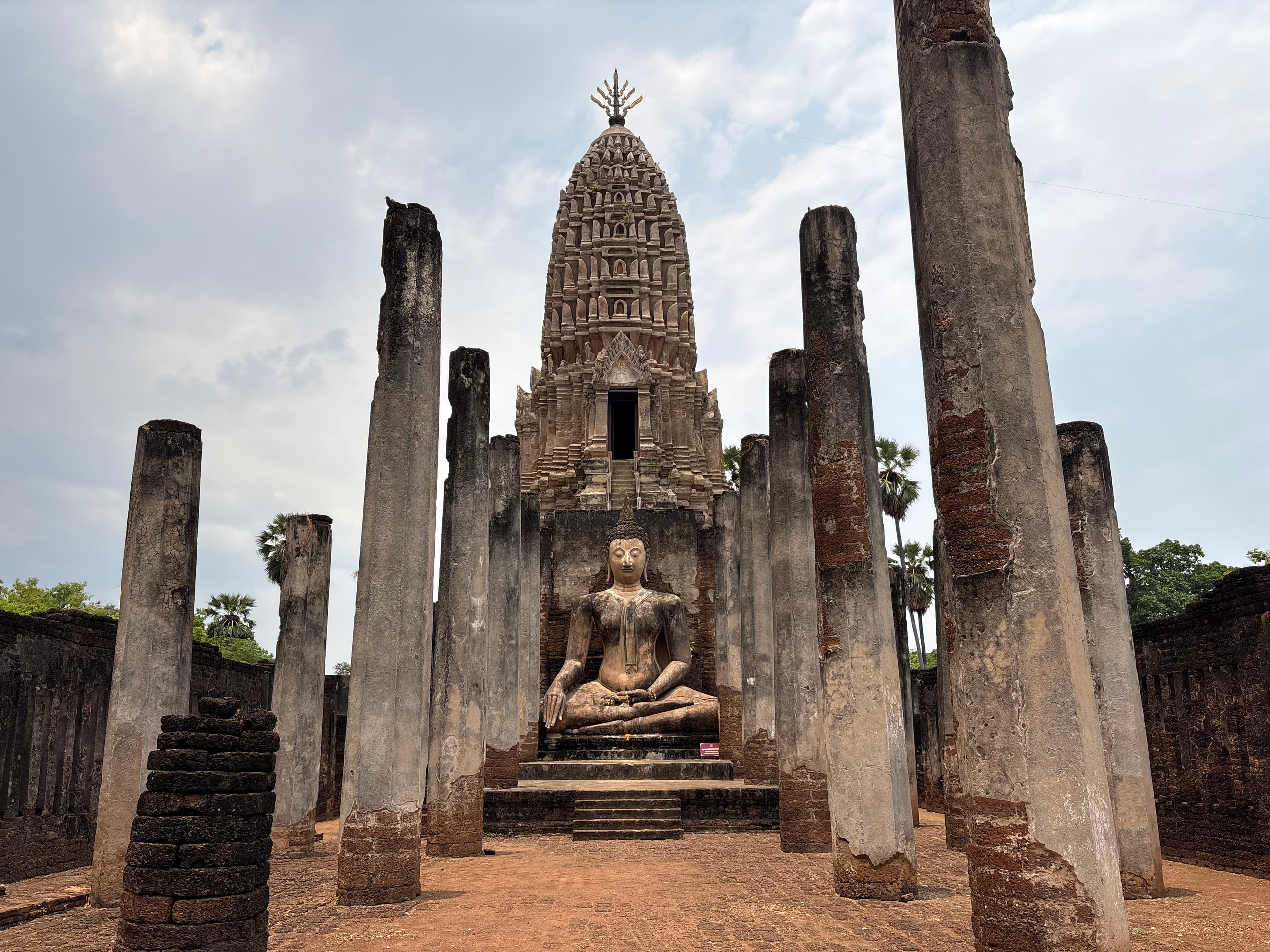
Wat Phra Si Rattana Mahathat Chaliang in Si Satchanalai, Sukhothai, Thailand. Image source · CC BY 4.0
Visit essentials
A quick read before you go
- Etiquette
- Protect laterite, murals, images, processional space, and active monastic boundaries.
Overview
The east-facing gateway introduces an architectural history older than the surviving principal prang. Fine Arts identifies Bayon-related faces associated with Avalokitesvara, while the central laterite tower took its present Ayutthaya-period form. Inside and around the sanctuary, Buddha images, a walking Buddha, faded murals, and Phra That Mutao preserve several Buddhist periods. The living royal temple does not erase the ruin, and the archaeological designation does not cancel devotion.
Government reporting of the annual cloth wrapping around the prang shows that worshippers address Buddha relics through a monument whose fabric also requires scientific conservation.
Why this place is sacred
Layered architecture can invite a vague claim that every religious tradition remains equally active. The evidence is more precise. Mahayana-related imagery belongs to the site's historical record; current worship is Theravada and centers Buddha relics and merit. The annual wrapping of cloth around the prang is a documented ritual, not proof that the masonry emits power. Sacred intensity arises through repeated care, embodied procession, relic belief, and the survival of Chaliang's religious center across rebuilding.
Visitors should let architectural ambiguity remain where chronology or original function is uncertain.
Experience and orientation
Approach through the east entrance and notice how the gateway, prang, Buddha images, and adjacent living halls belong to different phases. Do not climb laterite, touch murals, or treat standing images as supports. During worship or the annual cloth-wrapping ceremony, leave movement routes clear and photograph only with consent. The strong Places listing has no reliable hours, so check the temple page and Fine Arts park information before travel.
Conservation closures may apply to the archaeological fabric even when the monastery remains open.
Context and lineage
Ancient Chaliang formed an early settlement before the rise of Si Satchanalai. Fine Arts places the sacred complex by about 1237 and records later architectural change, including the Ayutthaya-style principal prang. Excavation and reconstruction began in 1956, clarifying a sequence that includes Mon-related and Khmer-related forms as well as Sukhothai and later Theravada use. The site is a first-class royal monastery inside Si Satchanalai, component 002 of UNESCO property 574, inscribed in 1991.
It is not independently inscribed under a separate World Heritage identity.
Traditions and practice
Current practice includes Buddha homage, relic veneration, merit-making, chanting, offerings at authorized stations, and an annual ceremony wrapping cloth around the principal prang. Government reporting identifies the event as more than a performance: participants make merit and pay respect to the relics. Visitors may observe or join only under temple direction. Do not tie personal cloth to the monument, place incense on ancient surfaces, or copy a procession out of context.
Heritage stewardship and living worship must share the compound without one displacing the other.
Theravada Buddhism
ActiveLiving Theravada practice centers Buddha relics, merit, chanting, and communal renewal.
Historic Buddhist traditions
ActiveAncient Chaliang, thirteenth-century evidence, later rebuilding, excavation, and annual worship differ.
Heritage stewardship
ActiveJoint temple and Fine Arts custody preserves living ritual within a UNESCO component.
Perspectives and open questions
Archaeology, Buddhist art, Theravada devotion, royal status, and UNESCO management intersect.
Scholarly perspective
Archaeology separates the site's many construction phases. Buddhist art history interprets Avalokitesvara-related faces, Buddha images, chedi forms, and later murals. Theravada practitioners encounter a relic shrine within an active royal monastery. UNESCO management protects the serial historic-town component, while local ceremony renews sacred relationships in the present. Together these perspectives justify a mixed activity status. They do not support claims of a timeless, undifferentiated energy or an unchanged rite extending back to the thirteenth century.
Joint custody requires both ritual access and material restraint.
Plan your visit
The strong exact Places record lacks hours; consult temple and Fine Arts notices.
Respectful visit
Protect laterite, murals, images, processional space, and active monastic boundaries.
Current practical details
Address
CRH6+MG7, Si Satchanalai, Si Satchanalai District, Sukhothai 64190, Thailand
Hours, fees, and access can change — verify on the official source before you travel. Practical details last checked Jul 2026.
Location
Map loads as you approach this section.
Pilgrim reflections
A portrait of encounter, not a score
Pilgrims describe what they felt, how present they could become, and whether the place would shape a journey. There are no stars and no ranking of traditions.
No reviewed reflections yet
The first pilgrims can help describe the character of being here.
Share a reflection
Available after an account-backed “Been there.” Every reflection is reviewed before publication.
Nearby sacred places
Explore other sacred places in the region. Proximity does not establish access or travel time; check each place’s guidance.

References
Sources consulted for this page. Source categories describe the publication, not a guarantee that every claim is verified. Traditional accounts and outside interpretations may differ.
- 01Wat Phra Sri Rattana Mahathat Rajaworaviharn — Google PlacesofficialExact-entity practical metadata accepted only after strong name, country, locality, and coordinate review.
- 02Wat Phra Si Rattana Mahathat Chaliang — Fine Arts DepartmentofficialExact monument plan, chronology, gateway imagery, prang, Buddha images, and royal-monastery status.
- 03History of Si Satchanalai Historical Park — Fine Arts DepartmentofficialAncient Chaliang and conservation history.
- 04Wat Phra Si Rattana Mahathat Chaliang — Si Satchanalai MunicipalityofficialExact local record of the archaeological complex and first-class royal temple.
- 05112th annual Wat Phra Si Rattana Mahathat Chaliang ceremony — Public Relations Department, SukhothaiofficialDirect 2026 evidence for cloth wrapping, merit-making, and Buddha-relic veneration.
- 06Historic Town of Sukhothai and Associated Historic Towns — UNESCO World Heritage CentreofficialAuthoritative serial-property identity, inscription year, and Si Satchanalai component scope.
Share a photo
Help visitors recognize Wat Phra Si Rattana Mahathat Chaliang. Every submission is reviewed before publication.