Wat Chang Lom, Si Satchanalai
Thirty-nine elephants carry a relic-centred Sri Lankan-form chedi
Understand sacred places, explore living traditions, and learn how to engage respectfully with Pilgrim Map.
Access has not been verified. Check current local guidance before planning a visit.
Si Satchanalai, Sukhothai, Thailand
Read the sources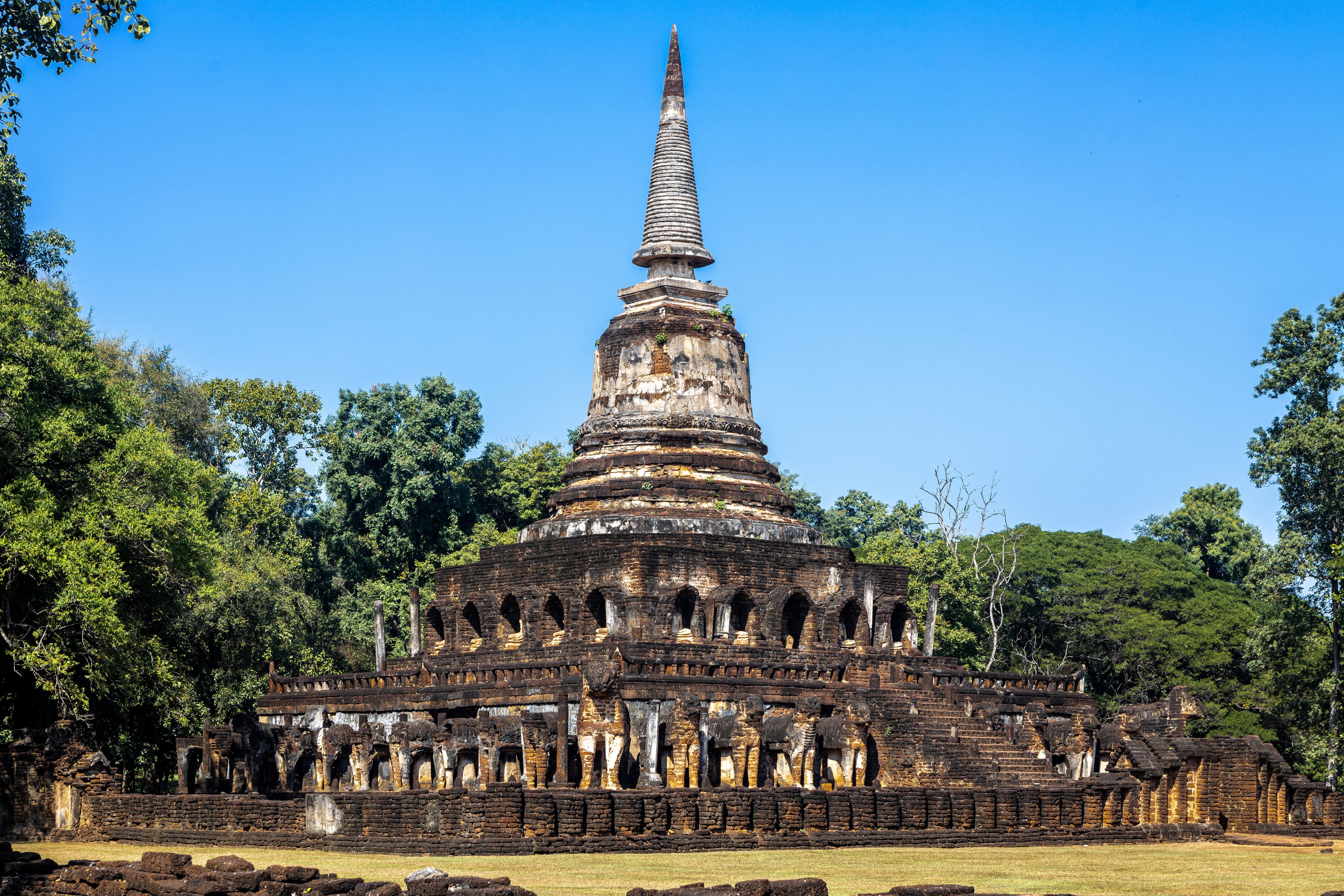
Wat Chang Lom, Si Satchanalai in Si Satchanalai, Sukhothai, Thailand. Image source · CC BY 4.0
Visit essentials
A quick read before you go
- Etiquette
- Never touch the full-bodied stucco elephants or use damaged figures as photographic supports.
Overview
The elephants are not a decorative fringe. Their bodies project from the square processional base as if carrying the chedi, with larger, richly ornamented animals marking the corners. Between them stand lamp columns and lotus-bud forms; above, niches held seated Buddhas with bodhi imagery, while relief disciples once moved around the upper structure. The sequence raises the reliquary through several registers of support and reverence.
Fine Arts reports that some scholars identify this as the chedi built over relics honored and reinterred in Si Satchanalai in 1286. The identification remains scholarly, but the architecture clearly turns a Buddhist monument into a protected, circumambulatory sacred centre.
Why this place is sacred
Elephants can signify strength, royal dignity, cosmological support, and Buddhist narrative memory, but their exact meanings should be argued from context rather than assumed. At this temple, the animals create a visible boundary between ground and reliquary while the Buddhas above redirect attention toward awakening. Moving around the base would once have joined architecture with bodily practice. Today barriers and damaged stucco interrupt that circuit, making restraint part of understanding. No source shows that the elephants confer luck when touched.
Their survival is fragile, and the most meaningful response is to preserve the distance that lets form, relic tradition, and historical craft remain legible.
Experience and orientation
Start at a corner, where the larger dressed elephant clarifies the hierarchy of the base, then follow the permitted perimeter without pressing close to the stucco. Count only if doing so does not distract from surface condition and composition. Look upward from elephants to Buddha niches and the bell-form chedi, noting how each level changes the sacred register. Stairs once led to a processional terrace, but current access restrictions must be obeyed.
Avoid using elephant trunks or damaged bodies as foreground props. The central location within the old city becomes clearer after comparing nearby terrain and routes, while the monument itself rewards one slow circuit.
Context and lineage
Fine Arts describes Wat Chang Lom inside Si Satchanalai's wall near the southern foot of Khao Phanom Phloeng. The official account records thirty-nine elephants, Buddha niches, disciple reliefs, halls, and subsidiary stupas. Scholars have connected the principal monument to an inscription stating that Ramkhamhaeng recovered, honored, and reburied relics in the city before building a chedi above them. The wording is properly kept as scholarly identification rather than undisputed fact. Archaeological study and conservation continue to refine the site's phases.
Si Satchanalai forms one component of UNESCO property 574, inscribed with Sukhothai and Kamphaeng Phet in 1991.
Traditions and practice
Historical use included relic-centred circumambulation, homage before Buddha images, lamp offerings, teaching, and monastic life. The ruin has no verified active sangha, so modern visitors should not recreate a procession on closed terraces or place offerings against elephants. Walk only the route provided by the historical park. A quiet bow from public ground respects Buddhist identity without claiming continuity of every rite.
The site's full-bodied stucco figures are unusually vulnerable to contact, moisture, and biological growth; non-touching is both etiquette and conservation. No current named pilgrimage or festival met the direct-source threshold.
Theravada Buddhism
HistoricalHistoric Theravada devotion centred relic memory, Buddha images, circumambulation, lamps, and merit.
Heritage stewardship
ActiveSpecialist care for thirty-nine full-bodied elephants allows the reliquary's lower register to survive without visitor contact.
Perspectives and open questions
Epigraphy, Buddhist symbolism, comparative art, archaeology, and conservation temper one another.
Scholarly perspective
Archaeology distinguishes what survives from reconstructed hypotheses. Epigraphy supplies the possible 1286 relic narrative but leaves room for scholarly debate about site identification. Buddhist studies reads the chedi as a reliquary and its images through Mara-victory and bodhi symbolism. Art history compares elephant-supported stupas across Sri Lanka, India, Khmer regions, Sukhothai, and Lanna without treating influence as simple copying. Conservation focuses on stucco technique and environmental risk. These perspectives converge on a monument deliberately designed for religious movement and memory.
They do not support claims of animal statues granting fortune or transferring power through touch.
Plan your visit
Strong Places supports identity and hours; custodian rules and surface work may change access.
Respectful visit
Never touch the full-bodied stucco elephants or use damaged figures as photographic supports.
Current practical details
Address
CQJP+Q2Q, Si Satchanalai, Si Satchanalai District, Sukhothai 64190, Thailand
Hours
Hours, fees, and access can change — verify on the official source before you travel. Practical details last checked Jul 2026.
Location
Map loads as you approach this section.
Pilgrim reflections
A portrait of encounter, not a score
Pilgrims describe what they felt, how present they could become, and whether the place would shape a journey. There are no stars and no ranking of traditions.
No reviewed reflections yet
The first pilgrims can help describe the character of being here.
Share a reflection
Available after an account-backed “Been there.” Every reflection is reviewed before publication.
Nearby sacred places
Explore other sacred places in the region. Proximity does not establish access or travel time; check each place’s guidance.

References
Sources consulted for this page. Source categories describe the publication, not a guarantee that every claim is verified. Traditional accounts and outside interpretations may differ.
- 01Wat Chang Lom — Fine Arts Department, Si Satchanalai Historical ParkofficialExact-site layout, elephants, Buddha niches, and proposed relic association.
- 02Research on Wat Chang Lom — Fine Arts DepartmentofficialFine Arts archaeological research on the exact monument and its Buddhist art.
- 03Historic Town of Sukhothai and Associated Historic Towns — UNESCO World Heritage CentreofficialAuthoritative inscription, property scope, criteria, and management context.
- 04Wat Chang Lom — Google Maps — Google PlacesSource contextStrong name, country, locality, and coordinate match; used only for practical visitor data and identity corroboration.
Pilgrim glossary
- Sangha
- The community of Buddhist practitioners, traditionally monks and nuns.
Share a photo
Help visitors recognize Wat Chang Lom, Si Satchanalai. Every submission is reviewed before publication.