Wat Pa Phu Kon
A forest monastery where Buddha recollection and conservation share one ridge
Understand sacred places, explore living traditions, and learn how to engage respectfully with Pilgrim Map.
Access has not been verified. Check current local guidance before planning a visit.
Na Yung, Udon Thani, Thailand
Read the sources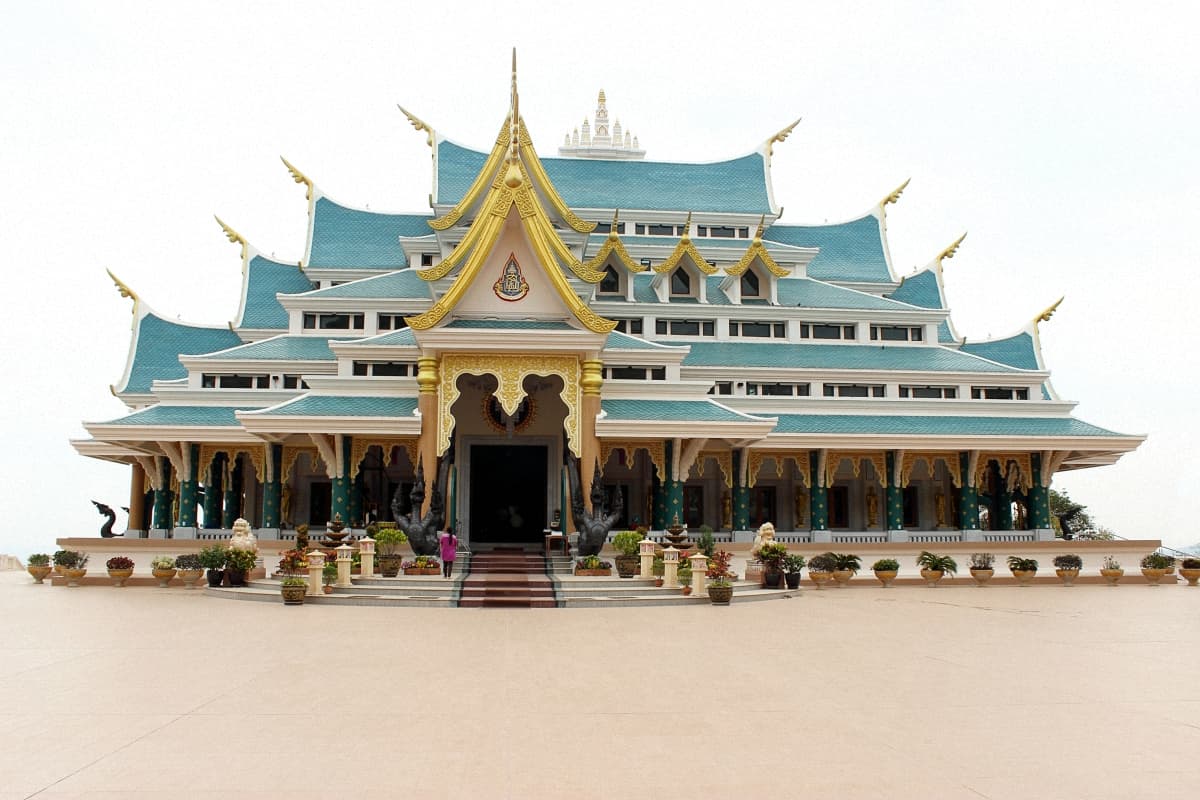
Wat Pa Phu Kon in Na Yung, Udon Thani, Thailand. Image source · CC BY-SA 3.0
Visit essentials
A quick read before you go
- Duration
- Allow 1.5–2.5 hours so the visit includes the wider monastery and forest setting rather than…
- Access
- The exact government coordinate is 17.9227634, 102.1182472 in Ban Kong, Na Yung.
Overview
The road into the Na Yung–Nam Som forest reserve prepares a visitor for Wat Pa Phu Kon's central relationship: built devotion held inside a recovering forest. The monastery's official history describes lay and monastic work beginning in the 1980s to secure land for practice and protect degraded woodland. Today the best-known sacred image is the twenty-metre reclining Buddha, carved from white Carrara marble and shown in the posture associated with final nirvana.
Yet reducing the site to that hall would distort its scope. Buddha relics, a chedi, resident monastic practice, water stewardship, and thousands of rai of protected forest belong to the same religious landscape.
Why this place is sacred
The polished reclining figure creates visual quiet, while ridges and tree cover change sound and temperature outside. These physical qualities may help attention settle, but they do not prove that the site emits a special energy. The temple's history also recounts a visionary dream connected with Luang Pu Fan Ajaro before the founders' journey. That account is meaningful within the community's own memory and is presented as tradition, not independent verification of a supernatural event.
The firmer spiritual evidence lies in active worship, meditation, relic care, and conservation undertaken over decades.
A forest monastery and Buddhist park established for monastic residence, meditation, worship, and protection of the surrounding watershed forest.
A small authorized temple area expanded into a broader conservation landscape, later joined by major Buddha images, relic shrines, and visitor facilities.
Experience and orientation
Before entering the reclining-Buddha hall, notice how the monastery sits among ridges rather than on a cleared urban plot. Inside, keep enough distance to perceive the marble figure as a complete posture, not a sequence of decorative details. The image invites recollection of impermanence and the Buddha's passing rather than a portrait session. Afterward, move toward the chedi and forest edges only along public routes. Resident monks, ritual activity, and conservation work have priority over sightseeing.
According to the identity audit, the component-only map result for the hall does not represent the entire monastery and was rejected.
Use the temple's official route to Ban Na Kham Yai and read the hall, chedi, monastic zone, and protected forest as parts of Wat Pa Phu Kon.
Context and lineage
The temple dates its decisive beginnings to 1984, when supporters traveled in the northeast and became involved with forest-practice communities. Government permission for a fifteen-rai temple site followed in 1987, with later authorization for a much larger Buddhist park. The community planted and protected forest, managed water, and developed facilities for monastic practice. The temple's dream account is retained as received tradition; legal dates, land permissions, and conservation work provide the historical framework.
Thai Forest Tradition practice operates within Theravada Buddhism, with teacher gratitude and secluded meditation emphasized alongside public Buddha devotion.
Piyawan and Olan Wirawan
lay supporters named in the temple's founding history
Phra Ajarn Chali Thiradhammo
monastic guide associated with construction and practice
Forest-monastery residents and supporters
custodians of worship and conservation
Traditions and practice
Worshippers may bow before the reclining Buddha, honor relics, make merit, listen to teaching, and sit in meditation. The parinirvana posture directs attention toward impermanence rather than wish-granting claims.
Resident monastic life continues beside public visitation, conservation, fire prevention, and maintenance of water and forest systems.
Pause before the reclining image, take three unhurried breaths, and reflect on what care for a forest contributes to the conditions for practice.
Thai Forest Tradition
ActiveMeditation, monastic discipline, and teacher remembrance shape the monastery's foundation and continuing identity.
Meditation, Buddha recollection, merit-making, teaching, and monastic observance.
Forest conservation stewardship
ActiveRestoring and protecting the watershed forest is part of the institution's documented purpose.
Reforestation, fire prevention, water management, and protection from hunting and encroachment.
Perspectives and open questions
Wat Pa Phu Kon can be read through forest-monastery practice, modern sacred art, relic devotion, and conservation history.
Scholarly perspective
The site is a modern foundation with documented government permissions and a strong institutional conservation narrative rather than an ancient archaeological monument.
Living and traditional perspectives
The temple presents forest seclusion, Buddha recollection, teacher gratitude, relics, and care for the natural world as mutually reinforcing supports for Dhamma practice.
Alternative interpretations
According to the temple's own origin account, a visionary dream forms part of the foundation story. It is preserved as a community belief and not presented as independently verified fact.
Open questions
No prevalent, independently cross-sourced claim of healing, energy, apparition, or guaranteed transformation met the inclusion threshold.
Plan your visit
Access and arrival
The exact government coordinate is 17.9227634, 102.1182472 in Ban Kong, Na Yung. No whole-site Google Places record cleared review, so component details are withheld.
Use only lodging or retreat arrangements explicitly authorized by the temple; ordinary visitors should plan licensed lodging outside resident monastic areas.
Respectful visit
Cover shoulders and knees and comply with any garment policy published or posted by the temple.
The temple maintains explicit rules for still, moving, and documentary photography in the hall. Obtain permission when required and never photograph prayer at close range.
Use designated donation and offering places; leave nothing in the forest or against sacred images.
Remove shoes where directed, keep feet from pointing toward Buddha images, and do not enter resident or conservation-only areas.
Do not touch the marble Buddha, invent a relic-contact rite, wander into monastic quarters, or treat protected forest as a scenic shortcut.
Location
Map loads as you approach this section.
Pilgrim reflections
A portrait of encounter, not a score
Pilgrims describe what they felt, how present they could become, and whether the place would shape a journey. There are no stars and no ranking of traditions.
No reviewed reflections yet
The first pilgrims can help describe the character of being here.
Share a reflection
Available after an account-backed “Been there.” Every reflection is reviewed before publication.
Nearby sacred places
Explore other sacred places in the region. Proximity does not establish access or travel time; check each place’s guidance.

References
Sources consulted for this page. Source categories describe the publication, not a guarantee that every claim is verified. Traditional accounts and outside interpretations may differ.
- 01Wat Pa Phu Kon official website — Wat Pa Phu KonSource contextAccording to the temple-controlled source, this is the exact identity and address, with published 08:30–17:00 gate hours for the worship hall; hours are cited in research but not imported as Places data.
- 02History of Wat Pa Phu Kon — Wat Pa Phu KonSource contextTemple account of the 1984–1990 founding sequence, forest restoration, meditation purpose, Buddhist park, relic aspirations, and monastic life.
- 03Wat Pa Phu Kon — Thailand Tourism DirectoryofficialGovernment tourism record with exact name, Ban Kong locality, coordinates 17.9227634, 102.1182472, Buddha relics, and the sacred images.
- 0410 Things to Do in Udon Thani: Wat Pa Phu Kon — Tourism Authority of ThailandofficialOfficial account of the forest-reserve setting, meditation purpose, Buddha relics, and the Carrara-marble reclining Buddha.
- 05Wat Pa Phu Kon (Q16935408) — Wikidata contributorsacademicStructured identity and coordinate corroboration; corrects the prior unrelated QID.
- 06Wat Pa Phu Kon - panoramio — Matt Prosser via Wikimedia CommonsacademicExact-site geotagged photograph in the Wat Pa Phu Kon category; CC BY-SA 3.0.
Share a photo
Help visitors recognize Wat Pa Phu Kon. Every submission is reviewed before publication.