Pha That Luang
The golden stupa that is the spiritual heart and national symbol of Laos
Understand sacred places, explore living traditions, and learn how to engage respectfully with Pilgrim Map.
Access has not been verified. Check current local guidance before planning a visit.
Vientiane Capital, Vientiane, Laos
Read the sources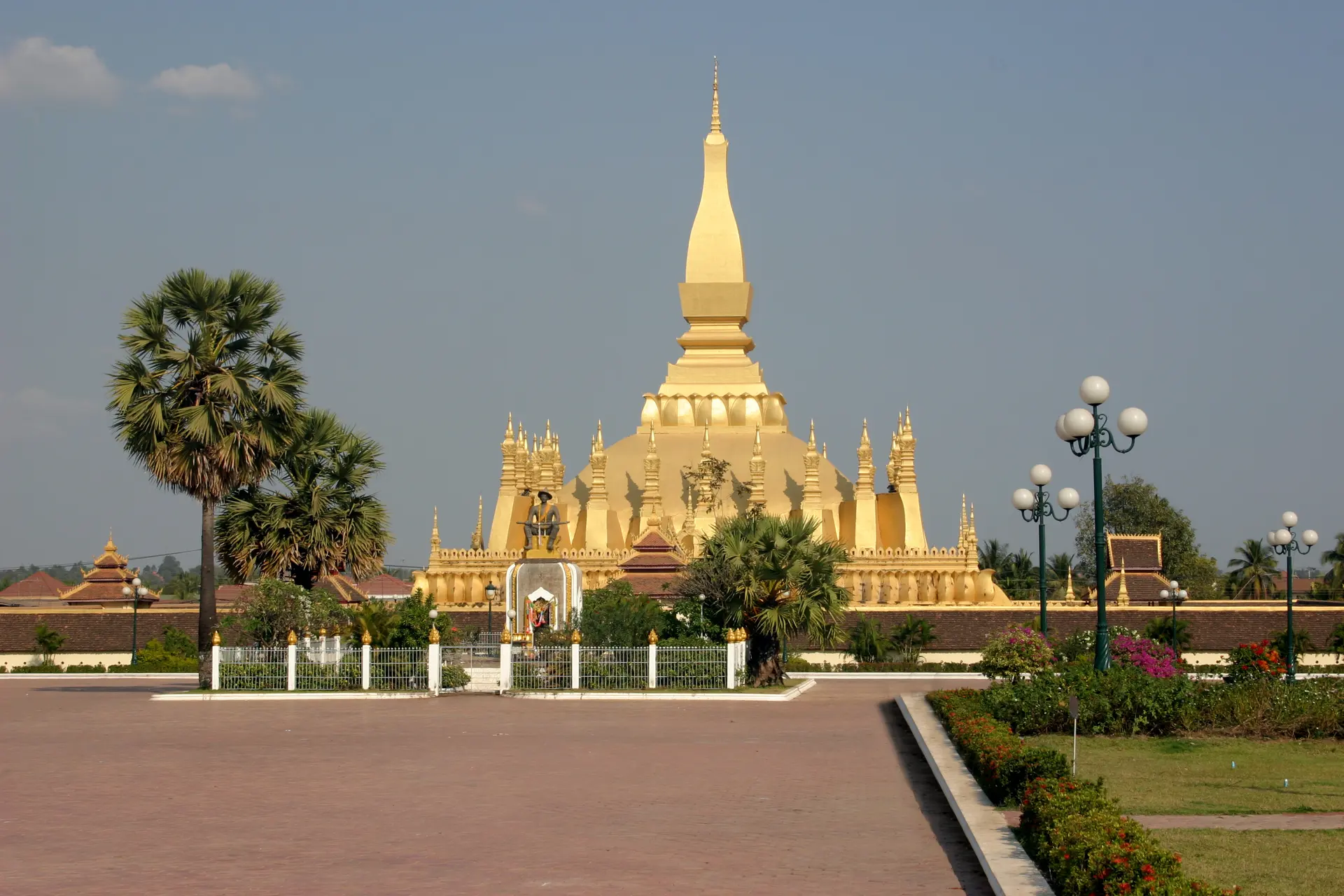
Image of Pha That Luang. Image source · CC-BY-SA-4.0
Visit essentials
A quick read before you go
- Duration
- 1 to 1.5 hours for the stupa and surrounding compound; longer during festival days.
- Access
- About 4 km northeast of central Vientiane at the end of That Luang Road; easily reached by…
Overview
Rising about forty-five meters in gilded tiers above Vientiane, Pha That Luang is Laos's most sacred Buddhist monument and national emblem, appearing on the state seal and currency. Tradition says it enshrines the Buddha's breastbone, brought by missionaries of Emperor Ashoka in the third century BCE, though this origin is legendary.
Its lotus-petal base opens to four directions, while three tiers are read as the underworld, the perfections, and enlightenment: a golden mountain of the path. King Setthathirath built the present stupa in 1566 over an earlier site; after a Siamese sack in 1828, it was reconstructed under French rule in the 1930s.
The cloistered compound can be contemplative at dawn and dusk. At November's full moon, Boun That Luang draws thousands before dawn for alms-giving and a candlelight procession, gathering national devotion at one golden point.
Why this place is sacred
What concentrates the sacred here is the meeting of relic, cosmos and nation in one golden form. The stupa is believed to house a relic of the Buddha, so that its core is treated as a point of contact with the awakened one himself.
Around that core the architecture is built to teach: a lotus-petal base opening to the four directions, three ascending tiers understood as the underworld, the moral perfections, and the attainment of enlightenment, so that the eye climbing the gold is led, in symbol, up the path itself, the stupa standing as a mountain of awakening akin to Mount Meru. To this is added the weight of a whole people's devotion.
The stupa is not only a shrine but the heart of Lao identity, its image on the seal and the money, the place toward which the nation turns each November. Its golden form catching the low light of dawn and dusk, the mass communal merit-making at the full moon, and the belief in a relic at its center together make it a place where personal devotion and collective faith are drawn into a single ascent.
Experience and orientation
By ordinary daylight the visit is one of luminous calm. The gilded stupa stands within a spacious, cloistered compound, and visitors most often remark on how striking the gold becomes at sunrise and sunset, when low light sets the whole form glowing, and on the serene, uncrowded openness of the grounds. The mood is contemplative; there is room to walk, to circle the monument, to sit. That changes utterly at Boun That Luang.
During the November full moon the compound fills with an overwhelming sense of national devotion: thousands gather before dawn for alms-giving to hundreds of monks drawn from across Laos, and the festival closes with a candlelight procession circling the stupa under the full moon. Visitors describe the festival as a rare immersion in a nation's living faith.
Whether on a quiet morning or a festival night, the stupa rewards a slow, reverent pace, ideally early or late in the day for cooler air and golden light.
The stupa stands about 4 kilometers northeast of central Vientiane, at the end of That Luang Road, easily reached by tuk-tuk, taxi or bicycle. The great gilded stupa sits within a square cloistered compound; nearby in the city are Wat Si Muang, from which the festival procession sets out, along with Wat Sisaket and Haw Phra Kaew. Modest dress is required, and shoes are removed before entering temple buildings.
Context and lineage
By tradition the site's sanctity reaches back to the third century BCE, when missionaries sent by the Indian emperor Ashoka are said to have brought a relic of the Buddha, his breastbone, and enshrined it here, a legendary origin rather than a documented one.
The great stupa standing today was built in 1566 by King Setthathirath of Lan Xang, when he moved his capital to Vientiane, raised over an earlier Khmer-era or thirteenth-century structure and sealing the kingdom's Buddhist identity into the monument. The stupa was sacked by a Siamese army in 1828 and left ruined; it was reconstructed under the French colonial administration in the 1930s, working from drawings made by Louis Delaporte in the 1860s.
It is not a UNESCO World Heritage Site, Laos's inscribed properties being the town of Luang Prabang and Vat Phou, but it is a nationally protected monument and the national symbol of Laos, its image carried on the state emblem and currency.
The stupa belongs to Lao Theravada Buddhism, shaped by the royal Buddhism of the Lan Xang kingdom under Setthathirath and, by tradition, by an older relic enshrinement reaching back toward the era of Ashokan missions. It remains an active monument within Lao Theravada practice and the civic-religious center of the modern nation.
King Setthathirath
Builder of the great stupa (1566)
Emperor Ashoka (by tradition)
Legendary patron of the original relic enshrinement
Louis Delaporte
Source of the reconstruction drawings
Traditions and practice
The great annual observance is Boun That Luang, held over the full moon of the twelfth lunar month, in November. It opens with a wax-castle (phasat) procession from Wat Si Muang, builds to dawn alms-giving (taak baat) in which crowds gather before five o'clock to offer food to hundreds of monks drawn from across Laos, and closes with a candlelight procession circling the stupa under the full moon, accompanied by offerings of flowers, incense and candles.
Beyond the festival the stupa sees year-round prayer, offerings and circumambulation, and the November gathering remains the nation's foremost religious event. Lao Buddhists come to make merit, and the monument continues as the spiritual and civic center of the country.
Circle the stupa slowly, taking in the symbolism of the rising tiers, and visit in early morning or late afternoon for cooler air and the gold at its most luminous. If present during Boun That Luang, follow the local lead: witness the dawn alms-giving respectfully and join the candlelight procession only as the crowd moves.
Theravada Buddhism (Lao)
ActivePha That Luang is the most important Buddhist monument in Laos, believed to enshrine a relic of the Buddha and serving as the focus of national merit-making, especially at the Boun That Luang festival.
Alms-giving (taak baat) to assembled monks; offerings of flowers, incense and candles; circumambulation and prayer; wax-castle (phasat) and candlelight processions.
Royal Lan Xang Buddhism
HistoricalRebuilt in 1566 by King Setthathirath when he moved the Lan Xang capital to Vientiane, the stupa expressed royal patronage of Buddhism and the kingdom's identity.
Royal patronage and dedication of the stupa.
Perspectives and open questions
The stupa is read at once as a documented royal monument, a living relic-shrine, and a cosmic diagram of the path.
Scholarly perspective
Scholars regard Pha That Luang as the preeminent Buddhist monument and national symbol of Laos, built in its present form by King Setthathirath in 1566 over an earlier site, destroyed by the Siamese in 1828 and reconstructed under the French in the 1930s. Its three-tiered, lotus-based form is read as an encoding of Theravada cosmology and the path to enlightenment.
Living and traditional perspectives
For Lao Buddhists the stupa enshrines a true relic of the Buddha and is the sacred center of the nation's spiritual and civic identity, honored above all at Boun That Luang.
Alternative interpretations
Popular tradition emphasizes the ancient Ashokan and Mauryan relic origin and reads the stupa as a cosmic mountain akin to Mount Meru, mapping the ascent to nirvana.
Open questions
Whether an authentic relic of the Buddha is enshrined, and the truth of the third-century-BCE origin tradition, remain matters of faith rather than verified history; the full nature of the earlier Khmer-era structure beneath the 1566 stupa is also uncertain.
Plan your visit
Access and arrival
About 4 km northeast of central Vientiane at the end of That Luang Road; easily reached by tuk-tuk, taxi or bicycle. Open roughly 8:00 to 12:00 and 13:00 to 16:00, with a small entrance fee (around 5,000 to 10,000 kip).
Vientiane, the national capital, offers a full range of hotels, guesthouses and hostels within a short tuk-tuk ride of the stupa.
Respectful visit
Modest dress with shoulders and knees covered for all genders; cover-cloths can be rented for those wearing shorts, and shoes are removed before entering temple buildings.
Permitted in outdoor areas; be discreet in sacred zones and around worshippers, and avoid disrupting ceremonies.
Flowers, incense and candles are customary; food alms are offered to monks during the festival.
Do not touch sacred objects or statues, speak softly, avoid public displays of affection, and do not turn your back disrespectfully to the stupa or point your feet at sacred images.
Do not touch the sacred objects or statues, point your feet at sacred images, or turn your back disrespectfully to the stupa. Speak softly, avoid public displays of affection, and do not disrupt ceremonies.
Location
Map loads as you approach this section.
Pilgrim reflections
A portrait of encounter, not a score
Pilgrims describe what they felt, how present they could become, and whether the place would shape a journey. There are no stars and no ranking of traditions.
No reviewed reflections yet
The first pilgrims can help describe the character of being here.
Share a reflection
Available after an account-backed “Been there.” Every reflection is reviewed before publication.
Nearby sacred places
Explore other sacred places in the region. Proximity does not establish access or travel time; check each place’s guidance.

References
Sources consulted for this page. Source categories describe the publication, not a guarantee that every claim is verified. Traditional accounts and outside interpretations may differ.
- 01That Luang Festival — Lao National Tourism / tourismlaos.orgofficialOfficial tourism listing of the festival.
- 02Pha That Luang — Wikipedia contributorsencyclopediaGold-covered stupa, ~45 m; legendary 3rd-c. BCE Ashokan relic origin; built 1566 by King Setthathirath; 1828 Siamese destruction; 1930s French reconstruction (Delaporte drawings); national symbol.
- 03That Luang Festival — Wikipedia contributorsencyclopediaBoun That Luang held over full moon of 12th lunar month (November); processions, alms-giving, wax-castle (phasat) procession from Wat Si Muang.
- 04Pha That Luang stupa Vientiane - Pha That Luang festival — Renown TravelguideDetailed festival sequence: taak baat alms at dawn, crowds before 5am, candlelight procession, homage to stupa.
- 05Pha That Luang, Vientiane — Martin Gray / World Pilgrimage GuidespiritualPilgrimage significance, relic tradition, history of the stupa.
- 06Pha That Luang | History, Architecture & Symbolism — Study.comencyclopediaThree-tier symbolism (underworld / perfections / enlightenment), lotus and mountain symbolism.
- 07Discover Pha That Luang, The Crown Jewel and National Symbol of Laos — Asia King TravelguideNational-symbol status, gold leaf, lotus-petal base, visit context.
- 08Pha That Luang - a symbol of Buddhism and Laos sovereignty — Indochina VoyagesguideSovereignty symbolism, gold, layout, visitor tips.
- 09Pha That Luang - not just a stupa — Inside LaosguideVisitor practicalities, etiquette, surrounding complex.
- 10Pha That Luang Vientiane: Travel Information 2026 — BestPrice TravelguideHours, entrance fee, dress code, best times.
Photo gallery
3 curated photos
Pilgrim glossary
- Stupa
- A dome-shaped Buddhist monument that holds relics or marks a sacred place.
Share a photo
Help visitors recognize Pha That Luang. Every submission is reviewed before publication.