Wat Hong Thong
Relic worship extends from mangrove shore into the gulf
Understand sacred places, explore living traditions, and learn how to engage respectfully with Pilgrim Map.
Access has not been verified. Check current local guidance before planning a visit.
Bang Pakong, Chachoengsao, Thailand
Read the sources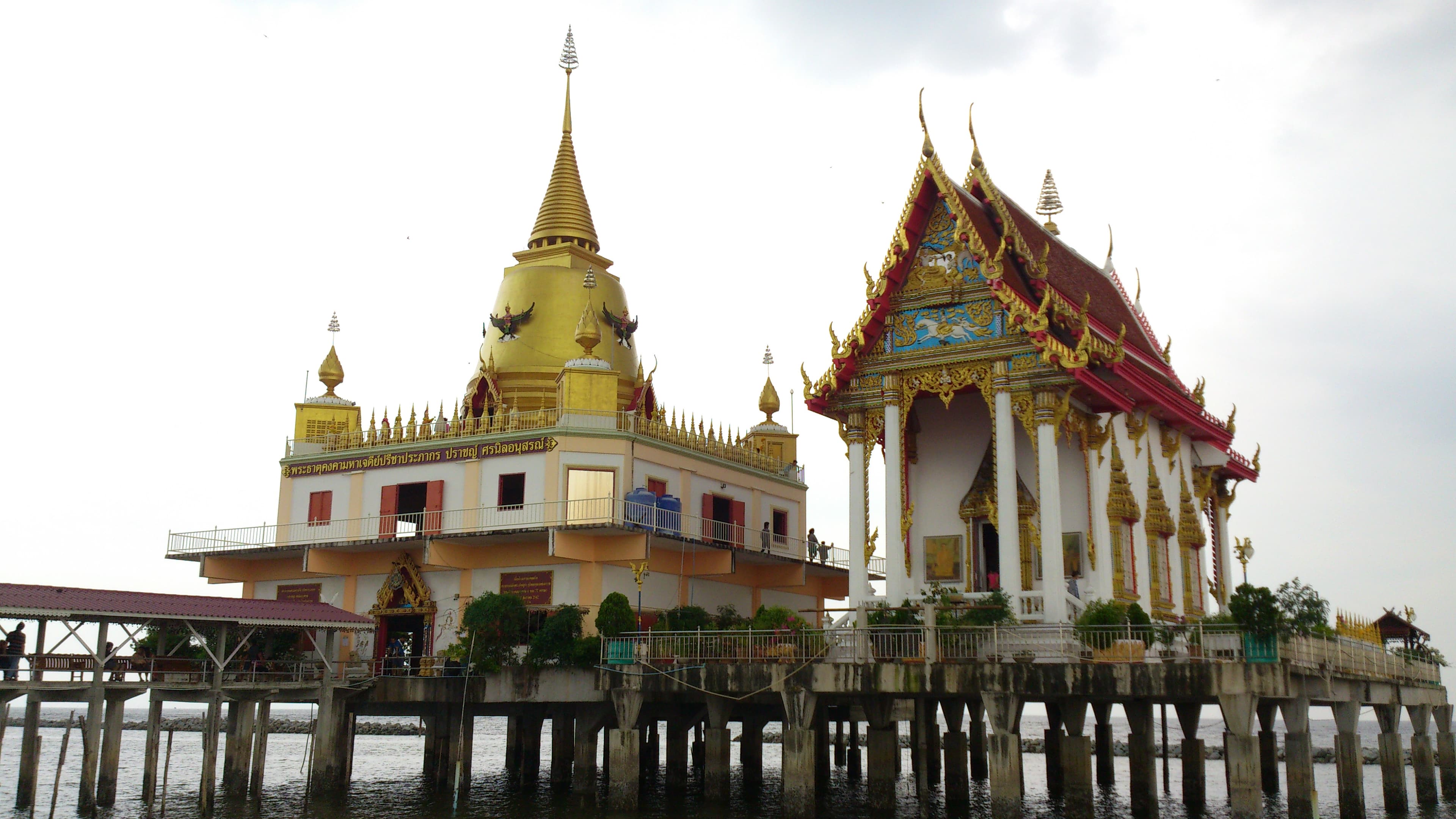
Wat Hong Thong in Bang Pakong, Chachoengsao, Thailand. Image source · CC BY-SA 3.0
Visit essentials
A quick read before you go
- Etiquette
- Protect worshippers, historic fabric, and closed thresholds.
Overview
The walk over water is part of the site's identity, but the religious destination remains the images, relics, and working monastery. The chedi's levels lead from accessible Buddha devotion toward the arhat-relic chamber, while the sea and mangrove horizon remain constantly visible. This arrangement joins Buddhist recollection with a coastal community whose livelihoods depend on the gulf. It should not be reduced to a floating-photo illusion.
Government fisheries material also places the temple within a local fishing-village initiative, linking worship, landscape, and community economy.
Why this place is sacred
Tides alter how the buildings appear and how the causeway feels underfoot. That change can intensify a visitor's awareness of impermanence, yet it does not establish that seawater or the upper chamber produces a measurable energy. Claims that the reliquary is the world's first arhat-relic shrine in the sea are reported from the government project description, not generalized into a supernatural ranking.
The stronger spiritual reading concerns relic homage, repeated crossing, coastal vulnerability, and the monastery's responsibilities to worshippers and neighbors.
Experience and orientation
Check tide, wind, rain, and any posted causeway restrictions before walking outward. Surfaces may be wet or crowded, and railings are not places for portraits that block passage. Inside the ordination hall, remove shoes and avoid photographing prayer at close range. The strong Places match provides current ordinary hours, address, and telephone, while Buddhist Office reporting verifies an active abbot and ceremonies. No independently confirmed temple-controlled website was found, so none is promoted.
Context and lineage
Official fisheries documentation describes the present arrangement: a landward temple connected to the three-storey chedi and sea-set ordination hall. The ground level contains Buddha images, the second includes Luang Pu Sot and an Emerald Buddha replica, and the upper golden chamber contains arhat relics. Rather than inventing an ancient origin, this page treats Wat Hong Thong as a modern coastal devotional complex whose meaning comes from active use and community context. It is not a UNESCO property.
Traditions and practice
Visitors may honor the principal Buddha, the Luang Pho Sothon replica, and the arhat relics, or sit quietly with the sea visible beyond the religious spaces. Do not leave offerings on the causeway, throw objects into the water, feed wildlife, or interfere with fisheries and mangrove restoration. Official records identify no recurring pilgrimage institution; the scenic crossing remains an approach. During ceremonies, the monastic schedule governs access and photography. Supporting authorized community vendors can accompany, but never replace, respectful worship.
Thai Theravada Buddhism
ActiveDocumented tradition layer 1.
Coastal community stewardship
ActiveDocumented tradition layer 2.
Perspectives and open questions
Religious, historical, and environmental evidence remain distinct.
Scholarly perspective
Theravada practice interprets Buddha and arhat relics as supports for recollection and merit. Coastal landscape analysis attends to tides, erosion, mangroves, and the engineering of a sea-linked temple. Community-development sources connect the monastery with local fisheries and products, while Buddhist Office records show contemporary institutional life. These lenses are kept distinct: environmental setting does not make the shore a natural sacred site by itself, and tourism language does not authorize exaggerated miracle claims.
Wat Hong Thong is classified as built and cultural. The modern sea-linked structures belong to a living monastery; no unsupported ancient foundation date is asserted. Environmental responsibility is especially concrete here because careless visitation can reach the gulf directly. Litter dropped from the causeway, food given to animals, or pressure on mangrove edges affects a working coastal system beyond temple walls.
The religious and ecological stories thus meet through behavior rather than through a claim that the sea itself is an object of worship. Relic homage can coexist with fisheries livelihoods when movement, waste, and photography are managed attentively.
Plan your visit
Day-of authority overrides routine listing data.
Respectful visit
Protect worshippers, historic fabric, and closed thresholds.
Current practical details
Address
9, 2 Sukhumvit Rd, Tambon Song Khlong, Amphoe Bang Pakong, Chang Wat Chachoengsao 24130, Thailand
Phone
Hours
Hours, fees, and access can change — verify on the official source before you travel. Practical details last checked Jul 2026.
Location
Map loads as you approach this section.
Pilgrim reflections
A portrait of encounter, not a score
Pilgrims describe what they felt, how present they could become, and whether the place would shape a journey. There are no stars and no ranking of traditions.
No reviewed reflections yet
The first pilgrims can help describe the character of being here.
Share a reflection
Available after an account-backed “Been there.” Every reflection is reviewed before publication.
Nearby sacred places
Explore other sacred places in the region. Proximity does not establish access or travel time; check each place’s guidance.
References
Sources consulted for this page. Source categories describe the publication, not a guarantee that every claim is verified. Traditional accounts and outside interpretations may differ.
- 01Wat Hong Thong — Google PlacesofficialExact practical metadata accepted after strong name, country, locality, and coordinate review.
- 02Wat Hong Thong (Wat Klang Na) — Tourism Authority of ThailandofficialExact official attraction identity.
- 03Fisherman's Village Resort: Wat Hong Thong — Department of Fisheries, ThailandofficialExact temple structures, images, relic chamber, mangrove coast, and community context.
- 04Wat Hong Thong monastic ceremony — Chachoengsao Provincial Office of BuddhismofficialCurrent exact-site abbot and active ceremony evidence.
Share a photo
Help visitors recognize Wat Hong Thong. Every submission is reviewed before publication.