Tây An Pagoda
Tây An Cổ Tự: Buddhist worship beneath Núi Sam's western slope
Understand sacred places, explore living traditions, and learn how to engage respectfully with Pilgrim Map.
Access has not been verified. Check current local guidance before planning a visit.
Châu Đốc, An Giang, Vietnam
Read the sources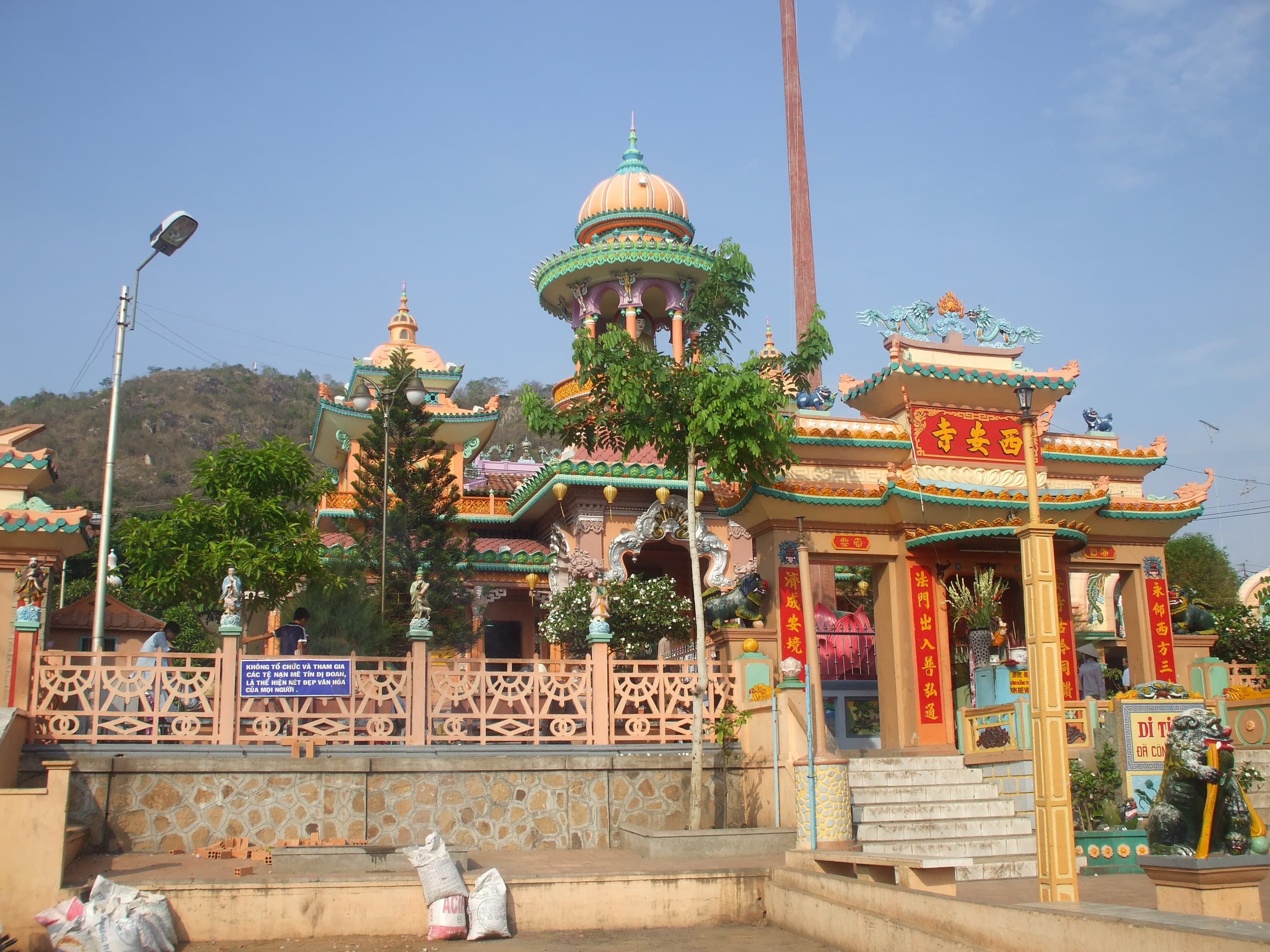
Tây An Pagoda in Châu Đốc, An Giang, Vietnam. Image source · CC BY-SA 3.0
Visit essentials
A quick read before you go
- Duration
- Set aside enough time to distinguish façade, Buddha sanctuary, and teacher memory instead of…
- Access
- The strong Places record supports the mountain-road address and operating listing; confirm both…
Overview
Tây An stands within a pilgrimage district crowded with other shrines, yet its own identity is Buddhist. The entrance and decorated halls lead toward images of the Buddha, spaces for merit-making, and memories of religious teachers associated with the region. Đoàn Minh Huyên matters here as a remembered teacher connected with Bửu Sơn Kỳ Hương, not as a substitute for the pagoda's central Buddhist worship. Let the relationship between sanctuary and mountain slope emerge slowly.
The building's unusual ornament attracts cameras, but incense, bows, and quiet prayer show why the place continues to be maintained.
Why this place is sacred
The pagoda joins devotion to Śākyamuni Buddha with southern Vietnamese teacher memory. Refuge, merit-making, reverence for Đoàn Minh Huyên, and ordinary temple discipline sustain its sacred identity. Official sources place the nationally protected nineteenth-century temple at Núi Sam and document its Buddhist and Bửu Sơn Kỳ Hương associations. They do not establish a separately named pilgrimage for this pagoda, so the page keeps its active-worship status distinct from the wider mountain's other sacred places.
Nineteenth-century Buddhist worship, teaching memory, and community patronage shaped the protected temple at the mountain's western slope.
Repairs preserved unusual architecture while living Mahayana practice continued inside the decorated halls.
Experience and orientation
Approach from the mountain side and notice how the façade announces the pagoda before the worship hall restores a quieter scale. Inside, identify the principal Buddha images and observe where practitioners kneel or set incense. Decorative abundance is easiest to understand when balanced with the rhythm of bowing and stillness. During crowded Núi Sam periods, stand away from doorways and let worshippers complete their circuit.
Locate the principal sanctuary and teacher memorial areas before joining the movement of incense and bows.
Context and lineage
Provincial and national culture sources place the pagoda's development in the nineteenth century and recognize its architecture as protected heritage. Accounts connect the temple with Đoàn Minh Huyên and the religious transformations of An Giang. Where dates or reconstruction details vary, this page keeps to the official historical frame rather than repeating a colourful but unsupported founding legend.
Śākyamuni remains the worship focus; Đoàn Minh Huyên is remembered as a teacher, not substituted for the Buddha.
Śākyamuni Buddha and the memory of Đoàn Minh Huyên
documented devotional focus
Traditions and practice
Incense, bows, quiet petitions, recitation, donations, and merit-making continue in the active halls. Remembrance of teachers belongs within that Buddhist setting. Remove footwear where requested, keep gifts within custodian practice, and do not block the main sanctuary while examining statues. A simple pause is preferable to imitating prostrations for a photograph.
Daily Buddhist use persists amid a wider Núi Sam religious landscape, without establishing a separate formal pilgrimage route.
Compare the decorated entrance with the sanctuary's quieter devotional rhythm from outside kneeling spaces.
Vietnamese Mahayana Buddhism and Bửu Sơn Kỳ Hương memory
ActiveVietnamese Mahayana worship is joined here by historically specific remembrance of Bửu Sơn Kỳ Hương's teacher.
Bowing, incense, merit-making, quiet prayer, and teacher remembrance occur within active Buddhist halls.
Perspectives and open questions
Buddhist devotion, protected architecture, regional religious history, and teacher memory should remain analytically distinct.
Scholarly perspective
Heritage records emphasize nationally protected architecture; Buddhist practice gives the precinct its living purpose; regional religious history explains Đoàn Minh Huyên's remembered presence. Keeping these layers separate prevents an ornate façade from becoming the only story.
Living and traditional perspectives
Temple practitioners define how Śākyamuni worship and respect for Đoàn Minh Huyên coexist in the precinct.
Open questions
The sources do not support a measurable energy claim or a separately named pilgrimage assigned to this pagoda.
Plan your visit
Access and arrival
The strong Places record supports the mountain-road address and operating listing; confirm both before travel.
Arrange Châu Đốc accommodation independently with attention to transport around the western slope.
Respectful visit
Dress modestly for Mahayana worship and remove footwear wherever the pagoda directs.
Wait until bows or incense placement finish before photographing interiors, images, or memorial areas.
Place only familiar Buddhist offerings accepted by custodians; observation is preferable when uncertain.
Remove shoes where instructed, avoid blocking the main sanctuary, and keep offerings within custodian practice.
Do not merge nearby goddess worship, Buddhist practice, and teacher memory into one undifferentiated cult.
Current practical details
Address
Đường Đ. Vòng Núi Sam, Vĩnh Tây 1, Vĩnh Tế, An Giang, Vietnam
Hours
Hours, fees, and access can change — verify on the official source before you travel. Practical details last checked Jul 2026.
Location
Map loads as you approach this section.
Pilgrim reflections
A portrait of encounter, not a score
Pilgrims describe what they felt, how present they could become, and whether the place would shape a journey. There are no stars and no ranking of traditions.
No reviewed reflections yet
The first pilgrims can help describe the character of being here.
Share a reflection
Available after an account-backed “Been there.” Every reflection is reviewed before publication.
Nearby sacred places
Explore other sacred places in the region. Proximity does not establish access or travel time; check each place’s guidance.


References
Sources consulted for this page. Source categories describe the publication, not a guarantee that every claim is verified. Traditional accounts and outside interpretations may differ.
- 01Địa chí An Giang — An Giang Department of Culture, Sports and TourismofficialProvincial cultural reference for Tây An Pagoda's identity, setting, and religious history.
- 02Thông tin du lịch An Giang — An Giang Department of Culture, Sports and TourismofficialProvincial visitor reference for the protected pagoda and Núi Sam context.
- 03Conservation agreement for Tây An Pagoda — Ministry of Culture, Sports and TourismofficialNational culture-ministry record confirming the protected monument identity.
- 04Tây An Temple — Wikipedia — Wikipedia contributorsacademicCorroborates canonical identity and historical context.
- 05Google Maps listing for Tây An Pagoda — Google MapsSource contextUsed only for strong-match coordinates and practical fields.
Share a photo
Help visitors recognize Tây An Pagoda. Every submission is reviewed before publication.