Golgulsa Temple
Cave shrines and moving Seon practice on Hamwolsan
Understand sacred places, explore living traditions, and learn how to engage respectfully with Pilgrim Map.
Access has not been verified. Check current local guidance before planning a visit.
Gyeongju, Gyeongsangbuk-do, South Korea
Read the sources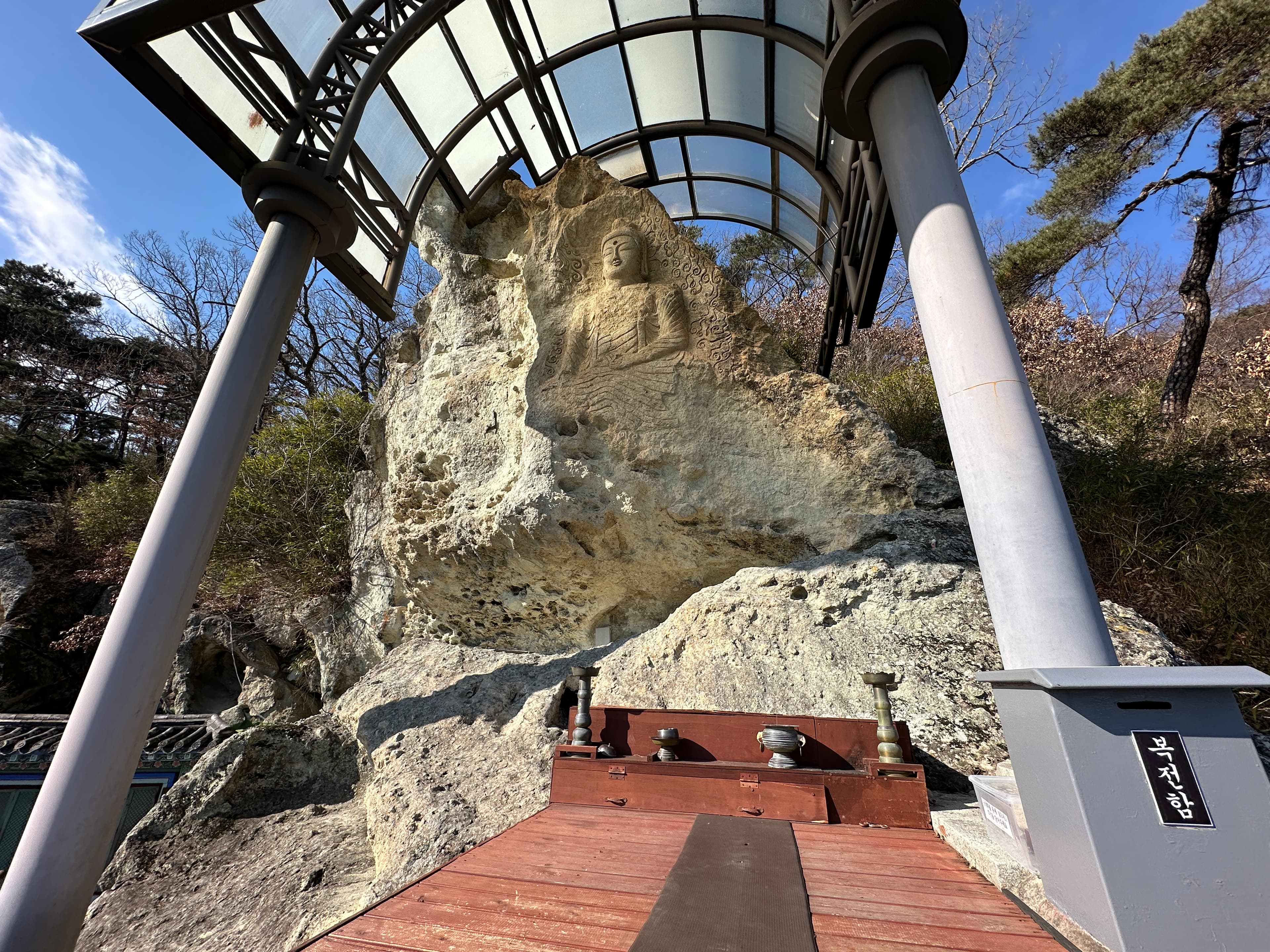
Golgulsa Temple in Gyeongju, North Gyeongsang, South Korea. Image source · CC BY-SA 4.0
Visit essentials
A quick read before you go
- Duration
- Reserve enough time to climb slowly between the cliff’s small sanctuaries.
- Access
- Contact the temple before travel because no verified hours were available.
Overview
Golgulsa’s cliff is visually unusual, but sacred meaning is not geology alone. Temple tradition describes twelve cave spaces around a carved Buddha, once fronted by wooden structures. Fire probably removed much of that architecture; after a period as a private hermitage, substantial renewal began around 1990. Surviving rock, repaired buildings, active altars, and training grounds thus represent different layers.
The custodian presents Seonmudo as moving meditation joining calming and insight practices with breath and bodily form, directed within Buddhism toward awakening, ethical integration, and liberation—not a martial-arts display or wellness promise. Official history also records prayers for a son at paired rock forms near Sansindang; this is inherited temple folklore, not a verified fertility effect.
Why this place is sacred
A cave limits the field of vision while the exposed cliff opens it again. Golgulsa’s alternating spaces make concentration physical: visitors duck, climb, pause, and reorient before different shrines. At the same time, Seonmudo asks practitioners to observe breathing and movement rather than treat the body as an obstacle to meditation. These spatial and disciplinary facts support a grounded spiritual reading.
They do not establish that the cliff emits energy, that one exercise cures illness, or that a petition at a rock formation causes childbirth. Traditional and participant language may describe harmony or internal energy; this page preserves that vocabulary as the community’s account while withholding biomedical or paranormal endorsement.
Temple history separates received foundation tradition from documented twentieth-century restoration.
Later change is identified without inventing continuity.
Experience and orientation
Begin below the main rock face and identify which spaces are public before climbing. The tuff can weather, stairs are steep, and a devotional route is not an invitation to scramble over protected surfaces. Notice how small cave halls address different figures rather than assuming every chamber repeats the Amitabha dedication. If a Seonmudo class or demonstration is underway, remain outside the practice floor unless staff invite participation.
Training requires instruction; copying advanced movements from a distance can be unsafe and strips them from their contemplative setting. Temple residents, retreat guests, day visitors, and worshippers may share narrow passages, so yield rather than stage photographs. The most useful sequence is slow: cliff, carved face, threshold, altar, breath, and only then the wider mountain view.
Follow the cliffside stair route and respect closed cave thresholds.
Context and lineage
Golgulsa’s official history attributes the cave temple to the monk Gwangyu and companions from India about fifteen centuries ago. That is the custodian’s received foundation account, not a securely dated excavation report. A Joseon-period painting by Jeong Seon and a travel description by Jeong Sihan provide firmer evidence that wooden-fronted cave structures once formed a larger ensemble. Temple historians believe fire destroyed those structures in the middle or later Joseon period.
The site subsequently stood empty, became a private hermitage, and was rebuilt into its present institutional form from 1990. This layered account respects tradition without converting every inherited date into archaeological certainty.
Korean Buddhism
Traditions and practice
Seonmudo is presented by Golgulsa as a Buddhist method of cultivating tranquility and insight through coordinated breath and movement. Retreat participants follow teachers, schedules, clothing requirements, and communal rules rather than improvising a private regimen. Cave halls support prayer to several Buddhist figures and associated Korean religious beings. The Sansindang fertility story belongs to folk tradition; people may report hopes or answered petitions, but those outcomes are not independently verified.
A suitable visitor practice is simpler: choose one threshold, steady the breath, and observe how posture changes before entering. Do not turn that exercise into a claim of healing or mastery.
Current observance remains under custodian authority.
Pause once and attend before interpreting.
Korean Buddhism
ActiveCave worship and Seonmudo join cliff sanctuaries with embodied Buddhist discipline.
Residents direct prayer, retreat schedules, and training within monastic rules.
Perspectives and open questions
Golgulsa is best understood through cave architecture, layered history, active worship, and embodied Seon discipline.
Scholarly perspective
Art history can examine the cliff image and lost wooden fronts; religious study can follow the multiple cave dedications; practitioners understand Seonmudo from inside a lineage of training. None of these perspectives should erase the others. Claims that practice restores health or that paired rocks grant children are community or participant assertions and are not independently verified.
The strongest common ground is observable: sustained teaching, active altars, difficult terrain, and a temple that has rebuilt religious life around an unusually vulnerable rock complex.
Living and traditional perspectives
Temple teachers frame Seonmudo as Buddhist meditation through breath and movement.
Open questions
Fertility petitions are inherited testimony, not evidence of reproductive effects.
Plan your visit
Access and arrival
Contact the temple before travel because no verified hours were available.
Overnight participation belongs to the separately booked Templestay program.
Respectful visit
Wear modest clothes and shoes secure enough for steep stone steps.
Ask before photographing worship, Seonmudo instruction, interiors, or the rock carving.
Use only forms explicitly authorized by custodians.
Barriers and ceremony instructions always take priority.
Avoid imitation, intrusion, and unsupported promises.
Current practical details
Address
101-5 Girim-ro, Munmudaewang-myeon, Gyeongju, Gyeongsangbuk-do, South Korea
Phone
Hours, fees, and access can change — verify on the official source before you travel. Practical details last checked Jul 2026.
Location
Map loads as you approach this section.
Pilgrim reflections
A portrait of encounter, not a score
Pilgrims describe what they felt, how present they could become, and whether the place would shape a journey. There are no stars and no ranking of traditions.
No reviewed reflections yet
The first pilgrims can help describe the character of being here.
Share a reflection
Available after an account-backed “Been there.” Every reflection is reviewed before publication.
Nearby sacred places
Explore other sacred places in the region. Proximity does not establish access or travel time; check each place’s guidance.


References
Sources consulted for this page. Source categories describe the publication, not a guarantee that every claim is verified. Traditional accounts and outside interpretations may differ.
- 01Golgulsa History — Golgulsa TempleofficialTemple account of the Hamwolsan cave complex, cliff-carved Amitabha, surviving cave shrines, received foundation history, fire, and restoration.
- 02What is Seonmudo? — Golgulsa TempleofficialCustodian explanation of Seonmudo as moving Seon practice integrating tranquility, insight, breath, body, speech, and thought.
- 03Golgulsa Temple — Cultural Corps of Korean BuddhismofficialOfficial Templestay record confirming the address, contact details, year-round programs, and Seonmudo focus.
- 04Golgulsa Temple — Google Maps place record — GoogleSource contextStrong exact identity used only for current coordinates, address, phone, and operating status.
Share a photo
Help visitors recognize Golgulsa Temple. Every submission is reviewed before publication.