Girimsa Temple
Vairocana, an old tree, and five remembered waters
Understand sacred places, explore living traditions, and learn how to engage respectfully with Pilgrim Map.
Access has not been verified. Check current local guidance before planning a visit.
Gyeongju, Gyeongsangbuk-do, South Korea
Read the sources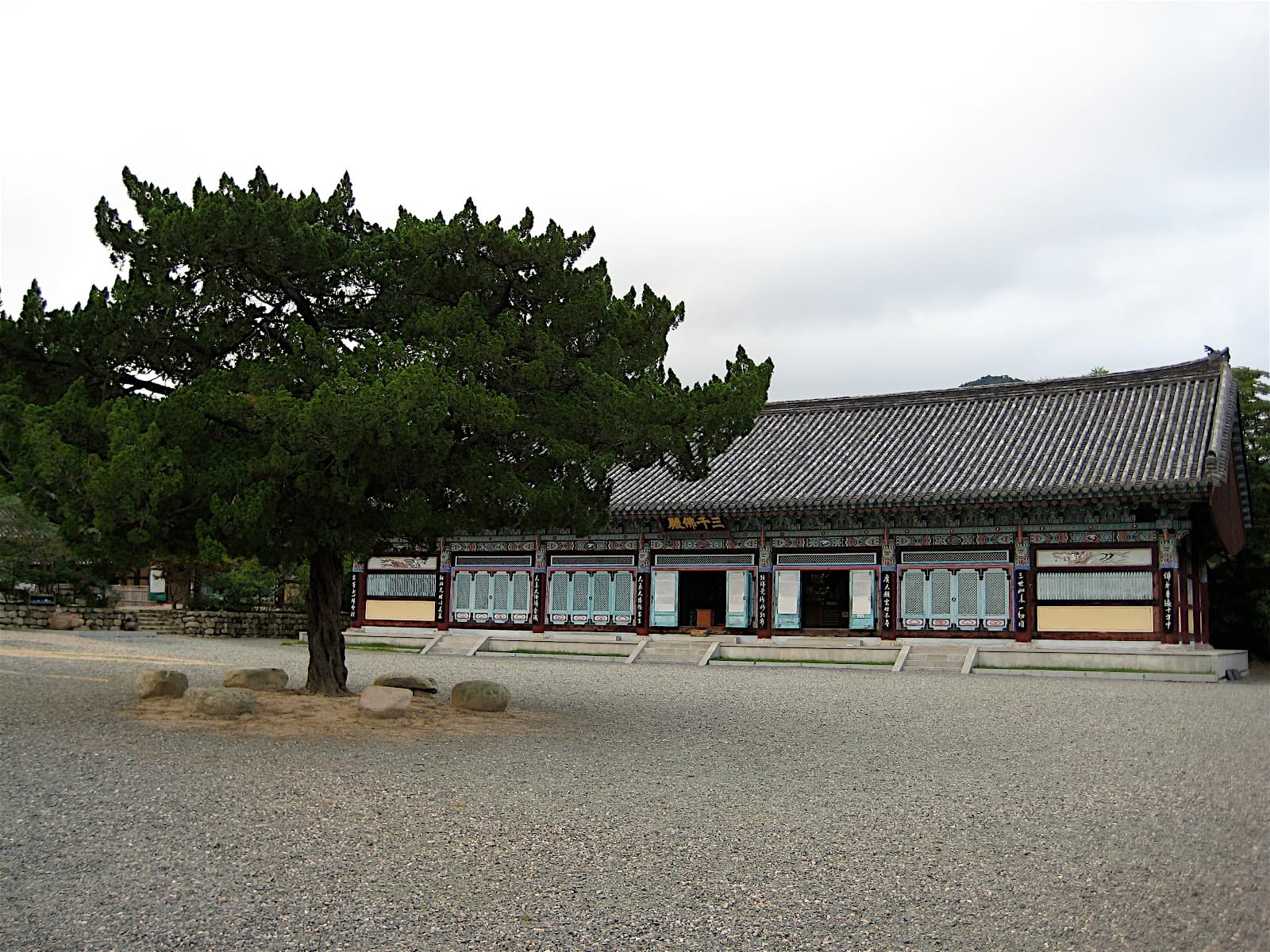
Girimsa Temple in Gyeongju, North Gyeongsang, South Korea. Image source · CC BY 3.0
Visit essentials
A quick read before you go
- Duration
- Allow ninety minutes to distinguish the two temple clusters, museum context, and any open water…
- Access
- KTO lists 08:00–17:00 in winter and 08:00–18:00 in summer, year-round opening, kirimsa.net,…
Overview
Girimsa's early chronology is received rather than exact. KTO places it in the Silla era, recounts foundation by the Indian sage Gwang-yu as Imjeongsa, and links Wonhyo to expansion and renaming, while stating that the building year is unclear. That boundary matters, as does the difference between water flowing today and claims about its effects. Ojongsu tradition names five waters with distinct tastes or effects; the official tourism account repeats claims of comfort, strength, clear vision, and luminous attraction.
These are prevalent site stories, not verified medical or paranormal properties. With that disclaimer, they show how sensory experience, national memory, and aspiration accumulated around particular sources.
Why this place is sacred
Vairocana imagery expresses illumination not as one lamp among others but as a principle extending through the cosmos in Mahayana Buddhism. The old tree offers a different register: growth, damage, shade, and season visible in one organism. Flowing water supplies a third: form that cannot be held without changing. These are distinct religious, ecological, and material facts, not proof that the precinct emits energy. Together they invite a disciplined comparison.
Radiance can mean wisdom, rootedness can mean responsibility, and flow can mean adaptation. The temple’s task is to keep such interpretations accountable to Buddhist teaching, conservation, and the limits of evidence.
Girimsa’s received Silla foundation and Wonhyo association place it within the spread and consolidation of Buddhism around Gyeongju.
Repeated rebuilding created the current multi-court monastery; Golgulsa later became independent, while Girimsa retained worship, heritage, water lore, and retreat.
Experience and orientation
Begin at Daejeokgwangjeon and notice how the hall’s structure concentrates attention on Birojanabul. Then cross to the court organized by the old tree and observe the different scale made by branches, shade, museum buildings, and smaller shrines. If a permitted water source is operating, read its name before tasting and follow all hygiene instructions. Do not sample from blocked, unmarked, or closed outlets.
The named waters can be received as cultural narrative while ordinary sensory differences—temperature, mineral taste, vessel, season—remain enough. On the way, remember that nearby Golgulsa has its own institutional identity and should not be collapsed into Girimsa today.
The complex has two principal clusters and seasonal closing times; locate the Vairocana hall, tree court, museum, and authorized water points before moving through it.
Context and lineage
KTO repeats a tradition that Gwang-yu established Imjeongsa early in Silla and that Wonhyo enlarged and renamed it Girimsa, while explicitly noting that the founding year remains unclear. Daejeokgwangjeon is associated with Queen Seondeok’s reign and six rebuildings rather than untouched original fabric. Its Vairocana image anchors the main devotional court. The five-water account is part of the temple’s cultural memory, including a colonial-era story that soldiers blocked the strength-giving Janggunsu source. The claimed bodily effects remain unverified.
Girimsa is an active Jogye Order temple in Gyeongju; Golgulsa, once a hermitage, is now independent.
Traditions and practice
Worship centers on Buddhist halls and images; water lore may accompany visitation but is not substituted for Dharma practice.
Templestay provides supervised participation, while conservation rules govern historic buildings, the old tree, and water access.
After visiting the two courts, name one way clarity, rooted responsibility, and flexibility could correct one another in daily life.
Korean Buddhism
ActiveGirimsa joins Vairocana devotion to the long maintenance of halls, living landscape, and culturally meaningful water sources.
Bowing, chanting, offerings, retreat, heritage care, respectful water use, and contemplative walking.
Perspectives and open questions
Girimsa supports Buddhist, architectural, ecological, and folklore readings when their evidence is not blurred.
Scholarly perspective
Uncertain foundation traditions, rebuilding chronology, water chemistry, and colonial memory require different kinds of proof.
Living and traditional perspectives
Vairocana devotion frames illumination as wisdom that reaches through ordinary distinctions and responsibilities.
Open questions
The bodily and extraordinary effects attributed to Ojongsu are widespread stories reported by tourism sources, not independently verified facts.
Plan your visit
Access and arrival
KTO lists 08:00–17:00 in winter and 08:00–18:00 in summer, year-round opening, kirimsa.net, parking, and Templestay. Google currently shows 08:00–17:00 daily; confirm the seasonal close before travel.
Use only the official Templestay channel for overnight participation.
Respectful visit
Wear modest clothing and stable footwear for stone, shade, and potentially wet ground.
Confirm rules for Daejeokgwangjeon, the Vairocana image, museum objects, monastics, ceremonies, and water collection.
Use established altar or donation practices; do not hang objects on the old tree or place offerings beside springs.
Never climb the tree, touch protected sculpture, enter residential buildings, or reopen a blocked water source.
Stories that a water grants strength, vision, comfort, or attraction are traditional or visitor claims, not verified health advice; do not drink from an unapproved source.
Current practical details
Address
437-17 Girim-ro, Munmudaewang-myeon, Gyeongju, Gyeongsangbuk-do, South Korea
Phone
Hours
Hours, fees, and access can change — verify on the official source before you travel. Practical details last checked Jul 2026.
Location
Map loads as you approach this section.
Pilgrim reflections
A portrait of encounter, not a score
Pilgrims describe what they felt, how present they could become, and whether the place would shape a journey. There are no stars and no ranking of traditions.
No reviewed reflections yet
The first pilgrims can help describe the character of being here.
Share a reflection
Available after an account-backed “Been there.” Every reflection is reviewed before publication.
Nearby sacred places
Explore other sacred places in the region. Proximity does not establish access or travel time; check each place’s guidance.


References
Sources consulted for this page. Source categories describe the publication, not a guarantee that every claim is verified. Traditional accounts and outside interpretations may differ.
- 01Girimsa Temple official website — Girimsa TempleofficialDomain matches the site or its managing religious/heritage body.
- 02Girimsa Temple — Korea Tourism OrganizationofficialOfficial tourism record for the Silla-era tradition, uncertain date, Wonhyo renovation, Vairocana hall, historic tree, five-water lore, Templestay, address, and seasonal hours.
- 03Girimsa — Wikipedia — Wikipedia contributorsacademicCorroborates identity, location, and general historical context; key claims require higher-tier support.
- 04Girimsa — Wikidata — Wikidata contributorsSource contextCommunity-maintained structured identity and coordinate cross-check; not treated as scholarship or an official custodian record.
- 05Girimsa Temple — Google Maps place record — GoogleSource contextStrong identity match used only for current practical fields and coordinates.
Pilgrim glossary
- Dharma
- The teachings of the Buddha; also the universal law underlying them.
Share a photo
Help visitors recognize Girimsa Temple. Every submission is reviewed before publication.