Mother House of the Missionaries of Charity
A modest Kolkata convent where prayer becomes service—and service returns to prayer.
Understand sacred places, explore living traditions, and learn how to engage respectfully with Pilgrim Map.
Access has not been verified. Check current local guidance before planning a visit.
Kolkata, West Bengal, India
Read the sources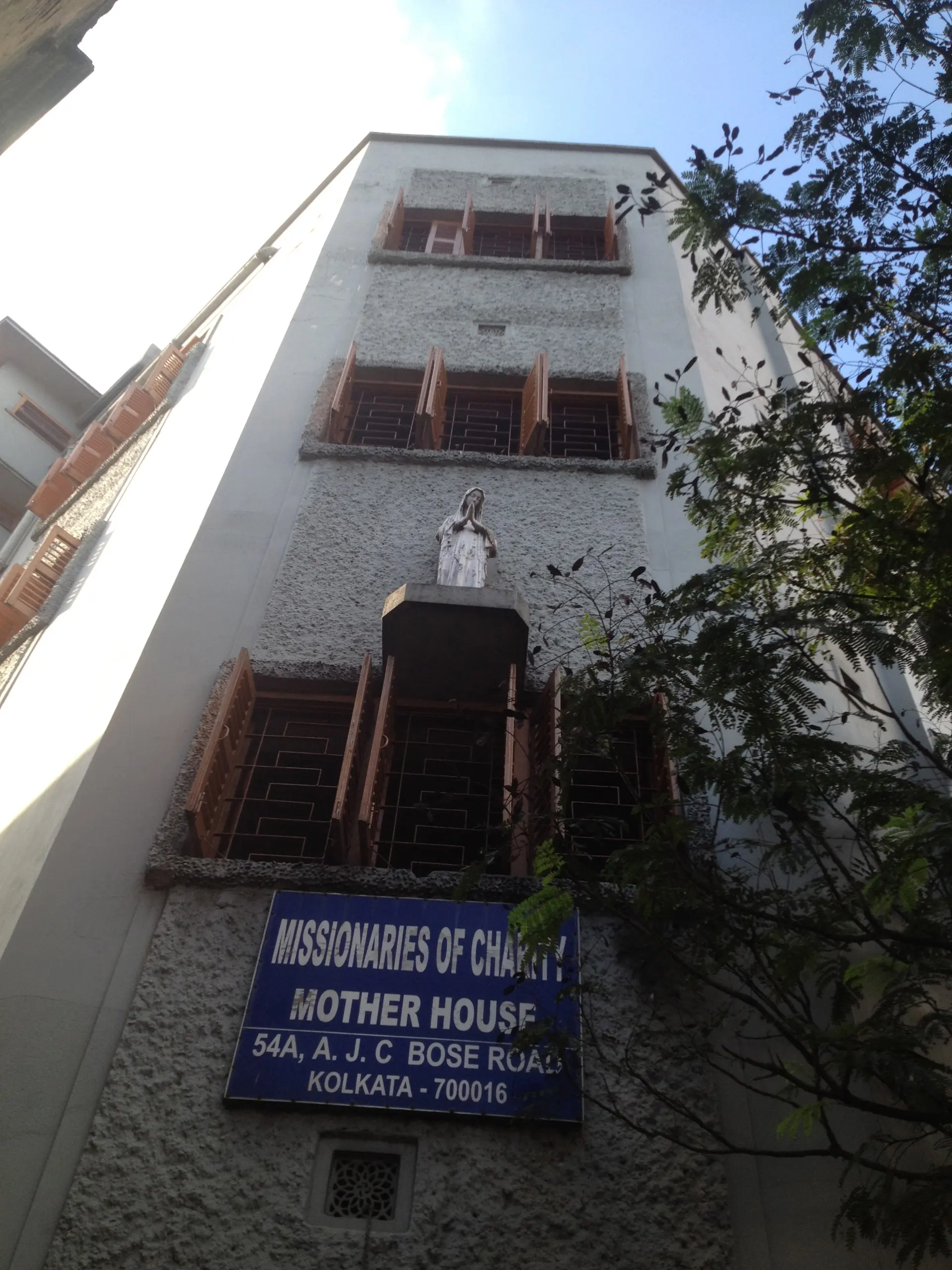
Visit essentials
A quick read before you go
- Duration
- Allow at least an unhurried hour, and substantially more for a major observance or controlled…
- Access
- The congregation currently lists visiting periods in the morning and afternoon and says the…
Overview
The exact record is the Mother House at 54A A.J.C. Bose Road in Kolkata: the headquarters and living convent of the Missionaries of Charity, the house where Mother Teresa lived, worked, died, and was buried. It must not be confused with Nirmal Hriday in Kalighat, the Memorial House in Skopje, or other Missionaries of Charity homes. The Mother House is not simply a museum to a famous humanitarian.
It remains the headquarters and home of a Catholic religious congregation whose spirituality understands care for each abandoned person as an encounter with Christ. The date connection for the upcoming social calendar is August 26, 2026, the anniversary of Mother Teresa’s birth.
Why this place is sacred
The sense of a threshold here comes from practiced attention, inherited story, repeated worship, and care for an exact place. It is not evidence of a measurable energy field. Awe is strongest when it grows from details the visitor can actually encounter and from meanings the custodial community can recognize.
The building continues to be a residence and center of prayer rather than a frozen memorial.
Mother House of the Missionaries of Charity has accumulated institutional, devotional, architectural, and visitor-facing layers. Those layers should be read in sequence rather than collapsed into one timeless story. Present worship and stewardship control the visit; historical change is not a loss of sacredness but part of how a living place continues.
Experience and orientation
The exterior is visually modest, and that modesty is part of the encounter. Inside, the atmosphere is shaped by a living community, daily Mass, pilgrims at the tomb, Mother Teresa’s preserved room, and a small museum. Silence matters more than collecting images. The most useful detail to carry away is the site’s scale: a global congregation is remembered here through a bed, a desk, a tomb, prayer, and the repeated choice to serve one person at a time.
Use the mapped point for Mother House of the Missionaries of Charity to find the recognized entrance, then defer to signs, custodians, and active-worship boundaries. A map pin is orientation, not permission to enter residential, sanctuary, security, river, or conservation areas.
Context and lineage
The Missionaries of Charity were established in Kolkata in 1950. The congregation’s own account says the A.J.C. Bose Road house has been its home since February 1953. Mother Teresa guided the expanding community from here, died here on 5 September 1997, and was buried on the ground floor after her state funeral on 13 September.
Her preserved room and a small museum stand near the tomb, but the building continues to be a residence and center of prayer rather than a frozen memorial.
The lineage of Mother House of the Missionaries of Charity includes the worshipping community, clergy or religious custodians, pilgrims, local workers, and the people who preserve its stories and physical fabric. Institutional and community sources take priority where the record is silent.
Traditions and practice
Pilgrims pray at Mother Teresa’s tomb, attend Mass when permitted, visit her room and museum, and reflect on the congregation’s charism of wholehearted and free service. Visitors of many faiths are welcomed to pay respects and pray. A suitable personal response is to name one practical act of care you can perform after leaving; the site’s spirituality is distorted if compassion remains only admiration.
Contemporary use remains living rather than reenacted. Visitors should observe the forms actually authorized at Mother House of the Missionaries of Charity; a practice seen online or at another site should not be imported here. Current events can change crowd movement and access, but they do not turn worshippers into performers for an audience.
Begin with two minutes of undistracted observation at Mother House of the Missionaries of Charity. Identify one material detail, one repeated human practice, and one ethical demand the place makes. After leaving, put the takeaway into a small action appropriate to your own tradition or conscience. Do not stage prayer, offerings, touching, or ritual gestures for a photograph.
Catholic Christianity
ActiveThe place’s spiritual center is a disciplined movement between contemplation and action. Missionaries of Charity sources describe seeing and serving Christ in poor, sick, lonely, and abandoned people. That conviction does not make poverty picturesque; it demands recognition of another person’s dignity. A visitor can therefore read the plain rooms and tomb not as evidence that deprivation is holy, but as a challenge to notice who is treated as disposable and to answer with concrete, person-to-person care.
Pilgrims pray at Mother Teresa’s tomb, attend Mass when permitted, visit her room and museum, and reflect on the congregation’s charism of wholehearted and free service. Visitors of many faiths are welcomed to pay respects and pray. A suitable personal response is to name one practical act of care you can perform after leaving; the site’s spirituality is distorted if compassion remains only admiration.
Perspectives and open questions
Catholic sources interpret Mother Teresa’s service through Christ’s words about serving ‘the least’ and through her call to bring divine love to the poorest of the poor. People outside Christianity may encounter the same place through ethical commitments to dignity, solidarity, and direct care. Those perspectives can meet without erasing the congregation’s explicitly Catholic identity. Claims about miracles or sainthood belong to Catholic belief and canonization, while the house’s address, institutional role, tomb, and continuing use are historical and observable.
Scholarly perspective
A source-critical view distinguishes the mapped place, current institution, documented event, and observable practice from claims held through faith. At Mother House of the Missionaries of Charity, that distinction protects both accuracy and devotion: belief is not dismissed, and historical evidence is not inflated.
Living and traditional perspectives
The place’s spiritual center is a disciplined movement between contemplation and action. Missionaries of Charity sources describe seeing and serving Christ in poor, sick, lonely, and abandoned people. That conviction does not make poverty picturesque; it demands recognition of another person’s dignity. A visitor can therefore read the plain rooms and tomb not as evidence that deprivation is holy, but as a challenge to notice who is treated as disposable and to answer with concrete, person-to-person care.
Alternative interpretations
Some visitors may describe Mother House of the Missionaries of Charity through universal spirituality, energy, synchronicity, or esoteric symbolism. Such language remains a personal interpretation unless a cited custodial tradition uses it. It must not be presented as the site’s own teaching or as scientific measurement.
Open questions
Dynamic access and some historical details remain uncertain. The page does not turn those gaps into mystery. For Mother House of the Missionaries of Charity, uncertainty is named, attributed, and left open for better evidence.
Plan your visit
Access and arrival
The congregation currently lists visiting periods in the morning and afternoon and says the house is closed to visitors on Thursdays, but hours and Mass access can change. Confirm on the official Missionaries of Charity site shortly before travel. The address is 54A A.J.C. Bose Road, Kolkata. Dress modestly, expect security or worship-related limits, and accept that some residential areas are never public.
No lodging at Mother House of the Missionaries of Charity is implied. Use established accommodation in Kolkata and do not assume that a convent, temple, or pilgrimage facility accepts overnight guests.
Respectful visit
Choose modest clothing suitable for an active convent in Kolkata. Follow any more specific instructions on head covering, shoulders, legs, footwear, or ritual purity without argument.
Treat Mother House first as a convent and place of prayer. Keep voices low, follow the Sisters’ directions, and avoid photographing residents, worshippers, or private areas. The official site asks people seeking permission to use Mother Teresa’s images to contact the Mother Teresa Centre; that is separate from the Creative Commons licenses covering the exterior and tomb photographs used on Pilgrim Map. Do not present volunteering as a visitor attraction or photograph people receiving care.
Use only offerings, donation points, or service opportunities explicitly authorized at Mother House of the Missionaries of Charity. Never leave objects, food, money, candles, or ritual materials in unapproved places.
Barriers, queues, sanctuary limits, residential rooms, security checks, river controls, and closed doors at Mother House of the Missionaries of Charity are binding. Do not search for alternate access or ask another visitor to bypass them.
Do not universalize Mother House of the Missionaries of Charity as proof of a generic mystical claim. Do not appropriate a community’s sacred vocabulary, intrude on worship, or use poverty, ritual intensity, or crowds as exotic scenery.
Location
Map loads as you approach this section.
Pilgrim reflections
A portrait of encounter, not a score
Pilgrims describe what they felt, how present they could become, and whether the place would shape a journey. There are no stars and no ranking of traditions.
No reviewed reflections yet
The first pilgrims can help describe the character of being here.
Share a reflection
Available after an account-backed “Been there.” Every reflection is reviewed before publication.
Nearby sacred places
Explore other sacred places in the region. Proximity does not establish access or travel time; check each place’s guidance.

Dakshineswar Kali temple, Kolkata, West Bengal
Kolkata, West Bengal, India
11.3 km away

Jeshoreshwari Kali Shaktipeeth Temple
Shyamnagar, Khulna, Bangladesh
81.7 km away

Puthia Rajbari Temple complex
Puthia, Rajshahi, Bangladesh
207.0 km away

Basukinath Temple, Jarmundi, Jharkhand
Jarmundi, Jharkhand, India
242.6 km away
References
Sources consulted for this page. Source categories describe the publication, not a guarantee that every claim is verified. Traditional accounts and outside interpretations may differ.
- 01Mother House — Missionaries of CharityofficialExact identity, address, history, tomb, room, museum, welcome, and current visitor guidance.
- 02Frequently Asked Questions — Missionaries of CharityofficialCongregation, mission, Mass, visiting guidance, and image-permission distinctions.
- 03Mother Teresa of Calcutta (1910–1997), biography — The Holy SeeofficialBiographical chronology, congregation, burial, and Catholic spiritual framing.
- 04Mother House in Kolkata — Incredible India, Ministry of TourismofficialIndependent government-tourism confirmation of the site and its visitor significance.
- 05Missionaries of Charity Mother House — flowcommSource contextExact exterior photograph; CC BY 2.0; photographer profile https://www.flickr.com/people/21162417@N07.
- 06Mother Teresa’s tomb — Jan BockaertSource contextExact tomb photograph inside Mother House; CC BY-SA 2.0; photographer profile https://www.flickr.com/people/91474557@N00.
Photo gallery
3 curated photos
Share a photo
Help visitors recognize Mother House of the Missionaries of Charity. Every submission is reviewed before publication.