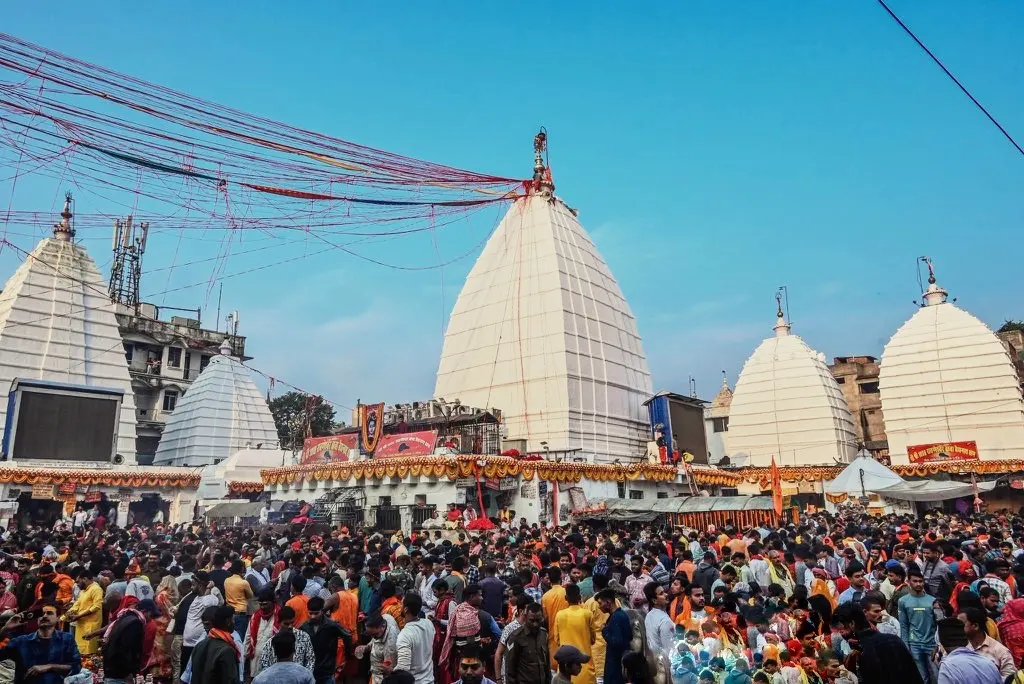
Basukinath Temple, Jarmundi, Jharkhand
The court of Fauzdari Baba, the shrine that completes the great Baidyanath pilgrimage
Understand sacred places, explore living traditions, and learn how to engage respectfully with Pilgrim Map.
Access has not been verified. Check current local guidance before planning a visit.
Jarmundi, Jharkhand, India
Read the sources
Visit essentials
A quick read before you go
- Duration
- 1–3 hours for darshan; far longer during Shravan due to queues.
- Access
- In Jarmundi block, Dumka district, on the Deoghar–Dumka state highway, about 25 km northwest of…
Overview
Basukinath Dham is defined by relationship—to Baidyanath Dham and to a divine couple. In Jarmundi block, Dumka district, about forty-five kilometres from Baidyanath at Deoghar, it is held to complete that pilgrimage: tradition says the Baidyanath Jyotirlinga's blessing remains unfulfilled without a visit here. Saffron-clad Kanwariyas carrying Ganga water along the Sultanganj route continue beyond Deoghar to finish their vow.
Known as Fauzdari Dham, Shiva's 'court,' it is where Fauzdari Baba is believed to hear petitions and directly grant wishes like a divine magistrate. Its name comes from Vasuki, serpent king of the founding legend. Shiva and Parvati's temples face each other, and tradition holds that the couple meet nightly in the sanctum.
The present structure may be about a hundred and fifty years old, though the site is held to be much older. Popular sources sometimes loosely call it a Jyotirlinga, but it is not among the canonical twelve; that designation belongs to its pilgrimage partner Baidyanath. Devotion intensifies during Shravan, with faith that petitions are heard in Fauzdari Baba's court.
Why this place is sacred
Two ideas give Basukinath its charge. The first is completion: a pilgrim's long journey from the Ganga to Baidyanath is held to be unfinished until offered here, so the temple carries the weight of a vow fulfilled, the end of an arduous barefoot walk. The second is intimacy — the face-to-face shrines of Shiva and Parvati and the belief that the divine couple meet each night in the closed sanctum, a union no one is meant to witness.
Layered over both is the temple's folk identity as the 'court' of Fauzdari Baba, where Shiva sits as a magistrate who hears petitions and grants wishes readily. Pilgrims arrive carrying both exhaustion and hope, and many leave with the sense that they have been heard.
A Shaiva shrine to Shiva worshipped as a lingam, named for the serpent king Vasuki and bound by tradition to the worship of the Baidyanath Jyotirlinga.
From legendary origins tied to Vasuki and a founding tradition crediting a tribal devotee, the present temple — perhaps about 150 years old — became established as the indispensable completing shrine of the mass Shravani Mela / Kanwar Yatra circuit, with a complex of more than thirty smaller shrines.
Experience and orientation
Pilgrims describe intense devotional energy, sharpest during Shravan, when long queues of saffron-clad Kanwariyas fill the approach. The central act is the Jalabhishek of the Shiva lingam, with offerings of bilva leaves and flowers. Because the temple completes the Baidyanath pilgrimage, many describe a particular relief and fulfilment on finishing the offering at both shrines.
The arduous barefoot walk that precedes it is experienced as penance and purification, and many leave with a sense that their petition has been received in the court of Fauzdari Baba. The evening Sandhya Aarti is a daily highlight, after which the doors close on the face-to-face shrines.
The Shiva and Parvati temples stand face to face within a complex of more than thirty smaller shrines; the doors are closed after the evening Sandhya Aarti. The main act is Jalabhishek of the Shiva lingam. The site lies on the Deoghar–Dumka state highway.
Context and lineage
Vasuki Nag, the serpent king and devotee of Shiva, is said to have performed penance here; pleased, Shiva granted that the place be named after him — hence Basukinath. By another telling, a tribal devotee discovered or established the lingam, founding the present shrine. The temples of Shiva and Parvati stand face to face, and tradition holds the divine couple meet in the sanctum each night, the doors closed after the evening aarti so the union is unwitnessed.
Shaivism (Hinduism), interwoven with older folk veneration of the serpent (Naga) linked to Vasuki, and embedded in the Baidyanath Jyotirlinga pilgrimage circuit.
Vasuki (Vasuki Nag)
Legendary devotee
Shiva (Fauzdari Baba)
Enshrined deity
Parvati
Enshrined goddess
Basaki Tatme (tradition)
Reputed founder
Traditions and practice
Jalabhishek of Ganga water carried from Sultanganj, offering of bilva (bel) leaves and flowers, and Sandhya Aarti at the Shiva and Parvati shrines.
Year-round darshan and puja, with the Shravani Mela (July–August) as the peak; Kanwariyas walk barefoot in saffron and never set the kanwar (water pots) on the ground. The doors close after the evening aarti.
If you can, witness the Sandhya Aarti and the closing of the doors on the face-to-face shrines — it gives the place's central mystery a form you can see. Performing Jalabhishek with water and bilva leaves is a simple way to take part. Pairing the visit with Baidyanath, as pilgrims do, completes the circuit's sense of arrival.
Shaivism (Hinduism)
ActiveRevered as 'Fauzdari Baba' — the court of Lord Shiva who grants devotees' wishes — and considered the essential completing shrine of the Baidyanath Dham Jyotirlinga pilgrimage.
Jalabhishek (offering Ganga water on the Shiva lingam), Kanwar Yatra, Sandhya Aarti, and visits during Shravan; offering of bilva leaves, flowers and water.
Perspectives and open questions
Basukinath is read as a relatively recent temple within an ancient pilgrimage culture, as the indispensable completing shrine, and as a folk-tantric site of cosmic union.
Scholarly perspective
A regional Shaiva temple whose present fabric is relatively recent — perhaps about 150 years — embedded in the much older mass-pilgrimage culture of the Baidyanath Jyotirlinga circuit. Its 'Jyotirlinga' framing in popular sources is not historically accurate; the canonical Jyotirlinga is Baidyanath at Deoghar.
Living and traditional perspectives
Devotees regard Basukinath as the court of Fauzdari Baba where Shiva grants wishes, and as the obligatory completing shrine of the Baidyanath pilgrimage; the Vasuki Nag penance legend grounds the name and sanctity.
Alternative interpretations
The nightly closing of the doors after the Shiva–Parvati 'union' is read by some as a folk-tantric motif of cosmic conjugal energy.
Open questions
The true antiquity of the lingam, and the historical kernel behind the Vasuki legend and the tribal-founder tradition, remain unverified; precise coordinates are not confirmed from a single authoritative source.
Plan your visit
Access and arrival
In Jarmundi block, Dumka district, on the Deoghar–Dumka state highway, about 25 km northwest of Dumka and about 45 km from Baidyanath Dham, Deoghar. Reached by road; nearest major railhead Jasidih/Deoghar.
Respectful visit
Modest, respectful dress; footwear removed before the sanctum. Kanwariyas traditionally wear saffron and go barefoot.
Often restricted in the inner sanctum; check on site and avoid photographing during rituals or of queuing pilgrims without consent.
Ganga water (Jalabhishek), bilva leaves, flowers and milk; leather, alcohol and footwear are kept away during the yatra.
Do not place the kanwar on the ground; avoid leather goods, alcohol and tobacco during the pilgrimage; maintain silence at the sanctum.
During Shravan the crowds are extremely heavy and queues long; follow the pilgrimage disciplines (do not place the kanwar on the ground; keep leather, alcohol and tobacco away) and the on-site directions.
Current practical details
Address
93WP+9JG, Shiv Ganga Rd, Basukinath, Jharkhand 814118, India
Hours, fees, and access can change — verify on the official source before you travel. Practical details last checked Jun 2026.
Location
Map loads as you approach this section.
Pilgrim reflections
A portrait of encounter, not a score
Pilgrims describe what they felt, how present they could become, and whether the place would shape a journey. There are no stars and no ranking of traditions.
No reviewed reflections yet
The first pilgrims can help describe the character of being here.
Share a reflection
Available after an account-backed “Been there.” Every reflection is reviewed before publication.
Nearby sacred places
Explore other sacred places in the region. Proximity does not establish access or travel time; check each place’s guidance.
Vaidyanath Jyotir Linga and Jai Durga Shakti Pitha, Deoghar, Jharkhand
Deoghar, Jharkhand, India
40.6 km away

Baidyanath Shiva Temple, Deoghar, Jharkhand
Deoghar, Jharkhand, India
40.6 km away

Ajgaivinath Dham Shiva Temple, Sultanganj, Bihar
Sultanganj, Bihar, India
101.8 km away

Puthia Rajbari Temple complex
Puthia, Rajshahi, Bangladesh
177.3 km away
References
Sources consulted for this page. Source categories describe the publication, not a guarantee that every claim is verified. Traditional accounts and outside interpretations may differ.
- 01Shrawani Mela — District Deoghar, Government of Jharkhand — District Administration DeogharofficialGovernment source on the Shravani Mela and the Sultanganj–Deoghar Kanwar Yatra to which Basukinath is the completing leg.
- 02Shravani Mela — Wikipedia — Wikipedia contributorsacademicConfirms the ~105 km Kanwar Yatra from Sultanganj to Baidyanath Dham and Basukinath as part of the broader circuit.
- 03Basukinath Temple Tourism (Deoghar) — A Complete Travel Guide — TravelSetuSource contextLocation ~25 km NW of Dumka, ~45 km from Deoghar; Shiva-Parvati face-to-face shrine tradition; festival information.
- 04Baba Basukinath Dham — History, Timing, Darshan Info — Deoghar.coSource contextHistory (present structure ~150 years, attributed builder), Vasuki Nag legend, darshan and timing details.
- 05Baba Basukinath Dham — History, Culture and Heritage — Utsav AppspiritualVasuki Nag penance legend, 'Faujdari Dham' court-of-Shiva belief, temple complex with 30+ smaller shrines.
- 06Basukinath Temple, Jharkhand — DoRitualsSource contextEvening aarti union of Shiva and Parvati; doors closed after Sandhya Aarti; ritual etiquette.
- 07Basukinath — Deoghar Tourism — Deoghar TourismSource contextConfirms Dumka-district location on the Deoghar–Dumka state highway and pilgrimage linkage to Baidyanath.
Photo gallery
3 curated photos
Share a photo
Help visitors recognize Basukinath Temple, Jarmundi, Jharkhand. Every submission is reviewed before publication.