Monastery of San Antonio de Padua, Izamal
A Marian shrine raised on the stones of a razed Maya pyramid
Understand sacred places, explore living traditions, and learn how to engage respectfully with Pilgrim Map.
Access has not been verified. Check current local guidance before planning a visit.
Izamal, Yucatán, Mexico
Read the sources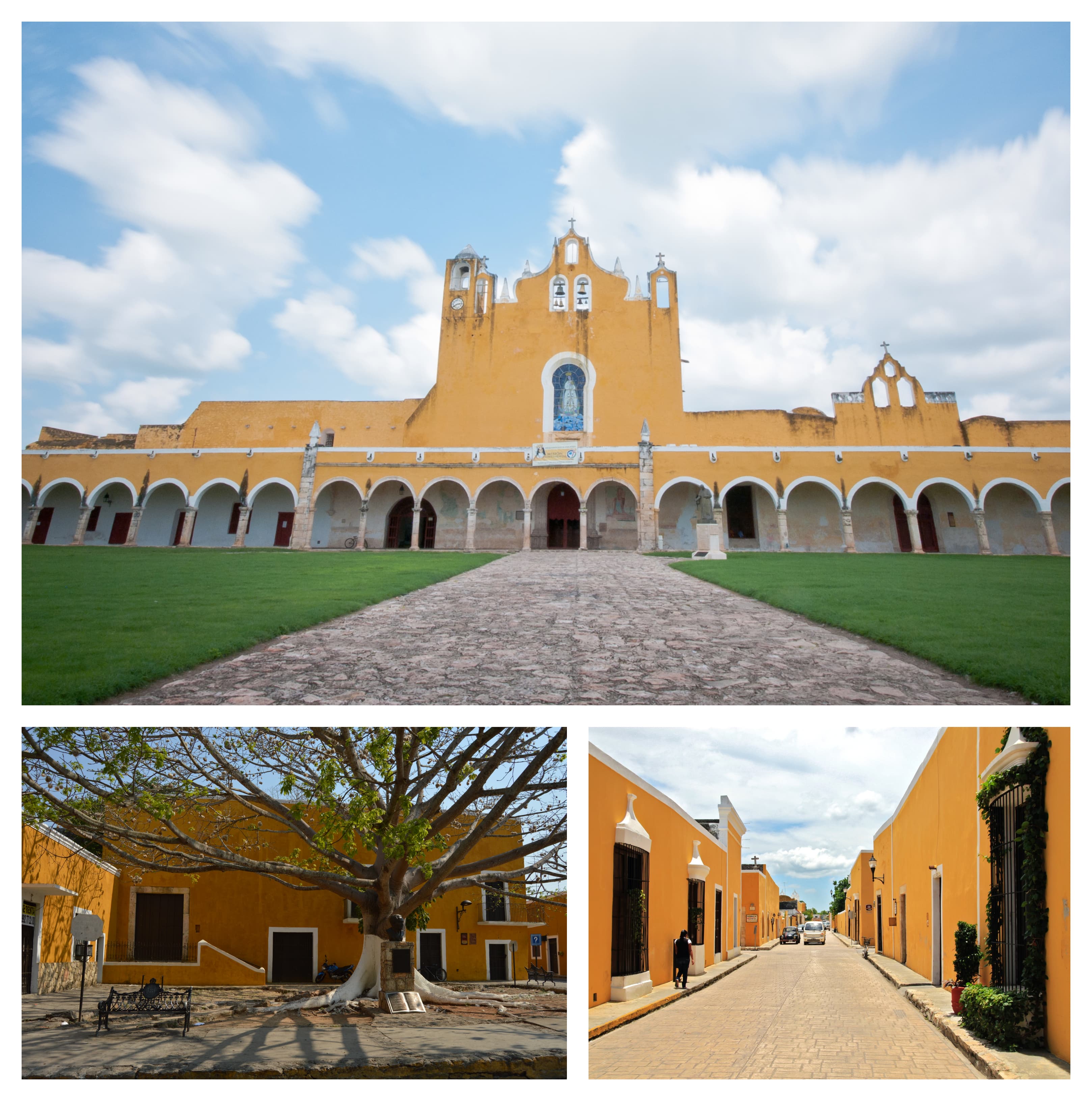
Collage of Izamal, Yucatan.. Image source · CC BY-SA 4.0
Visit essentials
A quick read before you go
- Duration
- 45 minutes to 2 hours for the monastery and atrium alone; a full day if combined with Izamal's…
- Access
- Located in the center of Izamal, Yucatán, roughly 70 km east of Mérida via paved highway.
Overview
The Monastery of San Antonio de Padua occupies an artificial hill at Izamal's center that began as Ppap-Hol-Chaak, a great Maya temple platform dedicated to the rain god Chaac; the town's name honors the creator god Itzamná. In the mid-16th century, Franciscan friars leveled the pyramid's upper levels and built their convent from its stones. Its vast atrium is said to rank second in size only to the one before St. Peter's Basilica in Rome.
Today this is both a living Catholic shrine, home to the widely venerated Virgin of Izamal, and a monument whose arcades reveal fragments of Maya relief: material memory of what stood here first.
Why this place is sacred
What makes this site distinct from most colonial churches is that its sacredness was not simply asserted alongside an existing tradition — it was built out of that tradition's physical remains. The Ppap-Hol-Chaak platform, one of several great pyramids that made Izamal a major pre-Hispanic ceremonial center, was partially dismantled so its cut stones could become the walls, foundations, and paving of the new monastery.
Visitors can still find blocks bearing mazelike Maya carving patterns worked into the arcades — stones that were shaped for one sacred purpose and repurposed, without being fully erased, for another. The elevated plaza on which the church and atrium sit is not a metaphorical continuation of the pyramid's height; it is, physically, what remains of the pyramid's summit.
This makes the monastery a rare case where colonial and indigenous sacred architecture are not adjacent but literally stacked, stone upon stone, within the same structure.
A Maya ceremonial platform (Ppap-Hol-Chaak) dedicated to the rain god Chaac, within Izamal's broader precinct associated with the creator deity Itzamná
Leveled and quarried by Franciscan friars beginning in the mid-16th century; rebuilt as a Catholic monastery and basilica completed in 1561; became home to a Marian devotion that grew into one of Yucatán's most significant pilgrimage traditions, visited by Pope John Paul II in 1993.
Experience and orientation
Arrival happens gradually. From the streets of Izamal — themselves painted the same warm yellow-ochre as the monastery — a sloping ramp lifts visitors up onto the old pyramid platform, and the scale of the atrium only becomes apparent once you are standing inside it: roughly 8,000 square meters enclosed by 75 arches, open to the sky, with the church itself set back at one end.
Walking the arcades that ring the plaza, it's worth slowing down to look at the stonework itself rather than only the architecture as a whole — some blocks, especially in less-restored sections, still show traces of the geometric relief carving that marks them as recycled material from the Maya temple beneath.
Inside the church, a small museum room holds memorabilia from the 1993 papal visit, a modest counterpoint to the devotional intensity of the altar where the Virgin of Izamal is enshrined. A sundial and painted 16th-century frescoes are also part of the walk through the atrium grounds.
Because the monastery remains a functioning parish, the atmosphere shifts with the liturgical calendar: on an ordinary weekday afternoon it can feel spacious and quiet, while during the December festival it fills with pilgrims, music, and procession.
Enter from Izamal's central square, climbing the ramped approach on the plaza's south side; the atrium is freely walkable at any hour the gates are open, with the church itself at the plaza's northern end.
Context and lineage
After the Spanish conquest of Izamal, Franciscan friars targeted the town's Ppap-Hol-Chaak pyramid — one of several massive platforms in a settlement long regarded as a major Maya ceremonial center tied to the creator god Itzamná. Sources place the initial dismantling and quarrying anywhere from 1533 to the late 1540s, with formal construction of the convent usually dated to 1553 under Fray Diego de Landa, guardian of the Izamal mission from 1552.
The basilica and atrium, built to a plan associated with Fray Juan de Mérida, were completed in 1561, built substantially by forced indigenous labor using the pyramid's own cut stones.
Around 1558, Landa arranged for twin Marian statues to be carved in Guatemala, one for Izamal and one for Mérida; soon after its installation in the new church, the Izamal statue began to be credited with healing miracles, and devotion to what became known as the Virgin of Izamal spread quickly across the peninsula.
Franciscan Order of Friars Minor, within the broader 16th-century Spanish evangelization of Yucatán; the monastery has functioned as an active Franciscan parish and Marian shrine continuously since its 1561 completion.
Traditions and practice
Historically, the Ppap-Hol-Chaak platform hosted Maya ceremonies associated with Chaac and the wider Itzamná cult; these practices ended with the Spanish conquest and construction of the monastery.
Daily Mass is celebrated in the basilica. Each December 7, a procession and midnight serenade ("Las Mañanitas") honor the Virgin, opening a novena and festival that runs December 8-12 and draws an estimated 8,000 pilgrims to Izamal. The Virgin is also credited in local tradition with historical interventions protecting Mérida from epidemics and locust plagues, a memory still invoked in devotional retellings.
Visitors who wish to participate respectfully can attend a regular Mass, light a candle at the Virgin's altar, or time a visit to the December festival to witness the procession and communal devotion firsthand rather than only viewing the architecture.
Roman Catholicism (Franciscan / Marian devotion)
ActiveHome to the statue of Our Lady of Izamal, proclaimed patroness of Yucatán and one of the most venerated Marian images in Mexico, credited in tradition with healing miracles and historical protection of Mérida from epidemic and locust plague.
Daily Mass; an annual novena and festival December 8-12 drawing roughly 8,000 pilgrims; a December 7 evening procession and midnight serenade to the Virgin.
Pre-Columbian Maya religion (historical)
HistoricalIzamal was a major pre-Hispanic ceremonial center associated with the creator deity Itzamná, with multiple large temple platforms including Ppap-Hol-Chaak, dedicated to the rain god Chaac, whose dismantled stones form the monastery's fabric.
Historical ceremonies to Itzamná and Chaac at the temple platforms, discontinued after the mid-16th-century conquest and construction of the monastery.
Perspectives and open questions
The monastery is read differently depending on the lens brought to it — as a monument to evangelization, as a living Marian shrine, or as a site of unresolved colonial rupture — and these readings coexist rather than resolve into one another.
Scholarly perspective
Historians and archaeologists treat the monastery's construction atop the Ppap-Hol-Chaak platform as a deliberate strategy of religious supersession, common among 16th-century Franciscans in Yucatán, intended to transfer indigenous sacred authority onto the new Catholic order by building directly over — and out of — existing holy ground.
Diego de Landa's role as both the monastery's founder and, a decade later, the man who ordered the 1562 burning of Maya codices and thousands of ritual objects at Maní, is widely discussed as a defining paradox of the early evangelization project: the same friar who destroyed most surviving Maya texts also authored the Relación de las cosas de Yucatán, one of the most valuable surviving ethnographic accounts of pre-conquest Maya culture.
Living and traditional perspectives
For Catholic devotees, the monastery's significance rests overwhelmingly in the Virgin of Izamal herself — her installation, her reported miracles protecting Mérida from epidemic and locust plague, and her standing as patroness of Yucatán, reaffirmed by Pope John Paul II's 1993 visit and coronation of her image.
Izamal's own civic identity, reflected in its UNESCO World Heritage tentative-list framing as a place of "Mayan continuity," holds that Maya heritage persists in local culture and craft even though the original temple was dismantled.
Open questions
The precise original form and full iconographic program of the Ppap-Hol-Chaak temple before its 16th-century dismantling is not fully documented, and is reconstructed only from early colonial accounts and the carved stone fragments visible in the monastery's arcades today.
Plan your visit
Access and arrival
Located in the center of Izamal, Yucatán, roughly 70 km east of Mérida via paved highway. Entry to the church and atrium is free, with donations welcome. Izamal's town center is walkable, and horse-drawn calesas are available for getting around. Mobile phone signal is generally reliable within the town itself.
Izamal offers a range of small hotels and guesthouses in the town center; availability tightens significantly during the December 8-12 festival, so advance booking is recommended for that period
Respectful visit
Modest dress is expected — shoulders and knees covered — as at any functioning Catholic church
Generally permitted in the atrium and church interior; avoid flash photography and refrain from photographing during Mass or other services
Small candles and monetary offerings at the Virgin's altar are customary; donations toward the church's upkeep are welcomed
Maintain quiet, respectful conduct during services; some interior spaces, such as the sacristy and the small papal-visit museum room, may have limited or separate access hours
The December festival period brings large crowds and limited accommodation in Izamal; travelers wanting a quiet architectural visit should consider other dates.
Location
Map loads as you approach this section.
Pilgrim reflections
A portrait of encounter, not a score
Pilgrims describe what they felt, how present they could become, and whether the place would shape a journey. There are no stars and no ranking of traditions.
No reviewed reflections yet
The first pilgrims can help describe the character of being here.
Share a reflection
Available after an account-backed “Been there.” Every reflection is reviewed before publication.
Nearby sacred places
Explore other sacred places in the region. Proximity does not establish access or travel time; check each place’s guidance.



References
Sources consulted for this page. Source categories describe the publication, not a guarantee that every claim is verified. Traditional accounts and outside interpretations may differ.
- 01Izamal — Wikipedia — Wikipedia contributorsacademicGeneral historical and geographic overview of Izamal and the monastery
- 02The Arrival of the Spanish Franciscans — Maya Ruins of Izamal — mayaruins.comacademicDetailed account of the conquest of Izamal, destruction of the Ppap-Hol-Chaak pyramid, and construction of the monastery from its stones
- 03Historical city of Izamal (Izamal, Mayan continuity in an Historical City) — UNESCO World Heritage CentreofficialIzamal is on Mexico's UNESCO World Heritage tentative list; documents the layered Maya-colonial urban significance
- 04Diego de Landa | Spanish Bishop & 16th Century Conquistador — Encyclopaedia BritannicaacademicBiography of Diego de Landa, guardian of the Izamal convent and later bishop of Yucatán; his role in both founding the monastery and destroying Maya codices
- 05Burning the Maya Books: The 1562 Tragedy at Maní — Popular ArchaeologyacademicContext on Diego de Landa's 1562 auto-da-fé and its relationship to his earlier work founding the Izamal monastery
- 06Convento de San Antonio de Padua — Lonely PlanetSource contextVisitor-facing description of the atrium, construction dates and architecture
- 07Our Lady of Izamal, the Virgin of the Immaculate Conception — Yucatán TodaySource contextHistory of the Marian statue, its miracles, and the annual December pilgrimage/festival
- 08Our Lady of Izamal — OnePeterFivespiritualCatholic devotional account of the Virgin of Izamal's history and miracle traditions
- 09Ruta de los conventos en Yucatán — Wikipedia (Spanish)academicDescribes the Ruta de los Conventos touring route through Yucatán's colonial Franciscan convents, including Izamal's role
- 10In Izamal, the Convento de San Antonio's Fading Glory — Yucatán MagazineSource contextContemporary reporting on the monastery's condition and conservation concerns
Photo gallery
3 curated photos
Share a photo
Help visitors recognize Monastery of San Antonio de Padua, Izamal. Every submission is reviewed before publication.