Archaeological Site of Mayapan
The last great Maya capital, where serpent pyramids still speak to those who arrive without crowds
Understand sacred places, explore living traditions, and learn how to engage respectfully with Pilgrim Map.
Access has not been verified. Check current local guidance before planning a visit.
Tecoh, Yucatán, Mexico
Read the sources
Visit essentials
A quick read before you go
- Duration
- One to two hours allows thorough exploration of the main structures, pyramid climb, and cenote.
- Access
- Mayapan lies in the municipality of Tecoh, Yucatan, approximately forty kilometers southeast of…
Overview
For over two hundred years, Mayapan was the Maya world's center. Unlike crowded Chichen Itza, it offers stillness in which to feel the place.
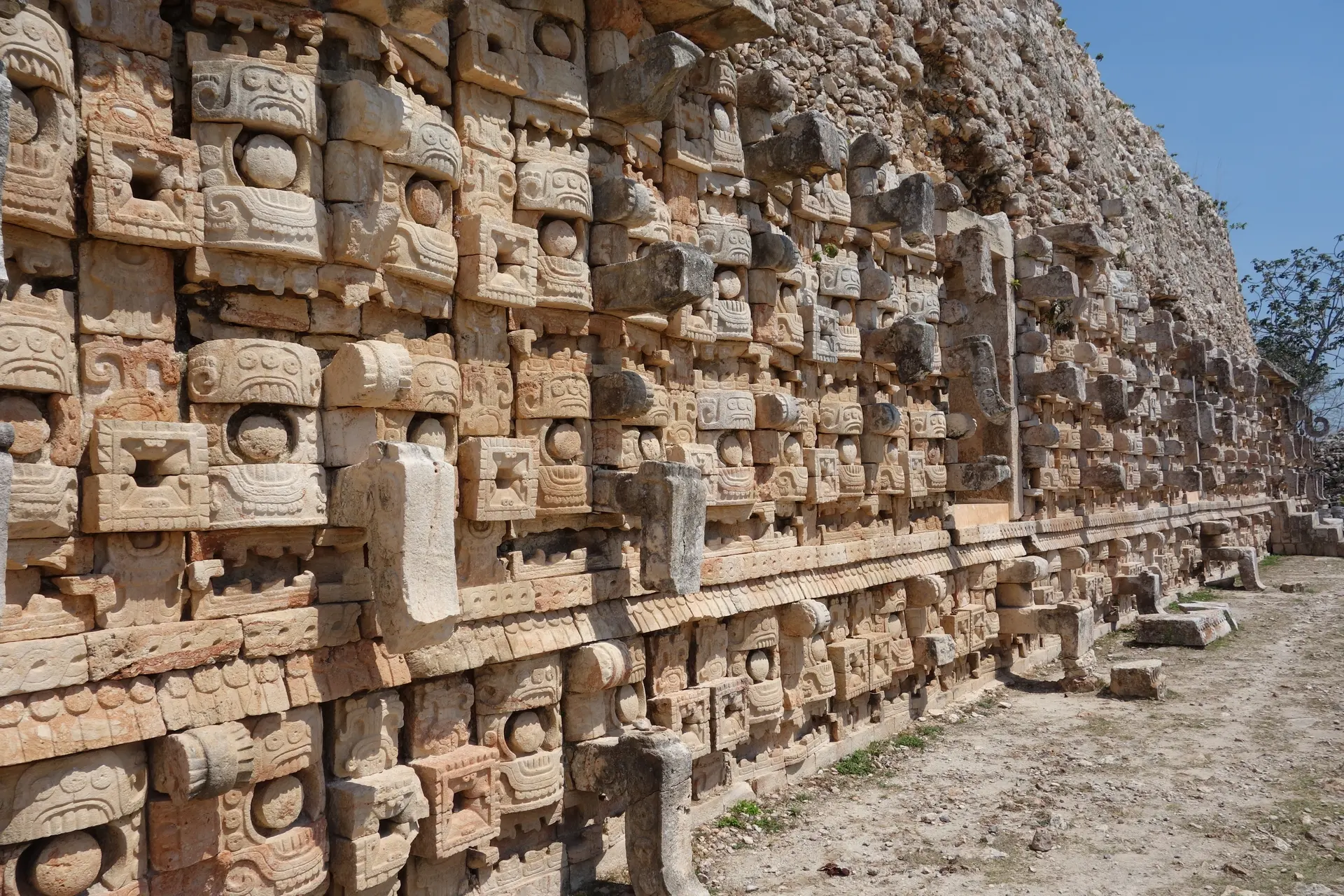
The Temple of Kukulcan deliberately replicates its famous counterpart on a smaller scale, perhaps with greater effect. Visitors may climb to where Maya priests once surveyed a city of fifteen thousand people governed through divine authority. At the pyramid's base, a cenote opens into darkness, the portal through which offerings reached Chaak, the rain god.
Mayapan's achievement and collapse share the same stones. Decades of drought and rivalry between the Cocom and Xiu lineages preceded violence in 1441, when the Cocom were massacred and the last great Maya capital burned. For contemporary Maya people, the site is not merely historical but the final expression of political unity before colonization, holding what was lost and what persists.
The cenote still opens to the underworld, the serpent deity coils through the stonework, and something built here outlasted abandonment.
Why this place is sacred
The Maya did not distinguish between political and sacred power. When they built Mayapan as their capital, they were not merely establishing an administrative center but recreating the cosmic order that Chichen Itza had embodied. The Temple of Kukulcan, with its nine terraces and four staircases, encodes the same astronomical and mythological mathematics as the original. During equinoxes, light and shadow create effects similar to the famous serpent descent, though with far fewer witnesses.
At the pyramid's base, the Ch'en Mul cenote opens into the earth. For the Maya, cenotes were not merely water sources but entrances to Xibalba, the underworld realm where gods and ancestors dwelled. The positioning of the temple directly above this portal was no accident. Whatever ceremonies took place here, they occurred at an intersection of earth and underworld, human and divine.
According to ethnohistorical sources, Kukulcan himself founded the city after Chichen Itza's decline. This divine founding gave Mayapan legitimacy that transcended any particular dynasty. The noble families who governed did so as stewards of a sacred trust, their authority derived from the Feathered Serpent's blessing.
The city's collapse adds another dimension to its power. Here, seekers encounter not only Maya achievement but Maya vulnerability, the drought and violence that ended what had seemed permanent. The preserved murals in the Hall of Frescoes include death cult imagery, reminders that the Maya engaged the full cycle of existence. Something of that engagement persists in the atmosphere of the place.
Mayapan served as the shared political and ceremonial capital of the northern Yucatan from the 1220s until 1441, governed jointly by the Cocom and Xiu noble lineages. The city's architecture was deliberately modeled on Chichen Itza, continuing that site's spiritual traditions while establishing new political arrangements.
The Temple of Kukulcan, the Observatory, and the cenote suggest the city maintained the astronomical and ritual calendar that ordered Maya life, while the Hall of Frescoes and other temples indicate ongoing ceremonial activity dedicated to multiple deities.
After the massacre of 1441, Mayapan was abandoned and the region fragmented into competing city-states. The Spanish who arrived in the following century never found the ruins. For nearly five hundred years, the forest claimed the city. Archaeological work began in 1939, with intensive excavation by the Carnegie Institution in the 1950s revealing the extent and importance of the site. Research continues today, uncovering new structures and murals that deepen understanding of post-classic Maya civilization.
The site's contemporary significance has grown as travelers seek alternatives to Chichen Itza's crowds. For those interested in Maya culture beyond the tourism spectacle, Mayapan offers authentic encounter. Indigenous Maya communities maintain connection to the site as part of their ancestral heritage, though specific contemporary ceremonial use is not extensively documented.
Experience and orientation
The first thing visitors notice is what is absent: the crowds, the vendors, the performance of tourism that now defines Chichen Itza. Mayapan allows something else to happen. You can stand at the pyramid's base in silence, taking in the scale of what the Maya built, before beginning to climb.
The ascent changes things. One hundred twenty steps is not merely physical exertion but a form of approach, each level bringing new perspective on the ruins below. At the summit, the sensation is one of arrival and overview, the ability to see as the Maya priests once saw: the city walls stretching into the jungle, the cenote opening at the pyramid's foot, the remains of thousands of structures fading into vegetation.
Many visitors describe the murals in the Hall of Frescoes as unexpectedly moving. These are not reconstructions but original pigments, reds and greens still visible after five centuries, depicting ceremonies and deities that remain partially mysterious. The Temple of the Fisherman's vibrant blue sea, surrounding its solitary figure, creates a sense of intimate encounter with an individual artist's vision.
The cenote invites contemplation of another kind. Birds now inhabit what was once the portal to Xibalba. The small square openings at the platform's base, through which rainwater once flowed into the depths, remain as evidence of the Maya's integration of architecture and cosmology. To sit near the cenote's edge, watching light and shadow shift across the water, is to engage something the Maya understood about the permeability of worlds.
Those who arrive at opening, before the few other visitors, report the strongest experiences: a sense of the site as living presence rather than archaeological artifact, as though the five hundred years of silence have preserved rather than depleted its power.
Mayapan rewards those who resist the urge to rush. The site's spread of four thousand structures across four square kilometers invites wandering rather than systematic coverage. Consider beginning at the Temple of Kukulcan and allowing the pyramid's height to orient you to the whole before exploring specific areas.
The cenote merits prolonged attention. Sitting near its edge, watching the birds that now make it home, allows reflection on what this opening once meant to the Maya, and on the persistence of sacred geography beyond its original context.
The murals in the Hall of Frescoes and Temple of the Fisherman should not be rushed. These are among the best-preserved Maya paintings, and their colors and imagery repay slow attention. Notice the death cult symbols in the Hall of Frescoes, the extraordinary blue sea of the Fisherman mural. These were not decoration but communication with powers the Maya considered real.
Context and lineage
According to ethnohistorical sources recorded by Diego de Landa in the 16th century, Mayapan was founded by Kukulcan, the Maya name for the Feathered Serpent deity. After Chichen Itza's power waned, Kukulcan convened the lords of the region and established a new capital. The nobles divided the towns of the Yucatan among themselves and chose the chief of the Cocom family as their leader.
This divine founding gave the city its legitimacy as a sacred center, and for over two centuries the arrangement held.
But the story ends in violence. By the 1350s, drought had gripped the region. Studies of cave deposits document decades of reduced rainfall, straining the agricultural base that supported the city's fifteen thousand inhabitants. The Cocom's authority, partly based on their ability to ensure rain through proper offerings to Chaak, weakened as the drought persisted. Tensions with the Xiu lineage, always present, intensified.
In 1441, Ah Xiu Xupan led a revolt. The Xiu massacred all members of the Cocom family except one, who happened to be trading in Honduras. The city was sacked, burned, and abandoned. The last unified Maya political authority ended. When the Spanish arrived less than a century later, they found a fragmented landscape of competing city-states, the memory of Mayapan's fall still fresh.
For over two centuries, Mayapan governed through a complex arrangement of noble families and sacred authority. The Cocom held primary power, supported by Canul mercenaries, with the Xiu as secondary rulers. This shared governance, rooted in Kukulcan's founding, maintained stability until environmental and political pressures became unbearable.
After the city's fall, the descendants of the Cocom and Xiu continued their rivalry into the colonial period, even allying with different Spanish factions. The sole Cocom survivor returned from Honduras to found a new settlement, keeping his lineage alive. Today, people bearing both names still live in the Yucatan, descendants of the families whose conflict shaped the region's history.
Archaeological attention to Mayapan developed slowly. Diego de Landa's 1566 account provided the first European documentation. Professional surveys began in 1939, with the Carnegie Institution's intensive excavation in the 1950s establishing the site's importance. Mexican and international collaboration continues, with new discoveries regularly emerging from the estimated six thousand structures that remain unexplored.
Kukulcan
deity
The Feathered Serpent deity, known elsewhere as Quetzalcoatl. According to tradition, Kukulcan founded Mayapan after the decline of Chichen Itza, establishing the city as the continuation of Maya sacred political authority.
Chaak
deity
The rain god, to whom offerings were made at the cenote. The prolonged drought that undermined Mayapan's stability was understood as a failure of reciprocal relationship with Chaak.
Cocom Dynasty
historical
The noble family that held primary power at Mayapan, ruling with the support of Canul mercenaries. Their massacre by the Xiu in 1441 ended the city.
Ah Xiu Xupan
historical
The Xiu leader who led the revolt against the Cocom in 1441, precipitating Mayapan's abandonment and the end of unified Maya political authority.
Traditions and practice
The Maya of Mayapan would have performed ceremonies aligned with their astronomical calendar, particularly at solstices, equinoxes, and significant Venus positions. Offerings at the cenote, addressed to Chaak, sought rain and maintained reciprocal relationship with the underworld. The Temple of Kukulcan likely hosted rituals honoring the Feathered Serpent, while the Observatory tracked celestial movements that determined ceremonial timing.
Political-religious governance was inseparable. The noble families administered sacred authority, their power legitimated by Kukulcan's founding act. Ceremonies would have reinforced this connection between human governance and divine order. The death cult imagery in the Hall of Frescoes suggests rituals engaging the full cycle of life and death, though specific practices remain a matter of scholarly inference.
While specific Maya ceremonies at Mayapan are not extensively documented, Maya shamans known as h'men continue traditional practices in Yucatan communities. The Ch'achaak rain ceremony, invoking Chaak's blessing, persists today. Mayapan's cenote retains its significance as a traditional portal to Xibalba, part of a sacred geography that contemporary Maya recognize.
The site hosts solstice and equinox events similar to those at Chichen Itza, but with far fewer visitors. The Temple of Kukulcan produces light-and-shadow phenomena that allow contemplative observation impossible at the crowded original.
For visitors seeking meaningful engagement rather than mere sightseeing, consider arriving at opening when few others are present. Climb the Temple of Kukulcan slowly, allowing the ascent to shift your attention from touring to pilgrimage.
At the pyramid's summit, take time to orient yourself. Notice the cenote below, the walls stretching into the jungle, the thousands of structures fading into vegetation. This was a city of fifteen thousand people, a civilization's final flowering.
At the cenote, sit in silence. Watch the birds that now inhabit what was once a portal to the underworld. Consider what the Maya understood about the permeability of worlds that we have forgotten.
The equinoxes and solstices offer opportunities to witness astronomical alignments as the Maya did, without Chichen Itza's massive crowds diminishing the experience.
Maya Religion and Cosmology
HistoricalMayapan was the political and spiritual center of Maya civilization in the Yucatan during the Late Post-Classic period. According to tradition, Kukulcan himself founded the city, establishing it as the continuation of sacred authority from Chichen Itza. The Temple of Kukulcan embodied this continuity, while the cenote served as a portal to Xibalba where offerings reached Chaak and other underworld powers.
Historical practices included pilgrimages and offerings at the cenote, astronomical observations aligned with the Maya calendar, ceremonies dedicated to Kukulcan and Chaak, and political-religious governance where noble families administered sacred authority. The specific rituals remain matters of scholarly inference, as no firsthand accounts survive.
Contemporary Maya Spirituality
ActiveContemporary Maya communities in the Yucatan maintain spiritual practices rooted in pre-Columbian traditions, though Catholic overlay since the Spanish conquest has created syncretic expressions. Mayapan represents ancestral heritage for today's Maya people, many of whom still speak Yucatec Maya. The h'men, traditional shamans, continue ceremonies that connect living practice to ancient tradition.
The Ch'achaak ceremony invokes rain during drought. Shamanic healing combines physical and spiritual dimensions. Agricultural rituals align with the Maya calendar. Pilgrimages to ancestral sites maintain connection across time. Offerings of copal incense, flowers, and traditional foods continue practices stretching back centuries.
Perspectives and open questions
Mayapan invites interpretation from multiple angles: archaeological, indigenous, and contemporary spiritual. Each offers genuine insight while illuminating different dimensions of what the site meant and means.
Scholarly perspective
Archaeologists recognize Mayapan as the last major Maya capital before Spanish contact, representing the continuation and transformation of Maya civilization into the post-classic period. The Carnegie Institution's excavation in the 1950s established the site's importance, and ongoing research continues to reveal new structures and murals.
Recent studies have linked the city's decline to prolonged drought, documented in cave deposits from 1350 to 1430. Climate stress appears to have exacerbated political tensions between the Cocom and Xiu lineages, culminating in the 1441 massacre. The site demonstrates both the sophistication of Maya civilization and its vulnerability to environmental pressure.
The deliberate replication of Chichen Itza's architecture, particularly the Temple of Kukulcan, indicates conscious continuity with earlier Maya traditions. The murals in the Hall of Frescoes show Central Mexican influence, suggesting cultural connections beyond the Yucatan peninsula.
Living and traditional perspectives
For contemporary Maya communities, Mayapan represents the last unified expression of Maya political authority before colonization. The site embodies both ancestral achievement and the loss that followed. The cenote retains spiritual significance as a portal to the underworld, part of a sacred geography that contemporary Maya recognize.
Maya people today continue to speak Yucatec Maya and practice traditions connecting them to sites like Mayapan. The h'men, traditional shamans, maintain ceremonies including the Ch'achaak rain ritual that invokes Chaak. The site's history resonates with ongoing struggles over land rights and cultural heritage management, as evidenced by disputes between local communities and INAH that have caused intermittent closures.
Alternative interpretations
Mayapan attracts visitors interested in Maya astronomical knowledge and the cosmological principles embedded in its architecture. The solstice and equinox phenomena, similar to Chichen Itza's famous serpent shadow, draw those seeking direct experience of Maya cosmic vision without tourist crowds.
Some visitors report feeling special energy at the site, particularly at the cenote and pyramid summit. The site's relative obscurity compared to Chichen Itza makes it appealing to those seeking authentic spiritual experience. While these interpretations are not endorsed by academic research, they represent genuine contemporary engagement with the site's power.
Open questions
Significant mysteries remain. What ceremonies and offerings were conducted at the cenote? What is the full meaning of the death cult imagery in the Hall of Frescoes? What was the exact sequence of events during the 1441 massacre and abandonment? What astronomical observations were made from the Observatory structure? What lies undiscovered in the unexplored portions of the site? How did the sole Cocom survivor in Honduras respond to the massacre of his family?
Plan your visit
Access and arrival
Mayapan lies in the municipality of Tecoh, Yucatan, approximately forty kilometers southeast of Merida along Highway 18, the Convent Route. By car from Merida, take Carretera Merida-Chetumal (Highway 184) then Highway 18, approximately forty minutes. ADO buses depart from Merida's Terminal de Autobuses Noreste with roughly hourly service, taking about ninety minutes. Do not confuse the archaeological zone with the separate village of Mayapan. Entry fee is approximately sixty-five Mexican pesos for foreign adults. Cash is recommended.
Merida, forty kilometers northwest, offers extensive lodging options at all price points. The site can be visited as a day trip from anywhere in the region. For those wishing to experience multiple Yucatan sites, Merida serves as an excellent base.
Respectful visit
Practical clothing for hot, humid tropical climate. Long pants recommended when sitting on stone structures. Sturdy shoes for pyramid climbing. Hat and sunglasses essential.
Personal photography permitted throughout. Care should be taken with murals, avoiding flash. Drones likely prohibited without INAH permit. Professional or commercial photography may require special permission.
Visitors should not make offerings at the cenote or other structures. If you observe offerings left by others, do not disturb them.
Stay on designated paths where indicated. Do not remove artifacts, stones, or vegetation. The site experiences intermittent closures due to land disputes; verify opening status before visiting. Sunday admission is free for Mexican nationals, bringing larger crowds.
Do not make offerings at the cenote or structures. The site is managed as an archaeological zone, and foreign objects are considered interference with preservation. If you encounter Maya individuals conducting personal observances, maintain respectful distance without photographing.
Be aware that the site has experienced intermittent closures due to land disputes between local communities and INAH. These tensions reflect ongoing struggles over heritage management and indigenous rights. Verify opening status before traveling.
Current practical details
Address
Carretera Mérida – Chetumal, Telchaquillo, 97824 Tecoh, Yuc., Mexico
Phone
Hours, fees, and access can change — verify on the official source before you travel. Practical details last checked Jun 2026.
Location
Map loads as you approach this section.
Pilgrim reflections
A portrait of encounter, not a score
Pilgrims describe what they felt, how present they could become, and whether the place would shape a journey. There are no stars and no ranking of traditions.
No reviewed reflections yet
The first pilgrims can help describe the character of being here.
Share a reflection
Available after an account-backed “Been there.” Every reflection is reviewed before publication.
Nearby sacred places
Explore other sacred places in the region. Proximity does not establish access or travel time; check each place’s guidance.


References
Sources consulted for this page. Source categories describe the publication, not a guarantee that every claim is verified. Traditional accounts and outside interpretations may differ.
- 01Revisiting Mayapan: Mexico's last Maya capital — Ancient Mesoamerica / Cambridge CoreacademicAcademic archaeological research publication
- 02Mayapan - Archaeological Zones — Yucatan.TravelofficialOfficial Yucatan tourism authority
- 03Rituals of the Modern Maya — Archaeology MagazineacademicAcademic documentation of contemporary Maya ceremonies
- 04Study: Collapse of Ancient Mayan Capital Linked to Drought — University at AlbanyacademicRecent academic research on Mayapan's collapse
- 05Mayapan — Wikipedia contributorsencyclopediaComprehensive historical overview with archaeological details
- 06League of Mayapan — Wikipedia contributorsencyclopediaHistorical context on political confederation
- 07Everything about Mayapan Archaeological Site — Mayan PeninsulaSource contextDetailed visitor guide with archaeological context
- 08Mayapan — The Mayan Ruins WebsiteSource contextDetailed archaeological site documentation
- 09A smaller version of Chichen Itza — TripAdvisorguideVisitor review comparing to Chichen Itza
- 10Mayapan: The Last of the Great Mayan Cities — Sailingstone TravelguideVisitor guide with cenote and observatory details
- 11Mayapan Archaeological Zone: Chichen Itza without the crowds — The Travelling LindfieldsguidePersonal travel blog with practical visitor information
- 12Mayapan ruins info price and much more to know — Mexico Cenotes and RuinsguidePractical visitor information and archaeological context
Share a photo
Help visitors recognize Archaeological Site of Mayapan. Every submission is reviewed before publication.