Museum of the Mayan Village at Dzibilchaltun
Where the sun rises through a temple doorway twice a year, marking equinoxes for three thousand years
Understand sacred places, explore living traditions, and learn how to engage respectfully with Pilgrim Map.
Access has not been verified. Check current local guidance before planning a visit.
Mérida, Yucatán, Mexico
Read the sources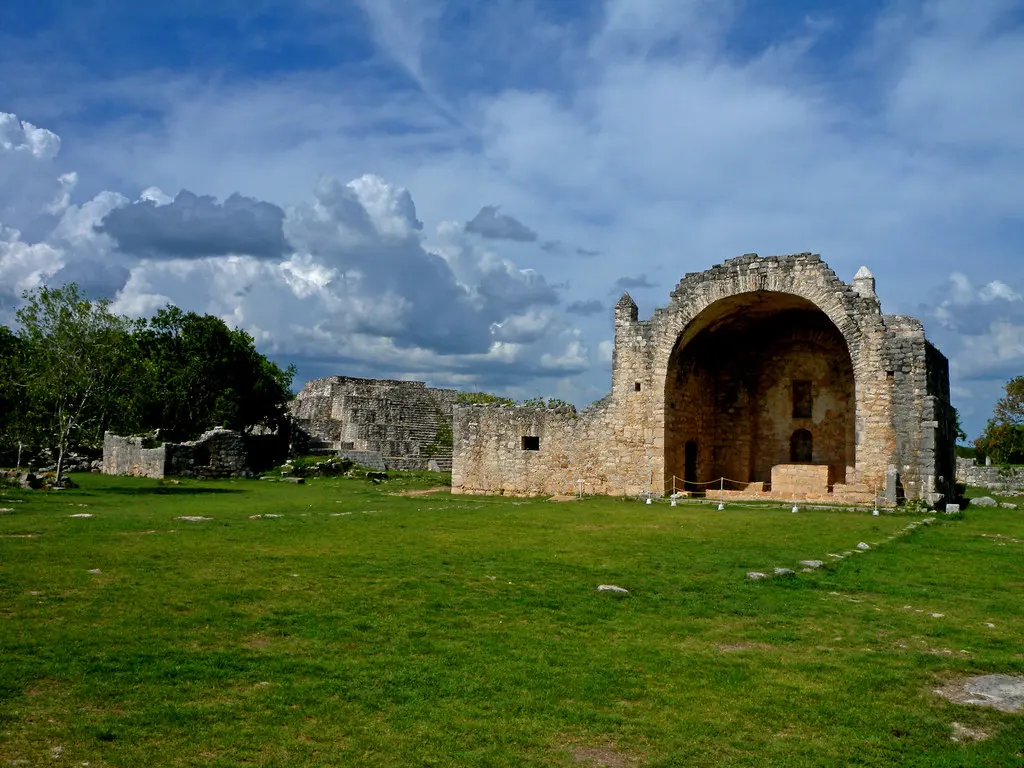
Image of Museum of the Mayan Village at Dzibilchaltun. Image source
Visit essentials
A quick read before you go
- Duration
- 2-3 hours for complete visit including museum, archaeological zone, sacbe walk, and cenote swim.
- Etiquette
- Approach as a site of profound astronomical and cultural achievement.
Overview
Sixteen kilometers north of Merida on the Yucatan Peninsula, the Maya built the Temple of the Seven Dolls to receive equinox sunrise through its doors. Named for seven effigies excavated there in the 1950s, it stands at the end of a 425-meter processional causeway (sacbe).
Dzibilchaltun was inhabited from perhaps 1500 BCE until the Spanish Conquest. At its peak, perhaps 40,000 people occupied 19 square kilometers containing more than 8,400 identified structures. Cenote Xlakah beside the main plaza supplied freshwater, and visitors can still swim there. A sixteenth-century Spanish church rises among the pre-Columbian foundations, layering colonial presence onto Maya ceremonial space.
The Museo del Pueblo Maya presents Maya history and culture, while a reconstructed traditional village demonstrates hurricane-resistant building with natural materials and strategic placement.
Why this place is sacred
At the spring and autumn equinoxes, dawn passes through the Temple of the Seven Dolls, briefly centering in an alignment achieved through accumulated Maya observation and the determination to mark cosmic events in stone. Xlakah adds both sustenance and cosmology: it was the city's water source, while cenotes were understood as entrances to Xibalba, the underworld. Swimming there now enters that accumulated practical and sacred meaning.
The seven buried effigies indicate ritual purpose, but their precise role remains unresolved: they may have been offerings, calendrical markers, or decommissioned objects whose power required burial. The Spanish church adds a colonial layer to the Maya precinct, marking the same place through a different religious claim. Across roughly three millennia, generations watched the equinox, drew from the cenote, and walked the sacbe; their sustained attention is the continuity visitors encounter today.
Dzibilchaltun served as major administrative and ceremonial center for over three thousand years, with the Temple of the Seven Dolls functioning as astronomical observatory marking the equinoxes.
Inhabited from approximately 1500 BCE to the Spanish Conquest. Rediscovered by modern archaeology in the 1950s. Now a protected National Ecological Park with the equinox alignment drawing thousands of visitors twice yearly.
Experience and orientation
Begin at the Museo del Pueblo Maya, whose approximately 700 pieces span stone monuments, statues, artifacts, the conquest of the Mayans, and the Caste War of 1847 to 1901. Then follow the 425-meter sacbe from the main plaza toward the Temple of the Seven Dolls, allowing the raised ceremonial causeway to mark the transition from daily space to sacred destination.
The square temple rises on a pyramid base with a short roof tower and cardinal orientation. On March 20 or September 23, arrive before dawn: the ticket office opens at 4:30 AM for sunrise at 6:00 AM, and arrival by 5:30 helps secure a position. Watch the light enter the eastern door and leave through the western, confirming the Maya calculation. Outside equinox, stand within the doorways and imagine that passage of light.
At cenote Xlakah beside the plaza, bring a swimsuit if you wish to enter the freshwater pool that sustained Maya life and also carried cosmological meaning. Continue to the sixteenth-century Spanish church within the Maya precinct, then visit the reconstructed traditional village to see natural materials and strategic placement that make its buildings hurricane-resistant.
Located 16 km (30 minutes) north of Merida via Highway 261. The Temple of the Seven Dolls lies at the end of a 425-meter sacbe from the main plaza. Cenote Xlakah is beside the main plaza. Museum near the entrance.
Context and lineage
The settlement that would become Dzibilchaltun began perhaps as early as 1500 BCE, exploiting the sea salt flats along the nearby coast. Salt was a major Maya trade commodity—the flats are still commercially worked today—and the settlement's location provided access to this valuable resource.
Over centuries, the village grew into a city. By its peak, perhaps 40,000 inhabitants occupied 19 square kilometers, with over 8,400 structures identified by modern archaeology. The cenote Xlakah provided the fresh water that the limestone peninsula's surface does not naturally offer. The community flourished.
The Temple of the Seven Dolls was built during this flourishing, its orientation calculated to capture equinox sunrise. When archaeologists excavated the temple from beneath a later pyramid in the 1950s, they found seven small effigies—dolls—buried within, giving the structure its modern name. The temple's solar alignment demonstrates Maya astronomical sophistication: precise observation encoded in architecture that still functions as intended.
The name Dzibilchaltun—'the place where there is writing on the stones'—refers to the commemorative stelae that the Maya carved throughout the site. These inscriptions, only decipherable since the 1960s, document what the stones were built to record: ceremonial events, dynastic succession, the calendar calculations that governed Maya life.
The Spanish who arrived in the sixteenth century built a church within the Maya precinct, layering colonial presence on pre-Columbian foundation. The site had not been abandoned; it still mattered. The Spanish claimed what they found significant.
Modern recognition came in the 1950s when systematic archaeological investigation began. The site is now protected as both archaeological zone and National Ecological Park, the equinox alignment drawing thousands of visitors on March 20 and September 23 to witness what the Maya calculated millennia ago.
Maya civilization from approximately 1500 BCE through Spanish Conquest. Colonial-era church construction within the precinct. Modern archaeological protection since the 1950s.
Maya builders and astronomers (unnamed)
Created the Temple of the Seven Dolls
Traditions and practice
Equinox observation ceremonies, stelae dedication, cenote-related rituals (cenotes as entrances to underworld), ceremonial use of the sacbe processional causeway.
Equinox gatherings (March 20, September 23) when thousands witness the sunrise alignment. Museum education programs. Swimming in cenote Xlakah. Traditional Maya village demonstrations.
Visit during equinox if possible—arrive by 5:30 AM for 6:00 AM sunrise (ticket office opens 4:30 AM). Outside equinox, walk the sacbe imagining processional use, swim in the cenote, and let the museum create historical context.
Maya Civilization / Astronomical Observation
HistoricalThe Temple of the Seven Dolls demonstrates Maya astronomical sophistication, with equinox alignment that continues functioning after three thousand years.
Equinox observation ceremonies, stelae dedication, cenote rituals, processional use of the sacbe.
Perspectives and open questions
Dzibilchaltun can be understood as astronomical achievement, as three-thousand-year-old continuously inhabited settlement, as National Ecological Park, or as place where Maya understanding of celestial mechanics remains demonstrably true.
Scholarly perspective
Archaeoastronomers study the Temple of the Seven Dolls as example of Maya astronomical precision. Archaeologists document the site's three-millennium habitation history. Historians analyze the colonial church's placement within Maya precinct.
Living and traditional perspectives
For contemporary Maya communities, Dzibilchaltun represents ancestral achievement. The equinox alignment demonstrates that their ancestors understood what modern science confirms.
Alternative interpretations
Some visitors experience the equinox sunrise as spiritually significant regardless of scholarly framework—the simple fact of ancient prediction confirmed by contemporary observation creating its own meaning.
Open questions
The specific purposes of the seven dolls remain debated. The full extent of ritual activity at the site is not documented. The precise understanding the Maya held of their astronomical calculations cannot be fully recovered.
Plan your visit
Access and arrival
Full services in Merida. No accommodations at the site.
Respectful visit
Comfortable walking shoes. Swimsuit for cenote. Sun protection essential.
Photography permitted throughout. Tripods may require permission.
Contemporary offerings not part of the site's practice. Entrance fees support preservation.
Stay on designated paths. Do not climb on structures. Respect museum guidelines.
Equinox tickets sell out quickly—book well in advance. Bring swimsuit for cenote (required swimming cap may be available for purchase). Protect against sun exposure.
Current practical details
Address
Mérida Municipality, 97302 Yucatan, Mexico
Hours
Hours, fees, and access can change — verify on the official source before you travel. Practical details last checked Jun 2026.
Location
Map loads as you approach this section.
Pilgrim reflections
A portrait of encounter, not a score
Pilgrims describe what they felt, how present they could become, and whether the place would shape a journey. There are no stars and no ranking of traditions.
No reviewed reflections yet
The first pilgrims can help describe the character of being here.
Share a reflection
Available after an account-backed “Been there.” Every reflection is reviewed before publication.
Nearby sacred places
Explore other sacred places in the region. Proximity does not establish access or travel time; check each place’s guidance.



References
Sources consulted for this page. Source categories describe the publication, not a guarantee that every claim is verified. Traditional accounts and outside interpretations may differ.
- 01Dzibilchaltun - WikipediaSource context
- 02Dzibilchaltun - The Mayan Ruins WebsiteSource context
- 03Museum of the Mayan People - YucatanSource context
- 04Temple of the Seven Dolls - Mayan PeninsulaSource context
- 05Dzibilchaltun - History HitSource context
- 06All About Dzibilchaltun - Casa LoltunSource context
Photo gallery
3 curated photos
Share a photo
Help visitors recognize Museum of the Mayan Village at Dzibilchaltun. Every submission is reviewed before publication.