Malinalco Archaeological Zone
A mountain-cut Mexica sanctuary of serpents, eagles, ocelots, and solar renewal
Understand sacred places, explore living traditions, and learn how to engage respectfully with Pilgrim Map.
Access has not been verified. Check current local guidance before planning a visit.
Malinalco, State of Mexico, Mexico
Read the sources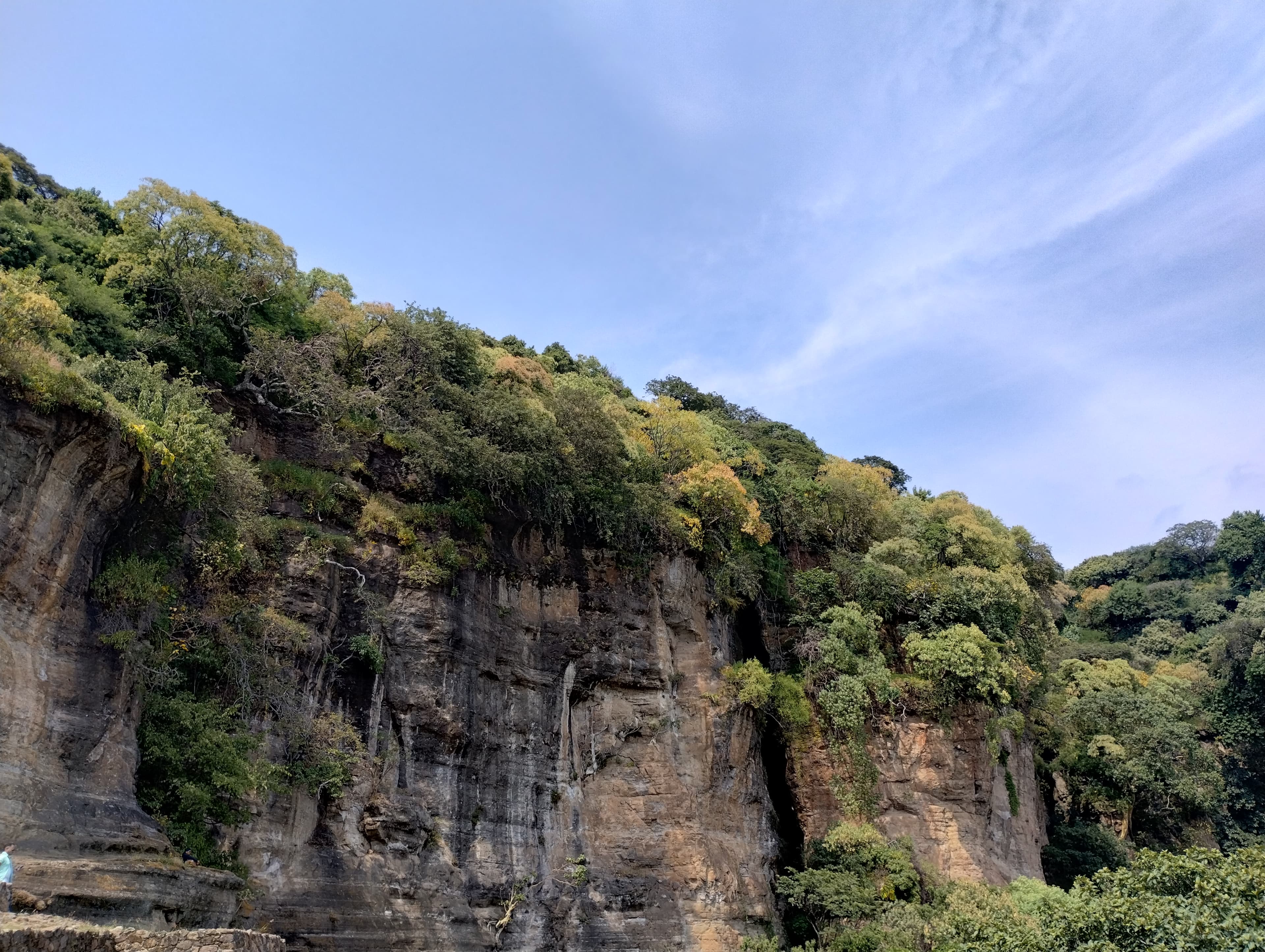
Rock-cut ceremonial buildings at Malinalco Archaeological Zone in the State of Mexico. Image source · CC BY-SA 4.0
Visit essentials
A quick read before you go
- Duration
- Plan a half-day rather than treating the zone as a quick photo stop.
- Access
- Use the official INAH entrance at Calle Amajac s/n, Barrio Santa Mónica, 52440 Malinalco.
Overview
Halfway up Cerro de los Ídolos, architecture and mountain become one. The Cuauhcalli—Temple I in the Cuauhtinchan complex—was cut from living rock. A forked serpent tongue forms its threshold; sculpted eagles and an ocelot occupy the interior, while INAH relates a central eagle and nearby cavity to ritual blood offerings. The imagery presents a carefully ordered sacred setting, not merely a fortified lookout.
INAH identifies the wider zone as a Matlazinca city brought under Mexica control around 1476, when it served strategic, ceremonial, and military purposes. The leading interpretation associates Cuauhcalli with consecrating elite eagle and ocelot warriors and a sacred political order intertwining warfare, offerings, agriculture, and renewal of the sun. An INAH interpretive essay calls the detailed initiation sequence a hypothesis: the surviving forms support a powerful ritual reading but preserve no complete ceremonial script.
This record covers the entire Malinalco Archaeological Zone. Cuauhtinchan is its best-preserved architectural complex, and Cuauhcalli its principal monolithic temple. The modern town of Malinalco and Sanctuary of the Lord of Chalma are separate places.
Why this place is sacred
The serpent doorway of the Cuauhcalli changes the act of entering. A carved tongue leads through open jaws into a circular interior populated by eagle and ocelot forms. INAH interprets these animals within Mexica military and sacred symbolism. The central eagle and associated cavity have been connected with the offering of blood, described in the official interpretation as nourishment for the gods. The building therefore materializes a relationship among human rank, warfare, sacrifice, sacred authority, and cosmic continuity.
That interpretation does not make every detail certain. INAH's essay on the site's solar meaning treats the proposed sequence of fasting, combat, bodily piercing, adornment, and promotion as a hypothesis. The architecture and sculpture are evidence; the exact choreography of initiation is a scholarly reconstruction. Naming this boundary respects both the power of the material record and the limits of what it can say.
Malinalco's identity also begins before the principal Mexica monuments. INAH describes a Matlazinca city with earlier occupation and regional connections before Mexica conquest around 1476. The later garrison and ceremonial complex did not erase that history. A responsible account therefore avoids presenting the site as if its story began when Mexica rulers transformed the hillside.
Today the original ceremonies are not documented as continuing unchanged at the archaeological zone. Sacred significance survives through the protected place, its imagery, Indigenous history, public interpretation, and the ethical responsibility to conserve it. Respectful engagement does not require claiming spiritual authority or reenacting rites for which no community mandate has been established.
A strategic and ceremonial center associated with Mexica military organization, divine obligation, offerings, and elite-warrior consecration, built within an older Matlazinca place.
After the Spanish campaign against Malinalco in 1521, the ceremonial complex ceased to function under its original political order. Explorations began in the early twentieth century, followed by systematic INAH archaeology, reconstruction, conservation, and public interpretation.
Experience and orientation
Approach the zone as a protected archaeological sanctuary. The climb is part of the physical experience, but it should not be romanticized as a recreated initiation. Weather, exposed steps, altitude above the valley, and conservation work can affect access. Pause at the official interpretation rather than using the sculptures as props or treating their sacred associations as entertainment.
At the Cuauhcalli, observe how the threshold directs movement. The serpent mouth is not applied decoration: it frames entry into the rock-cut chamber. Inside, the arrangement of the animals and circular bench creates a ceremonial geometry. The central eagle and offering cavity are especially sensitive features. Their meaning is best encountered through the custodial interpretation, without touching, climbing, inserting objects, or staging photographs that imitate sacrifice.
The valley view explains the site's strategic placement, yet surveillance is only one layer. INAH also emphasizes agricultural deities, military-religious gatherings, elite status, and solar renewal. Holding these layers together prevents the landscape from becoming merely scenic and the sanctuary from becoming merely martial. The most respectful visit leaves room for uncertainty and for the site's Matlazinca history before Mexica rule.
Follow the INAH entrance and marked ascent from Calle Amajac in Barrio Santa Mónica; treat Cuauhtinchan as a complex within the zone and Cuauhcalli as its principal rock-cut temple.
Context and lineage
Human occupation in the Malinalco region reaches earlier than the visible Mexica complex. INAH notes earlier settlement and ceramic evidence of Teotihuacan influence, followed by regional exchange with Tierra Caliente and the central highlands. After Mexica conquest around 1476, the hillside was developed as a strategic and ceremonial center.
The Cuauhcalli was carved at the beginning of the sixteenth century. Its serpent entrance, eagle and ocelot sculptures, circular interior, and offering cavities distinguish it from the surrounding masonry structures. INAH connects the room with meetings and ceremonies involving elite warriors. A separate INAH interpretation proposes a detailed process of fasting, ritual combat, bodily piercing, adornment, and elevation in rank, but explicitly frames that sequence as a hypothesis.
The conquest of 1521 ended the political and sacred system that produced the complex. Early modern exploration of the archaeological zone began in 1905, with further work in 1925 and systematic INAH investigations later. Conservation remains central because carved rock, stucco, reconstructed fabric, drainage, weather, and visitor pressure all affect the monuments. A peer-reviewed UNAM study documents deterioration and conservation measures, while INAH continues to interpret the ascent and the site's biocultural setting.
The place holds layered Matlazinca, regional, and Mexica histories. The surviving ceremonial complex belongs most directly to late Mexica sacred and political culture, while its stewardship today belongs to INAH and the public responsibilities of archaeological conservation.
Ahuítzotl
Mexica ruler under whose government INAH dates the beginning of the principal rock-cut monument.
Moctezuma Xocoyotzin
Mexica ruler associated by INAH interpretation with continued work at the complex.
José García Payón
Archaeologist whose investigations helped establish the modern study of Malinalco.
Traditions and practice
Historical practices may have included fasting, ritual combat, bodily piercing, adornment marking military rank, offerings of blood, and ceremonies linking warriors to the renewal of the sun. These elements should be stated as INAH's archaeological interpretation, with the detailed sequence explicitly marked as hypothetical.
The contemporary practice appropriate to a general visitor is attentive learning under INAH guidance: reading the site's interpretation, respecting its Indigenous histories, and supporting conservation. Public access does not authorize private ceremonies, offerings, smoke, performance, or occupation of the monuments.
Move quietly, study the spatial relation among threshold, animals, bench, and offering cavities, and reflect on how sacred authority and state power were joined. Let custodial interpretation guide the encounter rather than projecting an invented ritual onto the site.
Mexica ceremonial tradition
ActiveThe principal sanctuary is interpreted through Mexica relationships among divine obligation, warfare, agriculture, blood offering, elite status, and solar renewal.
Matlazinca and regional pre-Mexica history
ActiveThe place was a Matlazinca city before Mexica conquest and holds older occupation and exchange histories that prevent the site from being narrated as exclusively Mexica from its beginning.
Perspectives and open questions
Malinalco invites several readings at once: a Matlazinca place with earlier regional histories, a Mexica strategic center, a sanctuary of embodied political theology, a rare rock-cut monument, and a fragile archaeological site. These perspectives reinforce one another when their evidence and limits remain visible.
Scholarly perspective
Archaeology supports a late Mexica ceremonial-military interpretation for the Cuauhtinchan complex and recognizes the Cuauhcalli as an exceptional rock-cut building. Sculpture, spatial arrangement, offering cavities, historical accounts, and comparison with Mexica institutions inform the initiation interpretation. The detailed ritual sequence remains a hypothesis rather than a transcript preserved by the stones. Conservation research adds another scholarly lens: the monument's meaning cannot be separated from the physical processes that threaten its survival.
Living and traditional perspectives
INAH's interpretation places the sanctuary within Mexica relationships among warfare, rank, sacrifice, agriculture, divine sustenance, and the renewal of the sun. Eagle, ocelot, and serpent imagery carried more than decorative value. They organized a sacred-political world in which leadership and cosmic responsibility were joined. This entry reports that historical tradition without claiming authority to revive it.
Alternative interpretations
Modern claims about energy portals, secret initiations available to tourists, or direct continuity with undocumented ceremonies are not supported by the reviewed evidence and are not presented as fact.
Open questions
The exact dedication of every structure, the complete choreography of ceremonies, competing translations of Cuauhcalli, and the relationship between the name Malinalco and specific ancient worship remain open or qualified. Responsible interpretation keeps those limits present.
Plan your visit
Access and arrival
Use the official INAH entrance at Calle Amajac s/n, Barrio Santa Mónica, 52440 Malinalco. | Difficulty: A sustained outdoor ascent with many steps; conditions and access assistance should be confirmed directly with INAH. | Time to summit: Varies by pace, weather, rest stops, and current route conditions.
Malinalco town has visitor services. Confirm transportation and lodging independently; no commercial recommendation is implied.
Respectful visit
Wear clothing and footwear suitable for an exposed archaeological ascent. Modesty is less important than safety, sun and rain protection, and avoiding garments or equipment that could snag against protected fabric.
Ordinary personal photography is subject to current INAH and posted site rules. | Professional equipment may require an additional fee or authorization. Do not cross barriers or stage sacrificial or pseudo-ritual scenes.
Archaeological cavities are interpreted in relation to ancient offerings. | Do not place coins, flowers, liquids, incense, or any other object in the monuments.
INAH guidance prohibits smoking, food, and pets and may close areas for conservation. Posted instructions and staff direction take precedence over this entry.
Do not imitate sacrifice, initiate participants, enter closed areas, touch carvings, place objects in cavities, burn incense, or conduct a ceremony without explicit authorization. Avoid reducing Mexica religion to violence or warrior imagery alone.
Current practical details
Address
Amajac s/n, Barrio Santa Monica, 52440 Malinalco, Méx., México
Phone
Hours
Hours, fees, and access can change — verify on the official source before you travel. Practical details last checked Aug 2026.
Location
Map loads as you approach this section.
Pilgrim reflections
A portrait of encounter, not a score
Pilgrims describe what they felt, how present they could become, and whether the place would shape a journey. There are no stars and no ranking of traditions.
No reviewed reflections yet
The first pilgrims can help describe the character of being here.
Share a reflection
Available after an account-backed “Been there.” Every reflection is reviewed before publication.
Nearby sacred places
Explore other sacred places in the region. Proximity does not establish access or travel time; check each place’s guidance.

Sanctuary of the Lord of Chalma
Chalma, Mexico, Mexico
7.7 km away
Archaeological Zone Tepozteco
Tepoztlan, Morelos, Mexico
42.6 km away
Basilica of Our Lady of Remedies, Naucalpan de Juarez
Naucalpan de Juárez, Mexico, Mexico
63.9 km away
Mexico City Metropolitan Cathedral
Mexico City, Mexico City, Mexico
66.1 km away
References
Sources consulted for this page. Source categories describe the publication, not a guarantee that every claim is verified. Traditional accounts and outside interpretations may differ.
- 01Zona Arqueológica de Malinalco — Instituto Nacional de Antropología e HistoriaofficialOfficial identity, address, access route, ceremonial and military character, Cuauhcalli description, and current public schedule. Updated 6 January 2026.
- 02Malinalco — Lugares INAH, Instituto Nacional de Antropología e HistoriaofficialDetailed official interpretation of the whole site and its principal structures, including the Cuauhtinchan complex, Cuauhcalli, Tzinacalli, sculptures, offerings, and archaeological investigations.
- 03Lugar del eterno renacimiento del Sol — Lugares INAH, Instituto Nacional de Antropología e HistoriaofficialINAH interpretive essay framing the detailed elite-warrior initiation sequence as a hypothesis and linking the monument to Mexica solar renewal ideology.
- 04La Zona Arqueológica de Malinalco estrena sendero interpretativo para divulgar su patrimonio biocultural — Instituto Nacional de Antropología e Historiaofficial2024 custodial update on the interpretive ascent, local biocultural context, ceremonial instruments, site height above the valley, and official visitor information.
- 05Informe del deterioro y propuesta para la conservación de la zona arqueológica de Malinalco, Estado de México — Luis Alejandrino Torres Montes, Dolores Álvarez Gasca, Manuel Reyes, and José Hernández RiveroacademicPeer-reviewed conservation study documenting deterioration of the site's construction materials and measures intended to inhibit further loss.
- 06Zonas Arqueológicas abiertas al público — Instituto Nacional de Antropología e HistoriaofficialOfficial open-data confirmation that Malinalco is an archaeological zone open to the public under Centro INAH Estado de México.
- 07Zona Arqueológica Malinalco, estado de México — Bague-solacademicExact-site photograph made on 1 October 2023 and released by its creator under CC BY-SA 4.0.
- 08Archeological site of Malinalco (Q21503942) — Wikidata contributorsacademicStructured identity and coordinates used only as corroboration, not as the authority for cultural interpretation.
Share a photo
Help visitors recognize Malinalco Archaeological Zone. Every submission is reviewed before publication.