Sanctuary of the Lord of Chalma
Where the Smoking Mirror became a Black Christ, and pilgrims still dance around the ancient cypress
Understand sacred places, explore living traditions, and learn how to engage respectfully with Pilgrim Map.
Access has not been verified. Check current local guidance before planning a visit.
Chalma, Mexico, Mexico
Read the sources
Image of Sanctuary of the Lord of Chalma. Image source · CC-BY-SA-3.0
Visit essentials
A quick read before you go
- Duration
- Half day minimum; full day recommended for complete pilgrimage experience.
- Etiquette
- Approach Chalma as pilgrims approach it: with humility, willingness to participate in…
Overview
Chalma's mountain valley was sacred before its church. The cave held Oxtoteotl, an aspect of Tezcatlipoca—the Smoking Mirror, god of night and change—and its spring waters served purification before Christianity called them holy.
Augustinian tradition says that around 1537 two friars came to destroy the idol but found it already shattered, with a crucified Black Christ where Oxtoteotl had stood. The cave became Christian, while pilgrims continued older paths and practices. They bathe in the spring, weave flower-crown offerings, dance around the ancient ahuehuete, a Mexican cypress whose roots drank these waters when Tezcatlipoca still received worship, and process to the sanctuary along a pre-Christian route.
The rhythm and crowns are not European or Spanish.
The dark Christ, made light for procession from cornstalk paste, echoes the deity he replaced. His apparition cave remains the territory's original pilgrimage site. An eighteenth-century fire destroyed the first image; a replacement modeled on its charred remains carried devotion forward.
Over two million annual visitors make Chalma second only to the Basilica of Guadalupe. Whole villages arrive on designated days, bless local saints, and change the mayordomo organizing next year's journey. Paintings, photographs, locks of hair, and milagros testify to answered prayers, kept promises, and transformation.
This is folk Catholicism lived by pilgrims rather than decreed by bishops, bringing what they need to a power understood as responsive and incorporating rather than erasing the past: the ahuehuete stands, the spring flows, and the Christ remains black.
Why this place is sacred
The threshold at Chalma opens where transformation becomes visible. This is not a site that replaced what came before; it is a site that incorporates what came before, making the old new while keeping the new old.
The cave tells this story most directly. Oxtoteotl—the Smoking Mirror's night aspect—received worship here for centuries before Augustinians arrived. Caves in Mesoamerican cosmology served as entrances to the underworld, places of emergence and return. When the Black Christ appeared in this cave, he assumed not just the idol's location but its function: he became the power who meets seekers at the threshold between worlds.
The spring extends the thinness. Pilgrims have bathed in these waters for longer than written record. The Aztecs who preceded Christianity came here for purification before ceremony. Today's pilgrims continue the practice, immersing themselves, emerging renewed, weaving flower crowns to carry into the sanctuary. The water has not changed. The need for cleansing has not changed. Only the name of what cleanses has shifted.
The ahuehuete tree embodies accumulated time. This ancient cypress has witnessed everything: pre-Christian worship, the idol's fall, the Black Christ's reign, the fire that consumed and the reconstruction that followed. Pilgrims dance around it, their movements neither European nor purely indigenous but something evolved through centuries of contact. The tree does not judge the dance's origins; it witnesses.
The sanctuary walls document petition and response. Ex-votos crowd every surface—paintings showing accidents survived, illnesses cured, children found. Hair cut in gratitude hangs in bundles. Photographs of the healed stand beside the obviously impoverished: Chalma draws those who have nowhere else to turn. The Christ who answers is the same power that Tezcatlipoca exercised: the power to change what seems fixed, to transform suffering into survival.
What makes Chalma thin is this honesty about what it is. The pilgrimage is explicitly described by those who make it as 'Catholic but also indigenous.' The practices are deliberately syncretic. The power that answers prayers here draws on multiple traditions precisely because limiting it to one would reduce what it can do. The membrane is thin because so many have passed through for so long, seeking the same transformation that the site itself embodies.
The cave served worship of Oxtoteotl, an aspect of Tezcatlipoca, god of night and transformation. The spring provided ritual purification. Both predated Christianity by centuries.
After the reported miracle of 1539-1540, Augustinian friars established Christian devotion. The image remained in the cave until 1683, when it was transferred to a purpose-built sanctuary. Fire destroyed the original in the 18th century; the current image derives from those remains. The site draws over 2 million pilgrims annually.
Experience and orientation
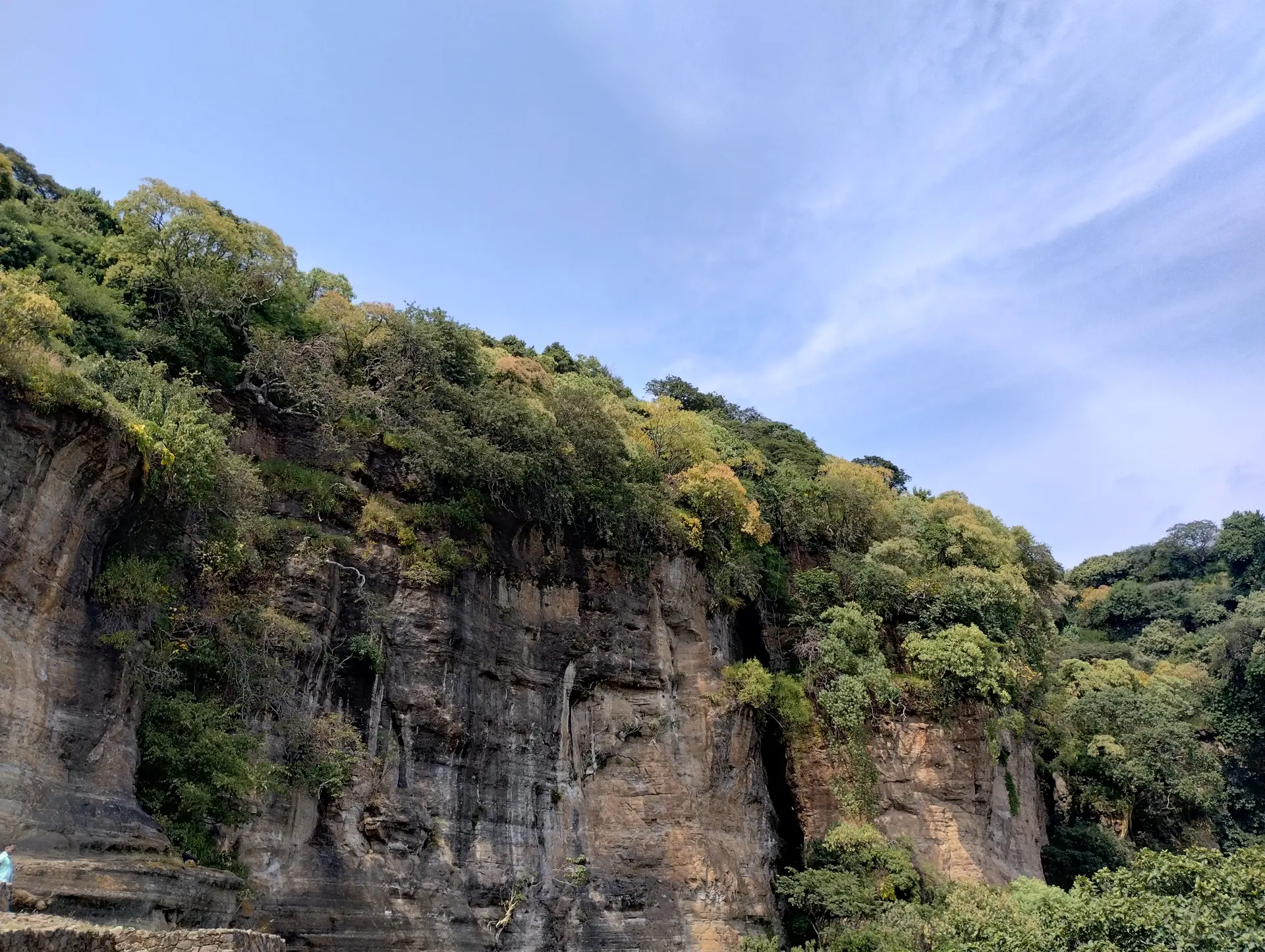
The approach matters. Whether you walk the traditional paths from Malinalco or arrive by vehicle, you enter Chalma through landscape that announces sacred destination. The valley cradles the sanctuary; mountains stand witness; the air shifts as you approach concentrated devotion.
If this is your first pilgrimage—your first visit to Chalma—tradition requires a flower crown. Weave it yourself or purchase one from the vendors who understand this need. The crown marks you as first-timer, as someone making initial approach to a power who notices such things.
Find the sacred spring near the ancient ahuehuete. The same waters that purified pagan ancestors await you. This is not symbolic immersion; this is actual bathing in waters that have not stopped being sacred since before memory. Emerge renewed. The crown you wear carries new meaning.
The ahuehuete itself demands attention. This Mexican cypress has witnessed centuries of transformation, its roots drinking the sacred waters, its branches offering shade to generation after generation of seekers. Many pilgrims dance around it, movements that echo pre-Christian practice while serving Christian devotion. Let the dancing teach you what it is: joy in reaching sacred space, gratitude for journey completed, preparation for what the sanctuary holds.
Enter the sanctuary. The baroque church sits in its valley like something grown rather than built. Inside, walls covered with ex-votos tell stories of desperation answered: accidents survived, illnesses cured, children found, jobs obtained, migrations completed. Let these testimonies accumulate. Understand what people bring here and what they take away.
Approach the Black Christ. Many pilgrims cross the nave on their knees, physical discomfort making offering of the approach itself. The Christ's protruded foot invites the kiss that completes pilgrimage. Touch what thousands have touched. Receive what two million seekers annually receive: presence, response, the power that transformation requires.
Before leaving, tradition requires removing your flower crown. Pass it through your body in a specific ritual movement—the gesture leaves your worries in the Christ's keeping. You arrived crowned; you leave crowned with something different: the assurance that you have been received.
Located approximately 25 km west of Cuernavaca in Malinalco municipality, Estado de Mexico. The spring and ahuehuete tree precede sanctuary entry. A 0.7-mile trail from Malinalco provides traditional walking approach.
Context and lineage
Before the Augustinians arrived, the cave at Chalma sheltered Oxtoteotl—the Smoking Mirror's night face, an aspect of Tezcatlipoca governing darkness and transformation. Pilgrims came to this cave seeking what Tezcatlipoca offered: the power to change, to cross between states, to move through the darkness that precedes dawn.
Around 1537, two Augustinian friars arrived with the intention of destroying the idol. What happened next depends on who tells the story. The Augustinian version: upon reaching the cave, they found Oxtoteotl already shattered and a figure of crucified black Christ standing in its place. The indigenous version suggests more complex negotiation between powers.
What followed was transformation of a different kind. The cave became Christian pilgrimage destination. The spring that had served purification continued serving it under new auspices. The paths that led ancestors to Tezcatlipoca led their descendants to Christ. For 143 years, the Black Christ remained in his cave, accepting the devotion that had always flowed to this place.
In 1683, the image was transferred to a newly built sanctuary under royal Spanish patronage: El Convento Real y Sanctuaria de Nuestro Senor Jesus Christo y San Miguel de los Cuevas de Chalma. The elaborate name spoke to colonial power's need to claim what pilgrims already knew was powerful. The original Christ was destroyed by fire in the 18th century; today's image was modeled on the remains, maintaining continuity through transformation.
Over two million pilgrims now arrive annually, making Chalma second only to Guadalupe in Mexican devotion. They come as their ancestors came: in community, walking traditional paths, bathing in sacred waters, dancing around the tree that has witnessed everything. The practices are explicitly syncretic—acknowledged by pilgrims themselves as 'Catholic but also indigenous.' Chalma does not hide what it is. It transforms it.
Augustinian foundation, later diocesan administration. The mayordomo system organizes village pilgrimages through cargo responsibilities passed annually.
The Augustinian Friars
Missionaries (c. 1537)
Oxtoteotl / Tezcatlipoca
Pre-Christian deity
Traditions and practice
Pre-Christian practices included walking narrow paths to the cave, bathing in the sacred spring for purification, and ceremonies honoring Tezcatlipoca's night aspect.
First-time pilgrims wear flower crowns removed through specific body-passing ritual. Spring bathing continues. Dancing around the ahuehuete persists. Knee-walking approach to the altar and kissing the Christ's foot complete pilgrimage. Ex-votos document miracles. Mass pilgrimages occur on the first Friday of Lent, Holy Week, Pentecost, and July 1st (feast day). Community pilgrimages follow traditional village schedules.
If possible, walk at least part of your approach. Bathe in the sacred spring. Wear a flower crown if this is your first visit. Let the dancing teach you joy. Approach the altar with whatever humility you can muster. Leave something of yourself—even attention is offering.
Mexican Folk Catholicism / Syncretic Pilgrimage
ActiveChalma represents the most explicitly syncretic major pilgrimage in Mexico, where pre-Hispanic and Catholic practices coexist openly and are acknowledged as complementary by practitioners.
Flower crown wearing, sacred spring bathing, ahuehuete dancing, knee-walking approach, foot kissing, ex-voto offerings, community pilgrimage with mayordomo organization.
Perspectives and open questions
Chalma can be understood as triumph of Christian evangelization, as indigenous spiritual resistance through transformation, as living laboratory of religious syncretism, or as evidence that sacred sites persist regardless of who claims them.
Scholarly perspective
Anthropologists study Chalma as primary example of religious syncretism in Mexico, where pre-Hispanic practices persist under Christian forms. The continuity of spring bathing, flower crowns, and dance demonstrates how indigenous populations maintained their practices by adapting them.
Living and traditional perspectives
For the faithful, Chalma's power transcends historical analysis. The Black Christ heals. The spring purifies. The pilgrimage transforms. Questions of origin matter less than demonstrated efficacy.
Alternative interpretations
Some see in Chalma evidence that sacred sites possess inherent power that survives changes of religious regime. The cave was sacred before Christ; it remains sacred after. Perhaps something in the place itself responds to human need.
Open questions
The full circumstances of Oxtoteotl's replacement by the Black Christ remain legendarily rather than historically documented. The specific mechanisms by which pre-Christian practices were incorporated into Catholic pilgrimage are not fully recorded.
Plan your visit
Access and arrival
Limited accommodations in Chalma village. Full services in nearby Malinalco and Cuernavaca.
Respectful visit
Practical clothing for walking and possible spring bathing. Many pilgrims dress festively for the celebration aspect of completed pilgrimage.
Respect the devotion of others. Do not photograph pilgrims in vulnerable moments without permission. The sanctuary itself is generally photographable.
Candles, milagros (metal charms representing petitions), ex-votos (paintings or photographs documenting answered prayers), and flower crowns are traditional. Cash donations support the sanctuary.
Respect the practices of community pilgrimages. Do not mock or trivialize syncretic elements. The faith here is serious.
Major pilgrimage days draw up to 50,000 people. Plan accordingly for crowds on weekends and feast days. The syncretic practices may surprise visitors expecting conventional Catholic devotion.
Current practical details
Address
Independencia S/N, 52460 Chalma, Méx., Mexico
Phone
Hours
Hours, fees, and access can change — verify on the official source before you travel. Practical details last checked Jun 2026.
Location
Map loads as you approach this section.
Pilgrim reflections
A portrait of encounter, not a score
Pilgrims describe what they felt, how present they could become, and whether the place would shape a journey. There are no stars and no ranking of traditions.
No reviewed reflections yet
The first pilgrims can help describe the character of being here.
Share a reflection
Available after an account-backed “Been there.” Every reflection is reviewed before publication.
Nearby sacred places
Explore other sacred places in the region. Proximity does not establish access or travel time; check each place’s guidance.


References
Sources consulted for this page. Source categories describe the publication, not a guarantee that every claim is verified. Traditional accounts and outside interpretations may differ.
- 01Chalma, Malinalco - WikipediaSource context
- 02Chalma - World Pilgrimage GuideSource context
- 03The Black Christ of Chalma - Mexico UnexplainedSource context
- 04Mexico's Second-Biggest Pilgrimage Site - Mexico News DailySource context
- 05The Magic of Chalma - MexConnectSource context
- 06Santuario del Señor de Chalma - Visit MexicoSource context
Share a photo
Help visitors recognize Sanctuary of the Lord of Chalma. Every submission is reviewed before publication.