Knocknarea megalthic site, Sligo, Ireland
The unexcavated cairn of a warrior queen crowns a mountain that has drawn seekers for over five thousand years
Understand sacred places, explore living traditions, and learn how to engage respectfully with Pilgrim Map.
Access has not been verified. Check current local guidance before planning a visit.
County Sligo, Sligo, Ireland
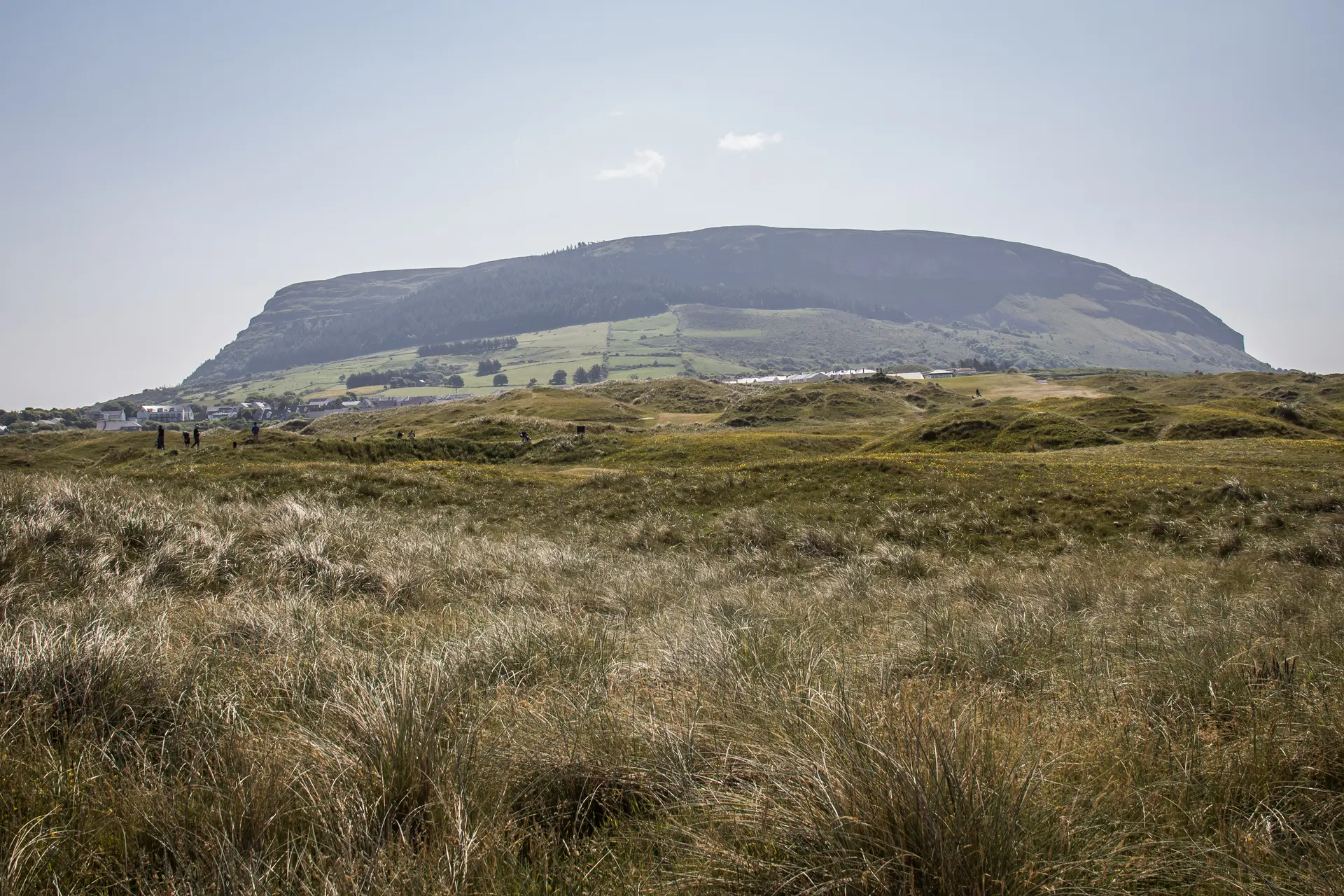
Image of Knocknarea megalthic site, Sligo, Ireland. Image source · CC-BY-SA-4.0
Visit essentials
A quick read before you go
- Duration
- Allow 2 to 3 hours for the return hike (approximately 6 km) plus time at the summit.
- Access
- The main trailhead is at the Queen Maeve Trail car park near Strandhill, approximately 8 km west…
Overview
A folk tradition of uncertain but possibly ancient origin tells walkers to carry a base stone to Knocknarea's summit cairn, briefly joining the labor begun five thousand years ago. The mountain rises 327 meters above the Sligo coast. Its unopened cairn—approximately 55 meters wide, 10 meters high, and 30,000 tons—is Ireland's largest outside the Boyne Valley; whether it contains a Newgrange-like passage tomb, cremations, megalithic art, or something unexpected remains a great archaeological unknown.
Tradition calls it Queen Medb of Connacht's grave. The Ulster Cycle's sexually sovereign warrior queen launched the Tain Bo Cuailnge and is said to stand buried upright, armored and facing Ulster enemies. Her name means 'she who intoxicates'; scholars read her as a euhemerized sovereignty goddess whose symbolic union legitimated Connacht kings.
University of Galway's Knocknarea Archaeological Project records seven passage graves, over thirty huts, two and a half kilometers of walls, two quarries, and twenty-seven caves, evidence of sustained Neolithic settlement and ceremony. Carrowmore lies south and Carrowkeel southeast, with astronomical alignments joining all three across the Sligo lowlands. The strenuous, marked rocky ascent takes an hour to an hour and a half; carrying and placing the stone, hard breathing, and the changed ocean-and-mountain perspective embody ascent's cost.
Why this place is sacred
The summit of Knocknarea offers a 360-degree panorama that encompasses the Atlantic Ocean, Lough Gill, Ben Bulben, the Ox Mountains, and the Bricklieve Mountains. On clear days, the views approach the cinematic. But the effect of the summit goes beyond scenery. Something about the combination of height, exposure, the wind off the Atlantic, and the presence of the massive cairn at your feet produces a shift in register that visitors consistently describe as both physical and psychological.
The cairn itself is the primary source of the site's power. It has never been excavated. In an era when most significant Neolithic monuments have been opened, catalogued, and interpreted, the cairn on Knocknarea retains its opacity. Whatever the builders placed inside, whatever the internal architecture looks like, whatever bones or artifacts or art the stone holds, remains a secret the mountain keeps. Some attribute this to respect for the monument's status as a burial site.
Others, half-seriously, invoke the fear of Medb's wrath.
The astronomical alignments documented by Martin Byrne and others connect Knocknarea to the broader Sligo ritual landscape. The winter solstice sunrise is visible from the cairn over the ridge of Moytura, a site associated with mythological battles. The equinox alignment from Carns Hill across to Knocknarea links the mountain to other cairn sites in a network of sightlines that the Neolithic builders appear to have deliberately established.
The mountain was not chosen at random; it was positioned, both geographically and cosmologically, as a focal point.
The stone-carrying tradition transforms visitors from observers into participants. Picking up a stone at the base and carrying it to the summit is a simple physical act, but it recapitulates the original cairn-building process. Each visitor adds to the accumulation. Each stone represents an individual intention, carried uphill and surrendered at the top. The tradition may be ancient or relatively modern; its power does not depend on its provenance but on its enactment.
The name itself carries resonance. Among the various proposed etymologies, 'Hill of the Moon' (Cnoc na Re) suggests celestial associations that complement the solar alignments. Whether this reflects an actual lunar significance or a later folk interpretation, the name places the mountain in relationship to the sky.
The summit cairn was built by Neolithic farming communities as part of the Irish passage tomb tradition, with connections to Brittany. The cairn almost certainly covers a passage tomb comparable in type to those at Carrowmore and Carrowkeel, though confirmation awaits excavation. The extensive settlement remains on the mountain, including hut foundations and walls, suggest that Knocknarea served as both a ceremonial center and a habitation site, challenging the assumption that passage tomb mountains were used only for ritual.
The original Neolithic significance was overlaid by Iron Age mythology when the cairn became associated with Queen Medb and the stories of the Ulster Cycle. This mythological reinterpretation, while historically disconnected from the cairn's actual builders by millennia, gave the mountain a new narrative power that has persisted into the present. The stone-carrying folk tradition maintains a form of active engagement with the cairn that may echo the communal labor of the original builders.
Today, the mountain serves as a hiking destination, a site of archaeological research, a location for modern pagan ceremony, and a place of cultural pilgrimage.
Experience and orientation
The Queen Maeve Trail begins at a car park near Strandhill, and the first decision presents itself immediately: choose your stone. Something you can carry comfortably for an hour of uphill walking. Not too large, not too small. A stone that represents something, even if you cannot articulate what.
The lower trail passes through woodland and open farmland, gaining elevation gradually. The mountain's flat summit is visible above, the cairn distinguishable as a grey mass against the sky. As the trail steepens and the surface becomes rockier, the effort increases and conversation tends to fall away. The ascent sorts itself into rhythm: breath, step, stone in hand.
The final approach to the summit is the most demanding, picking a path through limestone and heather. And then the ground levels, the cairn rises before you, and the world opens in every direction.
The panorama is extraordinary. To the west, the Atlantic stretches to the horizon. To the north, Ben Bulben's distinctive profile stands against the sky. To the south, Carrowmore's megalithic cemetery spreads across the lowland. To the east, the limestone plateau of the Bricklieve Mountains holds the passage tombs of Carrowkeel. You are standing at the center of a ritual landscape that the Neolithic builders designed to be experienced from exactly this point.
The cairn itself is massive, its scale difficult to appreciate from photographs. Thirty thousand tons of stone, piled by human hands, never opened. Some visitors sit quietly beside it. Others walk a slow circuit. The stone-carrying tradition brings you to its edge, where you add your stone to the accumulation. The act is surprisingly moving. You have carried weight uphill for an hour, and now you set it down.
Many visitors report a strong sense of presence at the cairn. Whether this reflects the landscape's psychological impact, the accumulated weight of five thousand years of human attention, or something that resists conventional explanation, the pattern is consistent enough to take seriously.
Choose your stone at the trailhead with intention. Carry it in your hand rather than your pocket; feel its weight throughout the ascent. When the trail steepens and your breathing deepens, let the effort become the practice. At the summit, walk a full circuit of the cairn before placing your stone. Sit facing north, the direction Medb faces, and take in the landscape she guards. Do not climb on the cairn. Do not remove stones.
You are a guest at the burial place of a queen and the threshold of a civilization.
Context and lineage
In Irish mythology, Queen Medb of Connacht is the fierce warrior queen who launched the Tain Bo Cuailnge, the great cattle raid against Ulster, seeking the brown bull of Cooley to match her husband Ailill's white bull and thereby demonstrate her equality. She took lovers as she chose, required that any king of Connacht submit to symbolic union with her to claim sovereignty, and ruled with a force that the stories never domesticate or apologize for.
She is said to be buried upright in the great cairn on Knocknarea, facing north toward Ulster, still at war in death as in life. The cairn has never been opened, and the tradition holds that this is at least partly because people fear what they might find, or unleash.
Scholars understand Medb as a euhemerized sovereignty goddess, her name meaning 'she who intoxicates,' cognate with 'mead.' Her many sexual partners and her requirement that kings mate with her before ruling are consistent with the sovereignty goddess pattern found across Celtic mythology. The cairn that bears her name predates the Iron Age stories by at least two thousand years, but the layering of mythology upon Neolithic reality created something more powerful than either alone.
The Neolithic builders chose Knocknarea for reasons that archaeology has begun to illuminate. The University of Galway's Knocknarea Archaeological Project documented extensive settlement evidence on the mountain, suggesting it was not merely a burial site but a living center of ceremonial and domestic activity over centuries.
The lineage of Knocknarea runs from Neolithic passage tomb builders who arrived from Brittany around 4200 BC, through the Celtic mythologists who gave the cairn its association with Medb, through the folk tradition of stone-carrying that maintains active engagement, to the modern hikers and seekers who continue to ascend the mountain seeking what seekers have always sought at sacred summits: perspective, encounter, transformation.
Queen Medb (Maeve)
mythological
Warrior queen and sovereignty goddess of Connacht, whose name means 'she who intoxicates.' Said to be buried upright in the cairn, facing her enemies in Ulster. Her mythology embodies female sovereignty, sexual agency, and the inseparability of political and sacred power.
Stefan Bergh
historical
Archaeologist at the University of Galway who has led the Knocknarea Archaeological Project since the late 1990s, documenting the extensive Neolithic settlement, passage graves, and landscape features on the mountain.
Martin Byrne
historical
Researcher who documented the astronomical alignments connecting Knocknarea to Carrowmore, Carns Hill, and Carrowkeel, revealing the deliberate sightline network that the Neolithic builders established across the Sligo landscape.
W.B. Yeats
historical
The Nobel Prize-winning poet who lived in the Sligo landscape and drew deeply on its mythology. His poem 'The Wanderings of Oisin' and other works gave literary form to the sacred landscape of Knocknarea and the surrounding Sligo countryside.
Traditions and practice
The Neolithic builders constructed the cairn through communal labor, quarrying and carrying approximately 30,000 tons of stone to the summit over an extended period. This collective act of construction was almost certainly ritualized, with the cairn-building itself functioning as ceremony. The passage tomb tradition involved cremation burials, ritual deposits, and astronomical alignments connecting the tomb to solar and lunar events.
In the Celtic period, Knocknarea was venerated as a site associated with the sovereignty goddess Medb. The Celtic festivals of Samhain (November 1), Bealtaine (May 1), Lughnasa (August 1), and Imbolc (February 1) were celebrated at prominent sacred sites across the Celtic world, and Knocknarea may well have been among them.
The ascent begins at the Queen Maeve Trail car park. Choose a stone near the trailhead and carry it with you. The stone does not need to be large; it needs to be present in your hand for the duration of the climb. Some walkers choose their stone deliberately, looking for a particular shape or weight. Others take the first one that comes to hand. Both approaches serve.
The trail takes most walkers between one and two hours to ascend. The lower section is gentle, the upper section steep and rocky. Allow the physical effort to occupy your attention. The climb works best when you stop trying to see the summit and simply walk.
At the top, walk a slow circuit of the cairn. Notice its scale. Thirty thousand tons of stone, placed here by human effort, never opened, still guarding whatever lies within. Place your stone at the edge of the cairn. The accumulation of visitors' stones around the base is itself a monument, a contemporary continuation of the building tradition.
Some visitors sit quietly at the cairn for an extended period, particularly those who have come with a specific intention or question. The summit is exposed and can be cold, but the panorama and the presence of the cairn reward those who stay.
Modern pagan and neo-Celtic practitioners hold ceremonies at the cairn, particularly around the cross-quarter days (Samhain, Imbolc, Bealtaine, Lughnasa). These ceremonies are informal and visitor-organized rather than institutionally scheduled.
The winter solstice (approximately December 21) offers the opportunity to watch the solstice sunrise over the ridge of Moytura from the cairn, connecting to the astronomical alignments the Neolithic builders established. Arrive well before sunrise and dress for extreme cold and wind at the exposed summit. The equinoxes (March and September) are significant for the alignment from Carns Hill across to Knocknarea.
Samhain (November 1) is the Celtic new year and carries particular mythological resonance at a site associated with the threshold between worlds.
Neolithic Passage Tomb Culture
HistoricalKnocknarea is part of the Sligo passage tomb complex, one of the four major concentrations of passage tombs in Ireland. The summit cairn is the largest in the country outside the Boyne Valley. The Neolithic settlement on the mountain, with its hut foundations, walls, and quarries, suggests a site of sustained ceremonial and residential activity over centuries.
Passage tomb construction, cremation burial, ritual deposits, and astronomical observation. The cairn-building itself was almost certainly a ritualized act of communal labor. The settlement evidence suggests domestic and ceremonial activity beyond burial alone.
Celtic Mythology / Sovereignty Goddess Tradition
HistoricalThe cairn is associated with Queen Medb of Connacht, understood by scholars as a euhemerized sovereignty goddess. Her name means 'she who intoxicates,' and her mythology embodies the inseparability of sovereignty, sexuality, and sacred power in the Celtic worldview. She is said to be buried upright, facing her enemies, making the cairn a site of enduring mythological authority.
Medb's association with sovereignty meant that a king could only rule Connacht through symbolic union with her. The cairn became a focal point for the stories of the Ulster Cycle, particularly the Tain Bo Cuailnge. The tradition of not excavating the cairn has effectively protected it for five millennia.
Irish Folk Tradition / Stone-Carrying
ActiveA living folk tradition holds that visitors should carry a stone from the base of the mountain to the summit and place it on or near the cairn. This is said to bring good luck, while removing a stone brings misfortune. The practice may echo the original Neolithic cairn-building as communal ritual.
Pick up a stone near the start of the Queen Maeve Trail. Carry it to the summit. Place it on or near the cairn. Do not remove stones. The tradition is participatory, requiring no instruction beyond the basic action, and its simplicity is part of its power.
Archaeological Research
ActiveThe University of Galway's Knocknarea Archaeological Project has been documenting the mountain's extensive Neolithic remains since the late 1990s, revealing a far more complex site than the cairn alone suggests. This ongoing research represents an active tradition of inquiry and knowledge production.
Archaeological survey, mapping of passage graves and settlement remains, documentation of astronomical alignments, and comparative analysis with other sites in the Sligo passage tomb complex. The cairn itself remains unexcavated.
Perspectives and open questions
Knocknarea holds multiple interpretations without resolution: the archaeological evidence of Neolithic settlement and burial, the Celtic mythology of Queen Medb, the living folk tradition of stone-carrying, and the experiential power of the summit itself. Each perspective illuminates the mountain differently, and the cairn's unexcavated state ensures that no interpretation can claim final authority.
Scholarly perspective
Archaeologists recognize Knocknarea as a major Neolithic ritual and settlement center. The University of Galway's Knocknarea Archaeological Project, led by Stefan Bergh since the late 1990s, documented seven passage graves, over thirty hut foundations, two and a half kilometers of walls, two quarries, and twenty-seven caves on the mountain.
The cairn is estimated at 55 meters wide and 10 meters high, containing approximately 30,000 tons of stone, and is believed to cover an unexcavated passage tomb dating to approximately 3000 to 3500 BC. The mountain was part of a broader ritual landscape with astronomical alignments to Carrowmore, Carns Hill, and Carrowkeel. The Queen Medb association is understood as mythological rather than historical, as the cairn predates the Iron Age setting of the Ulster Cycle by millennia.
Living and traditional perspectives
In Irish oral tradition, Queen Medb is buried upright in the cairn, facing her enemies in Ulster, still guarding Connacht in death. The cairn has never been excavated, and the cultural power of this taboo, whether rooted in superstition, respect, or genuine fear, has effectively protected the monument for five thousand years. The stone-carrying tradition connects living visitors to the ancient builders in what may be the longest continuous ritual practice in Europe.
The name 'Hill of the Moon' suggests the mountain held celestial significance in folk memory that complements the documented solar alignments.
Alternative interpretations
Esoteric and New Age interpretations view Knocknarea as a major earth energy center, connected by ley lines to Carrowmore and Carrowkeel. Some practitioners regard it as a goddess mountain embodying the feminine principle of sovereignty, with Medb understood not as a historical figure but as an aspect of the living landscape. The unexcavated state of the cairn is sometimes interpreted as the mountain maintaining its energetic integrity, resisting the reductive analysis that excavation would impose.
Open questions
The cairn has never been excavated, and what lies inside remains one of the great unknowns of Irish archaeology. Does it contain a passage and chamber like comparable cairns at Newgrange or Carrowkeel? Are there megalithic art, cremated remains, or ritual deposits? The precise function of the thirty-plus hut foundations on the mountain is debated. The full extent of astronomical alignments from the summit has not been comprehensively mapped.
Whether the stone-carrying tradition is genuinely ancient or relatively modern cannot be determined. The relationship between the Neolithic builders' intentions and the later Celtic mythology remains an open question that the cairn's sealed interior may one day answer, or may not.
Plan your visit
Access and arrival
The main trailhead is at the Queen Maeve Trail car park near Strandhill, approximately 8 km west of Sligo town. Free parking available. No public transport to the trailhead; car or taxi from Sligo is recommended. The trail is moderate to strenuous with a rocky upper section. Not suitable for wheelchair users or those with significant mobility limitations. No admission fee. No facilities at the trailhead or on the mountain.
Mobile phone signal may be intermittent on the mountain; ensure you have directions and emergency contacts before starting. Emergency access: Strandhill village, approximately 2 km from the car park, has services and reliable mobile signal.
Strandhill, at the base of Knocknarea, offers hotels, guesthouses, and holiday rentals, plus restaurants and a surf culture that provides a contemporary counterpoint to the mountain's antiquity. Sligo town, 8 km east, provides a full range of accommodation and services.
Respectful visit
Sturdy hiking boots or shoes are essential. The terrain is rough and rocky, especially on the upper slopes. Weather-appropriate layers are critical; the summit is exposed and conditions can change rapidly. Bring rain gear regardless of the forecast.
Photography is freely permitted and the summit offers exceptional panoramic opportunities. Be mindful of other visitors' experience of the sacred space; do not monopolize the area around the cairn for extended photography sessions.
Carry a stone from the base and place it at or near the cairn. This is the established and appropriate form of offering. Do not bring other items that could create litter.
Do not climb on the cairn. Do not remove stones, quartz, or any other materials. Carry a stone up to place on the cairn. Leave no trace. No facilities on the mountain. Dogs on leads.
Do not climb on Queen Maeve's Cairn. It is a protected National Monument and a burial site. Climbing causes erosion and may destabilize the internal structure. Do not remove stones or quartz from the cairn or the platform surrounding it; theft of quartz has been an ongoing conservation problem. There are no facilities on the mountain; prepare with sufficient water, food, and weather-appropriate clothing. The summit can be dangerously exposed in high winds. Check weather conditions before ascending.
Current practical details
Address
Knocknarea, Strandhill, Co. Sligo, Ireland
Hours
Hours, fees, and access can change — verify on the official source before you travel. Practical details last checked Jun 2026.
Location
Map loads as you approach this section.
Pilgrim reflections
A portrait of encounter, not a score
Pilgrims describe what they felt, how present they could become, and whether the place would shape a journey. There are no stars and no ranking of traditions.
No reviewed reflections yet
The first pilgrims can help describe the character of being here.
Share a reflection
Available after an account-backed “Been there.” Every reflection is reviewed before publication.
Nearby sacred places
Explore other sacred places in the region. Proximity does not establish access or travel time; check each place’s guidance.


Share a photo
Help visitors recognize Knocknarea megalthic site, Sligo, Ireland. Every submission is reviewed before publication.