Kadalekalu Ganesha Temple, Hampi, Karnataka
Part ofGroup of Monuments at Hampi
A 15-foot Ganesha carved from living rock, standing vigil over Hampi's sacred ruins
Understand sacred places, explore living traditions, and learn how to engage respectfully with Pilgrim Map.
Access has not been verified. Check current local guidance before planning a visit.
Hampi, Karnataka, India
Read the sources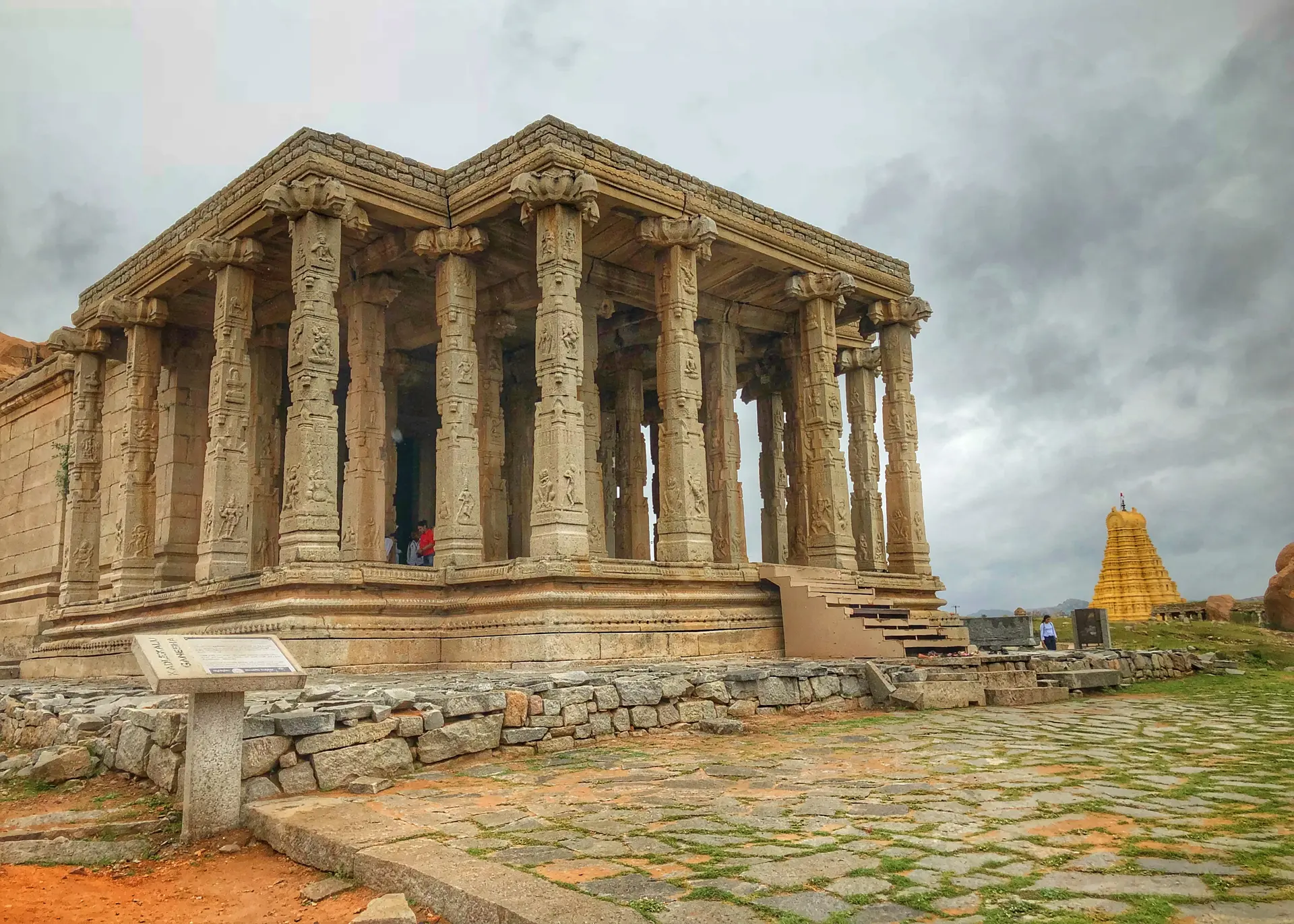
Image of Kadalekalu Ganesha Temple, Hampi, Karnataka. Image source · CC-BY-SA-4.0
Visit essentials
A quick read before you go
- Duration
- The temple itself requires 30-45 minutes for a meaningful visit—longer if you sit in…
- Access
- The temple sits on the northeastern slope of Hemakuta Hill, approximately 200 meters (a few…
Overview
Fifteen feet of granite from a single boulder forms the elephant-headed god. His belly curves like a kadalekalu, or Bengal gram seed, giving the temple its name and showing the Vijayanagara sculptors' deliberate work.
In Hindu tradition Ganesha is Pratham Pujya, worshipped first so obstacles may be removed before ceremonies or ventures begin. His monumental scale reflects the ambitions of his patrons. The temple stands on Hemakuta Hill in Vijayanagara's former sacred heart, when the capital may have been the world's second-largest city by 1500 and was certainly India's richest. After the Battle of Talikota in 1565, attackers damaged the statue's belly; the scars and the massive figure both remain.
The Archaeological Survey of India now manages the temple as a heritage monument. Because orthodox standards preclude formal puja to a damaged idol, none is conducted, yet devotees remove footwear and offer informal prayers to the remover of obstacles. During Ganesh Chaturthi they gather for blessings connected with success and new beginnings, sustaining devotion without requiring the image to be physically perfect.
Why this place is sacred
Hemakuta Hill was sacred long before the Vijayanagara kings built their temples here. According to the Sthala Purana, this golden peak—hemakuta means 'golden summit'—is where Pampa, the goddess who would become Parvati, performed austere practices to win the ascetic Shiva as her husband. The river that flows nearby still bears her name, transformed over centuries into 'Hampi.'
To build a temple to Ganesha here is to place him within his family's mythology—the divine son on the hill where his mother once practiced.
The Vijayanagara sculptors chose to work with the boulder rather than against it. Rather than quarrying blocks and assembling them, they carved in situ, finding the god already present in the stone and revealing him. This approach—common in Vijayanagara monolithic sculpture—carries its own theological weight. The deity is not constructed but discovered, not placed but released from matter that already contained divinity.
The temple's thin-place quality is intensified by what followed. When the combined forces of the Deccan sultanates sacked Vijayanagara in 1565, they systematically damaged temples and idols throughout the city. The Kadalekalu Ganesha's belly bears the scars of their attack. Yet the statue remains standing. The open-pillared mandapa still frames the enormous figure. The hill still rises, boulder-strewn, with views across to Virupaksha Temple and Matanga Hill.
Survivors carry a different weight than the untouched. The Kadalekalu Ganesha has witnessed empire and its destruction, centuries of abandonment, and gradual return. It has been worshipped, attacked, forgotten, and remembered. For visitors attuned to this history, the temple offers an encounter not just with divinity but with resilience—the persistence of sacred presence through historical catastrophe.
The Vijayanagara rulers built this temple to invoke Ganesha's blessing for their empire's success. In Hindu tradition, Ganesha is approached before any undertaking—a journey, a marriage, a business venture, a battle. The massive scale of the Kadalekalu Ganesha suggests the scale of what was being asked: protection and prosperity for one of medieval India's greatest kingdoms.
The temple's location on Hemakuta Hill, within walking distance of the Virupaksha Temple (the empire's primary pilgrimage center), embedded it in a larger sacred geography that structured both royal ceremony and popular devotion.
For perhaps a century, the temple functioned within the living religious life of the Vijayanagara capital. Then came 1565 and destruction. For nearly four hundred years afterward, the temple stood among ruins that jungle gradually reclaimed. Local villagers knew the site, but wider recognition came only with 20th-century archaeological attention.
The temple's UNESCO World Heritage inscription in 1986 (as part of the Group of Monuments at Hampi) marked a new phase. Conservation efforts stabilized structures. Visitor infrastructure developed. Today the temple occupies a space between heritage monument and active shrine—no longer the seat of royal worship, not merely an archaeological artifact, but something harder to categorize. The devotees who remove their footwear before the damaged idol seem unbothered by questions of canonical fitness. They come for Ganesha, and he remains.
Experience and orientation
The approach sets the tone. From Hampi Bazaar, visitors climb the northeastern slope of Hemakuta Hill, passing through a landscape of enormous boulders that seem deliberately placed by giants. The temple comes into view: an open pavilion with slender pillars framing the massive Ganesha within. The scale is difficult to absorb—fifteen feet of carved stone, yet rendered with such detail that the modak (sweet dumpling) in the deity's hand remains distinct.
Within the mandapa, the atmosphere shifts. Natural light filters through the open pillars, casting changing patterns across the stone floor. The ornate Vijayanagara-style columns—lathe-turned, carved with floral and mythological scenes—create a sense of enclosure without confinement. Visitors frequently spend time simply sitting, looking up at the statue, allowing the proportions to register.
The belly draws attention. Curved like a Bengal gram seed, it gives the temple its name and the deity his distinctive form. But look closer: the damage from 1565 is visible, the stone scarred where attackers struck. Somehow this does not diminish the statue's presence. If anything, it adds depth—the god who removes obstacles has himself been tested.
Many visitors miss the detail that rewards careful looking: a giant hand carved on the rear of the statue, said to represent Goddess Parvati holding her divine son. Discovering it requires walking around the figure, engaging with the sculpture fully rather than photographing it from the front alone. Those who find it often describe a moment of unexpected tenderness—the cosmic remover of obstacles is also, here, someone's child.
The views from the temple site extend across Hampi's sacred landscape: the towering gopuram of Virupaksha Temple, the heights of Matanga Hill where sunrise draws pilgrims, the boulder-strewn terrain that defines this region. The Kadalekalu Ganesha does not stand alone but in relationship with the larger sacred geography the Vijayanagara rulers understood.
Come early, when the light is soft and the tour groups have not yet arrived. Remove footwear at the threshold—this is still a sacred space, whatever its administrative status. Sit for a while rather than moving through quickly. Walk around the statue fully; the rear is as carefully carved as the front. Let your eyes adjust to the scale before reaching for your camera.
If you come during Ganesh Chaturthi, expect a different experience: crowds, decorations, the atmosphere of festival. If you come on an ordinary morning, expect stillness. Both are valid. Both encounter the same stone figure who has waited for five centuries.
Context and lineage
The Vijayanagara Empire arose in the 14th century as a Hindu bulwark against the Deccan sultanates pressing from the north. At its height under Krishna Deva Raya (1509-1530), it was perhaps the wealthiest kingdom in India and one of the largest cities in the world. The Vijayanagara rulers were prolific temple builders, and the capital became a forest of sacred architecture.
The Kadalekalu Ganesha Temple was likely built around 1500 CE, during this imperial peak. Unlike many Hampi temples, it lacks dedicatory inscriptions identifying its patron. The nearby Sasivekalu Ganesha, by contrast, carries an inscription dating it to 1506 and naming a merchant from Chandragiri who built it in memory of King Narasimha II. The Kadalekalu Ganesha's silence on this point suggests either lost inscriptions or different circumstances of patronage—perhaps direct royal commission requiring no merchant intermediary.
The Vijayanagara period ended catastrophically in 1565. A coalition of Deccan sultanates defeated the empire at the Battle of Talikota, then sacked the capital for months. Contemporary accounts describe systematic destruction: temples desecrated, statues broken, the city left a ghost of its former glory. The Kadalekalu Ganesha's damaged belly dates to this period. That the statue survived at all—massive, immovable, resilient—becomes itself a form of testimony.
The temple's lineage moves through distinct phases. First, the Vijayanagara period of active royal worship—perhaps a century of ceremonial life within the living capital. Then the rupture of 1565 and centuries of silence, during which the temple stood among ruins gradually reclaimed by forest. Local villagers knew the site, but wider attention came only with archaeological excavation beginning in the 1970s under the Hampi National Project.
UNESCO World Heritage inscription in 1986 marked formal international recognition. The Hampi World Heritage Area Management Authority, established in 2007, now coordinates conservation and visitor management. The temple exists today as a protected monument that nonetheless continues to function, in limited ways, as a sacred site. The devotees who come for Ganesh Chaturthi or daily informal prayer are part of this lineage—the latest chapter in a story that began five centuries ago.
Lord Ganesha
deity
The elephant-headed god, son of Shiva and Parvati, worshipped as the remover of obstacles (Vighnaharta) and the deity who must be invoked before any undertaking. The massive scale of this representation reflects the importance placed on Ganesha worship by Vijayanagara rulers.
Parvati/Pampa
deity
The mother of Ganesha and consort of Shiva. According to local tradition, she performed austerities on Hemakuta Hill to win Shiva as her husband. The giant hand carved on the rear of the Ganesha statue is said to represent her holding her divine son.
Krishna Deva Raya
historical
The greatest of the Vijayanagara emperors (r. 1509-1530), under whom the empire reached its peak. While not confirmed as the temple's patron, his reign represents the context of ambitious temple building in which the Kadalekalu Ganesha was created.
Traditions and practice
During the Vijayanagara period, the temple would have followed Agamic temple ritual: daily pujas at specified times, abhishekam (ritual bathing of the deity), alamkaram (adornment), and special celebrations during festivals. The presence of pushkaranis (sacred tanks) nearby indicates the infrastructure for ritual water requirements. Temple priests would have maintained the deity with elaborate offerings, and the massive Ganesha would have been invoked before important royal undertakings.
These formal practices ceased with the temple's damage in 1565. By orthodox standards, a damaged idol cannot receive Agamic worship—the deity is understood to have departed from a vessel that can no longer properly contain it. Yet devotion persists in other forms.
The Kadalekalu Ganesha Temple now operates in a space between heritage monument and active shrine. The Archaeological Survey of India manages the site, and no formal puja is conducted. Yet the temple maintains characteristics of sacred space: visitors remove footwear before entering, maintain respectful quiet, and many offer informal prayers.
Ganesh Chaturthi (typically August-September) transforms the site. Devotees gather at the temple, colorful decorations appear, and the atmosphere shifts from quiet heritage site to active worship. People come seeking Ganesha's blessing for the removal of obstacles, success in new ventures, and protection in transitions. The damaged idol, by festival time, seems to matter less than the deity it represents.
If seeking meaningful engagement with the Kadalekalu Ganesha, consider these approaches. Arrive in early morning, when light is soft and crowds minimal. Remove footwear at the threshold—this gesture of respect costs nothing and signals appropriate intention. Sit within the mandapa for a time, allowing the scale of the statue to register beyond first impression.
If you carry an obstacle you seek to release—a decision blocked, a fear persisted, a beginning delayed—bring it consciously to mind in the deity's presence. This requires no formal ritual, only honest attention. Walk around the full statue; discover the hand on the rear representing Parvati. Notice the damage to the belly and what remains despite it.
Before leaving, pause in silent acknowledgment. Whether you frame this as prayer, gratitude, or simple respect, the form matters less than the sincerity.
Ganapatya (Ganesha worship in Hinduism)
ActiveThe Kadalekalu Ganesha is one of South India's largest monolithic representations of Lord Ganesha, the elephant-headed deity universally worshipped as Vighnaharta—the remover of obstacles. In Hindu tradition, Ganesha is Pratham Pujya, meaning he must be worshipped first before any undertaking. The massive scale of this statue reflects the importance Vijayanagara rulers placed on invoking Ganesha's blessings for their empire's success. The distinctive 'Bengal gram' belly shape connects to Ganesha's well-known association with abundance and satisfaction.
While formal Agamic puja is no longer performed (the damaged idol makes traditional worship problematic by orthodox standards), devotees visit to offer informal prayers and seek Ganesha's blessings for new ventures, removal of obstacles, and success in endeavors. Ganesh Chaturthi (August-September) sees significant devotional activity, with the temple becoming a gathering place for worship, offerings, and seeking blessings.
Vijayanagara temple tradition
HistoricalThe temple represents the religious and artistic achievement of the Vijayanagara Empire at its height—one of the most powerful Hindu kingdoms in Indian history. The monolithic Ganesha and distinctive architectural style (slender lathe-turned pillars, ornate carvings, unique long monolithic columns) demonstrate the empire's technical mastery and devotional intensity. The temple was part of a broader sacred complex centered on Hemakuta Hill, where multiple architectural styles from different periods coexist.
During the Vijayanagara period, the temple would have followed Agamic temple ritual with daily pujas, abhishekam (ritual bathing), alamkaram (adornment), and festival celebrations. Temple priests would have maintained elaborate ceremonial schedules, and the statue would have been invoked before important royal undertakings. These practices ceased when the empire fell in 1565.
Perspectives and open questions
The Kadalekalu Ganesha Temple invites multiple readings: art historical, devotional, and experiential. Each offers genuine insight, and honest engagement holds them together without forcing resolution.
Scholarly perspective
Art historians recognize the Kadalekalu Ganesha as a significant example of Vijayanagara monolithic sculpture. The practice of carving large statues in situ from single boulders is a distinctive feature of Vijayanagara artistic production, reflecting both technical mastery and theological understanding—the deity released from stone rather than constructed. The temple's long monolithic pillars are noted as unique within the Vijayanagara architectural corpus, suggesting experimental approaches to structural engineering.
UNESCO recognizes Hampi's monuments as testimony to the brilliant achievements of the Vijayanagara period and an outstanding example of a medieval Hindu capital. Archaeological consensus places temple construction around 1500 CE, though the absence of dedicatory inscriptions (unlike the dated Sasivekalu Ganesha) leaves specific patronage uncertain. Scholars study the temple within the context of Hemakuta Hill's layered sacred history, where temple styles from multiple periods coexist, suggesting the hill's continuous religious significance across centuries.
Living and traditional perspectives
For Hindu devotees, particularly those with Ganapatya (Ganesha-focused) practice, the Kadalekalu Ganesha represents the cosmic remover of obstacles in one of his most impressive physical forms. That the idol was damaged does not, for many practitioners, diminish the sacred presence—divinity cannot be destroyed even when its physical vessel is harmed. Devotees continue to seek blessings here for new ventures, for the removal of obstacles, for success in endeavors.
The temple's location on Hemakuta Hill—where tradition holds that Parvati performed austerities—connects Ganesha to broader family mythology. The giant hand on the statue's rear, representing Parvati holding her son, reinforces this connection. For traditional practitioners, these layers of meaning are not historical curiosity but living significance.
Alternative interpretations
Some visitors approach Hampi through alternative frameworks, describing it as an energy center or sacred landscape where concentrated spiritual power persists. The unique boulder-strewn terrain, the density of temples, and the site's long pilgrimage history combine in this reading to create a location of heightened spiritual access. The Kadalekalu Ganesha, as one of the site's most imposing sacred images, becomes a focus for this perceived energy.
Open questions
Genuine mysteries remain. Who specifically commissioned the Kadalekalu Ganesha Temple? Unlike the Sasivekalu Ganesha, no inscription survives to identify the patron. Why do the temple's monolithic pillars differ from those elsewhere in Vijayanagara architecture? What was the full extent of ritual practice here before 1565—the daily rhythms of worship, the ceremonies at festivals, the relationship between this temple and the larger sacred geography of the capital?
What exactly does the giant hand on the statue's rear represent—is it certainly Parvati, or might other interpretations exist? These questions remain open, and the uncertainty is worth preserving.
Plan your visit
Access and arrival
The temple sits on the northeastern slope of Hemakuta Hill, approximately 200 meters (a few minutes' walk) from Hampi Bus Stand. The path involves climbing over boulder-strewn terrain. Hospet (13 km away) is the nearest town with extensive accommodation and transport connections. Nearest railway: Hospet Junction (13 km). Nearest airports: Hubli (143 km) or Bellary (74 km). Within Hampi's core area, walking is the primary transportation mode.
Hospet (13 km) offers the widest range of accommodation from budget to mid-range hotels. Hampi Bazaar has guesthouses and lodges within walking distance of the temple, though options are simpler. The quieter Virupapur Gaddi area across the river offers a more relaxed atmosphere with basic guesthouses.
Respectful visit
Modest dress is expected as at any Hindu sacred site. Cover shoulders and knees. In Hampi's warm climate, light cotton clothing serves both modesty and comfort. Avoid leather goods, which are traditionally inappropriate at Hindu temples. Carry socks if you want protection from hot stone floors while maintaining footwear-free requirements.
Photography is generally permitted in the temple exterior and around the statue. Be respectful of any devotees present and avoid flash if it might disturb prayer. Follow any posted ASI guidelines. Consider spending time actually seeing the temple before photographing it—the experience of scale and detail benefits from presence before documentation.
Fresh flowers and coconuts are traditionally appropriate offerings at Ganesha temples. However, confirm current practice before bringing offerings, as heritage sites sometimes restrict them. Whatever you bring should be fresh, simple, and appropriate to temple customs. Avoid tobacco, alcohol, and leather goods.
The temple is open during daylight hours, typically 6:00 AM to 6:00 PM. No entry fee is required. Do not touch or climb on the statue or temple structures. Do not remove any material from the site. The temple is managed by the Archaeological Survey of India as part of the Hampi monuments, and heritage protection regulations apply.
Do not touch the statue or temple structures—both preservation requirements and respect for sacred space prohibit this. Do not bring offerings of food or flowers unless you have confirmed current practice permits them; many heritage sites do not. Be mindful that during ordinary days this is a quiet space, and during Ganesh Chaturthi an active devotional one; adjust your presence accordingly.
Current practical details
Address
8FM6+4FQ, Krishnapura, Karnataka 583239, India
Phone
Hours
Hours, fees, and access can change — verify on the official source before you travel. Practical details last checked Jun 2026.
Location
Map loads as you approach this section.
Pilgrim reflections
A portrait of encounter, not a score
Pilgrims describe what they felt, how present they could become, and whether the place would shape a journey. There are no stars and no ranking of traditions.
No reviewed reflections yet
The first pilgrims can help describe the character of being here.
Share a reflection
Available after an account-backed “Been there.” Every reflection is reviewed before publication.
Nearby sacred places
Explore other sacred places in the region. Proximity does not establish access or travel time; check each place’s guidance.

Group of Monuments at Hampi
Hampi, Karnataka, India
0.0 km away
Anjeyanadri (Anjanadri) Hill, Hampi, Karnataka
Hanumanahalli, Karnataka, India
2.2 km away

Badami Cave Temples, Badami, Karnataka
Badami, Karnataka, India
104.7 km away

Chandramouleshwara Temple, Hubli, Karnataka
Hubli, Karnataka, India
144.1 km away
References
Sources consulted for this page. Source categories describe the publication, not a guarantee that every claim is verified. Traditional accounts and outside interpretations may differ.
- 01Group of Monuments at Hampi — UNESCO World Heritage CentreofficialOfficial UNESCO documentation for Hampi World Heritage Site
- 02Kadalekalu Ganesh Hampi's Must-See Attraction! — Incredible India (Ministry of Tourism, Government of India)officialOfficial government tourism documentation
- 03Hampi — Wikipedia contributorsencyclopediaComprehensive overview of Hampi archaeological site
- 04Ganesha — Wikipedia contributorsencyclopediaComprehensive overview of Ganesha worship in Hinduism
- 05Kadalekalu Ganesha Hampi — Hampi TourismSource contextDetailed visitor information and history
- 06Kadalekalu Ganesha Temple, Hampi: A Unique Monument in Stone — Karnataka.comSource contextArchitectural details and visitor information
- 07Gajanana Namostute: Hampi's Majestic Ganesha & Sasivekalu Kadalekalu Temple's Timeless Tale — NewsBharatiSource contextCultural and mythological context
- 08Kadalekalu Ganesha, Hampi — Soula TourguideVisitor experience and practical information
- 09Kadalekalu Ganesha Temple, Hampi - Timings, History, Architecture, Best Time to Visit — Trawell.inguideVisitor guide with practical details
- 10ETV Bharat looks at Hampi's ancient monolith Ganesha temples — ETV BharatnewsComparison of Hampi's two Ganesha temples
Photo gallery
3 curated photos
Share a photo
Help visitors recognize Kadalekalu Ganesha Temple, Hampi, Karnataka. Every submission is reviewed before publication.