Chamseongdan Altar
Heavenly ritual on Manisan, framed by Dangun and the calendar
Understand sacred places, explore living traditions, and learn how to engage respectfully with Pilgrim Map.
Access has not been verified. Check current local guidance before planning a visit.
Ganghwa-gun, Incheon, South Korea
Read the sources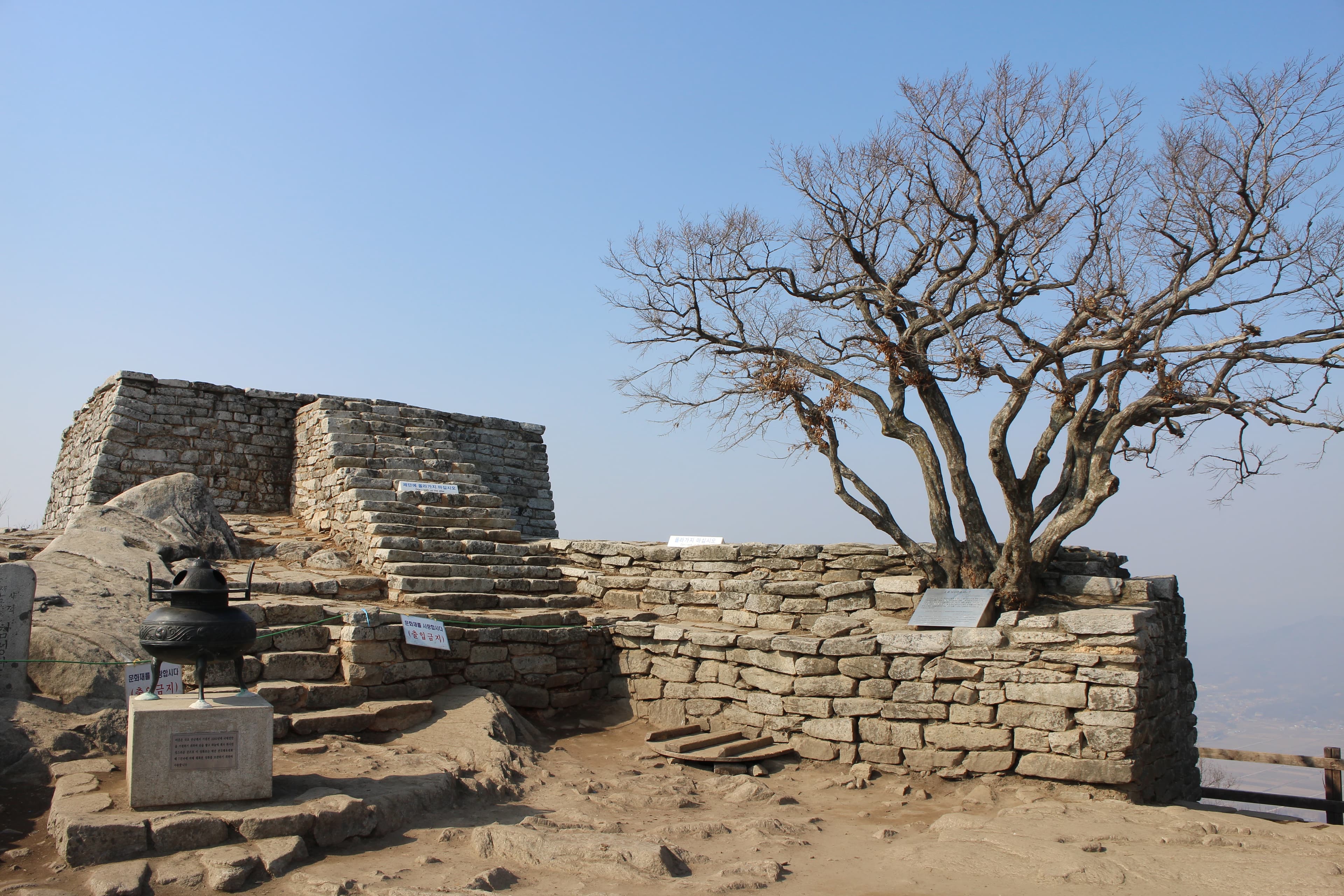
Chamseongdan Altar in Ganghwa-gun, Incheon, South Korea. Image source · CC BY-SA 4.0
Visit essentials
A quick read before you go
- Duration
- Build the visit around the mountain ascent rather than altar time alone.
- Access
- Confirm summit, trail, and ceremony restrictions with Ganghwa tourism information.
Overview
Chamseongdan's ascent opens a ritual horizon of sea, islands, inland ridges, sky, and weather around a deliberately shaped natural-stone platform. Ganghwa County presents it as the altar where Dangun served Heaven twice yearly for public prosperity—a national-origin tradition, not a securely dated four-millennia-old construction record. Documentary history begins more firmly with repair under Goryeo King Wonjong in 1270 and later work in 1639 and 1700.
Each early October, the Gaecheon Grand Festival includes a Daeje addressing heavenly gods, ceremonial ascent, and sacred-fire elements; athletic-competition flames also link the summit to civic ritual. Rather than proving supernatural intervention or making a generic wish site, these practices sustain a symbolic grammar of Heaven above, earth below, a founder between them, and national renewal through calendar, movement, offering, and shared memory.
Why this place is sacred
Chamseongdan’s spiritual force is spatially legible without invoking measurable energy. Climbers rise through forest toward an exposed altar where the sky occupies more of the visual field. The traditional round-sky and square-earth interpretation turns masonry into cosmology, while Dangun’s remembered sacrifice makes ascent a story of public responsibility rather than private achievement. The sacred flame carries summit fire back into civic events. None of this means the altar guarantees national prosperity or personal transformation.
It means repeated ceremonies have made the summit a durable place for staging relationships among heaven, land, ancestry, and collective time.
Foundation legend and surviving masonry are presented as different kinds of evidence.
Later change is identified without inventing continuity.
Experience and orientation
Check mountain conditions and entry controls before beginning. Google lists daily access from 09:30 to 16:00 and telephone 032-930-7068, while official festival or conservation arrangements can narrow access further. Near the summit, stay on built steps and platforms; the stone altar is not a lookout to climb or a seat for resting. Identify the curved lower wall and squared upper space from an authorized viewpoint.
On Gaecheonjeol, follow stewards, keep procession routes free, and expect collective ceremony rather than solitary contemplation. Outside festival dates, resist inventing an offering. Weather can change quickly on the exposed ridge, so spiritual attention includes practical care for footing, water, and descent time.
Stay on the summit route and outside any closed altar perimeter.
Context and lineage
Ganghwa tradition places Dangun at Chamseongdan offering to Heaven in spring and autumn. The altar’s cosmological geometry is explained through round sky and square earth. These are inherited accounts. KTO and Ganghwa County record repair in 1270 under King Wonjong, followed by work in 1639 and 1700, providing dated historical anchors. Contemporary Gaecheon ceremony and athletic-flame lighting continue symbolic use.
The page does not convert legendary antiquity into an archaeological date, nor does it call the altar a UNESCO World Heritage component.
Korean heavenly ritual and Dangun commemoration
Traditions and practice
The annual festival is the clearest documented recurrent rite. Ganghwa County describes worship of heavenly gods, the Gaecheon Daeje, sacred-fire lighting, ceremonial mounting, and public performance. Visitors should distinguish officiated ritual from festival programming and should never reproduce either on the altar independently. A suitable personal reflection is to consider what public prosperity asks of people below the summit after the ceremony ends. Do not leave incense, coins, food, flags, or stones unless custodians explicitly provide a place.
Current observance remains under custodian authority.
Pause once and attend before interpreting.
Korean heavenly ritual and Dangun commemoration
ActiveDangun tradition and national ceremonies focus attention on the summit altar.
Formal observances operate under heritage and event authorities, not visitor improvisation.
Perspectives and open questions
Legendary ancestry, cosmological form, documented repair, civic ceremony, and mountain stewardship converge here.
Scholarly perspective
Traditional interpretation centers Dangun’s service to Heaven. Historians separate that inherited story from dated repairs. Festival organizers activate the altar within modern national life, while conservators regulate a fragile summit monument. These perspectives agree that the place carries exceptional symbolic weight, even though claims of guaranteed prosperity, sacred energy, or personal transformation are not independently verified.
Living and traditional perspectives
Received tradition links Dangun with heavenly rites on Manisan.
Open questions
The legendary foundation is not converted into an archaeological certainty.
Plan your visit
Access and arrival
Confirm summit, trail, and ceremony restrictions with Ganghwa tourism information.
The altar record does not establish lodging on Manisan’s summit.
Respectful visit
Prepare for Manisan weather while dressing respectfully near national rites.
Observe all ceremony-specific camera limits and avoid photographing participants intrusively.
Use only forms explicitly authorized by custodians.
Barriers and ceremony instructions always take priority.
Avoid imitation, intrusion, and unsupported promises.
Current practical details
Address
산42-1 Heung-wang-ri, Hwado-myeon, Kanghwa, Incheon, South Korea
Phone
Hours
Hours, fees, and access can change — verify on the official source before you travel. Practical details last checked Jul 2026.
Location
Map loads as you approach this section.
Pilgrim reflections
A portrait of encounter, not a score
Pilgrims describe what they felt, how present they could become, and whether the place would shape a journey. There are no stars and no ranking of traditions.
No reviewed reflections yet
The first pilgrims can help describe the character of being here.
Share a reflection
Available after an account-backed “Been there.” Every reflection is reviewed before publication.
Nearby sacred places
Explore other sacred places in the region. Proximity does not establish access or travel time; check each place’s guidance.


References
Sources consulted for this page. Source categories describe the publication, not a guarantee that every claim is verified. Traditional accounts and outside interpretations may differ.
- 01Manisan Mountain — Ganghwa CountyofficialOfficial county account of the Dangun-to-Heaven tradition, stone geometry, medieval repairs, Gaecheonjeol ceremony, and sacred flame.
- 02Gaecheon Grand Festival — Ganghwa CountyofficialOfficial current annual festival description for early October, Gaecheon Daeje, heavenly worship, sacred fire, and organizers.
- 03Chamseongdan Altar — Korea Tourism OrganizationofficialExact visitor record for summit setting, traditional Dangun account, 1270 repair, altar form, contemporary ceremonies, address, and contact.
- 04Chamseongdan Altar — Google Maps place record — GoogleSource contextStrong exact identity used only for coordinates, address, telephone, hours, and operating status.
Share a photo
Help visitors recognize Chamseongdan Altar. Every submission is reviewed before publication.