Bongeunsa Temple
Scripture, Maitreya, and monastic time across from COEX
Understand sacred places, explore living traditions, and learn how to engage respectfully with Pilgrim Map.
Access has not been verified. Check current local guidance before planning a visit.
Seoul, Seoul, South Korea
Read the sources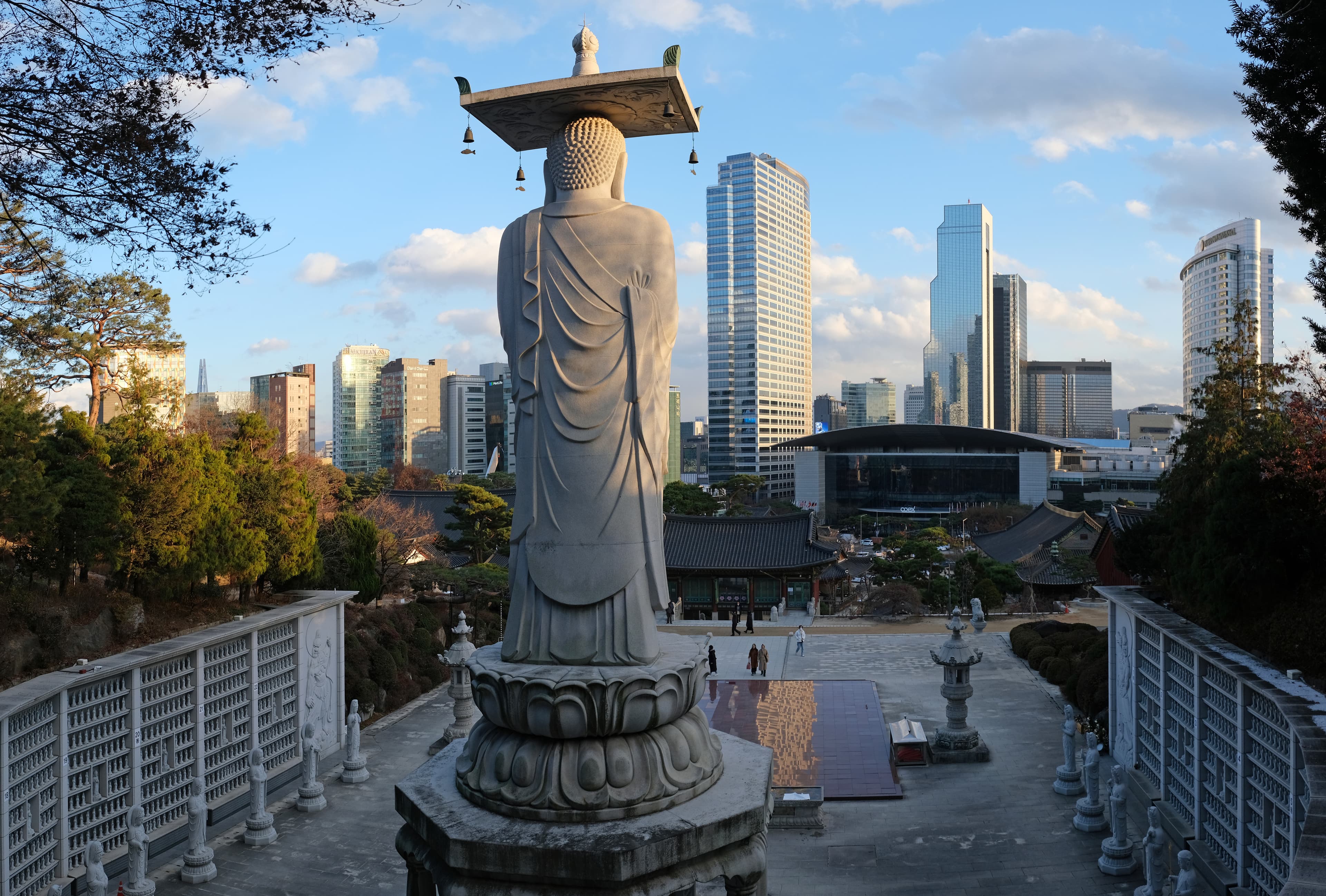
Bongeunsa Temple in Seoul, Gangnam District, South Korea. Image source · CC BY-SA 4.0
Visit essentials
A quick read before you go
- Duration
- Allow ninety minutes for the main precinct; scheduled Templelife or Templestay has its own…
- Access
- KTO currently lists 05:00–22:00, free admission, and +82-2-3218-4800.
Overview
Crossing from the COEX area to Bongeunsa can feel abrupt, yet the temple's history is one of relocation and adaptation rather than an untouched remnant surviving modernity. Changes in location, patronage, and form have sustained Buddhist purposes. The Great Statue of Maitreya gives those purposes a powerful public face, while nearby halls, calligraphy, scriptures, and ongoing programs prevent it from becoming a solitary landmark.
Why this place is sacred
Maitreya is the Buddha of the future, and the great outdoor figure can be approached as an image of hope rather than a scenic object. The temple’s scripture collection provides a complementary emphasis: the Dharma is copied, stored, carried, recited, and transmitted. During Jeongdaebulsa, monks bear scriptures on their heads while chanting, making bodily reverence for teaching visible. These practices support a spiritual account more precise than the common claim that the temple is an oasis.
Bongeunsa does offer contrast with Gangnam’s speed, but its deeper significance comes from directing aspiration through scripture, ritual, and disciplined community.
The received foundation as Gyeonseongsa belongs to Silla-period Buddhist history; later royal patronage reshaped and renamed the institution.
Relocation, Joseon-period restoration, modern rebuilding, international programs, and the Maitreya monument have expanded the temple’s public role.
Experience and orientation
Rather than photographing the large Buddha immediately, approach far enough to understand its scale against the city and then look for the smaller actions at its base. Move next toward the halls and examine how written teaching appears in signs, plaques, and the temple’s account of its scriptures. The contrast is useful: Maitreya’s height addresses a public horizon, while recitation and prostration work through repetition at human scale.
On program days, visitors may encounter tea, meditation, communal cleaning, or temple food. These are scheduled disciplines, not attractions available on demand.
Check the temple map and daily notices, because program areas, worship halls, and public paths overlap in a compact site.
Context and lineage
Official tourism material says the temple began in 794 as Gyeonseongsa. Queen Jeonghyeon sponsored its refurbishment and the name Bongeunsa in 1498, and it later moved from the vicinity of King Seongjong’s royal tomb to its present location. A collection of thousands of Buddhist scriptures and the Jeongdaebulsa ceremony preserve reverence for transmitted teaching. Modern additions, including the large Maitreya, should be understood as part of continuing religious history rather than evidence that only ancient fabric can be sacred.
Bongeunsa belongs to Korean Buddhism and gives prominent devotional focus to Maitreya Buddha.
Traditions and practice
Jeongdaebulsa venerates Buddhist texts through carrying and recitation on its lunar-calendar date. Ordinary worship in the halls follows the temple’s established forms.
English-language Templestay programs may include meditation, tea, 108 prostrations, communal work, and temple cuisine; book through official channels.
Read one translated teaching supplied by the temple before sitting where permitted; allow the words, rather than the skyline contrast, to organize the pause.
Korean Buddhism
ActiveKorean Buddhist practice at Bongeunsa binds transmitted scripture to hope embodied by Maitreya.
Prayer, chanting, scripture veneration, meditation, prostration, communal work, and temple programs.
Perspectives and open questions
Bongeunsa’s urban contrast is real, but scripture and Maitreya devotion provide the more substantial interpretive frame.
Scholarly perspective
Royal patronage, relocation, textual collections, and modern monumental sculpture reveal adaptation across distinct political and urban periods.
Living and traditional perspectives
Maitreya devotion opens practice toward the future, while reverence for scripture maintains continuity with the Dharma already received.
Open questions
Popular wishes offered here do not constitute evidence that requests are supernaturally fulfilled.
Plan your visit
Access and arrival
KTO currently lists 05:00–22:00, free admission, and +82-2-3218-4800. Recheck the official website, especially around major ceremonies.
Overnight participation is available only through the temple’s official Templestay booking and rules.
Respectful visit
Wear modest clothes that permit seated meditation or prostration if enrolled in a program.
Keep cameras away from active rites and obtain permission before photographing program participants.
Use designated candle, incense, lantern, or donation systems; never attach wishes to the statue or trees.
Scriptures, ritual implements, altars, monastic quarters, and teaching spaces are not to be handled or entered casually.
Do not promise that prostrations or the Maitreya image will grant a wish, heal illness, or produce a guaranteed mental state.
Current practical details
Address
531 Bongeunsa-ro, Gangnam District, Seoul, South Korea
Phone
Hours
Hours, fees, and access can change — verify on the official source before you travel. Practical details last checked Jul 2026.
Location
Map loads as you approach this section.
Pilgrim reflections
A portrait of encounter, not a score
Pilgrims describe what they felt, how present they could become, and whether the place would shape a journey. There are no stars and no ranking of traditions.
No reviewed reflections yet
The first pilgrims can help describe the character of being here.
Share a reflection
Available after an account-backed “Been there.” Every reflection is reviewed before publication.
Nearby sacred places
Explore other sacred places in the region. Proximity does not establish access or travel time; check each place’s guidance.

References
Sources consulted for this page. Source categories describe the publication, not a guarantee that every claim is verified. Traditional accounts and outside interpretations may differ.
- 01Bongeunsa Temple official website — Bongeunsa TempleofficialDomain matches the site or its managing religious/heritage body.
- 02Seoul Bongeunsa Temple — Korea Tourism OrganizationofficialOfficial tourism record for the 794 foundation tradition, royal refoundation, scripture collection, Jeongdaebulsa, hours, address, and website.
- 03Bongeunsa — Wikipedia — Wikipedia contributorsacademicCorroborates identity, location, and general historical context; key claims require higher-tier support.
- 04Bongeunsa — Wikidata — Wikidata contributorsSource contextCommunity-maintained structured identity and coordinate cross-check; not treated as scholarship or an official custodian record.
- 05Bongeunsa Temple — Google Maps place record — GoogleSource contextStrong identity match used only for current practical fields and coordinates.
Pilgrim glossary
- Dharma
- The teachings of the Buddha; also the universal law underlying them.
Share a photo
Help visitors recognize Bongeunsa Temple. Every submission is reviewed before publication.