Shree Ananthapadmanabha Temple, Kudupu
A living temple where Vishnu devotion and naga veneration share one sacred landscape
Understand sacred places, explore living traditions, and learn how to engage respectfully with Pilgrim Map.
Access has not been verified. Check current local guidance before planning a visit.
Mangaluru, Karnataka, India
Read the sources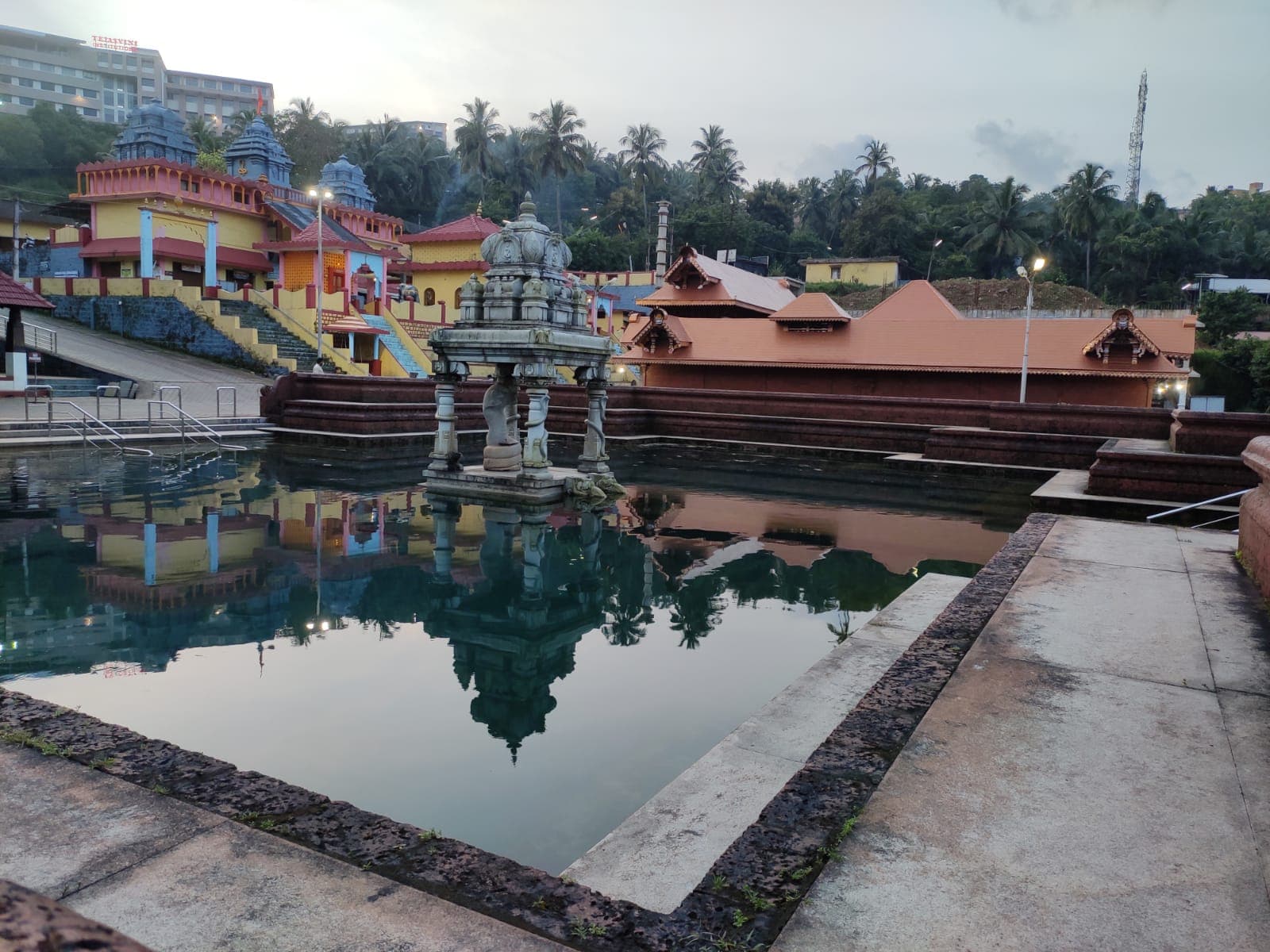
Original photograph of Shree Ananthapadmanabha Temple, Kudupu, with the temple tank and serpent-form stone pavilion. Image source · CC BY 4.0
Visit essentials
A quick read before you go
- Duration
- Allow one to two hours when worship schedules and access permit; ritual participants should…
- Access
- Use the exact Google Place for Shri Ananthapadmanabha Swamy Temple (Kudupu), about ten…
Overview
Kudupu invites sacred architecture to be read as an inhabited devotional world. Bright temple buildings, a stone pavilion reflected in water, and repeated serpent forms belong together. Anantha Padmanabha is the principal deity, while Subramanya and naga deities are also central. The Naga Bana, sacred tank, anthill, serpent images, shrines, festivals, and sevas form a landscape where repeated worship, not visual symbolism alone, approaches divine presence.
Calling Kudupu merely a 'snake temple' risks turning a specific coastal Karnataka practice into spectacle. Custodial sources describe a working temple with daily hours, regulated services, ritual calendars, and active spiritual authority. Nagara Panchami matters, but naga veneration extends beyond one festival day through Ashlesha days, monthly lunar days, daily services, vows, and family concerns.
Kudupu is best understood relationally. Vishnu devotion, Subramanya worship, naga presence, sacred water, local story, and visitor obligations coexist without being collapsed into one universal explanation.
Why this place is sacred
The temple website identifies Anantha Padmanabha, a form of Vishnu, as the principal deity and describes serpent worship as a defining feature of the kshetra. On the eastern side of the complex, the west-facing Naga Bana holds a large gathering of serpent images. Bhadra Saraswathi Thirtha lies beside the temple, while the complex also includes an anthill and shrines associated with Subramanya, Shree Devi, Mahaganapathi, Jarandaya, Ayyappan, Navagraha, Jaya, and Vijaya.
These elements do not function as a museum catalogue. The official festival and service lists show how sacred relationships are renewed. Shravana Shuddha Nagara Panchami, annual Shashti observances, Anantha Chaturdashi, Ashlesha Bali, Naga Pratishte, Sarpa Samskara, and other services place time, vow, and ritual action around the site. The temple's significance therefore comes from continuity of attention: images are tended, water is approached under rules, stories are retold, and rites are conducted by recognized custodians.
The site also carries devotional claims involving fertility, physical affliction, sin, and ritual fault. Karnataka HRCE explicitly frames these as beliefs. Pilgrim Map preserves that boundary. The claims help explain why devotees come, but they are not medical evidence, diagnoses, or guarantees. A respectful account can recognize the force of a belief without presenting it as a clinical outcome.
The exact construction chronology is not independently established in the reviewed sources. Temple tradition presents Kudupu as a place of penance, worship of Subramanya and Anantha Padmanabha, naga presence, sacred water, and eventual temple foundation. Current evidence supports describing it as a longstanding active temple rather than assigning a precise founding year.
Karnataka HRCE reports a comprehensive renovation completed in 2018, including work shaped around the sanctum, circumambulatory structures, Naga Bana, and Bhadra Saraswathi tank. Renovation changed material fabric while maintaining the site's living ritual organization.
Experience and orientation
Approach Kudupu as a participant-observer in someone else's place of worship, not as a photographer entering a scenic compound. The exact Google Place brings visitors to Kudupu/Kulashekara on the Mangaluru side of Dakshina Kannada. Temple buildings rise around Bhadra Saraswathi Thirtha, and the water creates one of the site's most memorable visual relationships: structure, sky, ritual space, and reflection occupy the same field.
The visual center is not necessarily the devotional center. The main sanctum, the Naga Bana, the anthill, serpent images, and subsidiary shrines have their own roles and access boundaries. A visitor may not know which actions are appropriate simply by looking. Pause, watch how devotees move, and follow the instructions of priests, staff, and posted signs. Remove footwear where directed, keep phones quiet, and allow worshippers space.
On festival days, the experience is collective and compressed. Nagara Panchami and the annual Shashti period can bring larger gatherings and intensified ritual schedules. Ashlesha days are also identified by the temple as especially busy for Ashlesha Bali. A quieter visit may offer more time to notice spatial relationships, but quiet does not mean the space is available for personal staging.
The most useful interpretive question is simple: what changes when a serpent image is no longer read as ornament but encountered as a focus of living devotion? That question does not require an outsider to define the deity. It asks the visitor to recognize that form, place, and ritual attention are inseparable here.
Begin by identifying the main sanctum, Naga Bana, Bhadra Saraswathi Thirtha, and the directions given for visitor movement. Do not assume the photographed stone pavilion is the main shrine or that every serpent form has the same ritual status.
Context and lineage
The temple's traditional narrative begins with Kedar, a Vedic scholar distressed by childlessness, who meets Shringa Muni near Bhadra Saraswathi Thirtha. The sage directs him to undertake penance to Subramanya. In the story, the intensity of that penance affects the worlds, and Vishnu asks Subramanya to respond. Kedar's wife later gives birth to three egg-like forms understood as manifestations connected with Mahavishnu, Mahashesha, and Subramanya.
A divine voice instructs Kedar to conceal the forms at the place of penance. He places them in a basket woven from forest creepers, called a kudupu in the temple's explanation, and continues worship of Anantha Padmanabha. The place becomes known as Shree Kshetra Kudupu, while the anthill and sacred water remain part of the narrated landscape.
A second temple legend concerns a king called Shurasena. After an act that leaves him seeking atonement, he worships Vishnu at Bhadra Saraswathi Thirtha and is instructed to build a temple within a day. The story explains an unfinished ornamental element of the sanctum through the moment construction stops at dawn.
These narratives are spiritually important because they explain names, forms, ritual concerns, and relationships within the temple. They are not used here as a datable building record. Karnataka HRCE also transmits local history, mentions worn inscriptions, and reports renovation in 2018. Accessible sources do not yet provide a full epigraphic or architectural chronology.
The site is an active Hindu temple under contemporary custodianship and Karnataka HRCE administration. Its Vaishnava dedication, Subramanya associations, naga veneration, and local Tulu place-story should be held together without implying that all serpent traditions in India are identical.
Anantha Padmanabha
The principal deity, identified by the temple as a form of Vishnu.
Subramanya
A central deity in the temple's origin story and living ritual landscape.
Kedar and Shringa Muni
Figures in the sthala-purana whose encounter and penance explain the site's sacred origin.
King Shurasena
The king in the traditional construction legend; not treated as an independently dated historical founder.
Traditions and practice
The temple lists Shravana Shuddha Nagara Panchami among its special celebrations. It also identifies Ashlesha Bali as an important seva and notes that demand is especially high on Ashlesha nakshatra days. Karnataka HRCE lists Naga Pratishte and Sarpa Samskara among available services. The sthala-purana connects worship with vows, fertility concerns, sacred water, and naga manifestations.
Exact procedures, eligibility, offerings, fees, and meanings should come from temple authorities. A public list is not permission to perform a rite independently or to explain its inner significance on behalf of practitioners.
For visitors who are not undertaking a seva, appropriate participation may be as simple as quiet attention, darshan where permitted, and respect for the movement of devotees. Those seeking a particular service should contact the temple directly rather than relying on generalized internet instructions.
Notice how the temple landscape distributes attention among sanctum, grove, water, anthill, images, and paths. Ask how repetition—returning on a lunar day, maintaining an image, carrying a vow, or joining a festival—turns a location into a sustained sacred relationship.
Vaishnava Hinduism
ActiveThe principal deity is Anantha Padmanabha, identified by the temple as a form of Vishnu; the site's own narrative connects Vishnu with Subramanya and naga presence.
Coastal Karnataka naga veneration
ActiveThe Naga Bana, serpent images, Nagara Panchami, Ashlesha Bali, Naga Pratishte, Sarpa Samskara, and related worship form a documented living practice at Kudupu.
Perspectives and open questions
Kudupu can be understood through living worship, temple tradition, regional sacred geography, and modern custodianship. Each perspective adds something, provided its authority and uncertainty remain visible.
Scholarly perspective
The accessible site-specific record is strongest for current identity, layout, administration, services, and the fact that traditions are actively maintained. A precise construction chronology and full study of the inscriptions remain gaps. Claims about age or origin should not be upgraded beyond the custodial wording.
Living and traditional perspectives
Temple tradition holds that the sthala-purana presents the place through penance, divine intervention, serpent-form manifestations, the kudupu basket, sacred water, and temple foundation. Within that tradition, the story's purpose is not merely to date a structure; it reveals how devotees understand the relationship among place, vow, deity, and blessing.
Alternative interpretations
Claims of paranormal energy, universal serpent codes, guaranteed healing, or hidden esoteric initiation are not supported by the reviewed evidence. They are excluded rather than blended with temple teaching.
Open questions
Open questions include the dating and interpretation of inscriptions, the sequence of earlier building phases, historical development of the Naga Bana, and the relationship between material renovation and older ritual layouts.
Plan your visit
Access and arrival
Use the exact Google Place for Shri Ananthapadmanabha Swamy Temple (Kudupu), about ten kilometres from central Mangaluru on the Kudupu/Kulashekara side. | Difficulty: The complex includes steps and potentially wet surfaces around the tank. Confirm accessible routes and assistance directly with the temple. | Time to summit: There is no summit route.
Mangaluru has transport and lodging options. No commercial recommendation is implied.
Respectful visit
Choose clothing that covers shoulders and knees unless the temple publishes more specific requirements. Be prepared to remove footwear and to walk on warm or wet surfaces.
Exterior photography may be possible where current temple rules allow it. | Ask before photographing worship, interiors, the Naga Bana, sacred water practices, or ritual objects. Do not use flash, drones, tripods, or commercial equipment without permission.
Offerings and sevas are administered within temple practice. | Use authorized counters and priestly guidance. Do not improvise milk, food, flowers, coins, or other offerings at serpent images, the anthill, or the tank.
Current temple instructions override this general guidance. Access may tighten during festivals, sevas, renovation, or crowd control.
Do not pour substances, touch images, enter the Naga Bana, bathe, roll, leave offerings, or undertake a seva without current temple direction. Do not interpret devotional healing or fertility beliefs as a substitute for medical care.
Current practical details
Address
WV3V+H9M AnanthaPadmanabha Temple, Kudupu, Kudpu, Kulashekara, Mangaluru, Karnataka 575028, India
Phone
Hours
Hours, fees, and access can change — verify on the official source before you travel. Practical details last checked Aug 2026.
Location
Map loads as you approach this section.
Pilgrim reflections
A portrait of encounter, not a score
Pilgrims describe what they felt, how present they could become, and whether the place would shape a journey. There are no stars and no ranking of traditions.
No reviewed reflections yet
The first pilgrims can help describe the character of being here.
Share a reflection
Available after an account-backed “Been there.” Every reflection is reviewed before publication.
Nearby sacred places
Explore other sacred places in the region. Proximity does not establish access or travel time; check each place’s guidance.

Anegudde Shree Vinayaka Ganapathi Temple, Anegudde, Karnataka
Kumbhashi, Karnataka, India
76.7 km away

Kukke Subramanya Temple
Subrahmanya, Karnataka, India
82.8 km away
Talakaveri Temple, Karnataka
Talakaveri, Karnataka, India
86.8 km away
Belkal Theertha (Govinda Theertha)
Udupi, Karnataka, India
104.3 km away
References
Sources consulted for this page. Source categories describe the publication, not a guarantee that every claim is verified. Traditional accounts and outside interpretations may differ.
- 01About Temple — Shree Ananthapadmanabha Temple, KudupuofficialCustodial source for exact identity, dedication to Anantha Padmanabha, serpent worship, Naga Bana, Bhadra Saraswathi Thirtha, subsidiary shrines, and published temple hours.
- 02Shree Ananthapadmanabha Temple - Mythology and construction legend — Shree Ananthapadmanabha Temple, KudupuSource contextTemple-authoritative account of the sthala-purana involving Kedar, Shringa Muni, Subramanya, Vishnu, serpent-form eggs, the forest-creeper basket called kudupu, Bhadra Saraswathi Thirtha, and King Shurasena. Used as attributed tradition, not independent chronology.
- 03Special Poojas and Celebrations in Temple — Shree Ananthapadmanabha Temple, KudupuofficialCustodial festival and seva list, including Shravana Shuddha Nagara Panchami, Anantha Chaturdashi, annual Shashti observances, and Ashlesha Bali.
- 04Sri Anantha Padmanabha Temple, Kudupu [TM000048] — Hindu Religious Institutions and Charitable Endowments Department, Government of KarnatakaofficialGovernment custodial registry confirming exact temple identity, operating hours, and temple services including Ashlesha Bali, Naga Pratishte, and Sarpa Samskara.
- 05Temple History - Sri Anantha Padmanabha Temple, Kudupu — Hindu Religious Institutions and Charitable Endowments Department, Government of KarnatakaofficialGovernment-hosted Kannada account of local tradition, living naga worship, Bhadra Saraswathi tank practices, special ritual days, 2018 renovation, and belief-framed healing and fertility claims.
- 06Shri Ananthapadmanabha Swamy Temple (Kudupu) — Google PlacesSource contextExact operational place match for coordinates, address, phone, website, and published opening hours; Place ID ChIJ38f9W-ZZozsR2hicB6zILFc. Verified 2026-08-10.
- 07Ananta Padmanabha Temple near Mangalore — Evani Vinaya Sai Phani Rama KrishnaacademicExact-site original photograph dated 2020-08-26, 1600 by 1200 pixels, released by the creator under CC BY 4.0. No AI refinement is used for the Pilgrim Map site image.
Share a photo
Help visitors recognize Shree Ananthapadmanabha Temple, Kudupu. Every submission is reviewed before publication.