Qoyllorit’i
A living Andean pilgrimage governed by eight pilgrim nations and their brotherhood
Understand sacred places, explore living traditions, and learn how to engage respectfully with Pilgrim Map.
Access has not been verified. Check current local guidance before planning a visit.
Ocongate, Cusco, Peru
Read the sources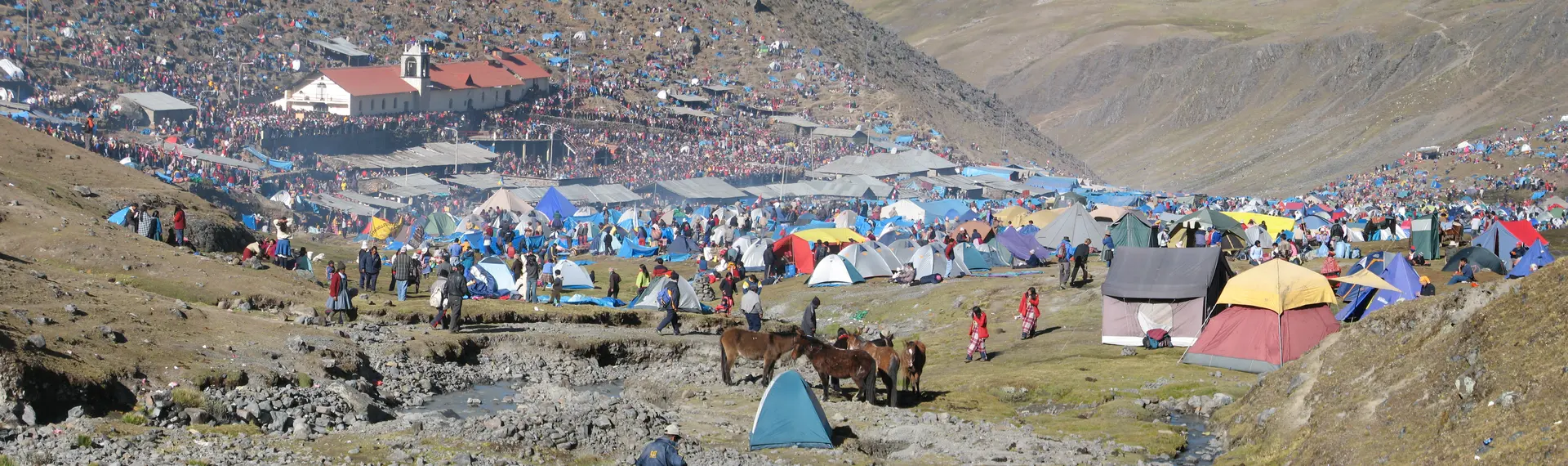
Qoyllur Rit'i sanctuary gathering in the Sinakara hollow. Image source · CC BY-SA 3.0
Station 1 of 1
Qoyllur Rit'i PilgrimageVisit essentials
A quick read before you go
- Duration
- Allow time for current access procedures and for worshippers to have priority; no fixed duration…
- Access
- The sanctuary is at high altitude in a remote mountain environment.
Overview
The sanctuary in the Sinakara hollow is the gathering place of the pilgrimage of the Lord of Qoyllurit'i, inscribed by UNESCO in 2011. The tradition brings Catholic devotion into relationship with pre-Hispanic Andean sacred understandings without making either a decorative backdrop for the other. This page is bounded to the exact sacred place and its cited traditions. It does not convert inherited belief into scientific fact, and it does not treat a living community as scenery for a route checklist.
Why this place is sacred
UNESCO documents eight pilgrim nations—Paucartambo, Quispicanchi, Canchis, Acomayo, Paruro, Tawantinsuyo, Anta, and Urubamba—and a pilgrimage directed by the Council of Pilgrim Nations and the Brotherhood. The safeguarding record assigns community and municipal roles for discipline, routes, sanitation, and environmental care. Pilgrim Map separates documented history, tradition-held meaning, and current visitor information so that uncertainty remains visible.
UNESCO documents eight pilgrim nations—Paucartambo, Quispicanchi, Canchis, Acomayo, Paruro, Tawantinsuyo, Anta, and Urubamba—and a pilgrimage directed by the Council of Pilgrim Nations and the Brotherhood. The safeguarding record assigns community and municipal roles for discipline, routes, sanitation, and environmental care.
The place has continued through changing political, environmental, institutional, and visitor conditions. Present practice is governed by its own community and responsible authorities.
Experience and orientation
Cross processions, dance, music, prayer, and the twenty-four-hour procession toward Tayancani form part of a much larger living event. Pilgrim Map maps the sanctuary rather than inventing a fixed visitor trail through community-governed ritual spaces. Outsiders should not imitate dancers, masks, or ritual roles without invitation. A respectful visit is attentive, unhurried, and willing to remain at a public threshold when a space or action is not clearly open.
The map pin identifies Qoyllorit’i. It is not a live navigation instruction, a ritual script, or permission to enter every nearby space.
Context and lineage
UNESCO documents eight pilgrim nations—Paucartambo, Quispicanchi, Canchis, Acomayo, Paruro, Tawantinsuyo, Anta, and Urubamba—and a pilgrimage directed by the Council of Pilgrim Nations and the Brotherhood. The safeguarding record assigns community and municipal roles for discipline, routes, sanitation, and environmental care.
Andean Catholic pilgrimage with pre-Hispanic sacred traditions
Traditions and practice
Cross processions, dance, music, prayer, and the twenty-four-hour procession toward Tayancani form part of a much larger living event. Pilgrim Map maps the sanctuary rather than inventing a fixed visitor trail through community-governed ritual spaces. Outsiders should not imitate dancers, masks, or ritual roles without invitation.
Living practice and current custodial guidance take priority over descriptions written for visitors.
Listen, follow the community's pace, keep passageways clear, and participate only where the invitation and manner are clear.
Andean Catholic pilgrimage with pre-Hispanic sacred traditions
ActiveThe sanctuary in the Sinakara hollow is the gathering place of the pilgrimage of the Lord of Qoyllurit'i, inscribed by UNESCO in 2011. The tradition brings Catholic devotion into relationship with pre-Hispanic Andean sacred understandings without making either a decorative backdrop for the other.
Cross processions, dance, music, prayer, and the twenty-four-hour procession toward Tayancani form part of a much larger living event. Pilgrim Map maps the sanctuary rather than inventing a fixed visitor trail through community-governed ritual spaces. Outsiders should not imitate dancers, masks, or ritual roles without invitation.
Perspectives and open questions
The profile distinguishes community-held meaning, documented history, heritage description, and a visitor's personal response.
Scholarly perspective
The cited institutional sources establish the page's identity and bounded claims. They do not settle every historical or theological question.
Living and traditional perspectives
Cross processions, dance, music, prayer, and the twenty-four-hour procession toward Tayancani form part of a much larger living event. Pilgrim Map maps the sanctuary rather than inventing a fixed visitor trail through community-governed ritual spaces. Outsiders should not imitate dancers, masks, or ritual roles without invitation.
Alternative interpretations
Personal experiences can be meaningful, but claims of measurable energy, healing, portals, or guaranteed transformation are not presented as facts.
Open questions
Current access, ceremonies, and local conditions can change and require direct confirmation.
Plan your visit
Access and arrival
The sanctuary is at high altitude in a remote mountain environment. Dates follow the religious calendar and current community direction. Use authorized local guidance, prepare for cold and altitude, carry waste out, and follow the Council, Brotherhood, municipalities, and cultural authorities. Past glacier practices must not be generalized into present permission.
Use current local and custodial information; no lodging availability is promised here.
Respectful visit
Choose modest, practical clothing and follow any head-covering, footwear, or gendered-space guidance given locally.
Ask first; no photograph is owed. Avoid worship, children, close ritual activity, restricted interiors, and anyone who has not consented.
Give or receive only in the manner shown by the responsible community; do not leave improvised objects or create waste.
Obey closures, barriers, protected-area rules, security screening, and community direction.
Do not imitate ritual roles, improvise offerings, interrupt prayer, or make supernatural, medical, or safety promises about the place.
Location
Map loads as you approach this section.
Pilgrim reflections
A portrait of encounter, not a score
Pilgrims describe what they felt, how present they could become, and whether the place would shape a journey. There are no stars and no ranking of traditions.
No reviewed reflections yet
The first pilgrims can help describe the character of being here.
Share a reflection
Available after an account-backed “Been there.” Every reflection is reviewed before publication.
Nearby sacred places
Explore other sacred places in the region. Proximity does not establish access or travel time; check each place’s guidance.



References
Sources consulted for this page. Source categories describe the publication, not a guarantee that every claim is verified. Traditional accounts and outside interpretations may differ.
- 01Pilgrimage to the sanctuary of the Lord of Qoyllurit'i — UNESCO Intangible Cultural HeritageSource contextSupports the living pilgrimage, eight nations, dance, processions, community governance, and 2011 inscription.
- 02Community consent and safeguarding coordination for Qoyllurit'i — Council of Pilgrim Nations, Brotherhood, and Peruvian cultural and municipal authorities via UNESCOSource contextSupports community authority, pathway care, discipline, environmental protection, and safeguarding roles.
Share a photo
Help visitors recognize Qoyllorit’i. Every submission is reviewed before publication.