Valle de Sinakara—Quyllurit'i
One hundred thousand pilgrims walk through the night at 4,700 metres, where the Pleiades meet a painted Christ
Understand sacred places, explore living traditions, and learn how to engage respectfully with Pilgrim Map.
Access has not been verified. Check current local guidance before planning a visit.
Ocongate, Cusco, Peru
Read the sources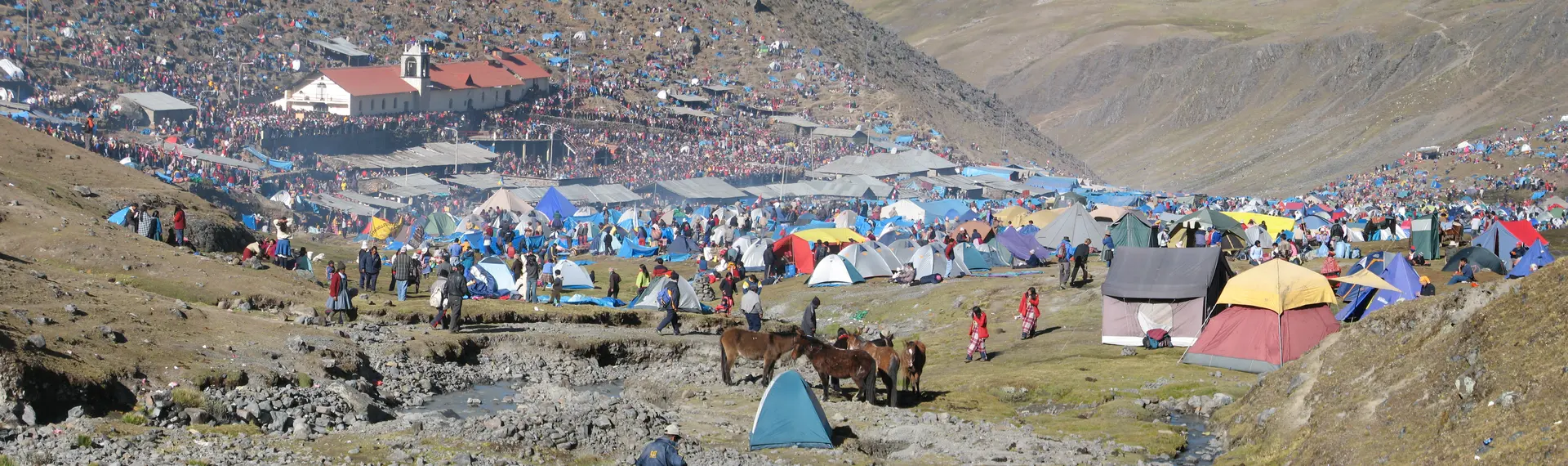
Image of Valle de Sinakara—Quyllurit'i. Image source · CC-BY-SA-3.0
Visit essentials
A quick read before you go
- Duration
- 3-4 days minimum (travel from Cusco, hike in, overnight vigil, return)
- Access
- From Cusco, travel to Mawayani by bus or private transport (3 hours, 127 km).
Overview
The Sinakara Valley sits at 4,700 metres in the Cusco highlands, a glacial hollow beneath the apu Ausangate. For most of the year it is empty — wind, rock, ice, and the particular silence of very high places. Then, in late May or early June, it fills with humanity.
The pilgrimage of Quyllurit'i (Quechua: 'bright white snow') brings together Catholic devotion and Andean cosmological practice without asking either to yield. The Catholic layer tells of a miraculous image of Christ that appeared on a rock in the late eighteenth century, after a mysterious child befriended a shepherd boy named Mariano Mayta.
The Andean layer is older: this is the time when the Pleiades — Qullqa, 'storehouse' in Quechua — reappear above the horizon, signalling that the harvest can begin and the cosmic cycle renew.
The pilgrims walk for three hours uphill from Mawayani to reach the sanctuary. They arrive organised by 'nations' — eight regional groups that preserve pre-colonial social structures within the pilgrimage's Catholic framework. Dance troupes perform through the night: the ukukus (bear dancers) in thick costumes and woollen masks, speaking in high-pitched voices, serving as tricksters, mediators, and spiritual guardians. The Chunchos represent jungle warriors. The Qollas represent highland traders. Bilingual Masses are held in Quechua and Spanish.
Candles burn at the rock. The glacier reflects the dawn.
UNESCO inscribed the pilgrimage on the Intangible Cultural Heritage list in 2011. The ukukus, who once climbed the glacier at night to bring back sacred ice with healing powers, no longer do so — the glacier is retreating. Climate change has altered the ritual, but the pilgrimage continues, adapting as it has for centuries, holding its contradictions together in the cold and the dark.
Why this place is sacred
At 4,700 metres, the air is thin in the literal sense. Breathing requires attention. Cold penetrates to the bone after midnight. The hike in — three hours uphill with a pack — leaves the body in a state of depleted alertness. These are not obstacles to the experience. They are the experience.
Quyllurit'i operates on the principle that transformation requires ordeal. The all-night vigil, the continuous music and dancing of hundreds of troupes, the dawn procession, the sheer presence of 100,000 people in collective devotion in a glacial valley — these conditions dissolve the ordinary separations between self and crowd, between waking and sleeping, between the mundane and whatever the word 'sacred' points toward.
The convergence of two cosmological systems compounds the effect. The pilgrimage does not ask visitors to choose between Christ and the Pleiades, between the Taytacha on the rock and the apu Ausangate above. It holds both. Many pilgrims report weeping without understanding why. The altitude, the cold, the music, and the collective faith produce a state that does not map easily onto everyday categories of experience.
The retreating glacier adds a dimension of grief to the thinness. What was once a source of sacred ice — carried down the mountain by ukukus at dawn, believed to heal — is now a visible index of planetary change. The thinness at Sinakara is not timeless. It is marked by history and by loss.
Pre-Christian astronomical observation of the Pleiades' reappearance, later merged with Catholic pilgrimage following the reported miraculous appearance of Christ's image on the rock (c. 1780). The site's selection reflects both its astronomical suitability and its proximity to the apu Ausangate.
The pre-Christian stellar celebration was syncretised with Catholic pilgrimage tradition in the late eighteenth century. The festival has grown in scale over the past two centuries, from a regional devotion to South America's largest indigenous pilgrimage. The glacier ice collection ritual, which was a central practice, has been discontinued due to glacial retreat from climate change — one of the most visible cases of environmental loss altering a sacred tradition.
Experience and orientation
Leave Cusco before dawn. Drive three hours to Mawayani. Begin walking uphill at the trailhead — eight to nine kilometres of steady ascent into thinning air, surrounded by other pilgrims making the same journey. Arrive at the Sinakara sanctuary in late afternoon. The valley opens into a glacial hollow with the rock sanctuary at its centre and Ausangate's glaciers above.
As darkness falls, the night begins. Hundreds of dance troupes perform continuously — ukukus in their bear costumes, Chunchos with jungle feathers, Qollas with their highland trader masks, Saqras and Contradanzas and dozens more. The music does not stop. Candles burn at the rock where Christ's image appears. Bilingual Masses are held through the night. The cold deepens toward midnight and beyond. The stars appear with the intensity that only 4,700 metres of altitude provides.
Toward dawn, the processions begin — the sacred image carried through the gathered thousands, the ukukus ascending toward the glacier's edge (no longer collecting ice but carrying candles), the first light touching the ice. Many pilgrims describe this moment — dawn in the glacial valley after a night of exhaustion, cold, music, and collective devotion — as unlike anything they have experienced.
The descent begins in daylight. The valley that filled with 100,000 people empties again. Sinakara returns to wind and silence.
This is not a casual visit but a pilgrimage requiring preparation. Acclimatise for 2-3 days in Cusco before attending. Join a guided group for safety and cultural context. Bring winter-grade sleeping gear (rated to -15 degrees Celsius), warm layers, headlamp, sun protection, and plenty of water. The physical ordeal is not incidental — it is the method.
Context and lineage
The Catholic narrative tells of Mariano Mayta, a shepherd boy who befriended a mysterious child near the rock at Sinakara in the late eighteenth century. When authorities tried to seize the child, they found only an image of Christ embedded in the rock, and Mariano died. The rock became the Taytacha — 'beloved father.'
The Andean narrative is older and does not require this story: the valley was already a site of stellar observation where the Pleiades' reappearance was celebrated as the beginning of the agricultural year. The pilgrimage holds both accounts without requiring reconciliation.
Pre-Christian astronomical observation at Sinakara, syncretised with Catholic pilgrimage tradition in the late eighteenth century. Inscribed on UNESCO's Intangible Cultural Heritage list in 2011. The glacier ice collection by ukukus has been discontinued due to climate change, but the pilgrimage itself continues and grows.
Mariano Mayta
Shepherd boy at the centre of the Catholic origin narrative
Traditions and practice
Night-long vigils watching for the Pleiades, continuous performance by costumed dance troupes (ukukus, Chunchos, Qollas, and others), Mass at the rock sanctuary, candle offerings, dawn processions, formerly glacier ice collection by ukukus at dawn — the ice was believed to have healing powers and to bring blessings.
The pilgrimage structure remains intact. Pilgrims arrive organised by eight regional nations. Bilingual Masses (Quechua-Spanish) are held through the night. Dance troupes perform continuously. The ice collection ritual has been replaced by carrying candles to the glacier's edge. Approximately 100,000 pilgrims attend annually.
Attend as a pilgrim, not as a tourist. Join a guided group. Participate in what is open to all: candle lighting at the rock, attendance at the bilingual Masses, witnessing the dawn processions. Do not attempt to join a dance troupe — this requires a multi-year commitment and community acceptance. Allow the night's ordeal to work on you without trying to understand it rationally.
Andean stellar cosmology
ActiveThe pilgrimage coincides with the reappearance of the Pleiades (Qullqa), signalling the harvest and the Andean new year
Night-long vigils, music and dance, offerings to the apus and Pachamama
Catholic pilgrimage
ActiveThe Taytacha — Christ's image on the rock — draws Catholic devotion that is inseparable from the Andean layer
Mass, candle lighting, processions, veneration of the sacred rock
Ukuku (bear dancer) tradition
ActiveThe ukukus serve as spiritual guardians, tricksters, and mediators between the human and more-than-human worlds
Masked dance in bear costumes, high-pitched speech, whip-carrying to enforce rules, night vigils. Glacier ice collection has been discontinued.
Perspectives and open questions
Quyllurit'i resists interpretation from the outside. It is simultaneously a Catholic pilgrimage, an indigenous astronomical celebration, a social gathering of 100,000 people, and an ordeal that dissolves the categories visitors bring to it.
Scholarly perspective
Anthropologists recognise Quyllurit'i as a premier example of Andean-Catholic syncretism, where indigenous astronomical observation (the Pleiades cycle) merged with Catholic pilgrimage tradition. The festival's social organisation through eight nations preserves pre-colonial regional structures. The discontinuation of the glacier ice collection ritual due to climate change has been studied as one of the most visible cases of environmental loss altering sacred practice.
Living and traditional perspectives
In Andean cosmology, the pilgrimage renews the relationship between humans, the star world (the Pleiades as Qullqa), the apus (Ausangate and Sinakara), and Pachamama. The all-night vigil and physical ordeal are not obstacles but the means through which transformation occurs. The ukukus mediate between the human and more-than-human worlds — their half-bear nature placing them at a boundary that human form alone cannot cross.
Alternative interpretations
The transformative quality of Quyllurit'i does not require esoteric explanation. The physical conditions — altitude, cold, exhaustion, collective devotion, continuous music through the night — produce altered states without recourse to metaphysical frameworks. Whether these states are 'merely' physiological or genuinely spiritual is a question the pilgrimage does not answer, because it does not ask.
Open questions
The precise pre-Christian form of the stellar celebration at Sinakara is not fully recoverable. The long-term impact of glacial retreat on the pilgrimage's meaning and practice remains an open question — how does a tradition centred on ice adapt to a warming world? The internal governance of the eight nations and their relationship to older Inca provincial structures warrants further study.
Plan your visit
Access and arrival
From Cusco, travel to Mawayani by bus or private transport (3 hours, 127 km). From Mawayani, hike 8-9 km uphill to the sanctuary (2.5-3 hours). Altitude: 4,700 m. Acclimatise 2-3 days in Cusco beforehand. Guided tours strongly recommended for safety and cultural context. No formal permits required.
Camping at the festival site — bring your own tent and sleeping bag rated to -15 degrees Celsius minimum. No formal accommodation at Sinakara. Basic lodging available in Ocongate (the nearest town).
Respectful visit
Survival gear: thermal layers, windproof jacket, winter hat, gloves, scarf. This is not a dress code but a safety requirement.
Permitted but should be respectful and discreet. No flash during ceremonies. Ask before photographing individuals or troupes closely.
Candle lighting at the rock sanctuary is open to all visitors.
No alcohol — enforced by ukukus | Respect the governance of the eight nations | Do not treat the pilgrimage as a spectacle | Follow festival rules or face ukuku enforcement | Do not approach the glacier beyond designated areas
This pilgrimage is physically demanding and potentially dangerous. Altitude (4,700 m), extreme cold (-10 degrees Celsius at night), and the all-night vigil require serious preparation. Bring winter-grade gear. A sleeping bag rated to -15 degrees Celsius is essential. Acclimatise in Cusco for at least 2-3 days. The hike in is 8-9 km uphill. This experience is not suitable for those with altitude sensitivity or cardiovascular concerns.
Current practical details
Address
FQ37+FX4, Mahuayani 08170, Peru
Hours, fees, and access can change — verify on the official source before you travel. Practical details last checked Jun 2026.
Location
Map loads as you approach this section.
Pilgrim reflections
A portrait of encounter, not a score
Pilgrims describe what they felt, how present they could become, and whether the place would shape a journey. There are no stars and no ranking of traditions.
No reviewed reflections yet
The first pilgrims can help describe the character of being here.
Share a reflection
Available after an account-backed “Been there.” Every reflection is reviewed before publication.
Nearby sacred places
Explore other sacred places in the region. Proximity does not establish access or travel time; check each place’s guidance.



References
Sources consulted for this page. Source categories describe the publication, not a guarantee that every claim is verified. Traditional accounts and outside interpretations may differ.
- 01Pilgrimage to the sanctuary of the Lord of Qoyllurit'i — UNESCO Intangible Cultural HeritageofficialOfficial UNESCO listing with detailed description
- 02The Glacier, the Rock, the Image: Emotional Experience and Semiotic Diversity at the Quyllurit'i Pilgrimage — ResearchGate publicationacademicAcademic study of emotional and semiotic experience at the pilgrimage
- 03Quyllurit'i - Wikipedia — Wikipedia contributorsencyclopediaComprehensive overview of the festival, its origins, and traditions
- 04The ULTIMATE Guide to Peru's Snow Star Festival — Apus PeruguideDetailed logistics and visitor experience guide
- 05The Qoyllur Rit'i Festival - A Peruvian Religious Pilgrimage — Kuoda TravelguideOverview of the festival with emphasis on ukukus and syncretism
- 06An Unforgettable Pilgrimage to Quyllurit'i — Dos Manos Peru TravelguideFirst-person visitor account with cultural context
- 07Lord of Qoyllurit'i 2025 - Complete guide — Kantu Peru ToursguidePractical logistics and cultural overview
Share a photo
Help visitors recognize Valle de Sinakara—Quyllurit'i. Every submission is reviewed before publication.