Monastery of The Blessed Virgin Mary (Al Muharraq)
The Second Bethlehem, where the infant Christ dwelt longest during the Holy Family's flight into Egypt
Understand sacred places, explore living traditions, and learn how to engage respectfully with Pilgrim Map.
Access has not been verified. Check current local guidance before planning a visit.
El Quseya (Al-Qusiyah), Asyut, Egypt
Read the sources
Visit essentials
A quick read before you go
- Duration
- Half day to full day.
- Access
- The monastery is approximately 60 km from Asyut (1 hour drive) and 15 km southwest of…
Overview
Deir el-Muharraq rises from the Egyptian desert as Christianity's Second Bethlehem. According to Coptic tradition, this is where the infant Jesus spent the longest duration of the Holy Family's Egyptian sojourn, approximately six months at the foot of Mount Koskam. The stone where the child Christ rested became the altar of the monastery's ancient church, which Coptic tradition holds is the first church in Christendom, predating all others.
The monastery's location is not accidental. Coptic tradition identifies this spot as the exact geographical center of Egypt, fulfilling Isaiah's prophecy: 'In that day there will be an altar to the LORD in the midst of the land of Egypt.' It was at this very place that the angel appeared to Joseph in a dream, declaring that those who sought the young child's life were dead and commanding the family's return to Israel.
This divine message marked the turning point of salvation history, the moment when exile ended and the path to Bethlehem, then Nazareth, then ultimately Golgotha opened before the child who would become mankind's redeemer.
Today, approximately one hundred monks maintain this tradition in one of Egypt's most active monasteries. The community preserves Coptic liturgical language with particular care, offers hospitality to the thousands who visit annually, and continues the ancient rhythms of prayer and celebration that have characterized this site for over seventeen centuries.
Five churches, a fortress, a library, and extensive facilities spread across thirty acres at the desert's edge, creating a self-contained sacred city dedicated to Mary and the memory of her Son's Egyptian dwelling.
Why this place is sacred
The thinness of Deir el-Muharraq begins with presence. According to Coptic tradition, the infant Jesus lived here for six months, not merely passing through but dwelling in this place. Every stone, every grain of sand, was blessed by his daily presence. The cave where the family sheltered remains beneath the ancient church, accessible to those who descend into its darkness.
To enter that space is to enter the same shelter that protected the holy family from the Egyptian sun and the threat of Herod's reach.
The altar of the Church of the Virgin stands, tradition holds, on the exact spot where the infant Jesus rested. This is not a replica or a memorial but the same stone, sanctified by contact with Christ's body. When the Eucharist is celebrated here, it occurs on what believers consider the oldest and holiest altar in Christianity. The liturgy becomes a continuation across two millennia, the same sacrifice offered on the same stone where the infant Savior once lay.
The angelic visitation adds another dimension. This is where Joseph received divine instruction, where the trajectory of salvation history shifted from flight to return. The angel's message marked the end of exile and the beginning of the path that would lead to Christ's ministry, passion, and resurrection. To stand here is to stand at a hinge point in the Christian narrative.
Seventeen centuries of monastic prayer have layered devotion upon this foundation. The monks' continuous liturgical cycle, the countless pilgrims' prayers, the tears and thanksgivings of generations have accumulated into an atmosphere that visitors consistently describe as powerful. The Coptic language, preserved here longer than at any other monastery, adds its ancient resonance. Ethiopian Christians' centuries of connection, their own fasting and pilgrimage traditions, have contributed another stream of devotion.
All of this concentrates at the foot of Mount Koskam in a place that, for believers, remains as thin as any in the Christian world.
To mark and venerate the dwelling place of the Holy Family during their Egyptian sojourn, and the site of the angelic command to return to Israel.
From the original cave-church, the site developed into a major monastery by the late fourth century. The current Church of the Virgin dates primarily from the twelfth century with later additions. Ethiopian monks established a significant presence from the fourth century onward, building their own churches within the complex. Despite the 2013 arson attack during broader anti-Coptic violence, the monastery has recovered and continues its ancient mission.
Experience and orientation
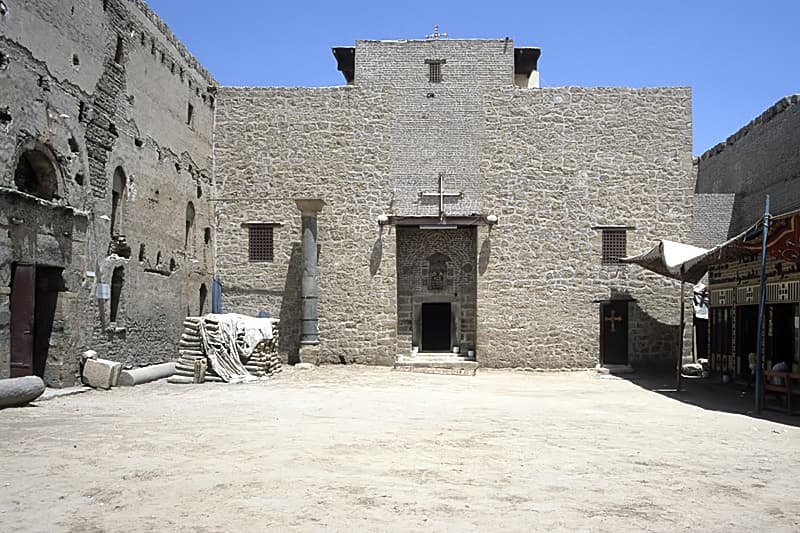
Approaching Deir el-Muharraq through the agricultural lands of Upper Egypt, the monastery appears as an oasis of ancient walls and domes against the desert backdrop. The massive entrance gate marks the transition from secular to sacred space. Inside, visitors encounter a self-contained world of churches, gardens, monastic quarters, and pilgrim facilities spread across thirty acres.
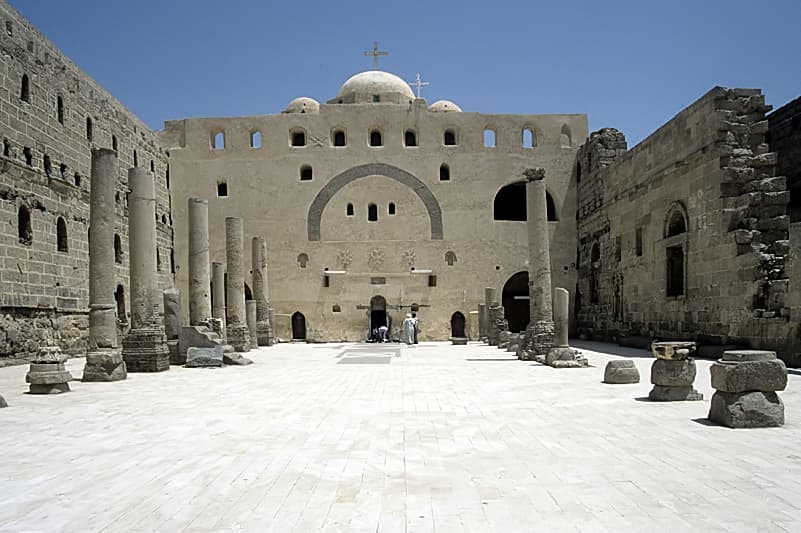
The Church of the Virgin draws pilgrims to its ancient altar. The interior, with its three domes built in the sixteenth century, encloses a space dense with devotion. Icons cover the walls. The smell of incense lingers. Pilgrims approach the altar area with palpable reverence, aware that tradition holds this to be the stone where the infant Jesus rested.
Beneath the church, the cave where the Holy Family sheltered can be visited, offering a moment of profound intimacy with the site's origins.
The atmosphere during liturgical celebrations intensifies the experience. The Coptic language, which the monks here have preserved with particular care, fills the space with sounds that reach back to Egypt's earliest Christians. The chanting, the incense, the ritual movements create an environment where time seems suspended. Visitors often describe a sense that the walls between centuries grow thin, that the same prayers offered by fourth-century monks continue to resonate.
The annual ten-day feast in June draws thousands of pilgrims. During this period, the monastery transforms into a concentrated expression of Coptic faith. Special liturgies, processions, communal meals, and continuous prayer create an atmosphere that pilgrims describe as spiritually overwhelming. The feast commemorates the consecration of the Church of the Virgin, but for many participants, it is an encounter with the living reality of the Holy Family's presence.
Beyond the main church, four additional churches, the ancient fortress, the library, and the monastery's other facilities offer further exploration. The hospitality of the monks, the peace of the gardens, the silence of the desert edge all contribute to an experience that combines active pilgrimage with contemplative retreat.
Deir el-Muharraq lies approximately 60 km from Asyut and 15 km southwest of Al-Qusiyah, at the foot of Mount Koskam. The complex covers about 30 acres (12.5 hectares). Expect considerable walking on uneven terrain. The monastery welcomes visitors but is first and foremost an active monastic community. Security checkpoints may be present.
Context and lineage
According to Coptic tradition based on ancient manuscripts and oral tradition, the Holy Family fled to Egypt to escape King Herod's massacre of infants in Bethlehem. After traveling through various sites where miracles occurred, they came to rest in a cave at Mount Koskam. Here they lived for 185 days, the longest stay of their journey. The infant Jesus blessed this place, and the cave where He rested became the altar of the first church.
An angel of the Lord appeared to Joseph in a dream, saying: 'Arise, take the young Child and His mother, and go to the land of Israel, for those who sought the young Child's life are dead.'
The monastery's Arabic name, Al-Muharraq (meaning 'burned'), has two traditional explanations. One holds that it was partially burned by foreign invaders during the medieval period. Another tradition states that the surrounding area was used for burning harmful weeds and crops.
The monastery belongs to the Coptic Orthodox Patriarchate of Alexandria. Approximately 100 monks practice Koinonia (community) monasticism in the Pachomian tradition. Ethiopian Orthodox Christians have maintained a presence here since the fourth century, building their own churches within the complex.
The Holy Family
Virgin Mary, the infant Jesus, Joseph the Carpenter, and their helper Salome
Pachomian Monks
Fourth-century founders of the monastic community
Queen Mentowab of Ethiopia
Eighteenth-century Ethiopian monarch
Traditions and practice
The Divine Liturgy at the ancient altar in the Church of the Virgin continues the practice of Eucharistic celebration where tradition holds the infant Jesus rested. Pilgrims venerate this altar and the cave beneath the church. The annual feast (Moulid) from June 18-28 commemorating the church's consecration draws thousands for ten days of special liturgies, processions, and celebration. All Coptic Orthodox feasts are observed throughout the liturgical year.
Daily liturgical prayers follow the complete Coptic cycle, with the monks uniquely preserving the Coptic liturgical language. Pilgrims visit throughout the year as part of the Holy Family Trail through Egypt. Ethiopian Christians continue their pilgrimage tradition, particularly around the time commemorating the Holy Family's arrival. The monastery offers hospitality to all visitors, maintaining the ancient Christian practice of welcome.
Visit outside the annual feast (June 18-28) for quieter access to the churches and more personal prayer time. If seeking the most intense spiritual experience, the feast offers unparalleled communal devotion but very limited individual space. Time your visit to observe at least part of a liturgical service. Visit the cave beneath the Church of the Virgin. Walk the monastery grounds to appreciate the full scope of this sacred complex.
Coptic Orthodox Christianity
ActiveDeir el-Muharraq holds supreme importance in Coptic Christianity as the site where the Holy Family resided for approximately six months during their flight into Egypt. The altar of the Church of the Virgin stands on the exact spot where the infant Jesus rested, fulfilling Isaiah's prophecy about an altar in the midst of Egypt. The monastery is called the Second Bethlehem because the angel appeared here commanding the family's return to Israel. Pilgrimage here equals pilgrimage to Jerusalem in spiritual merit.
Daily liturgical prayers in Coptic, annual ten-day feast (June 18-28), celebration of all Coptic Orthodox feasts, veneration at the ancient altar, reception of pilgrims seeking healing and spiritual renewal.
Ethiopian Orthodox Christianity
ActiveEthiopian Christians have maintained profound connection with Deir el-Muharraq since the fourth century, when Ethiopian monks first arrived at Mount Koskam. The monastery served as a waystation for Ethiopian pilgrims traveling to Jerusalem. Queen Mentowab of Ethiopia took sand from here to mix with building materials for a church in Gondar. The Ethiopian Orthodox Church observes the forty-day Qosqam Fast in honor of the Holy Family's stay.
Qosqam Fasting (forty-day fast), pilgrimage from Ethiopia, historical presence of Ethiopian monks (reaching 40 in the nineteenth century), Ethiopian churches built within the monastery complex.
Perspectives and open questions
Deir el-Muharraq represents the spiritual heart of the Holy Family's Egyptian journey, venerated by Coptic and Ethiopian Christians as a place of supreme sanctity.
Scholarly perspective
Scholars recognize Deir el-Muharraq as one of the oldest continuously operating monasteries in Egypt, with origins in the fourth-century Pachomian monastic movement. The physical altar stone is dated by inscription to 747 CE. While traditions about the Holy Family's stay are matters of faith rather than archaeological evidence, the monastery's historical significance to Coptic Christianity is well-documented. The site's importance as a pilgrimage center is attested in medieval sources including Al-Maqrizi's fifteenth-century documentation.
Architectural studies confirm the layered construction of the Church of the Virgin, with the present building likely dating to the twelfth century with later additions.
Living and traditional perspectives
Within Coptic Orthodox understanding, Deir el-Muharraq is among the holiest sites in Christianity. The altar stands on the exact spot where the infant Christ rested, making it the first altar in Christendom. The monastery's location at Egypt's geographical center fulfills Isaiah's prophecy about an altar to the LORD in the midst of Egypt. This is the Second Bethlehem where the angelic message of return was received.
For Ethiopian Orthodox Christians, the site holds similar profound significance, leading to their centuries-long presence and the establishment of the Qosqam Fast, a forty-day observance honoring the Holy Family's stay.
Alternative interpretations
Some spiritual seekers view the monastery as a powerful thin place where the veil between earthly and divine realms is particularly permeable due to concentrated spiritual energy accumulated over two millennia. The site's location at Egypt's center is sometimes interpreted through sacred geography frameworks suggesting intentional placement along earth energy lines.
Open questions
The exact nature and extent of the original cave beneath the Church of the Virgin remains incompletely documented. Whether any physical evidence from the first-century period exists beneath current structures is unknown. The full history of the altar stone before 747 CE is uncertain. The precise routes by which Ethiopian monks historically traveled to the monastery are not fully recorded. Whether the monastery's location truly corresponds to the mathematical center of ancient Egypt has not been definitively demonstrated.
Plan your visit
Access and arrival
The monastery is approximately 60 km from Asyut (1 hour drive) and 15 km southwest of Al-Qusiyah. From Cairo, approximately 327 km south (4-5 hours). Public transport is limited. Hiring a taxi or arranging private transport from Asyut is most practical. The monastery provides parking.
The monastery has limited guest facilities for pilgrims. Most visitors stay in Asyut and make day trips. Simple accommodations are available in Al-Qusiyah.
Respectful visit
Modest clothing covering shoulders and knees. Women should wear long skirts or trousers and cover their heads inside churches. Men should wear long trousers and shirts with sleeves. Remove shoes if requested.
Generally restricted inside churches and during services. Always ask permission. Never photograph monks or pilgrims without consent. Exterior photography usually permitted.
Donations to the monastery are welcome. Candles may be lit at designated locations. Material offerings should be given to monks or placed in donation boxes.
{"Respect monastic privacy","Maintain silence in sacred spaces","Do not enter restricted areas","Women excluded from some spaces","No alcohol or smoking","Silence mobile phones","Non-pilgrim visitors may be excluded during annual feast"}
During the annual feast (June 18-28), non-pilgrim visitors may not be admitted due to crowds. Security checkpoints require identification. Some areas are restricted for monastic privacy. Women may be excluded from certain spaces. Liturgical services can be lengthy. The summer months are extremely hot in Upper Egypt.
Current practical details
Address
9QMH+XPH، شارع بيت بو عبد، El-Ansar, El Qusiya, Assiut Governorate 2132117, Egypt
Hours
Hours, fees, and access can change — verify on the official source before you travel. Practical details last checked Jun 2026.
Location
Map loads as you approach this section.
Pilgrim reflections
A portrait of encounter, not a score
Pilgrims describe what they felt, how present they could become, and whether the place would shape a journey. There are no stars and no ranking of traditions.
No reviewed reflections yet
The first pilgrims can help describe the character of being here.
Share a reflection
Available after an account-backed “Been there.” Every reflection is reviewed before publication.
Nearby sacred places
Explore other sacred places in the region. Proximity does not establish access or travel time; check each place’s guidance.

References
Sources consulted for this page. Source categories describe the publication, not a guarantee that every claim is verified. Traditional accounts and outside interpretations may differ.
- 01St. Mary's Monastery Muharraq, Mount Qesqam, Assiut - Coptic Orthodox Church — Coptic Orthodox ChurchofficialOfficial church documentation of the monastery
- 02Al-Muharraq Monastery Official Website — Al-Muharraq MonasteryofficialPrimary source from the monastery itself
- 03The Holy Virgin Mary Ancient Church — Al-Muharraq MonasteryofficialDetailed information about the ancient church architecture
- 04Dayr al-Muharraq | Holy Family in Egypt — Holy Family in Egypt ProjectofficialOfficial Holy Family pilgrimage route documentation
- 05Egypt: Mass Attacks on Churches — Human Rights WatchSource contextDocumentation of 2013 attacks on Coptic sites
- 06The Holy Family in its Journey to Egypt — State Information Service, EgyptofficialEgyptian government documentation of Holy Family sites
- 07Deir el-Muharraq - Wikipedia — Wikipedia contributorsencyclopediaComprehensive overview with historical and archaeological details
- 08A rare spiritual experience at Egypt's oldest monastery — Marc Espanol, The Arab WeeklyacademicIn-depth journalistic account with monastery visit
- 09Deir Al Muharraq - Lonely Planet — Lonely PlanetSource contextEstablished travel resource with practical information
- 10Muharraq Monastery: A pilgrimage point to the Ethiopians — Blessed EgyptofficialDocumentation of Ethiopian Christian connection
Photo gallery
3 curated photos
Share a photo
Help visitors recognize Monastery of The Blessed Virgin Mary (Al Muharraq). Every submission is reviewed before publication.