White Monastery, Sohag, Egypt
Where Saint Shenouda built a city of monks and shaped the soul of Coptic Christianity
Understand sacred places, explore living traditions, and learn how to engage respectfully with Pilgrim Map.
Access has not been verified. Check current local guidance before planning a visit.
Suhaj, Sohag, Egypt
Read the sources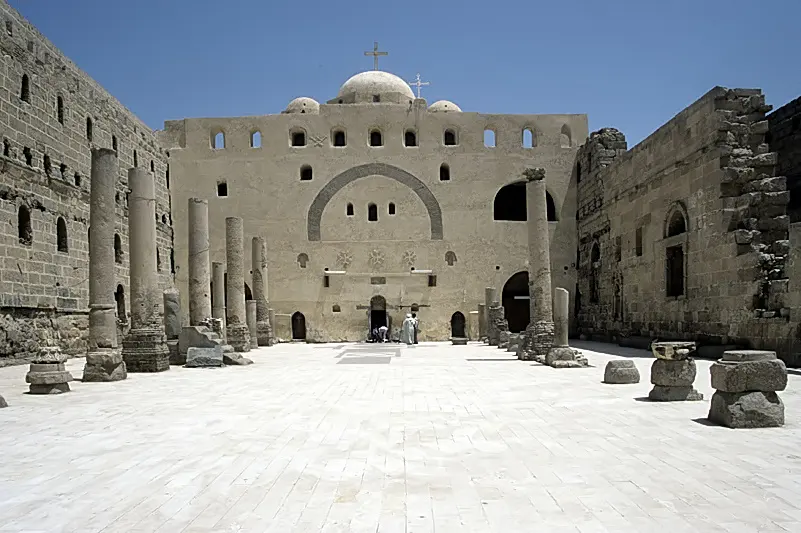
Visit essentials
A quick read before you go
- Duration
- 1-2 hours to explore the church and monastery grounds.
- Etiquette
- As an active Coptic monastery, modest dress and respectful behavior are required.
Overview
White limestone walls rise from green fields at the desert edge, built partly from pharaonic temples whose hieroglyphs remain visible. Roman basilica form, transported Egyptian columns, Byzantine liturgy, and the Coptic language Shenouda developed for sacred writing meet here.
Saint Shenouda the Archimandrite inherited thirty monks from his uncle Pigol in 385 CE. By his death around 465, his federation held more than four thousand monastics across nearly thirteen thousand acres, with separate men's and women's houses under his rigorous, caring discipline. Its thousand-plus-codex library, mostly Sahidic Coptic, supported his literary work, while care for poor people and refugees sometimes drew tens of thousands.
Shenouda's church is a major monument of Christian antiquity. A triple-apsed triconch sanctuary, ancient nave columns, and classical acanthus capitals recall a center whose influence reached Ethiopia, Nubia, and Byzantium.
After the 641 Muslim conquest, centuries of taxation weakened the federation; Mamluks burned the remainder in 1798, leaving the stone church. Monks from Saint Antony's resettled it in 1975. Each July, thousands now attend Shenouda's mulid, continuing sixteen centuries of devotion—interrupted, but never broken.
Why this place is sacred
The White Monastery has held prayer for more than sixteen hundred years. Even through decline, someone maintained worship; walls absorbed incense, liturgy, pilgrimage, the 1798 burning, near-emptiness, and renewed monastic devotion.
Shenouda's body rests somewhere in the complex. Coptic Christians understand saints as present at their tombs, so prayer here seeks the intercession of a continuing protector of Egyptian Christianity.
More than a thousand codices, chiefly Sahidic Coptic, once formed its library. Monks copied scripture, patristic theology, and community canons in the language Shenouda perfected for faith; those manuscripts are now dispersed worldwide.
For several July days, thousands at the mulid restore the site's role as an Egyptian Christian gathering place and assertion of enduring heritage. On ordinary days, church scale, ancient columns, hieroglyphic blocks, green desert edge, and monks sustaining a Roman-era vocation combine into its atmosphere.
The White Monastery served as the headquarters of a vast monastic federation, housing over two thousand monks while coordinating the work of additional thousands in satellite monasteries. The church was built for liturgical worship on a monumental scale. The library preserved and transmitted Christian literature in Coptic. The agricultural lands supported both the monastic community and extensive charitable work with the poor.
After Shenouda's death, the monastery continued under his successors, Saints Wissa and Zenobius. Armenian monks resided here in the 11th-12th centuries. The Islamic conquest brought gradual decline through taxation. The Mamluk burning in 1798 reduced the monastery to its church. In 1975, monks from Saint Antony's at the Red Sea resettled the site, beginning its modern revival. Today the monastery functions as an active place of worship and pilgrimage.
Experience and orientation
Massive white walls rise from green fields, with hieroglyphic blocks, ancient columns, and pharaonic cavetto molding incorporated rather than erased. Inside, a basilica built for thousands leads between temple-sourced columns toward a triple-apsed sanctuary.
Visitors often feel sixteen centuries of continuity: today's liturgy descends from Shenouda's 5th-century worship, prayers retain the Coptic language he perfected, and monastic life follows his canons.
For several July days, the mulid brings thousands of camping pilgrims, special liturgies, processions, and communal celebration. It turns a historical visit into participation in the gathering community Shenouda built.
The White Monastery rewards context. Reading about Saint Shenouda before your visit, understanding his role in Coptic Christianity, knowing that the hieroglyphic blocks came from temples and the columns from ruins, all of this deepens what you encounter. Consider combining the visit with the nearby Red Monastery, which preserves extraordinary painted decorations from the same period.
If possible, attend during the mulid in July. The ordinary experience of the monastery, significant though it is, cannot compare to the pilgrimage atmosphere when thousands gather to honor Saint Shenouda. The heat will be intense, but the experience is irreplaceable.
Context and lineage
Saint Pigol, an ascetic monk, founded a small settlement on approximately five acres in the late 4th century. His nephew Shenouda entered the monastery as a boy and eventually succeeded him as abbot around 385 CE. At that time, only about thirty monks lived there. Under Shenouda's 66-year leadership, the community expanded to over two thousand monks with eighteen hundred nuns in affiliated houses, spread across nearly thirteen thousand acres.
Shenouda built the monumental basilica that survives today, using white limestone that gives the monastery its name. Much of the stone came from nearby pharaonic temples, their hieroglyphs still visible in the walls. The construction technique alternated stone and wood layers for earthquake resistance. Ancient Egyptian columns were transported to the site and erected in the nave.
The monastery library grew to over a thousand codices, mostly in Sahidic Coptic. Shenouda championed this dialect for literary use, perfecting it as a vehicle for theology, hagiography, and scripture. Many manuscripts later dispersed to European collections preserve works that would otherwise be lost.
The monastery's lineage runs through Shenouda's immediate successors, Saints Wissa (Besa) and Zenobius, through centuries of declining population under Islamic rule, through the Armenian monks who resided here in the 11th-12th centuries, through near-abandonment, through the Mamluk burning of 1798, to the modern resettlement by monks from Saint Antony's at the Red Sea in 1975. The current community represents renewal after near-extinction.
Saint Shenouda the Archimandrite
founder
The legendary abbot who led the monastery for 66 years, expanded it into a federation of thousands, championed the Coptic language, defended orthodoxy at the Council of Ephesus, and cared for the poor with legendary generosity. Died around 465 CE at approximately 118 years of age.
Saint Pigol
founder
Shenouda's uncle, who founded the original small monastery in the late 4th century. His vision initiated what his nephew would transform.
Patriarch Cyril of Alexandria
ecclesiastical leader
The patriarch who invited Shenouda to accompany him to the Council of Ephesus in 431 CE, where they successfully opposed Nestorian Christology.
Traditions and practice
The monastery developed the patterns of cenobitic (communal) monasticism that Shenouda established in his Canons. These emphasized organized community life, mandatory literacy, strict discipline, and care for the poor. The Divine Liturgy followed the ancient Coptic rite. The library supported study of scripture and theological texts. The monastic hours structured daily life around prayer.
Daily Coptic Orthodox prayers and regular liturgical services continue in the Church of Saint Shenoute. The Divine Liturgy follows the ancient forms, conducted in Coptic and Arabic. Monks maintain the cycle of daily offices. Visitors are welcome to observe or, if Orthodox, to participate. The mulid of Saint Shenouda on 7 Abib (July 14) draws thousands of pilgrims for several days of celebration including special liturgies, processions, and communal festivities.
For meaningful engagement with the White Monastery, consider these approaches:
Visit during the mulid if at all possible. The pilgrimage atmosphere transforms understanding of what the monastery is and what it means to those who cherish it.
Attend a liturgical service if your schedule permits. The Coptic liturgy, sung in ancient languages in this ancient space, reveals dimensions that silent tourism cannot capture.
Combine with a visit to the nearby Red Monastery. The two sites together demonstrate the breadth of the Shenoutean federation and the range of early Coptic artistic achievement.
Read about Saint Shenouda before you come. His personality, his achievements, his place in Coptic Christianity, all of this context enriches the encounter.
Coptic Orthodox Christianity
ActiveThe White Monastery is one of the most important monastic sites in Coptic Christianity, founded in the late 4th century and brought to its zenith by Saint Shenouda the Archimandrite. Under Shenouda's 66-year leadership, it became one of the largest monastic federations in Egypt. Saint Shenouda perfected the Sahidic Coptic literary dialect, defended orthodoxy at the Council of Ephesus, and opposed paganism. The monastery's library once held over a thousand codices. Today, the site remains a living testament to Coptic spiritual and cultural heritage.
Daily Coptic Orthodox liturgy in the Church of St. Shenoute. Annual mulid of Saint Shenouda on 7 Abib (July 14) draws thousands of pilgrims. Pilgrimage and veneration of Saint Shenouda throughout the year. Coptic prayers and devotions. Monastic life continues with resident monks.
Desert Monasticism (Cenobitic)
ActiveThe White Monastery represents a crucial development in Christian cenobitic (communal) monasticism. Unlike the solitary anchorites of earlier Egyptian Christianity, Shenouda's federation emphasized organized community life with strict rules, communal labor, mandatory literacy, and centralized discipline across multiple monasteries. This model influenced monastic organization throughout the Christian world.
Communal living under strict monastic rule. Mandatory literacy and scriptural study. Agricultural labor and crafts. Ascetic discipline including fasting and prayer. Care for the poor and refugees.
Perspectives and open questions
The White Monastery invites interpretation from multiple angles. Scholars recognize it as one of the most important sites for understanding late ancient Christianity and Egyptian monasticism. Coptic Christians understand it as the living heritage of their tradition. Visitors encounter both dimensions simultaneously.
Scholarly perspective
Scholars recognize the White Monastery as one of the most important sites for understanding late ancient Christianity and Egyptian monasticism. Shenouda's extensive writings provide unparalleled insight into cenobitic community life, ascetic discipline, and theological controversies of the 5th century. The monastery's architecture demonstrates the transition from paganism to Christianity in Egypt, with pharaonic temple stones incorporated into the basilica. Archaeological work has revealed multiple building phases and confirmed the site's significance for art history, epigraphy, and material culture.
Shenouda is recognized as the greatest native writer in the Coptic language and a crucial figure in shaping both Egyptian Christian identity and the Coptic linguistic tradition.
Living and traditional perspectives
In Coptic Orthodox understanding, Saint Shenouda is among the greatest of the church's saints, a desert father whose ascetic rigor, theological wisdom, and pastoral care set the standard for Egyptian monasticism. His 118-year life and 66-year abbacy demonstrate divine blessing. The White Monastery remains a holy place animated by his spiritual presence, where pilgrims seek his intercession and blessing. The annual mulid celebrates not just a historical figure but a living saint who continues to guide and protect the faithful.
Open questions
Genuine mysteries remain. The exact date and circumstances of the monastery's founding by Saint Pigol are uncertain. The full extent of the original monastic complex and its organization across nearly thirteen thousand acres is not fully mapped. The dispersal and current locations of the monastery's thousand-plus codices across world libraries and collections remain incompletely documented. The precise nature of the relationship between the White Monastery, Red Monastery, and women's monastery at Atripe under Shenouda's federation is not fully understood.
Plan your visit
Access and arrival
Sohag offers basic accommodation options. The city is accessible by train from Cairo and Luxor. The Boyne Valley area provides context for Egyptian sacred geography spanning pharaonic and Christian eras.
Respectful visit
Modest dress is required. Women should wear loose pants or dresses covering at least to the knees, with tops covering shoulders and elbows. Women should cover their heads in the church. Men should avoid shorts, tank tops, and overly casual clothing.
Photography is generally permitted in outdoor areas and the monastery grounds. Flash photography may be restricted inside the church. During services, photography may be prohibited or limited. Always ask permission and be respectful of worshippers.
Donations to support the monastery are appreciated. Candles may be available for purchase and lighting as devotional offerings.
Remove shoes if asked before entering certain areas. Turn off or silence mobile phones inside the church. Maintain quiet, respectful behavior during services. Do not touch or sit on ancient stonework or wall paintings. Men and women may be asked to stand on separate sides during services. Smoking is prohibited on monastery grounds.
As an active monastery, the White Monastery requires respectful behavior appropriate to a religious site. Some areas may have restricted access. Photography during services is generally not appropriate. The mulid draws large crowds and requires patience and flexibility.
Current practical details
Address
GJMW+R8J نجا حامد, Nagaa Al Deir Al Abyad Al Bahri - Edfa, Awlad Azaz, Sohag, Sohag Governorate 1692003, Egypt
Hours, fees, and access can change — verify on the official source before you travel. Practical details last checked Jun 2026.
Location
Map loads as you approach this section.
Pilgrim reflections
A portrait of encounter, not a score
Pilgrims describe what they felt, how present they could become, and whether the place would shape a journey. There are no stars and no ranking of traditions.
No reviewed reflections yet
The first pilgrims can help describe the character of being here.
Share a reflection
Available after an account-backed “Been there.” Every reflection is reviewed before publication.
Nearby sacred places
Explore other sacred places in the region. Proximity does not establish access or travel time; check each place’s guidance.

References
Sources consulted for this page. Source categories describe the publication, not a guarantee that every claim is verified. Traditional accounts and outside interpretations may differ.
- 01The White Monastery | Yale Egyptology — Yale Monastic Archaeology Project SouthacademicAcademic archaeological project documentation with extensive historical details
- 02The Church of St. Shenoute | Yale Egyptology — Yale Monastic Archaeology Project SouthacademicDetailed architectural documentation of the basilica
- 03St. Shenouda's Monastery, Sohag - Coptic Orthodox Church — Coptic Orthodox ChurchofficialOfficial Coptic Church source
- 04Monastic Bodies: Discipline and Salvation in Shenoute of Atripe — Caroline T. SchroederacademicScholarly monograph on Shenoute's asceticism and theology
- 05White Monastery - Wikipedia — Wikipedia contributorsencyclopediaComprehensive overview with citations, useful for cross-referencing
- 06Shenoute - Wikipedia — Wikipedia contributorsencyclopediaDetailed biography of Saint Shenouda with theological context
- 07White Monastery in Sohag: History, Architecture, and Scholarship — Egypt Best VacationsguideComprehensive visitor-oriented overview
- 08White Monastery | Attractions - Lonely Planet — Lonely PlanetguideReputable travel publication
- 09Shenouda the Archimandrite - OrthodoxWiki — OrthodoxWikispiritualOrthodox Christian perspective on the saint
- 10Red Monastery - Wikipedia — Wikipedia contributorsencyclopediaContext on the related nearby monastery
- 11White Monastery - Coptic monastery in Sohag Governorate, Egypt — AroundUsSource contextGPS coordinates and location data
- 12White Monastery Map - Archaeological site — MapcartaSource contextGeographic reference
Share a photo
Help visitors recognize White Monastery, Sohag, Egypt. Every submission is reviewed before publication.