Holy Trinity Monastery, Meteora
Trinitarian worship on an isolated southern rock documented as an organized monastery by 1362
Understand sacred places, explore living traditions, and learn how to engage respectfully with Pilgrim Map.
Access has not been verified. Check current local guidance before planning a visit.
Kalambaka, Thessaly, Greece
Read the sources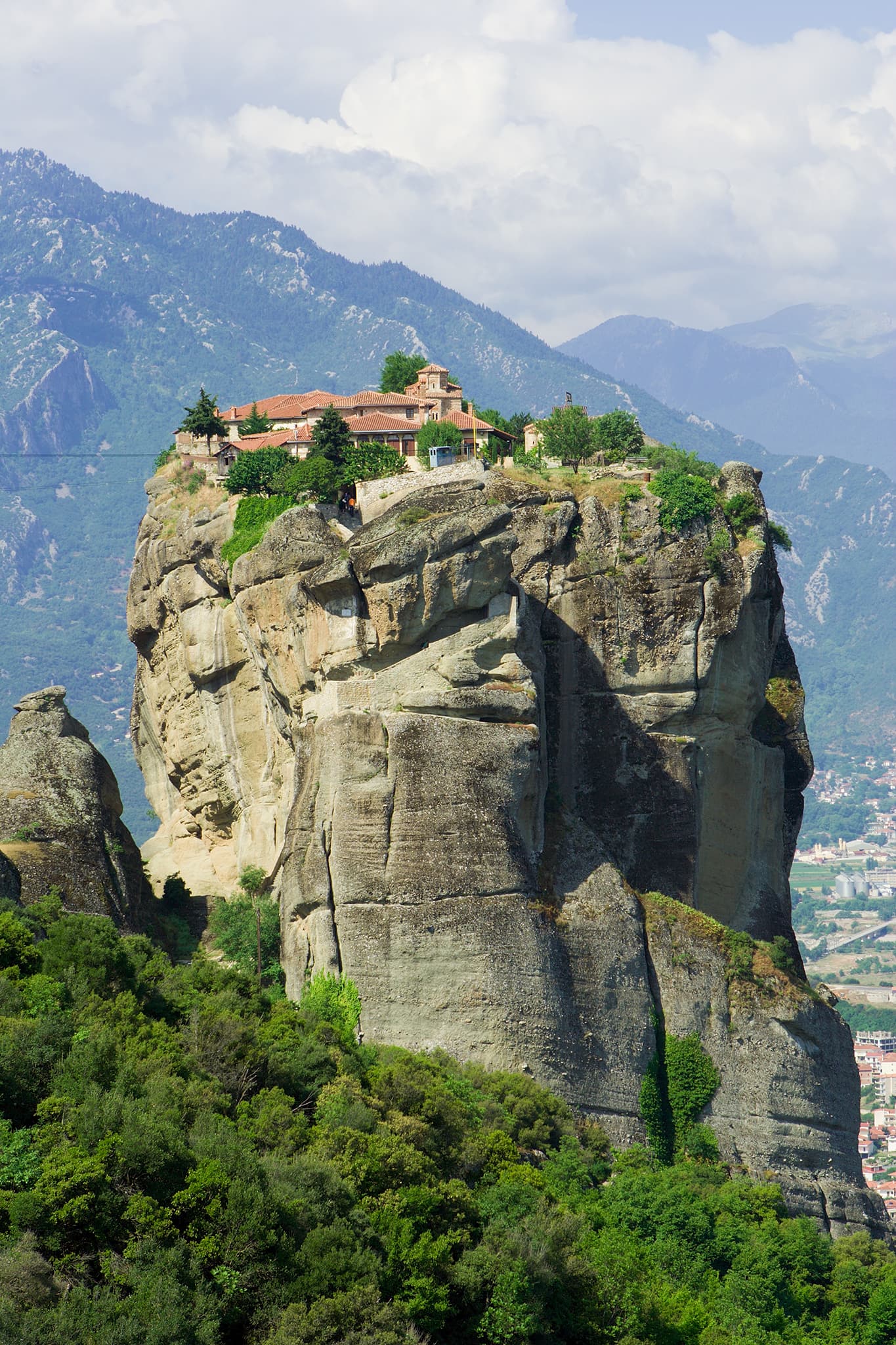
Holy Trinity Monastery, Meteora - rights-reviewed Wikimedia image. Image source · CC BY-SA 3.0
Visit essentials
A quick read before you go
- Duration
- Allow for the approach, queue, opened interiors, and quiet conduct; actual access varies.
- Access
- Holy Trinity requires one of the more demanding approaches among the accessible monasteries,…
Overview
Agia Triada at Meteora is distinct from the monastery of the same name on Crete. The Pineios Valley setting, isolated southern rock, exact place name and coordinates, Meteora documentation, and supplied entity record remove that recurrent ambiguity. The monastery is one institution within Meteora, not a generic marker for the whole UNESCO property. Its community, dedication, art, rock, and access history make it a distinct site entry.
Why this place is sacred
The Holy Trinity dedication, Orthodox worship, and monastic continuity remain the core sacred claims. Orthodox monastic practice understands the remote rock as a setting for prayer and communal discipline, but the community's lived theology should not be reduced to the visual drama of isolation. The rock and architecture can support contemplation, but the entry does not promise every visitor the same response.
Sacred standing comes from Orthodox worship and monastic continuity as articulated by the community, alongside the documented heritage fabric.
A place for Orthodox monastic prayer, communal discipline, liturgy, and withdrawal within the Meteora landscape.
A decree of Symeon Uroš Palaiologos mentions Holy Trinity as an organized monastery in 1362. The present katholikon belongs to the monastery's medieval building history, while later chapels, fresco work, repairs, and renewed occupation record continued use rather than a single construction moment.
Experience and orientation
Holy Trinity stands apart from the main northern cluster, with sheer faces visible above Kalambaka. Historic access depended on lifting systems and ladders; the modern route crosses a path and climbs rock-cut stairs. The small summit contains the katholikon, chapel, cells, and working spaces within a sharply bounded enclosure. Inside spaces opened to visitors, move slowly enough to distinguish church, refectory, cells, service structures, and historic access equipment without crossing private boundaries.
Visitors encounter a working or sacred monastic site, and no particular emotional response is promised.
Check the monastery's current notice before setting out. Weather, services, feast days, conservation, and community needs can change access.
Context and lineage
Meteora's monastic landscape grew from medieval eremitic settlement into organized communities on the rocks; this monastery has its own documented sequence within that wider history.
Greek Orthodox monasticism within the ecclesiastical and living heritage landscape of Holy Meteora.
Traditions and practice
Prayer, psalmody, liturgy, fasting, obedience, work, and hospitality belong to Orthodox monastic life; public participation depends on the monastery's calendar and permission.
The site receives pilgrims and heritage visitors while protecting worship, collections, art, and private community life.
Enter quietly, follow the route opened to visitors, pause without blocking icons or doorways, and leave private doors and objects untouched.
Greek Orthodox monasticism at Meteora
ActiveThe monastery is dedicated to the Holy Trinity. Orthodox monastic practice understands the remote rock as a setting for prayer and communal discipline, but the community's lived theology should not be reduced to the visual drama of isolation. Liturgy and monastic continuity remain the core sacred claims.
Perspectives and open questions
Monastic, art-historical, architectural, and visitor perspectives meet here but do not carry the same authority for every claim.
Scholarly perspective
The main church retains post-Byzantine decoration from different phases. Its imagery, architectural fabric, and later restoration belong together: no single date accounts for the entire interior. A rock-cut chapel dedicated to Saint John the Baptist adds another devotional layer within the site.
Living and traditional perspectives
Within the monastic tradition, the monastery is dedicated to the Holy Trinity. Orthodox monastic practice understands the remote rock as a setting for prayer and communal discipline, but the community's lived theology should not be reduced to the visual drama of isolation. Liturgy and monastic continuity remain the core sacred claims.
Alternative interpretations
Claims of measurable energy, levitation, or guaranteed transformation are unsupported and unnecessary.
Open questions
The dating of every part of the katholikon and its decoration is not uniform across sources; current access conditions require direct confirmation.
Plan your visit
Access and arrival
Holy Trinity requires one of the more demanding approaches among the accessible monasteries, combining a path and many steps. Current physical access, weather, closures, dress, and photography rules should be confirmed. Private monastic spaces remain outside visitor entitlement.
No lodging claim is included; use current options in Kalambaka or Kastraki and verify transport independently.
Respectful visit
Current modest-dress rules apply to all visitors; use onsite coverings where provided.
Confirm separately at each monastery and each interior. No permission should be assumed.
Candles, veneration, and donations should follow the monastery's established practice.
Sanctuaries, cells, service areas, collections, and some worship may be closed to visitors.
Do not infer photography rights, liturgical participation, or private access from payment or UNESCO status.
Location
Map loads as you approach this section.
Pilgrim reflections
A portrait of encounter, not a score
Pilgrims describe what they felt, how present they could become, and whether the place would shape a journey. There are no stars and no ranking of traditions.
No reviewed reflections yet
The first pilgrims can help describe the character of being here.
Share a reflection
Available after an account-backed “Been there.” Every reflection is reviewed before publication.
Nearby sacred places
Explore other sacred places in the region. Proximity does not establish access or travel time; check each place’s guidance.

References
Sources consulted for this page. Source categories describe the publication, not a guarantee that every claim is verified. Traditional accounts and outside interpretations may differ.
- 01Meteora — UNESCO World Heritage CentreofficialWorld Heritage boundaries, monastic history, architecture, post-Byzantine painting, and living heritage context.
- 02Meteora — Hellenic Ministry of Culture and SportsofficialGreek cultural authority for the Meteora complex and its principal monasteries.
- 03Meteora Monasteries — Greek National Tourism OrganisationofficialCurrent national description of the active monastery group, identities, history, and visitor context.
- 04Holy Meteora — Holy Monastery of Great MeteoronSource contextMeteora monastic community account of foundations, documentary history, and Orthodox meaning.
- 05The katholikon of the Holy Trinity — Greek ecclesiastical, heritage, or academic sourceSource contextSite-specific corroboration of history, dedication, architecture, community status, or wall painting.
- 06Wikimedia Commons image for Holy Trinity Monastery, Meteora — Dido3academicExact-site image with resolved reuse terms: CC BY-SA 3.0.
- 07Monastery of the Holy Trinity, Meteora — Wikipedia contributorsacademicSupplied exact-entity reference used for disambiguation and coordinate cross-checking.
- 08Q2179863 — Wikidata contributorsacademicStructured entity and coordinate evidence; generic points are rejected when exact whole-site evidence is stronger.
Share a photo
Help visitors recognize Holy Trinity Monastery, Meteora. Every submission is reviewed before publication.