Higashi Hongan-ji
Immense timber halls built for shared listening and nembutsu
Understand sacred places, explore living traditions, and learn how to engage respectfully with Pilgrim Map.
Access has not been verified. Check current local guidance before planning a visit.
Kyoto, Kyoto Prefecture, Japan
Read the sources
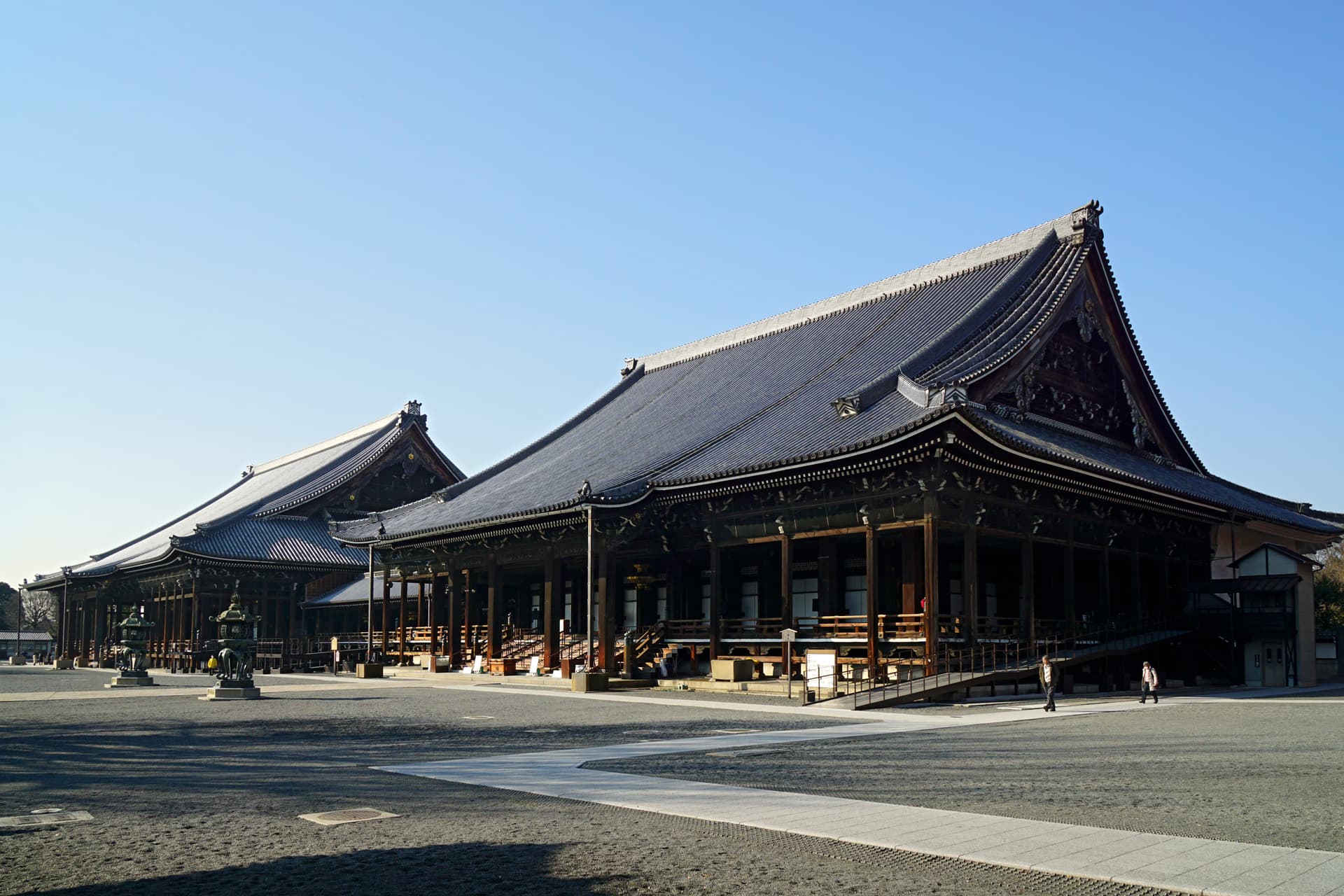
Image of Higashi Hongan-ji. Image source
Visit essentials
A quick read before you go
- Duration
- Let Higashi Hongan-ji's available route determine the duration.
- Access
- Check transport, admission, booking, and mobility with Higashi Hongan-ji.
Overview
Higashi Hongan-ji’s forecourt gives the two great halls room to register before one enters. The Goeidō and Amidādō are immense, but their significance is not a contest of dimensions. They were rebuilt to receive congregations who gather around Shinran’s teaching, Amida Buddha, sermons, nembutsu, and memorial observance.
Fire repeatedly altered the complex. The present halls therefore make rebuilding visible as a communal act, especially in the preserved ropes made from hair donated by women supporters. Those ropes should be approached within the temple’s own account of devotion and labor, not reduced to an unusual construction anecdote.
As the head temple of the Ōtani-ha branch of Jōdo Shinshū, Higashi Hongan-ji remains a working religious headquarters. Its broad public access is generous, but openness does not turn congregants into exhibits. The most revealing experience may be sitting on tatami while a hall’s scale recedes and the sound of teaching takes over.
Why this place is sacred
Shared hearing gives the temple its spiritual architecture. The Goeidō focuses reverence for Shinran, while the Amidādō directs devotion toward Amida Buddha. Nembutsu and sermons occupy spaces rebuilt through collective support, making material renewal part of the community’s religious memory.
Higashi Hongan-ji centers religious attention on Amida Buddha in Ōtani-ha teaching and reverence for Shinran.
Higashi Hongan-ji endures through custodianship, repair, and continuing observance.
Experience and orientation
Pause in the forecourt to understand the relation between the halls, then enter only through the indicated route. Shoes, seating, and photography follow temple instructions. Sit behind or beside worshippers rather than in front of them. If a sermon is audible, allow the hall to function as a place of listening before treating it as a timber achievement.
Use Higashi Hongan-ji's current directions and posted route.
Context and lineage
Tokugawa Ieyasu supported a separate eastern Honganji in 1602; today's halls followed repeated fires and rebuilding. Later fabric at Higashi Hongan-ji reflects renewal, not one construction moment.
Jōdo Shinshū Buddhism, Ōtani-ha
Traditions and practice
At Higashi Hongan-ji, established observance includes nembutsu recitation, sermons, memorial services, and congregational listening.
Higashi Hongan-ji's custodians continue services and religious care.
At Higashi Hongan-ji, watch first; unfamiliar rites need not be copied.
Jōdo Shinshū Buddhism, Ōtani-ha
ActiveHigashi Hongan-ji remains a living Jōdo Shinshū Buddhism, Ōtani-ha institution.
See Higashi Hongan-ji's documented practices above.
Perspectives and open questions
Higashi Hongan-ji holds religious, historical, and material registers.
Scholarly perspective
Historical interpretation at Higashi Hongan-ji follows its cited record.
Living and traditional perspectives
Jōdo Shinshū Buddhism, Ōtani-ha supplies Higashi Hongan-ji's authoritative devotional frame.
Alternative interpretations
No esoteric overlay is asserted for Higashi Hongan-ji.
Open questions
Higashi Hongan-ji's changing schedule remains outside this account.
Plan your visit
Access and arrival
Check transport, admission, booking, and mobility with Higashi Hongan-ji.
No visitor lodging at Higashi Hongan-ji is established here.
Respectful visit
Wear practical clothing; follow Higashi Hongan-ji's shoe instructions.
Photograph only where Higashi Hongan-ji explicitly permits it.
Use only offering places provided by Higashi Hongan-ji.
Higashi Hongan-ji is a living headquarters: enter quietly, sit respectfully, and avoid photographing people at worship.
Never interrupt worship or private observance at Higashi Hongan-ji.
Location
Map loads as you approach this section.
Pilgrim reflections
A portrait of encounter, not a score
Pilgrims describe what they felt, how present they could become, and whether the place would shape a journey. There are no stars and no ranking of traditions.
No reviewed reflections yet
The first pilgrims can help describe the character of being here.
Share a reflection
Available after an account-backed “Been there.” Every reflection is reviewed before publication.
Nearby sacred places
Explore other sacred places in the region. Proximity does not establish access or travel time; check each place’s guidance.


References
Sources consulted for this page. Source categories describe the publication, not a guarantee that every claim is verified. Traditional accounts and outside interpretations may differ.
- 01Higashi Hongan-ji official site — Higashi Hongan-ji custodial institutionofficialPrimary institutional source for identity, religious life, and visitor rules.
- 02Google Maps place record for Higashi Hongan-ji — Google PlacesofficialExact-place identity, coordinates, operational status, and official website candidate.
- 03Higashi Hongan-ji — Wikipedia contributorsSource contextGeneral reference cross-checked against the institutional source.
- 04Wikidata record for Higashi Hongan-ji — Wikidata contributorsacademicStructured identity and coordinate cross-check.
- 05Kyoto City Official Travel Guide — Kyoto City Tourism AssociationSource contextOfficial destination context; current details require checking the site page.
Pilgrim glossary
- Pure Land
- A Buddhist tradition focused on rebirth in Amida Buddha's western paradise through devotional practice.
Share a photo
Help visitors recognize Higashi Hongan-ji. Every submission is reviewed before publication.