Goa Gajah
A carved cave within Bali’s Hindu and Buddhist heritage
Understand sacred places, explore living traditions, and learn how to engage respectfully with Pilgrim Map.
Access has not been verified. Check current local guidance before planning a visit.
Bali, Indonesia
Read the sources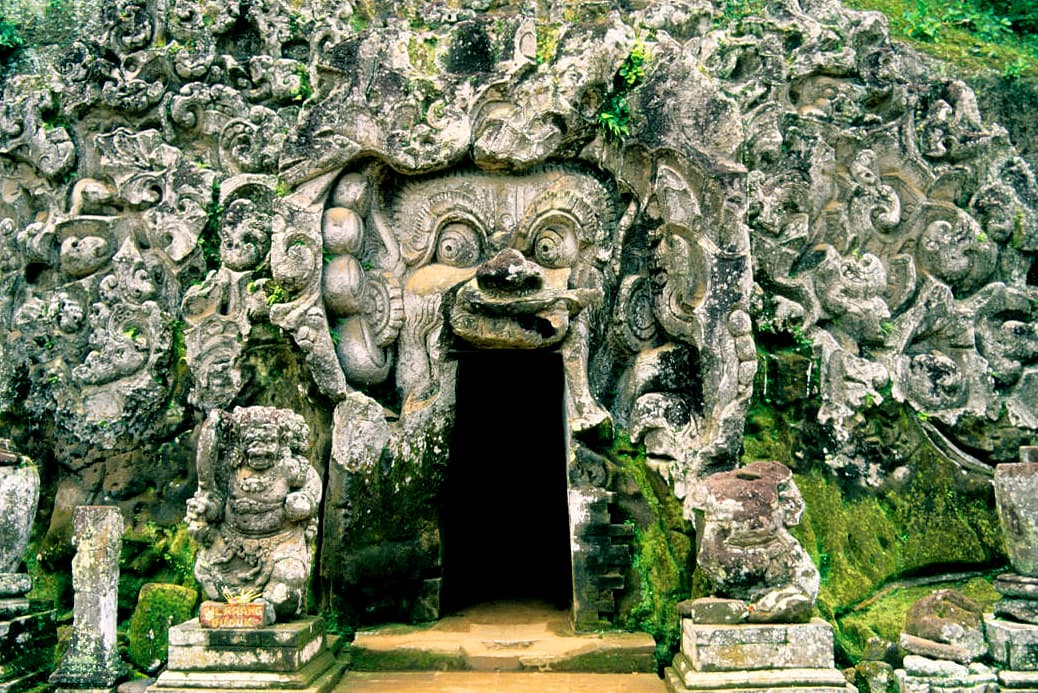
The carved entrance to Goa Gajah, photographed in 1998. Image source · CC BY-SA 4.0
Visit essentials
A quick read before you go
- Etiquette
- Respect worship, sacred objects and the people responsible for this place.
Overview
At Bedulu in Gianyar, Goa Gajah brings together a carved cave entrance, Hindu sacred objects and archaeological remains associated with Hindu and Buddhist traditions. Indonesia’s tourism ministry dates the site approximately to the eleventh century. Its well-known entrance belongs to a wider religious landscape that includes bathing structures.
The carved entrance is only one element of the complex. Gianyar’s tourism authority distinguishes the Shaiva remains around the cave from Buddhist remains in the southern area, helping visitors understand why a single religious label is incomplete. A thoughtful visit can move between these elements without forcing them into one founding story. The surrounding structures and sacred objects deserve the same attention as the widely photographed doorway.
This is a place where looking beyond the entrance changes the understanding of what survives.
Why this place is sacred
The cave contains Ganesha and the Tri Lingga, while other parts of the complex preserve Buddhist associations. Gianyar’s interpretation also discusses Hariti, known locally in relation to Ratu Brayut. These named figures give the archaeology a religious context.
Experience and orientation
Take time to observe the place through its own religious and historical context. Follow the authorized visitor route and the guidance of its custodians.
Context and lineage
Gianyar’s tourism authority recounts Hariti’s transformation from a harmful figure into a protector who loves children after encountering Buddhist teaching. It connects that account with the image kept in front of the cave. This publicly shared story explains a particular figure at Goa Gajah; it is not presented as an archaeologically witnessed event.
Traditions and practice
Follow local guidance around sacred objects and any active worship. A visitor may study the architecture without treating every religious space as available for unrestricted photography.
Hinduism
ActiveAssociation with Shiva and the Hindu sacred objects or pilgrimage described above.
Buddhism
ActiveBuddhist devotion and religious heritage expressed through the site’s images or spaces.
Perspectives and open questions
The local authority offers several historical explanations for the place-name and its wider connections. Its suggestion of a link with an Indian hermitage remains a possibility, not an established origin of the Balinese site.
Plan your visit
The complex is in Bedulu, Gianyar. Confirm current admission and follow local guidance for dress, worship and photography.
Respectful visit
Follow the site’s current photography rules and ask before photographing worshippers.
Location
Map loads as you approach this section.
Pilgrim reflections
A portrait of encounter, not a score
Pilgrims describe what they felt, how present they could become, and whether the place would shape a journey. There are no stars and no ranking of traditions.
No reviewed reflections yet
The first pilgrims can help describe the character of being here.
Share a reflection
Available after an account-backed “Been there.” Every reflection is reviewed before publication.
Nearby sacred places
Explore other sacred places in the region. Proximity does not establish access or travel time; check each place’s guidance.

References
Sources consulted for this page. Source categories describe the publication, not a guarantee that every claim is verified. Traditional accounts and outside interpretations may differ.
- 01Indonesia Ministry of Tourism: Goa GajahofficialBedulu location, approximate chronology, Hindu and Buddhist elements, cave and baths
- 02Gianyar tourism authority: Goa GajahofficialLocal heritage interpretation, religious objects and Hariti account
- 03Gianyar cultural heritage registerofficialArtificial cave classification and representative location
- 04Goa Gajah — geographic reference — Wikipedia contributorsacademicSecondary identity and representative complex coordinates; religious claims rely on the primary sources above.
Share a photo
Help visitors recognize Goa Gajah. Every submission is reviewed before publication.