Church of El Pilar de la Mola
A living Marian parish for Formentera's La Mola community
Understand sacred places, explore living traditions, and learn how to engage respectfully with Pilgrim Map.
Access has not been verified. Check current local guidance before planning a visit.
El Pilar de la Mola, Formentera, Balearic Islands, Spain
Read the sources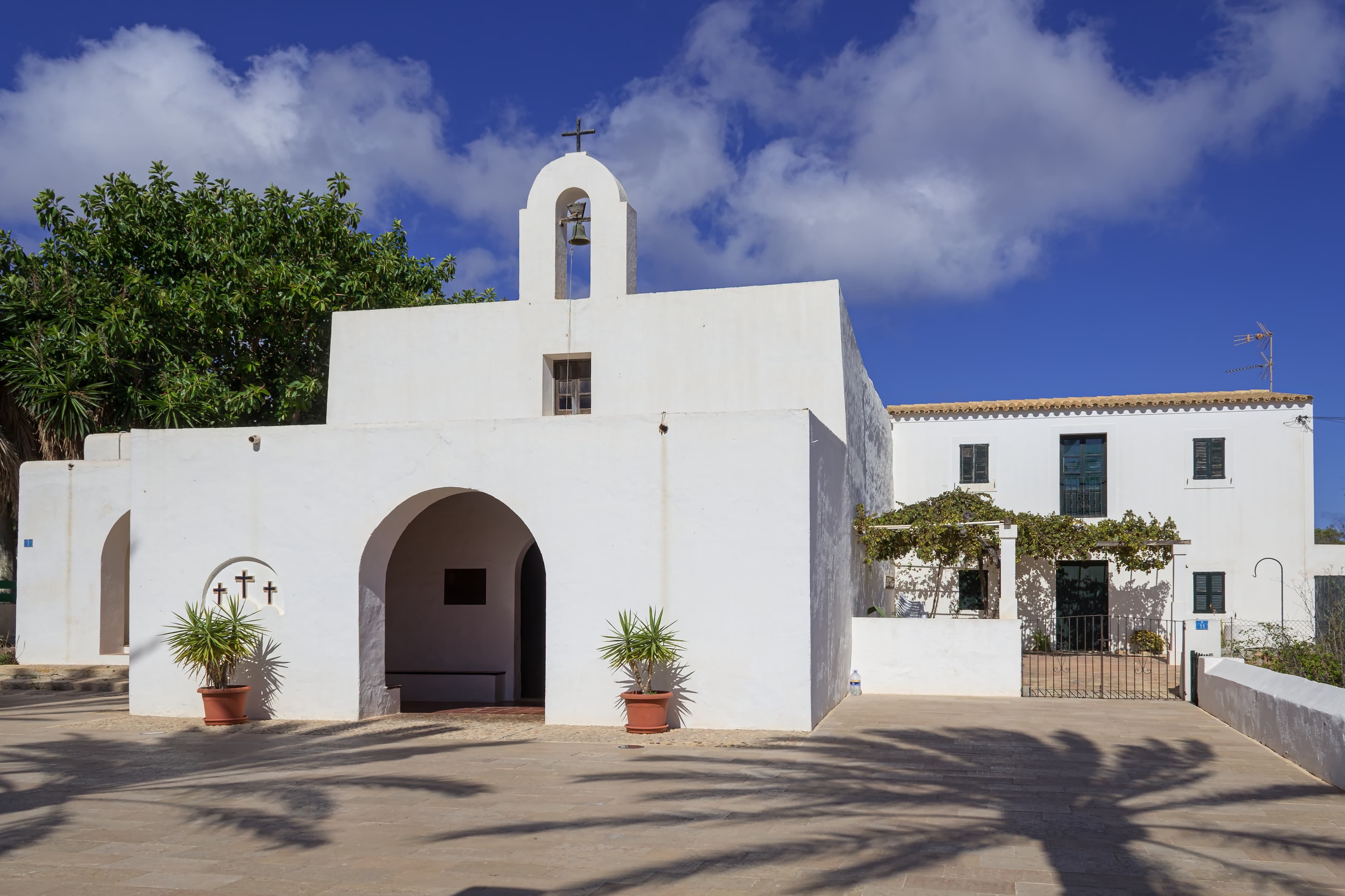
Image of Church of El Pilar de la Mola. Image source · CC BY-SA 4.0
Visit essentials
A quick read before you go
- Duration
- No official visitor duration is prescribed.
- Access
- Reach El Pilar de la Mola by the island road and use current local transport and parking…
Overview
At the center of El Pilar de la Mola stands a modest whitewashed church built for a community that had long faced a difficult journey to worship elsewhere on Formentera. The Diocese of Ibiza records construction from 1771 to 1784 and later enlargement in the nineteenth century. The island's official visitor information likewise dates the church to 1784 and identifies its dedication to the Virgin of the Pillar.
The building's restraint suits its original purpose: a parish church for scattered farming households on the La Mola plateau. Its single-nave form, barrel vault, porch, and strong walls are often discussed alongside Formentera's church architecture, but the most important continuity is use. This is still a place for Mass, prayer, sacraments, and the parish feast of Our Lady of the Pillar.
The square also hosts La Mola's seasonal artisan market. That public gathering adds life to the setting but should not be confused with the church's religious practice. Visitors should let worship and parish needs govern whether and how they enter.
Why this place is sacred
El Pilar de la Mola does not depend on a dramatic apparition story or a major pilgrimage route. Its sacred character is expressed through sustained local use and dedication to Our Lady of the Pillar. The church gave plateau residents a nearby place for Mass and sacraments after years of dependence on Sant Francesc.
The conjectured medieval Augustinian monastery sometimes mentioned in local writing should remain separate. Its exact location is unknown, and no reviewed source establishes architectural or institutional continuity with the present eighteenth-century church. The defensible story begins with the documented parish campaign, construction, and continuing diocesan life.
To serve the Roman Catholic worship and sacramental needs of the dispersed farming community on the La Mola plateau.
The church was built between 1771 and 1784, enlarged in the nineteenth century, and protected as a cultural-interest property in 1996. It remains an active parish rather than a deconsecrated heritage building.
Experience and orientation
The square can change character sharply between a quiet morning, a parish observance, and a busy seasonal market afternoon. Pause before entering, read any posted notice, and follow the cues of parishioners. An open door is not permission to interrupt prayer, a service, preparation, or cleaning.
Inside, keep the visit quiet and brief unless participating in worship. No reviewed source establishes a public interpretation program or guaranteed daily opening. If the church is closed, the exterior and its place in the village can still be understood without trying side doors or seeking informal entry.
The church stands on the central square of El Pilar de la Mola along Avinguda de la Mola. It is reached by the island road across the plateau; the village, market, church, and nearby lighthouse are distinct destinations.
Context and lineage
Before the present church, plateau residents traveled to Sant Francesc for worship. Their requests for a parish culminated in construction of a church close to their own farms and homes. The documented foundation is therefore communal and practical rather than miraculous: the sacred place grew from the need to sustain regular Catholic life in an isolated part of Formentera.
The parish belongs to the Roman Catholic Diocese of Ibiza and the Latin Church. Its active community and diocesan custodian are distinct from secular tourism and market organizations using the surrounding square.
Our Lady of the Pillar
Marian title to whom the parish church is dedicated
Traditions and practice
Mass, prayer, sacraments, and Marian devotion form the church's documented religious life. The patronal feast is associated with 12 October.
The church remains an active parish. Seasonal market activity in the square is a civic and cultural event, not evidence of a separate religious rite inside the church.
If the church is open and no service is underway, enter quietly, sit without occupying space needed by parishioners, and allow the dedication to Our Lady of the Pillar to frame the visit.
Roman Catholicism (Latin Church)
ActiveEl Pilar de la Mola is the active parish church serving the plateau community and is dedicated to Our Lady of the Pillar.
Mass, sacraments, prayer, Marian devotion, and the patronal feast form its documented religious life.
Perspectives and open questions
The church can be understood as architecture, local history, and living Catholic worship. Parish use is the controlling frame; tourism and the market explain the setting but do not define the sacred practice.
Scholarly perspective
The reviewed record supports an eighteenth-century rural parish foundation, subsequent enlargement, and protected heritage status. No academic architectural study, named architect, or fully documented interior program was located.
Living and traditional perspectives
For Roman Catholics, the church is a place of communal worship dedicated to Our Lady of the Pillar. This page reports that public identity without attempting to summarize private devotion or speak for parishioners.
Alternative interpretations
Claims that the present church directly succeeds a medieval Augustinian monastery are not established. The earlier monastery's location and relationship to this building remain unresolved.
Open questions
Ordinary opening hours, accessibility, photography policy, named builders, and details of interior artworks were not confirmed in the reviewed authoritative sources.
Plan your visit
Access and arrival
Reach El Pilar de la Mola by the island road and use current local transport and parking information. Do not assume the church interior is open because the square or market is active.
Use established lodging elsewhere in El Pilar de la Mola or Formentera; the parish is not presented as visitor accommodation.
Respectful visit
No site-specific dress code was found. Modest clothing suitable for an active Catholic church is the prudent default.
Confirm current permission before photographing the interior, and do not photograph services or identifiable worshippers without consent.
Use only established parish donation or candle arrangements if available; do not leave improvised objects.
Posted parish instructions, services, private ceremonies, and temporary closures take precedence over visitor access.
Do not imitate sacraments, handle devotional objects, enter restricted liturgical areas, or treat a service as a tourist performance.
Location
Map loads as you approach this section.
Pilgrim reflections
A portrait of encounter, not a score
Pilgrims describe what they felt, how present they could become, and whether the place would shape a journey. There are no stars and no ranking of traditions.
No reviewed reflections yet
The first pilgrims can help describe the character of being here.
Share a reflection
Available after an account-backed “Been there.” Every reflection is reviewed before publication.
Nearby sacred places
Explore other sacred places in the region. Proximity does not establish access or travel time; check each place’s guidance.

Ca na Costa Megalithic Tomb
Es Pujols, Formentera, Balearic Islands, Spain
11.6 km away

Church of Sant Francesc Xavier
Sant Francesc Xavier, Formentera, Balearic Islands, Spain
11.9 km away

Cathedral of Santa Maria of Ibiza
Eivissa, Balearic Islands, Spain
28.4 km away

Puig des Molins Necropolis
Eivissa, Balearic Islands, Spain
28.7 km away
References
Sources consulted for this page. Source categories describe the publication, not a guarantee that every claim is verified. Traditional accounts and outside interpretations may differ.
- 01El Pilar de la Mola — Turismo de Formentera — Consell Insular de Formentera (official tourism board)officialOfficial tourism board description of the village atop La Mola plateau; church described as built in the 18th century to serve the isolated community; notes agricultural (vineyard) heritage and nearby lighthouse.
- 02La Mola Artisan Market — Turismo de Formentera — Consell Insular de Formentera (official tourism board)officialOfficial confirmation of the craft market held Wednesdays and Sundays (afternoon/evening) from May to mid-October in the village centered on the church square.
- 03Flea market Mercado artesanal de La Mola (Formentera) — Illes Balears Travel (regional tourism board)officialRegional government tourism site corroborating the artisan market's schedule and character; market established 1984 per allied sources.
- 04Parroquias — Diocese of IbizaofficialDiocesan directory confirming active parish status, dedication, construction from 1771 to 1784, nineteenth-century enlargement, and the 12 October feast; accessed 2026-09-04.
- 05Church of La Mola — Consell Insular de FormenteraofficialOfficial local visitor source confirming the church's identity, 1784 completion, dedication to the Virgin of the Pillar, and 1996 cultural-interest designation; accessed 2026-09-04.
- 06Iglesia de La Mola, historia del culto en Formentera — AllFormenteraSource contextLocal tourism directory; covers 1784 construction, prior request from 1760, porch feature, 1996 cultural-interest declaration, and a note on a possible earlier 13th-century Augustinian monastery (Es Monestir) in the area whose exact site is unknown.
- 07Historia Iglesia de Nuestra Señora del Pilar en La Mola, Isla de Formentera — Viaje UniversalSource contextDescribes single-nave, barrel-vaulted structure; frames 18th-century Formentera churches generally as church-fortress types built partly as refuge from pirate raids; notes 1996 declaration as site of cultural interest.
- 08El Pilar de la Mola — Wikipedia — Wikipedia contributorsSource contextStub article; confirms village location on La Mola peninsula (highest point of Formentera) and gives village-level coordinates. No church-specific detail.
- 09Església del Pilar de la Mola — OpenStreetMap — OpenStreetMap contributorsSource contextCrowd-sourced geodata confirming building footprint, address (Avinguda de la Mola 7), classification as Catholic place of worship, and heritage-listing tag; used to cross-check coordinates.
Share a photo
Help visitors recognize Church of El Pilar de la Mola. Every submission is reviewed before publication.