Church of Sant Francesc Xavier
Formentera's fortress-church, built to pray in and to defend
Understand sacred places, explore living traditions, and learn how to engage respectfully with Pilgrim Map.
Access has not been verified. Check current local guidance before planning a visit.
Sant Francesc Xavier, Formentera, Balearic Islands, Spain
Read the sources
Visit essentials
A quick read before you go
- Duration
- 20–40 minutes for the church and square; longer if combined with the adjoining cemetery and the…
- Access
- Plaça de la Constitució, s/n, 07860 Sant Francesc Xavier, Formentera, directly opposite the town…
Overview
Formentera's main town takes its name from the fortified church at its center and grew around it. Construction began on 15 May 1726 during the Spanish crown's resettlement of an island periodically emptied by piracy. The community outgrew the older Sa Tanca Vella chapel, completed the church and surrounding Sa Raval ensemble by 1738, and built houses in its shelter—nineteen were recorded by 1797.
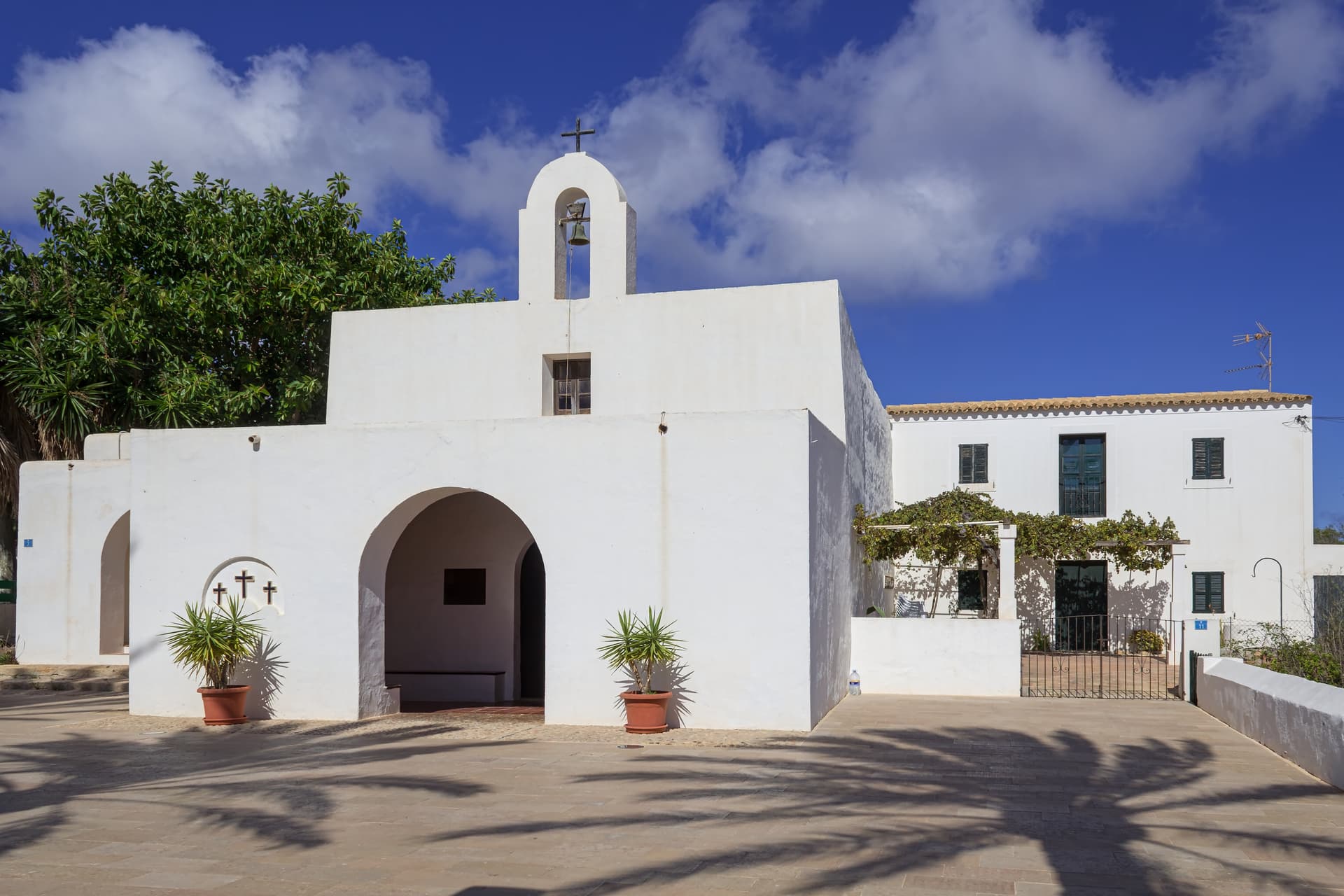
Blind whitewashed walls roughly two meters thick, an iron-sheathed door, and a spy-hole from which defenders could fire make the stronghold legible. Inside, a single barrel-vaulted nave preserves a low-relief stone baptismal font and a choir rail dated 1737; most religious images are modern because the originals were lost during the Spanish Civil War. Its 1996 designation as a Bien de Interés Cultural recognizes the building as both religious and military, identities that have never been separable here.
Why this place is sacred
The Church of Sant Francesc Xavier is sacred in the way that a lot of rural Mediterranean churches from this period are sacred: not because of a miracle or relic, but because it was the single structure a vulnerable community built to hold everything that mattered — worship, baptism, marriage, burial, and physical safety — inside one set of two-meter-thick walls.
Formentera in the early 18th century was being resettled after periods when Barbary pirate raids had made permanent habitation too dangerous to sustain. The chapel of Sa Tanca Vella, dating to the 13th or 14th century, had served the island's earlier, thinner population; when settlers returned in greater numbers, they needed something that could double as a stronghold, and they built one.
That dual function shaped everything about the design — the blind walls, the iron door with its gun port, the two cannons once mounted on the terrace — but it did not make the building any less a place of ordinary religious life. It became a vicarage almost immediately and a full parish in 1785, and the December 3 feast of its patron, Saint Francis Xavier, has been marked in the town square outside its door for centuries.
A parish church built simultaneously to serve the sacraments and to shelter the resettled population against Barbary pirate raids.
Vicarage until 1785, then full parish; declared a Bien de Interés Cultural historical-artistic ensemble in 1996; façade repainted white circa 2004; original religious imagery lost in the Spanish Civil War and replaced with modern pieces; the surrounding Sa Raval settlement grew up around it from the late 18th century onward.
Experience and orientation
There is little to soften the first impression of the church from the square: a whitewashed block of a building, its walls unbroken by ornament, its door reinforced with iron and pierced by a defensive spy-hole rather than a stained-glass window. It reads, correctly, as a fortress before it reads as a church.
Stepping inside changes the register — a single nave, a barrel vault overhead, side chapels kept shallow so as not to compromise the thickness of the surrounding walls, and light falling on a stone baptismal font carved with worn low-relief decoration. The choir rail carries the date 1737, one of the few details in the interior that dates unmistakably to the building's founding years.
Outside again, the church sits opposite the ajuntament across Plaça de la Constitució, and the two buildings together frame the daily life of the town — market mornings, the quiet of early evening, the gathering crowds on December 3 when Sant Francesc Xavier's patronal feast brings out traditional dances timed to the close of the tourist season. The adjoining cemetery, restored and opened to visitors, extends the same unhurried, unadorned quality of the church itself.
Arrive via the town square, Plaça de la Constitució, in the middle of Sant Francesc Xavier village; the church faces the town hall directly. Entry is at street level with no barriers to access.
Context and lineage
After periods when Barbary piracy had made settlement on Formentera too dangerous to sustain, the Spanish crown pushed to resettle the island in the early 18th century. The returning population first gathered around Sa Tanca Vella, a chapel dating to the 13th or 14th century, but soon outgrew it.
The first stone of the new church was laid on 15 May 1726; the building and its surrounding Sa Raval ensemble were substantially complete by 1737–1738, with a choir rail dated 1737 and the wider settlement finished by 1738. It served as a vicarage before becoming a full parish in 1785, by which point nineteen houses (recorded in 1797) had already been built in its shelter — the seed of today's town.
Diocese of Ibiza; one of Formentera's three parish churches, alongside Sant Ferran de Ses Roques and Pilar de la Mola.
Traditions and practice
Parish Mass and the sacraments, including baptism using the church's preserved stone font.
The December 3 patronal feast marks Saint Francis Xavier's day with traditional dances and community gatherings in the square, coinciding with the close of the tourist season and offering a more intimate counterpart to the island's larger July and August festivals (Sant Jaume on 25 July and Santa Maria on 5 August).
Visit outside of service times to view the interior quietly, then sit in the square to take in the church's relationship to the town hall and the daily rhythm of the village around it.
Roman Catholic Christianity
ActiveDedicated to Saint Francis Xavier, co-founder of the Society of Jesus and patron of Catholic foreign missions; the church has served as the parish seat of Sant Francesc Xavier since 1785 within the Diocese of Ibiza.
Parish Mass, baptism at the preserved stone font, and the December 3 patronal feast.
Perspectives and open questions
The church is read consistently across sources as a hybrid of religious and military architecture, though the emphasis shifts depending on whether the lens is heritage classification, local civic identity, or devotional history.
Scholarly perspective
Heritage authorities classify the church formally as both a religious and a military monument — a fortified rural church of a type built across Ibiza and Formentera in the 17th and 18th centuries specifically in response to Barbary piracy. Its 1996 designation as a Bien de Interés Cultural historical-artistic ensemble reflects this dual classification.
Living and traditional perspectives
For the local community, the church is inseparable from civic identity: it is the point from which the modern town grew, and the December 3 patronal feast remains a marker of local life distinct from the island's more tourist-facing summer festivals.
Open questions
No individual architect or master builder is named in available sources. The original pre-Civil War religious imagery is not documented beyond the fact of its loss and later replacement.
Plan your visit
Access and arrival
Plaça de la Constitució, s/n, 07860 Sant Francesc Xavier, Formentera, directly opposite the town hall in the center of the island's capital. No vehicle access needed once in the village; Formentera is reached by ferry from Ibiza.
Respectful visit
Modest dress is appropriate — covered shoulders and knees are recommended, particularly if a service is underway.
Generally permitted in the interior when no Mass or ceremony is in progress; avoid photographing worshippers during services.
No specific offering customs are documented beyond standard parish donation practice.
Defer to services in progress and keep voices low; the adjoining restored cemetery calls for the same quiet respect as the church interior.
Location
Map loads as you approach this section.
Pilgrim reflections
A portrait of encounter, not a score
Pilgrims describe what they felt, how present they could become, and whether the place would shape a journey. There are no stars and no ranking of traditions.
No reviewed reflections yet
The first pilgrims can help describe the character of being here.
Share a reflection
Available after an account-backed “Been there.” Every reflection is reviewed before publication.
Nearby sacred places
Explore other sacred places in the region. Proximity does not establish access or travel time; check each place’s guidance.

Ca na Costa Megalithic Tomb
Es Pujols, Formentera, Balearic Islands, Spain
2.8 km away
Church of El Pilar de la Mola
El Pilar de la Mola, Formentera, Balearic Islands, Spain
11.9 km away

Sa Caleta Phoenician Settlement
Sant Josep de sa Talaia, Balearic Islands, Spain
20.0 km away

Cathedral of Santa Maria of Ibiza
Eivissa, Balearic Islands, Spain
22.4 km away
References
Sources consulted for this page. Source categories describe the publication, not a guarantee that every claim is verified. Traditional accounts and outside interpretations may differ.
- 01Iglesia de San Francisco Javier (Formentera) — Wikipedia — Wikipedia contributorsacademicPrimary source for dates, coordinates, heritage designation, and architectural description
- 02Church Sant Francesc Xavier (Formentera) — Illes Balears Tourist BoardofficialOfficial regional tourism board description of architecture, sacristy addition, and Civil War loss of original religious images
- 03Turismo de Formentera — Sant Francesc — Ajuntament de Formentera / Turismo de FormenteraofficialOfficial municipal tourism page; covers church completion date, Sa Tanca Vella chapel, town square location, and festival calendar
- 04Iglesia Fortificada de San Francisco Javier — MonumentalNet — Fortificaciones de EspañaacademicSpecialist fortifications registry; confirms military-monument classification and legal heritage protection framework
- 05Memorial of St. Francis Xavier, Priest — Catholic CultureacademicConfirms December 3 feast day and biographical facts about Saint Francis Xavier (1506-1552), the church's dedicatee
- 06Iglesia de San Francisco Javier — Yo Soy FormenteraSource contextLocal guide site; supplementary detail on fortress features, cannons on terrace
- 07Sant Francesc de Formentera — Visit the capital of the island — Affitto FormenteraSource contextTravel guide covering the town's role as island capital and festival calendar
Share a photo
Help visitors recognize Church of Sant Francesc Xavier. Every submission is reviewed before publication.