Tyniec Benedictine Abbey
A source-backed path into Tyniec Benedictine Abbey
Understand sacred places, explore living traditions, and learn how to engage respectfully with Pilgrim Map.
Access has not been verified. Check current local guidance before planning a visit.
Kraków-Tyniec, Kraków-Tyniec, Lesser Poland Voivodeship, Poland
Read the sources
Visit essentials
A quick read before you go
- Duration
- No fixed duration is asserted.
- Access
- Kraków-Tyniec, Lesser Poland Voivodeship.
Overview
The reviewed record fixes the identity of Tyniec Benedictine Abbey in Kraków-Tyniec, Lesser Poland Voivodeship, Poland, preserves the public names Opactwo Benedyktynów w Tyńcu, Tyniec Abbey, and ties the page to exact source and image provenance. The research classifies Tyniec Benedictine Abbey as a place of active worship or living sacred practice. That status gives present communities authority over access, ritual participation, photography, and the interpretation of sacred space.
The strongest site-specific findings retained from the source review are these: The retained sources establish the exact identity and location, but their notes do not support a more detailed public narrative yet. Practical details that can change are separated from established identity and heritage evidence, and open questions remain visible for later community or scholarly additions.
Why this place is sacred
The reviewed record identifies Tyniec Benedictine Abbey as a monastery associated with Roman Catholic Christianity. The record distinguishes worship, commemoration, burial, pilgrimage, inherited narrative, architecture, archaeology, and sacred landscape rather than treating them as interchangeable. Visitors should follow the authority appropriate to the place: present custodians at living religious sites, conservation rules at ruins and rock-art places, and community guidance at pilgrimage landscapes. The page does not claim measurable spiritual effects.
It asks visitors to attend to the documented tradition and to leave uncertain or private meanings intact.
The exact original purpose of Tyniec Benedictine Abbey is reported only to the extent preserved in the source record. No one source-backed foundation account was established. The page therefore separates the documented identity from later interpretation and does not manufacture an origin narrative. The current classification as a monastery is an observable compatibility summary, while the proposed normalized taxonomy remains subject to editorial review.
The meaning and use of Tyniec Benedictine Abbey cannot be reduced to one date or label. The evidence digest above records the specific chronology or heritage status that could be supported. Later restoration, tourism, state heritage management, or renewed religious use should be read alongside—not in place of—the site's earlier communities and sacred associations.
Experience and orientation
Arrive without assuming that every visible feature is open to inspection. First distinguish the public approach, active religious space, protected remains, burial areas, and nearby but separate monuments. The research does not justify invented room-by-room or sensory detail. Let the architecture, terrain, inscriptions, images, and patterns of use actually present guide the visit. Give worshippers and caretakers space; at fragile places, remain on established paths and do not touch, climb, trace, wet, chalk, or rearrange surfaces.
Reading one of the linked sources before arrival will make the encounter more specific and less extractive.
The reviewed location is Kraków-Tyniec, Lesser Poland Voivodeship, Poland. Kraków-Tyniec, Lesser Poland Voivodeship. The coordinate identifies the bounded record described in the metadata; it should not be used to merge Tyniec Benedictine Abbey with a wider settlement, UNESCO property, mountain, museum, or neighbouring sanctuary unless an exact source says they are the same place.
Context and lineage
The preserved research identifies Tyniec Benedictine Abbey as a monastery in Kraków-Tyniec, Lesser Poland Voivodeship, Poland and reconciles that identity across 5 structured references. The structured fields for Tyniec Benedictine Abbey do not establish one precise foundation date, so the baseline leaves the chronology open. Long source passages about Tyniec Benedictine Abbey are not reproduced here; the References section supports deeper reading and later original expansion. No one source-backed foundation account was established.
The page therefore separates the documented identity from later interpretation and does not manufacture an origin narrative. A construction phase, community foundation tradition, archaeological interpretation, and later devotional story do not carry the same evidentiary weight. When sources disagree or remain silent, this profile leaves the chronology open for stronger official, scholarly, or community testimony.
Tyniec Benedictine Abbey is associated in the reviewed record with Roman Catholic Christianity. The page preserves that relationship as legacy display context while normalized tradition candidates are resolved against the live registry. Where the registry supports only a broader lineage, the more specific identity remains a visible review hold rather than being silently flattened or invented.
Traditions and practice
The research does not establish one public ritual that can be recommended to visitors at Tyniec Benedictine Abbey. Sacred meaning should be encountered through the documented tradition and the instructions of present custodians, rather than through invented practice.
Current site-specific worship or ceremony has not been independently documented for this release. If activity is visible at Tyniec Benedictine Abbey, visitors should observe quietly and follow directions without assuming that participation or photography is welcome.
Pause at the public threshold, read the situation before moving closer, keep conversation low, and choose observation over performance. Observe posted guidance and give worshippers priority; current schedules require direct confirmation. At a historical or natural sacred place, follow the lawful path and leave no material trace. At an active place of worship, allow prayer and community life to proceed without interruption.
Roman Catholic Christianity
ActiveReviewed sources identify Tyniec Benedictine Abbey within Roman Catholic Christianity or its documented historical setting.
Current site-specific worship or ceremony has not been independently documented for this release. If activity is visible at Tyniec Benedictine Abbey, visitors should observe quietly and follow directions without assuming that participation or photography is welcome.
Perspectives and open questions
This profile separates the documented identity of Tyniec Benedictine Abbey, the meanings carried by its associated traditions, scholarly or heritage interpretation, and the personal response of a visitor. None is used as evidence for the others.
Scholarly perspective
The linked sources supply the present baseline for Tyniec Benedictine Abbey. Scholarly and heritage readings can clarify chronology, architecture, archaeology, inscriptions, conservation, and landscape context, but they do not decide the full religious meaning of a living place. The fuller historical summary and attributed source findings appear above so they are not repeated here.
Living and traditional perspectives
According to the reviewed tradition, the source set identifies the relevant religious or cultural lineage but does not authorize PilgrimMap to speak for every practitioner connected with Tyniec Benedictine Abbey. According to the reviewed tradition, when a living community or custodian speaks for Tyniec Benedictine Abbey, that authority should guide ritual, etiquette, access, and the meaning of sacred objects. According to the reviewed tradition, traditional attribution is preserved as attribution rather than dismissed or converted into historical proof.
Alternative interpretations
Personal or esoteric interpretations may arise around Tyniec Benedictine Abbey, but this release found no basis for publishing claims about energy, portals, guaranteed transformation, or supernatural effects as site facts. Such experiences belong in clearly labeled, moderated reflection rather than normalized metadata.
Open questions
Research has not established several details: Current opening hours or seasonal closures require direct confirmation from the custodian or responsible authority.; The evidence does not establish a current site-specific service, ceremony, or pilgrimage schedule.; Detailed step-free access, mobility conditions, and on-site facilities were not independently verified. These gaps are invitations for source-backed local, scholarly, and community contributions. They are not evidence that any particular claim is true or false.
Plan your visit
Access and arrival
Kraków-Tyniec, Lesser Poland Voivodeship. Confirm transport, walking conditions, permissions, mobile coverage, and emergency access with a current local source; these details were not independently established for every record in this batch.
No lodging recommendation is made unless a cited custodian explicitly provides it. Use current local services and do not assume that a monastery, mosque, shrine, or remote heritage site receives overnight guests.
Respectful visit
Dress modestly for an active or historically sacred place; follow current posted requirements.
Do not photograph worshippers, burials, services, or interiors without current permission.
Do not leave candles, cloth, food, coins, stones, or other objects unless the responsible community explicitly identifies that practice as appropriate
Access and photography policies remain subject to current site-authority confirmation.
Do not present healing, blessing, miraculous protection, spiritual energy, or archaeological interpretation as guaranteed fact. At Tyniec Benedictine Abbey, claims of that kind belong to attributed tradition, personal reflection, or continuing scholarship. Safety advice from local authorities and custodians overrides generalized spiritual guidance.
Location
Map loads as you approach this section.
Pilgrim reflections
A portrait of encounter, not a score
Pilgrims describe what they felt, how present they could become, and whether the place would shape a journey. There are no stars and no ranking of traditions.
No reviewed reflections yet
The first pilgrims can help describe the character of being here.
Share a reflection
Available after an account-backed “Been there.” Every reflection is reviewed before publication.
Nearby sacred places
Explore other sacred places in the region. Proximity does not establish access or travel time; check each place’s guidance.

Divine Mercy Sanctuary, Kraków-Łagiewniki
Kraków, Kraków, Lesser Poland Voivodeship, Poland
9.7 km away

Wawel Cathedral
Kraków, Kraków, Lesser Poland Voivodeship, Poland
10.2 km away
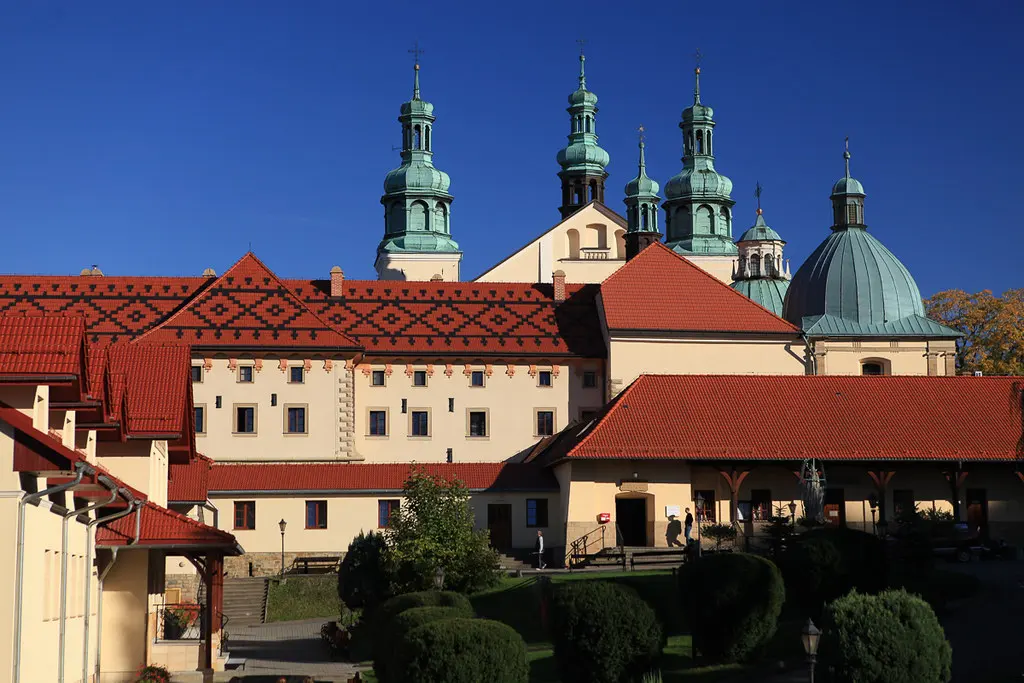
Sanctuary in Kalwaria Zebrzydowska
Kalwaria Zebrzydowska, Lesser Poland Voivodeship, Poland
18.9 km away

Mogiła Cistercian Abbey
Kraków-Mogiła, Kraków-Mogiła, Lesser Poland Voivodeship, Poland
19.0 km away
References
Sources consulted for this page. Source categories describe the publication, not a guarantee that every claim is verified. Traditional accounts and outside interpretations may differ.
- 01Official or institutional page for Tyniec Benedictine Abbey — opactwotynieckie.plofficialProvided in authority_url; use only for claims within this source's scope.
- 02Reference source for Tyniec Benedictine Abbey — poland.travelofficialProvided in References and Sources; use only for claims within this source's scope.
- 03Wikidata record Q334336 — Wikidata contributorsacademicCountry and coordinate-validated structured identity record.
- 04Benedictine Abbey of Tyniec — Wikipedia contributorsacademicIdentity and historical overview resolved through the accepted Wikidata sitelink; detailed claims require corroboration.
- 05File:20200529 Widok ze Skały Okrążek na Opactwo w Tyńcu 1735 2128.jpg — Jakub HałunacademicExact image-subject and reuse-license provenance only; not used for historical claims.
Share a photo
Help visitors recognize Tyniec Benedictine Abbey. Every submission is reviewed before publication.