San Sebastián Cathedral (Catedral del Buen Pastor)
A diocesan cathedral beside the northern Camino
Understand sacred places, explore living traditions, and learn how to engage respectfully with Pilgrim Map.
Access has not been verified. Check current local guidance before planning a visit.
San Sebastián, Gipuzkoa, Spain
Read the sources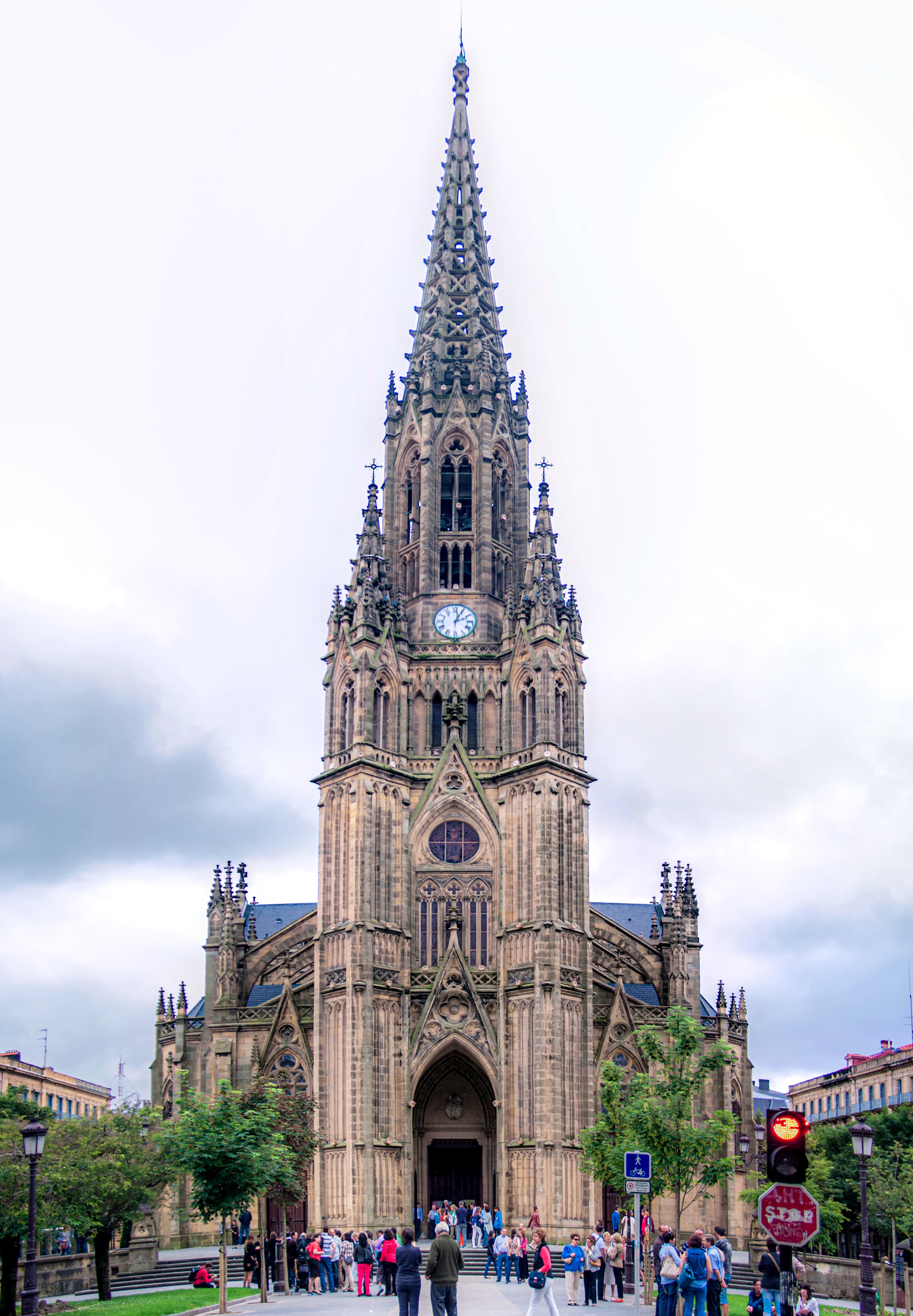
San Sebastián Cathedral (Catedral del Buen Pastor) - rights-reviewed Wikimedia image. Image source · CC BY 2.0
Visit essentials
A quick read before you go
- Duration
- Give San Sebastián Cathedral (Catedral del Buen Pastor) enough time for worship.
- Access
- Use diocesan sources for current hours, ask staff about services, and check Camino del Norte…
Overview
The cathedral belongs to a living diocesan community in Donostia-San Sebastian. Built in the closing years of the nineteenth century and later raised to cathedral rank, it is dedicated to Christ as the Good Shepherd. Pilgrims on the northern Camino meet it within a modern city rather than at a remote shrine: prayer, parish administration, urban movement, and heritage attention overlap at the same doors.
The tall spire and disciplined Gothic vocabulary may organize a first impression, but visitors should allow worship to set the pace. The route association does not make every visitor a pilgrim, and the building's architectural prominence does not turn services into performances. Enter quietly, look for current diocesan notices, and recognize that the cathedral serves local Catholics before it serves an itinerary.
Why this place is sacred
A busy city threshold becomes contemplative when the cathedral's height, stonework, and ordered nave draw attention away from street pace toward common prayer. That shift is created by architecture and practice, not by a claim of supernatural atmosphere. For a walker, it can mark a deliberate pause within the Camino's urban section; for parishioners, it is part of ordinary diocesan life.
The supplied encyclopedia record identifies the church as a late nineteenth-century Neo-Gothic building and the seat of the Diocese of San Sebastian. The diocesan website is the authority for current services and access. Spain's Ministry of Culture confirms the protected northern routes of the Camino de Santiago.
Worship carries continuity; repair, institutional change, and community stewardship also shape the cathedral.
Experience and orientation
Begin with current diocesan instructions. Camino movement, worship, and conservation share the cathedral without assigning one Roman Catholic purpose to everyone. Mass, private prayer, diocesan celebrations, and quiet Camino customs may coincide. Pause without assuming a stamp, blessing, or special access; ask staff and follow posted guidance.
Use Diocese of San Sebastian guidance to distinguish public space from worship, residential, conservation, and administrative areas.
Context and lineage
The supplied encyclopedia record identifies the church as a late nineteenth-century Neo-Gothic building and the seat of the Diocese of San Sebastian. The diocesan website is the authority for current services and access. Spain's Ministry of Culture confirms the protected northern routes of the Camino de Santiago.
San Sebastián Cathedral (Catedral del Buen Pastor) belongs to Roman Catholic Christianity here. Route evidence places San Sebastián Cathedral (Catedral del Buen Pastor) on Camino del Norte; this exact San Sebastián Cathedral (Catedral del Buen Pastor) relationship is distinct.
Traditions and practice
Mass, private prayer, diocesan celebrations, and the quiet customs of a Camino visit may coincide. A pilgrim may pause without assuming that a stamp, blessing, or special access is available; ask staff and follow posted guidance.
Describe current practice only through direct Roman Catholic and Diocese of San Sebastian guidance, not visitor inference.
Notice who worships, who cares for the cathedral, and what the diocese invites.
Roman Catholic Christianity
ActiveSan Sebastian's Cathedral of the Good Shepherd is the active seat of the Roman Catholic Diocese of San Sebastian and a clear ecclesial landmark near the Camino del Norte. Its late nineteenth-century Neo-Gothic fabric gives the city a vertical religious focus, while its primary meaning remains liturgical rather than architectural alone.
Mass, private prayer, diocesan celebrations, and the quiet customs of a Camino visit may coincide. A pilgrim may pause without assuming that a stamp, blessing, or special access is available; ask staff and follow posted guidance.
Perspectives and open questions
Read the cathedral through living Roman Catholic practice; its Camino del Norte relationship complements architecture, community history, and conservation.
Scholarly perspective
Institutional sources bound the history; exact-entity evidence leaves unresolved Roman Catholic matters explicit.
Living and traditional perspectives
The Roman Catholic community's language is the primary interpretive frame.
Open questions
San Sebastián Cathedral (Catedral del Buen Pastor) carries no claimed paranormal, therapeutic, or guaranteed transformative effect.
Plan your visit
Access and arrival
Use diocesan sources for current hours, ask staff about services, and check Camino del Norte closures separately. The matched map record lists Urdaneta Kalea, 12, 20006 Donostia / San Sebastián, Gipuzkoa, Spain.
No lodging claim is verified; consult current Camino del Norte sources for the Donostia-San Sebastián stop.
Respectful visit
Dress modestly for San Sebastián Cathedral (Catedral del Buen Pastor); follow its rules on covering, footwear, and sacred thresholds.
Follow diocesan guidance; ask before photographing people, rites, interiors, devotional objects, or protected surfaces.
Use only offerings and donation channels authorized by the Diocese of San Sebastian.
Respect barriers, private rooms, protected fabric, and uninterrupted prayer.
Promise no outcome, improvise no rite, and never stage worshippers for cathedral or Camino accounts.
Location
Map loads as you approach this section.
Pilgrim reflections
A portrait of encounter, not a score
Pilgrims describe what they felt, how present they could become, and whether the place would shape a journey. There are no stars and no ranking of traditions.
No reviewed reflections yet
The first pilgrims can help describe the character of being here.
Share a reflection
Available after an account-backed “Been there.” Every reflection is reviewed before publication.
Nearby sacred places
Explore other sacred places in the region. Proximity does not establish access or travel time; check each place’s guidance.


References
Sources consulted for this page. Source categories describe the publication, not a guarantee that every claim is verified. Traditional accounts and outside interpretations may differ.
- 01Diocese of San Sebastian — Diocese of San SebastianofficialInstitutional or custodian source used for current identity and visitor guidance; time-sensitive details require rechecking.
- 02The Camino de Santiago — Consejo Jacobeo, Ministry of Culture of SpainofficialOfficial national cultural source for the northern Camino routes and their protected pilgrimage context.
- 03San Sebastián Cathedral — Wikipedia contributorsSource contextExact supplied entity page used for identity and bounded historical orientation; claims are corroborated where an institutional source is available.
- 04Wikidata entity Q2942904 — Wikidata contributorsSource contextStructured identity and coordinate cross-check for the exact supplied entity.
- 05San Sebastián Cathedral (Catedral del Buen Pastor) - Google Maps place record — GoogleSource contextStrong exact-entity match used only for coordinates, address, phone, and operational status.
Share a photo
Help visitors recognize San Sebastián Cathedral (Catedral del Buen Pastor). Every submission is reviewed before publication.