Roman Baths of Bath (Temple of Sulis Minerva)
Where hot water rises from deep earth and ancient Britons recognized a goddess in the steam
Understand sacred places, explore living traditions, and learn how to engage respectfully with Pilgrim Map.
Access has not been verified. Check current local guidance before planning a visit.
Bath, England, United Kingdom
Read the sources
Featured in this guide
98 Sacred Springs and Holy Wells Around the World
Sacred water, community stories and spring sanctuaries worldwide
Featured in this guide
100 Sacred Sites of Healing and Pilgrimage
100 places of healing devotion, sacred water, and ancient sanctuary traditions
Visit essentials
A quick read before you go
- Duration
- 2-3 hours for the Roman Baths museum.
- Etiquette
- Standard museum protocols apply.
Overview
Before Rome, the Celtic Dobunni knew Britain's unique hot spring, whose unexplained flow stayed warm through winter and summer, as Sulis: goddess of healing, sacred water, and perhaps vision. Roman conquerors did not suppress her worship; they built one of their province's finest temple complexes to Sulis Minerva, placing the local goddess first to acknowledge her prior claim.
For three centuries pilgrims from across Europe sought healing, offered coins, inscribed curse tablets against wrongdoers, drank and bathed, and slept at the shrine for curative dreams. Pagan temples later closed under Christianity, but water kept flowing through churches built and lost over the ruins and the Georgian spa city raised around them. More than a million annual visitors now meet what Celtic people understood as a divine presence rising beyond ordinary explanation.
Why this place is sacred
What makes Bath thin is the spring itself. Water enters the ground somewhere in the Mendip Hills, descends to a depth of nearly two kilometers, is heated by the earth's core, and rises through faults in the limestone to emerge at 46 degrees Celsius—a quarter of a million gallons daily, without pause, without variation, for millennia beyond counting. This phenomenon was beyond ancient understanding.
The Celts, encountering perpetually hot water rising and steaming from the earth, understood it as the manifestation of a goddess. They called her Sulis—a name perhaps related to 'eye' or 'sight,' suggesting solar or prophetic associations. The Romans, arriving with their own theology, recognized the power already present and named it in syncretic fashion: Sulis Minerva, the local goddess first. The thermal phenomenon continues unchanged.
Standing beside the spring today, watching steam rise from green water, the visitor encounters what the Celts encountered: something emerging from deep earth, something continuous and inexplicable, something that invites the question of what powers might dwell beneath. The thinness is in this geological reality that every ancient visitor experienced and that remains accessible to anyone who pauses beside the sacred spring.
Celtic sacred site honoring the goddess Sulis. Roman temple complex for healing pilgrimage and devotion to Sulis Minerva.
Celtic sacred springs (prehistoric). Roman temple complex built 60-70 CE, expanded over 300 years. Temple closed 391 CE. Christian churches built on ruins from 7th century. Medieval healing spa. Georgian spa city development 18th century. Archaeological excavation and museum from 19th century. UNESCO inscription 1987, 2021.
Healing traditions
Later healing legend and Roman sacred spring
Bath's later legend tells of Prince Bladud, afflicted with a skin disease described as leprosy, noticing that his pigs recovered after rolling in warm mud. He tried the spring himself and was healed, then returned to rule. This is a legendary explanation of Bath's healing waters, distinct from the archaeological evidence for Roman worship of Sulis Minerva and the offerings placed in her sacred spring.
Ways to participate
At the Roman Baths, look at the spring and votive objects and consider the hopes people brought to the goddess. Follow museum rules: the ancient pools are not for bathing or drinking. Any visit to a modern licensed spa is a separate activity, subject to its own access and health guidance, not a reenactment that promises Bladud's cure.
These accounts describe religious traditions and reported experiences. They do not promise a cure or replace medical care.
Experience and orientation
Enter through the Georgian building that surrounds and protects the Roman site. The experience begins with context: the museum introduces Sulis Minerva and the pilgrims who came seeking her aid. The bronze head of the goddess—discovered in 1727, the only surviving fragment of her cult statue—gazes with eyes that once saw the temple interior.
The curse tablets, inscribed on lead and pewter, are among the most remarkable artifacts: individual voices reaching across two thousand years, asking the goddess to punish thieves, to right wrongs, to deliver justice. Over 130 tablets have been found, along with over 12,000 coins thrown as offerings. These personal documents are inscribed on the UNESCO Memory of the World register. Descend to the level of the Roman baths.
The Great Bath stretches before you, its lead-lined pool still filled with steaming green water. The columns that once supported a vaulted ceiling now stand open to the sky. The steam rises as it has for millennia. Move to the Sacred Spring itself, enclosed but visible, the water bubbling up from the earth at its constant temperature. Here is the heart of the site: the geological phenomenon that created the sacred place.
The temple ruins reveal the grandeur of Roman devotion: a classical podium, Corinthian columns, the famous Gorgon pediment with its carved head that combines Celtic and classical elements. The experience is of encountering something continuous: water still rising, steam still forming, the same phenomenon that drew Celtic worshippers and Roman pilgrims and Georgian spa-goers and modern visitors.
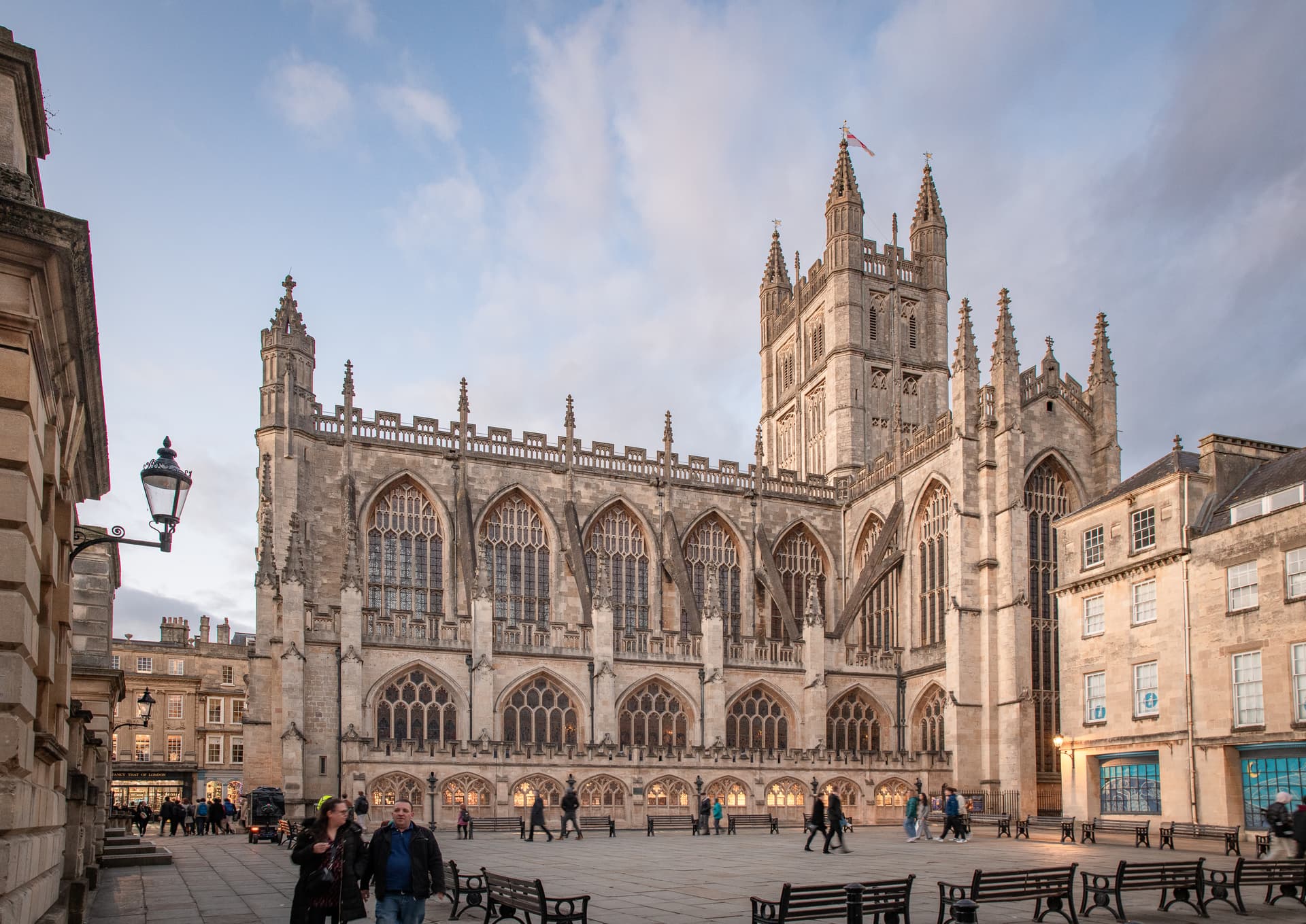
The Roman Baths museum is located in the city center, adjacent to Bath Abbey. The visit proceeds through museum displays, the Sacred Spring viewing area, the Great Bath and surrounding pools, and the temple remains. The Pump Room, adjacent, offers the chance to taste the mineral water. The Thermae Bath Spa, a short walk away, provides contemporary thermal bathing. Allow 2-3 hours for the museum.
Context and lineage
The geological reality came first: rainwater entering the Mendip Hills, descending to great depth, being heated by the earth, rising through faults to emerge hot and steaming in the valley below. The Dobunni people, the Celtic tribe of this region, encountered this phenomenon and understood it as divine. They named the presence Sulis—a goddess of healing, of water, perhaps of prophetic vision. When the Roman legions arrived after 43 CE, they found an established sacred site.
Rather than suppress the local worship, they transformed and monumentalized it. Between 60 and 70 CE, they built a temple in classical style, dedicating it to Sulis Minerva—unusually placing the Celtic name first. Over three centuries, they expanded the bathing complex until it rivaled any in the empire. Pilgrims came from across Europe. The temple's oracle was consulted. Coins and offerings accumulated in the spring. Curse tablets were thrown into the water, asking the goddess for justice.
When the Emperor Theodosius closed pagan temples in 391 CE, the worship ended, but the waters continued. The temple fell into ruin. Churches rose on its foundations. The medieval period used the springs for healing. Georgian architects rediscovered the Roman remains and built an elegant spa city around them. Today the waters still rise, unchanged.
Celtic sacred site (prehistoric). Roman temple complex (60-70 CE to 391 CE). Christian churches on temple ruins (7th century onward). Medieval healing springs. Georgian spa development (18th century). Archaeological site and museum (19th century to present).
Sulis
Celtic goddess of the hot springs
Sulis Minerva
Romano-Celtic syncretic deity
The Curse Tablet Authors
Individual pilgrims seeking divine justice
Traditions and practice
Pilgrimage for healing. Immersion in the hot waters for physical and spiritual restoration. Drinking the mineral water. Sleeping at the shrine (incubation) for healing dreams or prophetic visions. Offerings of coins and valuables thrown into the spring. Inscribing curse tablets asking the goddess for justice against wrongdoers.
The Roman Baths function as a museum; no formal religious practice occurs. Some neo-pagans view the site as sacred to Sulis and visit for personal devotion. The Thermae Bath Spa offers contemporary thermal bathing for wellness purposes. The Pump Room offers visitors the chance to taste the mineral water.
Visit the Sacred Spring and pause to watch the water rise. Consider that this phenomenon has been continuous for millennia—that what you see is what Celtic worshippers saw, what Roman pilgrims saw. Read the curse tablets and consider the individuals who inscribed them: people asking a goddess for help with personal wrongs, reaching across two thousand years.
Meet the gaze of the bronze head of Sulis Minerva and consider what it would have been like to enter her temple seeking healing. If you wish to experience the waters directly, the Thermae Bath Spa offers thermal bathing using the same natural hot water.
Celtic Sulis Worship
HistoricalThe Dobunni tribe venerated Sulis at the hot springs before Roman arrival. Sulis was a goddess of healing and sacred water, her name possibly meaning 'eye' or 'sight.' The perpetually hot water rising from the earth was understood as divine manifestation.
Worship at the springs, likely including healing rituals and offerings. Specific practices are not documented.
Roman Sulis Minerva Cult
HistoricalThe Romans built a monumental temple complex honoring the syncretic deity Sulis Minerva. For three centuries, the site was a major pilgrimage destination. The curse tablets and coin hoards document widespread devotion. The temple oracle was consulted by pilgrims from across Europe.
Pilgrimage for healing. Bathing in the sacred waters. Drinking the mineral water. Incubation (sleeping at the shrine for curative dreams). Offerings of coins. Inscribing curse tablets seeking divine justice.
Neo-Pagan Devotion
ActiveSome contemporary Wiccans and pagans venerate Sulis and view the Bath springs as sacred. This represents modern revival inspired by ancient practice rather than continuous tradition.
Personal devotion and offerings. Individual prayer and meditation. Practices are informal and not publicly organized.
Perspectives and open questions
Bath invites engagement with a geological phenomenon that ancient people experienced as divine—hot water rising from deep earth, continuous and inexplicable, inviting the question of what powers might dwell beneath.
Scholarly perspective
Archaeologists recognize the Bath complex as one of the most important Roman religious sites in Britain. The temple and baths document Romano-British religious syncretism and the continuity of Celtic beliefs under Roman rule. The curse tablets are considered exceptional evidence for personal religion in antiquity and are inscribed on the UNESCO Memory of the World register. The engineering of the Roman baths demonstrates sophisticated Roman hydraulic technology.
Living and traditional perspectives
No continuous religious tradition claims the site. The worship of Sulis Minerva ended in the 4th century CE. The Celtic practices that preceded it left no written records. What survives is archaeological evidence rather than living faith.
Alternative interpretations
Some neo-pagans and practitioners of Celtic-inspired spirituality venerate Sulis and view the springs as sacred. These modern devotions represent revival rather than continuous tradition from antiquity. Some visitors approach with interests in goddess spirituality or earth energies.
Open questions
What was the nature of Celtic worship at the springs before the Romans arrived? What rituals accompanied the inscribing and depositing of curse tablets? How did local people experience the transition from pagan shrine to Christian church? What spiritual practices, if any, accompanied medieval and Georgian use of the springs?
Plan your visit
Access and arrival
Bath offers accommodation ranging from historic Georgian townhouses to modern hotels. As a UNESCO World Heritage city, options are plentiful but can be expensive during peak season.
Respectful visit
Normal museum attire. Comfortable walking shoes recommended for the uneven Roman paving.
Generally permitted throughout the museum and bathing complex.
Do not throw coins or objects into the water. This is a protected archaeological site.
No bathing in the Roman Baths. No touching water or artifacts. Standard museum protocols.
Bathing in the Roman Baths is not permitted for public health reasons. Do not throw coins or objects into the water despite the ancient tradition—this is a protected archaeological site.
Current practical details
Address
Bath, UK
Hours, fees, and access can change — verify on the official source before you travel. Practical details last checked Jun 2026.
Location
Map loads as you approach this section.
Pilgrim reflections
A portrait of encounter, not a score
Pilgrims describe what they felt, how present they could become, and whether the place would shape a journey. There are no stars and no ranking of traditions.
No reviewed reflections yet
The first pilgrims can help describe the character of being here.
Share a reflection
Available after an account-backed “Been there.” Every reflection is reviewed before publication.
Nearby sacred places
Explore other sacred places in the region. Proximity does not establish access or travel time; check each place’s guidance.
References
Sources consulted for this page. Source categories describe the publication, not a guarantee that every claim is verified. Traditional accounts and outside interpretations may differ.
- 01Aquae Sulis, Bath, England — SmarthistoryacademicAcademic art history perspective
- 02The Roman Temple — Roman Baths MuseumofficialOfficial site documentation
- 03Roman Baths (Bath) — Wikipedia contributorsencyclopediaComprehensive archaeological overview
- 04Sulis — Wikipedia contributorsencyclopediaDeity information
- 05Bath — World Pilgrimage GuideSource contextPilgrimage perspective
- 06The tale of King Bladud and his pigs — Visit BathofficialSupports the attributed account or visitor practice in the healing section; not evidence of clinical efficacy.
- 07The Roman sacred spring — Roman Baths museumofficialSupports the attributed account or visitor practice in the healing section; not evidence of clinical efficacy.
Photo gallery
6 curated photos
Share a photo
Help visitors recognize Roman Baths of Bath (Temple of Sulis Minerva). Every submission is reviewed before publication.