Poverty Point Mounds, Louisiana
Where 3,400 years ago, hunter-gatherers moved 2 million cubic yards of earth by hand to repair the cosmos
West Carroll Parish, Louisiana, United States
Visit essentials
Before you go
- Address
- 6859 LA-577, Pioneer, LA 71266, USA
- Duration
- 2-4 hours for a complete visit including museum, tram tour, and walking trails.
- Etiquette
- Standard archaeological site etiquette applies.
Overview
Poverty Point is older than the Parthenon, older than Rome, contemporary with the height of ancient Egypt. Between 1700 and 1100 BCE, people gathered in what is now Louisiana and moved nearly 2 million cubic yards of earth without draft animals, without wheels, without metal tools—carrying it in woven baskets to build a monument that would remain the largest earthwork in North America for over two thousand years.
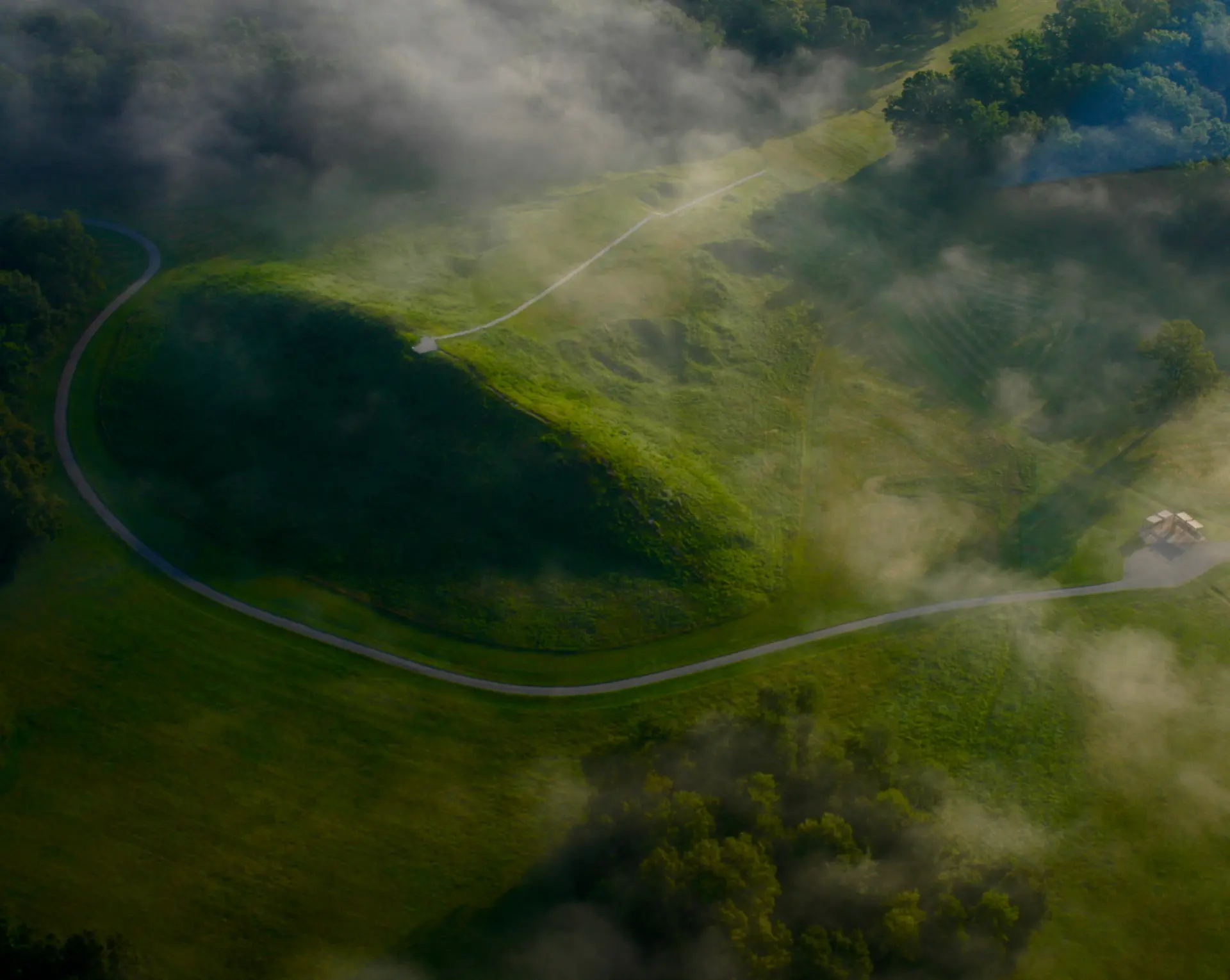
The result stands today: six concentric semi-elliptical ridges curving around a 37-acre plaza, a 72-foot mound shaped like a bird in flight, and scattered mounds marking the edges of a complex that once covered over a square mile. The scale alone demands attention. But it is the recent reinterpretation of Poverty Point that transforms how we understand it.
For decades, archaeologists assumed such monumental construction required a hierarchical society—elites commanding laborers. Recent research suggests otherwise. Poverty Point appears to have been built by egalitarian hunter-gatherers who gathered periodically, perhaps seasonally, from across a vast region. They came to trade, to feast, to build together, and to perform rituals that researchers believe were meant to address cosmic disorder—severe weather and floods that threatened their world. The earthworks were not monuments to power but cooperative offerings to restore balance.
This interpretation transforms Poverty Point from an engineering curiosity into something more contemplative: evidence that thousands of people, united by shared purpose rather than coercion, could create something that would outlast empires. The question the site poses is not just who built it, but what brought them together—and what it might mean that they succeeded.
Why this place is sacred
What makes a place thin? At Poverty Point, the answer lies in accumulation. For six hundred years, from approximately 1700 to 1100 BCE, people came here. They brought materials from vast distances—copper from the Great Lakes, quartz crystal from Arkansas, soapstone from the Appalachians. They built earthworks that required moving nearly 2 million cubic yards of soil by hand. They deposited valuable objects as offerings. They gathered in the plaza for ceremonies we can only imagine.
Each journey, each basket of earth, each offering added to what the place held. The ridges grew. The bird mound rose. The plaza filled with the evidence of communal effort. By the time Poverty Point reached its peak, it had been absorbing human intention for centuries. That accumulation persists.
The site's thinness is also a function of mystery. We do not know the builders' identity or what ceremonies took place in the plaza. We do not know why, around 1100 BCE, the people stopped coming. The culture that created Poverty Point vanished, leaving only the earthworks and millions of artifacts to speak for them.
This absence creates a particular quality. Unlike sites where living traditions provide interpretation, Poverty Point requires visitors to sit with not-knowing. The bird mound rises, but no story explains it. The ridges curve, but no ritual context survives. What remains is the evidence of effort—the physical proof that thousands of people, over hundreds of years, found this place worth building. That proof is thin because it is silent. It speaks through scale rather than narrative.
Recent research has fundamentally reframed our understanding of Poverty Point's purpose. For decades, archaeologists assumed the site was a permanent settlement, perhaps the capital of a chiefdom that commanded the labor necessary for such monumental construction. This interpretation has given way to something more complex and, arguably, more remarkable.
Archaeologists Tristram Kidder and Seth Grooms propose that Poverty Point was neither permanent village nor monument to ruling elites. Instead, it functioned as a ceremonial gathering place where egalitarian hunter-gatherers from across the Southeast and Midwest assembled periodically. They came to trade, to socialize, to participate in shared rituals—and to build. The construction of the earthworks was itself ceremonial, a cooperative religious activity meant to address environmental uncertainties.
The region during this period was prone to severe weather and massive floods. The researchers suggest the inhabitants built mounds and performed rituals as 'sacrifice and spiritual offering' to restore cosmic balance. The exotic materials found at the site—copper, quartz crystal, soapstone—were not merely trade goods but offerings deposited during ceremonial gatherings. Poverty Point, in this interpretation, was an effort to repair the universe.
Poverty Point was built over approximately six hundred years, from 1700 to 1100 BCE. The earthworks grew incrementally, with radiocarbon dates showing construction across multiple centuries. One exception is Mound A, the 72-foot bird effigy, which appears to have been built rapidly—possibly in less than three months. This suggests a moment of intense, coordinated effort, perhaps marking a particularly important ceremonial event.
Around 1100 BCE, the gatherings stopped. The culture that built Poverty Point faded from the archaeological record. Why remains unknown. Climate change, shifting trade routes, social transformation—any or all may have contributed. What is certain is that no comparable earthwork would be built in North America for over two thousand years, until the rise of Cahokia around 1000 CE.
The site was rediscovered by Euro-Americans in the 19th century, receiving its name from a nearby plantation. Scientific study began in 1873 and intensified through the 20th century. Poverty Point became a National Historic Landmark in 1962, a National Monument in 1988, and a UNESCO World Heritage Site in 2014—recognition that this is one of the most significant archaeological sites in the Americas.
Experience and orientation
The drive to Poverty Point winds through northeastern Louisiana—cotton fields, pine stands, the flat expanses of the Mississippi floodplain. The site lies in West Carroll Parish, an hour from Monroe, far from major highways. By the time you arrive, you have entered a landscape that feels removed from time.
The visitor center provides essential context. Exhibits explain the Poverty Point culture, display artifacts including thousands of Poverty Point Objects (the distinctive clay cooking balls that are the site's most numerous artifact), and present the archaeological interpretations that have evolved over decades of study. A film introduction prepares you for what you will see outside.
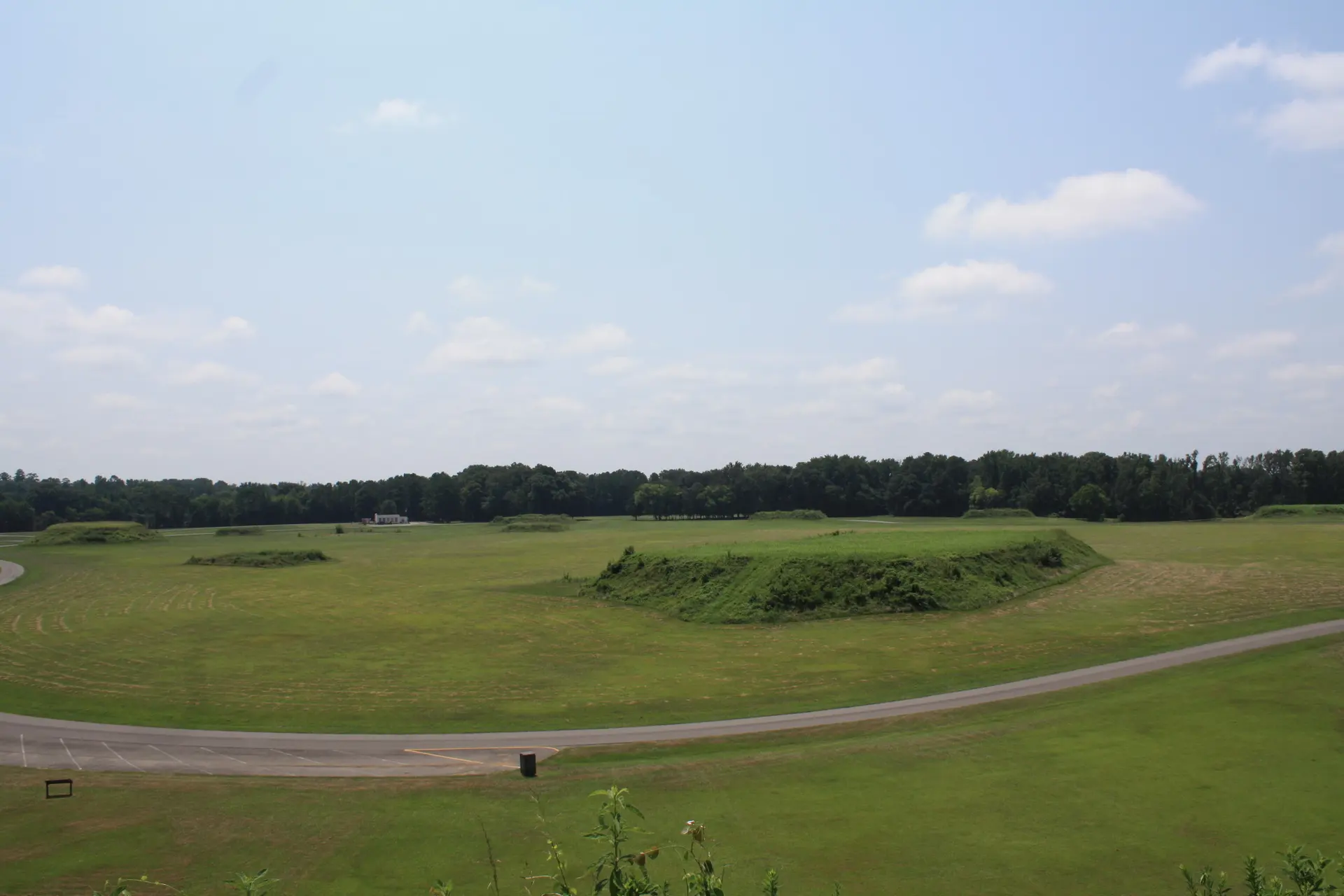
But the earthworks must be experienced to be understood. From ground level, the ridges are subtle—low rises in the landscape, easily mistaken for natural terrain. The scale becomes apparent only with perspective. The observation tower near the plaza offers a view across the ridges, revealing their concentric curve. From here, looking west toward Mound A, the bird shape emerges: a 72-foot mound stretching over 600 feet, its wings spread, its head pointed toward the summer solstice sunset.
Tram tours provide guided interpretation, taking visitors around the earthwork complex while rangers explain what is known and what remains uncertain. Walking the trails offers a different experience—slower, more contemplative, with time to consider what it meant to carry baskets of earth, year after year, building something this large without modern technology.
What visitors often report is a sense of disproportion. The effort required to build Poverty Point so exceeds what seems possible for hunter-gatherers that the mind struggles to reconcile evidence and expectation. This cognitive dissonance can be transformative. It challenges assumptions about what pre-agricultural societies could achieve—and what might motivate them to achieve it.
Plan for 2-4 hours to fully experience the site. The visitor center and museum require 30-60 minutes. Tram tours run 45 minutes (Wednesday-Sunday, March-October; call for off-season schedule). Walking the trails adds another hour or more. The observation tower is essential for understanding the earthworks' layout. Bring water and sun protection—Louisiana summers are hot and humid. Mosquito repellent is advisable.
Context and lineage
The Poverty Point people left no written record, and no oral tradition has been passed down through surviving cultures. What we know comes from archaeology—and archaeology speaks through material evidence rather than narrative.
The most recent interpretation frames Poverty Point as a response to environmental crisis. The Southeast during this period experienced severe weather and catastrophic floods. The researchers Kidder and Grooms propose that the people who built Poverty Point understood these disasters as cosmic disorder—a world out of balance. They gathered at this place to perform rituals and build earthworks as offerings meant to restore equilibrium. The mounds were not monuments but medicine, cooperative religious structures built to repair the universe.
This interpretation aligns with animistic worldviews documented in Indigenous cultures across the Americas. The understanding that all living things are imbued with spirit, that humans have responsibility to maintain cosmic balance, that sacred architecture can focus spiritual energy—these patterns recur in traditions from the Arctic to Tierra del Fuego. Poverty Point may represent one of the earliest monumental expressions of such beliefs in North America.
The available record identifies no contemporary Indigenous people claiming direct descent or ceremonial connection to the Poverty Point builders. Their culture disappeared by about 1100 BCE, over a millennium before those encountered by European colonizers. Poverty Point is therefore heritage without known heirs: identity is lost, while the builders' effort and achievement remain.
The Builders
The people of the Poverty Point culture who gathered periodically between 1700-1100 BCE to construct the earthworks, trade, feast, and perform ceremonies. Recent research suggests they were egalitarian hunter-fisher-gatherers, not subjects of a hierarchical chiefdom.
James Ford
Archaeologist who began systematic study of Poverty Point in 1953, establishing the site's significance and chronology. His work laid the foundation for all subsequent research.
Tristram Kidder & Seth Grooms
Archaeologists whose 2025 research proposed that Poverty Point was a ceremonial gathering place for egalitarian hunter-gatherers, built cooperatively as spiritual offering rather than commanded by elites.
William Haag
Archaeologist who excavated at Poverty Point in the 1970s and proposed that the aisles between ridge segments aligned with solstices, suggesting astronomical significance. His interpretation remains debated.
Traditions and practice
Archaeological evidence suggests that the plaza at the center of Poverty Point's ridges served as a ceremonial gathering space. The 37-acre open area could have accommodated thousands of people. Researchers believe it hosted public ceremonies, ritual dances, games, and major community events.
The construction of the earthworks was itself ritualized. Moving nearly 2 million cubic yards of earth required coordinated effort over generations. Each basket carried was an offering. The act of building was the ceremony. The exotic materials deposited at the site—copper from the Great Lakes, quartz crystal from Arkansas, soapstone from the Appalachians—were not merely trade goods but offerings. People brought precious items from great distances to contribute to collective ritual activities.
The Poverty Point Objects (PPOs) present a particular mystery. These small clay cooking balls—millions of which have been found at the site—served practical purposes (heating earth ovens in a region without cooking stones), but may also have functioned as symbolic tokens. Some archaeologists hypothesize that visitors took PPOs on the pilgrim road with them, leaving some behind as offerings and taking some home as souvenirs. If correct, Poverty Point may have been a pilgrimage site 3,400 years ago.
No active ceremonial practice occurs at Poverty Point today. Its builders' culture disappeared around 1100 BCE; the site is managed for archaeological preservation and public education.
Visitors cannot participate in ceremonies at Poverty Point—there are no living traditions to participate in. What the site offers is contemplative engagement with questions. Walk the ridges slowly. Climb the observation tower and look toward the bird mound as the sun moves west. Consider what it meant to carry baskets of earth, year after year, building something this large by hand. Consider what brought thousands of people together, what they believed, what they hoped the earthworks would accomplish.
The site invites meditation on collective effort, on what communities can achieve when united by shared purpose. The recent interpretation—that Poverty Point was built not by commanded labor but by voluntary participation, not to aggrandize rulers but to repair the cosmos—offers a different model of monumentality than we typically imagine.
Poverty Point Culture
HistoricalThe Poverty Point culture flourished between 1700-1100 BCE, creating the largest earthwork complex in North America for over two thousand years. Recent research suggests these were egalitarian hunter-fisher-gatherers who gathered periodically for trade, feasting, and ceremonies meant to restore cosmic balance. They maintained trade networks spanning from the Great Lakes to the Gulf Coast.
Mound building as sacred offering, ceremonial gatherings in the central plaza, trade and exchange of exotic materials (copper, quartz, soapstone), creation of Poverty Point Objects (clay cooking balls), communal feasting, possible astronomical observations tied to solstices.
Archaic Mound-Building Tradition
HistoricalPoverty Point represents the pinnacle of Late Archaic earthwork construction in North America. The tradition of building mounds as sacred architecture stretches back to Watson Brake (c. 3500 BCE) and forward to Cahokia (c. 1000 CE). Poverty Point occupies a central position in this millennia-long tradition, demonstrating what hunter-gatherers could achieve before the advent of agriculture.
Construction of effigy mounds and geometric earthworks, alignment of structures to celestial events, deposition of valuable materials as spiritual offerings, communal labor organized for sacred purposes rather than economic production.
Perspectives and open questions
Poverty Point invites multiple interpretations: engineering achievement, ceremonial complex, astronomical observatory, cooperative monument. What unifies these perspectives is recognition that something extraordinary happened here 3,400 years ago. The debates concern what, exactly, and why.
Scholarly perspective
The scholarly consensus recognizes Poverty Point as the largest and most complex Late Archaic earthwork in North America. Built between 1700-1100 BCE, it represents an achievement in earthen construction that would not be matched for over two thousand years. The builders maintained trade networks spanning from the Great Lakes to the Gulf Coast, exchanging copper, quartz crystal, soapstone, and other exotic materials.
The major interpretive shift in recent years concerns social organization. Earlier scholars assumed such monumental construction required hierarchical leadership—elites commanding labor. The 2025 research by Kidder and Grooms challenges this assumption, proposing that Poverty Point was built by egalitarian hunter-gatherers gathering periodically for ceremonial purposes. The earthworks were cooperative religious monuments, built voluntarily to address perceived cosmic disorder.
Astronomical alignments remain debated. William Haag proposed in the 1970s that the aisles between ridge segments aligned with solstices. Subsequent analysis found discrepancies. The question remains open: were alignments intentional, coincidental, or partially both?
Living and traditional perspectives
No present Indigenous community claims a direct ancestral or ceremonial tie to Poverty Point's builders, whose culture disappeared around 1100 BCE. Unlike Bighorn Medicine Wheel or Effigy Mounds, the site has no living tradition supplying interpretive continuity.
Any broader Indigenous comparison must remain qualified. Archaeological readings of animistic builders using mounds to focus spiritual energy and restore cosmic balance resemble worldviews found elsewhere in the Americas—spirit-imbued existence, human responsibility for cosmic maintenance, and spiritually effective sacred architecture—but Poverty Point's specific beliefs cannot be recovered.
Alternative interpretations
Poverty Point has attracted attention from those interested in ancient civilizations and anomalous archaeology. The site has appeared in popular media, including the Netflix series Ancient Apocalypse. Such treatments tend to emphasize mystery over evidence, suggesting connections to lost civilizations or extraordinary knowledge.
The scholarly response is that Poverty Point is remarkable on its own terms without requiring extraordinary explanations. Hunter-gatherers building monumental earthworks challenges modern assumptions, but it does not require positing lost civilizations. The achievement is human, local, and documented—and more impressive for being so.
Open questions
Significant mysteries remain. Why was Poverty Point abandoned around 1100 BCE? What specific ceremonies took place in the plaza? Were the astronomical alignments intentional? How did egalitarian societies coordinate construction across generations? Why was Mound A built so rapidly, possibly in less than three months? What is the meaning of the bird effigy? What is the relationship between Poverty Point and other contemporary cultures across the Southeast? These questions remain open, inviting continued research and contemplation.
Plan your visit
Access and arrival
Limited lodging near the site. Monroe, Louisiana (50 miles south) offers full hotel services. Poverty Point Reservoir State Park, adjacent to the site, offers camping with hookups.
Respectful visit
Comfortable outdoor attire appropriate for Louisiana's climate. Summer temperatures regularly exceed 90°F with high humidity. Spring and fall are mild. Sturdy walking shoes are essential for the trails. Sun protection and mosquito repellent are recommended.
Photography is permitted throughout the site. The observation tower provides the best vantage for photographing the earthwork complex. Consider visiting in morning or late afternoon light for best photographic conditions.
Not applicable. Do not leave items at the site. Unlike active sacred sites, Poverty Point does not have living traditions that include offerings.
{"Stay on designated paths and trails","Do not climb, walk on, or disturb the earthworks","Do not dig, probe, or excavate","Do not collect or remove any artifacts","Pets must be leashed"}
Poverty Point is an archaeological site without active sacred traditions. The contemplative engagement it offers is historical and imaginative, not ceremonial. Respect the site as heritage—do not disturb the earthworks or collect artifacts—but do not expect to encounter living practice here.
Current practical details
Address
6859 LA-577, Pioneer, LA 71266, USA
Phone
Hours
Hours, fees, and access can change — verify on the official source before you travel. Practical details last checked Jun 2026.
Location
Map loads as you approach this section.
Pilgrim reflections
A portrait of encounter, not a score
Pilgrims describe what they felt, how present they could become, and whether the place would shape a journey. There are no stars and no ranking of traditions.
No reviewed reflections yet
The first pilgrims can help describe the character of being here.
Share a reflection
Available after an account-backed “Been there.” Every reflection is reviewed before publication.
Nearby sacred places
Explore other sacred places in the region. Proximity does not establish access or travel time; check each place’s guidance.


Share a photo
Help visitors recognize Poverty Point Mounds, Louisiana. Every submission is reviewed before publication.