Nine Ladies Stone Circle
A small Bronze Age circle where fragile archaeology and living spiritual meaning share the moor
Understand sacred places, explore living traditions, and learn how to engage respectfully with Pilgrim Map.
Access has not been verified. Check current local guidance before planning a visit.
Stanton in Peak, England, United Kingdom
Read the sources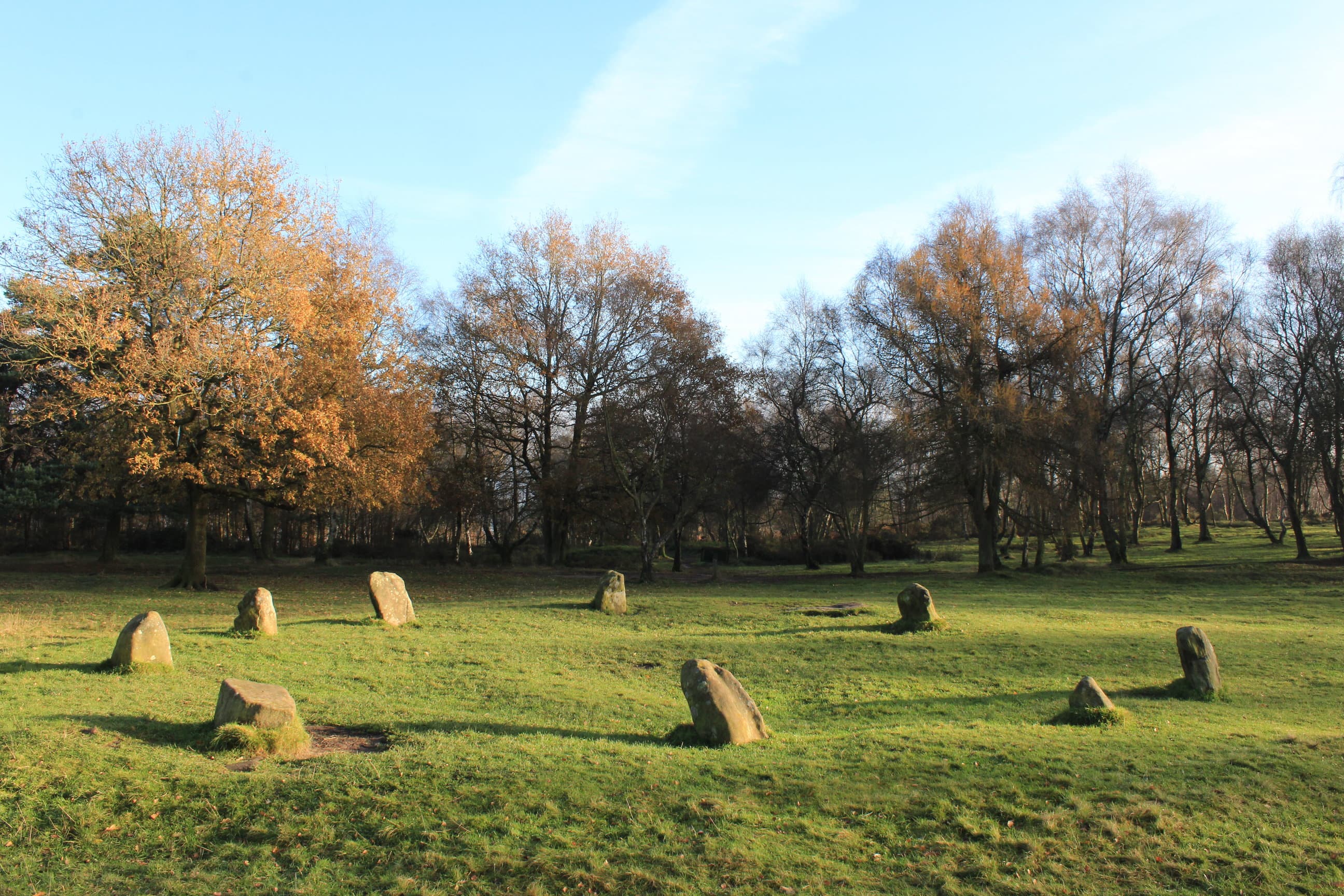
Image of Nine Ladies Stone Circle. Image source
Visit essentials
A quick read before you go
- Duration
- Two hours including Stanton Moor
- Access
- Walk from formal parking near Birchover or another legal public-path access point.
Overview
Nine low stones stand within a small embanked circle on Stanton Moor. Their scale is intimate rather than monumental: the site asks visitors to notice spacing, ground, trees, and the surrounding prehistoric landscape. English Heritage dates the monument to the Early Bronze Age and places it within a complex that includes other circles, standing stones, burial mounds, and cairns.
Archaeology does not tell us exactly what happened here. Geophysical and survey work has refined the plan of the circle, including a fallen tenth stone identified in the twentieth century and possible additional features, but no secure evidence names its ceremonies or builders’ beliefs. The popular story of nine women punished for dancing on Sunday is later folklore, valuable as a history of how people interpreted the stones rather than a Bronze Age account.
Stanton Moor is also a living spiritual and aesthetic resource. Peak District planning documents recognize that contemporary communities value the landscape in these terms. That living layer deserves respect alongside archaeology. The circle is neither an empty ruin nor a stage for unrestricted ritual: it is protected, fragile ground shared among many visitors.
Why this place is sacred
The circle is small enough to take in at once, yet its wider context extends across Stanton Moor. Low stones create a human-scale enclosure while nearby barrows and cairns remind the visitor that the visible ring is one part of a long-used landscape.
Uncertainty is central to an honest encounter. Archaeology supports an Early Bronze Age date and ceremonial or communal significance in broad terms, but not modern claims about healing, lunar calendars, Druids, or a specific goddess cult. The Sunday-dancing story belongs to later Christian-era folklore and reveals a different relationship with the monument.
Contemporary Pagan and other spiritual visitors may experience the circle as active and relational. That experience can be acknowledged without declaring one modern practice to be the original meaning. The ethical task is to keep all three layers visible: prehistoric monument, later story, and living spiritual resource.
Experience and orientation
Approach is part of the experience. Formal parking lies outside Birchover, roughly 1.5 kilometres away, because roads beside Stanton Moor are narrow and unsuitable for parking. Routes include gates, stiles, fields, woodland, and uneven surfaces.
At the circle, avoid making the stones into seats or props. Walk the outside first and notice how the ring sits in relation to the slope and trees. Then, if the site is quiet and no ceremony is taking place, enter without assuming the center is yours to occupy.
The site can be busy at weekends and seasonal gatherings. If others are praying or conducting a quiet observance, give them space. If a group blocks the monument or leaves material, the protected status and shared access still apply.
Allow time to explore Stanton Moor beyond the circle while staying on legal paths. Visit in daylight, carry a map, and expect mud after rain.
Context and lineage
Local folklore says that nine women were turned to stone for dancing on a Sunday, with a nearby stone representing the fiddler. The story is not an archaeological explanation; it belongs to a widespread family of British tales that moralize ancient stones through later Christian ideas.
Early Bronze Age communities created the circle within a wider funerary and ceremonial landscape. Later residents attached the dancing-stone story. Archaeologists and conservation bodies documented and protected the monument, while modern spiritual communities continue to value it.
Traditions and practice
The dancing-stone story remains the best-known local folklore associated with the circle. It should be retold as folklore, not as fact or as the voice of the builders.
Some Pagan and other spiritual visitors mark seasonal occasions or use the circle for prayer and meditation. Practices vary and no single group holds exclusive authority over the public monument.
Walk one slow circuit outside the stones, then pause where you can see both the ring and the wider moor. Let unanswered questions remain unanswered.
Early Bronze Age Ceremonial Landscape
HistoricalThe circle is one element of a dense prehistoric landscape of monuments and burials.
Specific original practices are unknown.
Dancing Stones Folklore
ActiveThe story of dancers turned to stone has shaped local interpretation for generations.
Retelling and place-based memory.
Contemporary Pagan and Spiritual Use
ActivePresent-day communities value the circle as a spiritual and seasonal gathering place.
Quiet prayer, meditation, and varied seasonal observance within conservation rules.
Perspectives and open questions
Nine Ladies is understood through archaeology, folklore, conservation, and living spiritual use. None of these should erase the others.
Scholarly perspective
Survey and geophysics support an Early Bronze Age embanked stone circle within a wider prehistoric complex. The original ceremonies and symbolic system are unknown.
Living and traditional perspectives
The nine dancers and fiddler story is a later local explanation that connects the stones with Sunday observance and moral warning.
Alternative interpretations
In an alternative contemporary interpretation, Matías De Stefano’s Gaia episode places Nine Ladies within a spiritual journey. It is not evidence of the circle’s Bronze Age purpose.
Open questions
The builders’ names, language, rites, and precise reasons for selecting this location are not recoverable from current evidence.
Plan your visit
Access and arrival
Walk from formal parking near Birchover or another legal public-path access point. | Difficulty: Moderate walking on uneven moorland; challenging for wheelchairs and buggies.
Respectful visit
Weatherproof layers and footwear suitable for uneven, muddy paths.
permitted: Yes | Ask before photographing ceremonies or identifiable participants; do not climb stones for a viewpoint.
Leave no candles, ribbons, coins, food, crystals, or other material.
Do not light candles or fires, camp, dig, chalk, climb, move stones, leave offerings, or attach objects to vegetation.
Location
Map loads as you approach this section.
Pilgrim reflections
A portrait of encounter, not a score
Pilgrims describe what they felt, how present they could become, and whether the place would shape a journey. There are no stars and no ranking of traditions.
No reviewed reflections yet
The first pilgrims can help describe the character of being here.
Share a reflection
Available after an account-backed “Been there.” Every reflection is reviewed before publication.
Nearby sacred places
Explore other sacred places in the region. Proximity does not establish access or travel time; check each place’s guidance.
References
Sources consulted for this page. Source categories describe the publication, not a guarantee that every claim is verified. Traditional accounts and outside interpretations may differ.
- 01Nine Ladies Stone Circle — English HeritageofficialDate, folklore, opening, access, parking, and rules.
- 02Nine Ladies Stone Circle: Report on Geophysical Survey 1998 — Historic EnglandacademicMonument plan and survey results.
- 03Stanton Moor scheduled monument — Historic EnglandofficialWider protected prehistoric landscape.
- 04MDR3735 Nine Ladies Stone Circle — Derbyshire Historic Environment RecordofficialLocal archaeological record.
- 05Stanton in Peak Parish Statement — Peak District National ParkofficialSpiritual, aesthetic, and archaeological significance.
- 06The Journey of Remembering S2:E5 — Reconnecting to Your True Nature — GaiaSource contextContemporary spiritual perspective only.
Share a photo
Help visitors recognize Nine Ladies Stone Circle. Every submission is reviewed before publication.