Barakoni Church
eighteenth-century Georgian church
Understand sacred places, explore living traditions, and learn how to engage respectfully with Pilgrim Map.
Access has not been verified. Check current local guidance before planning a visit.
Tsesi, Racha-Lechkhumi and Kvemo Svaneti, Georgia
Read the sources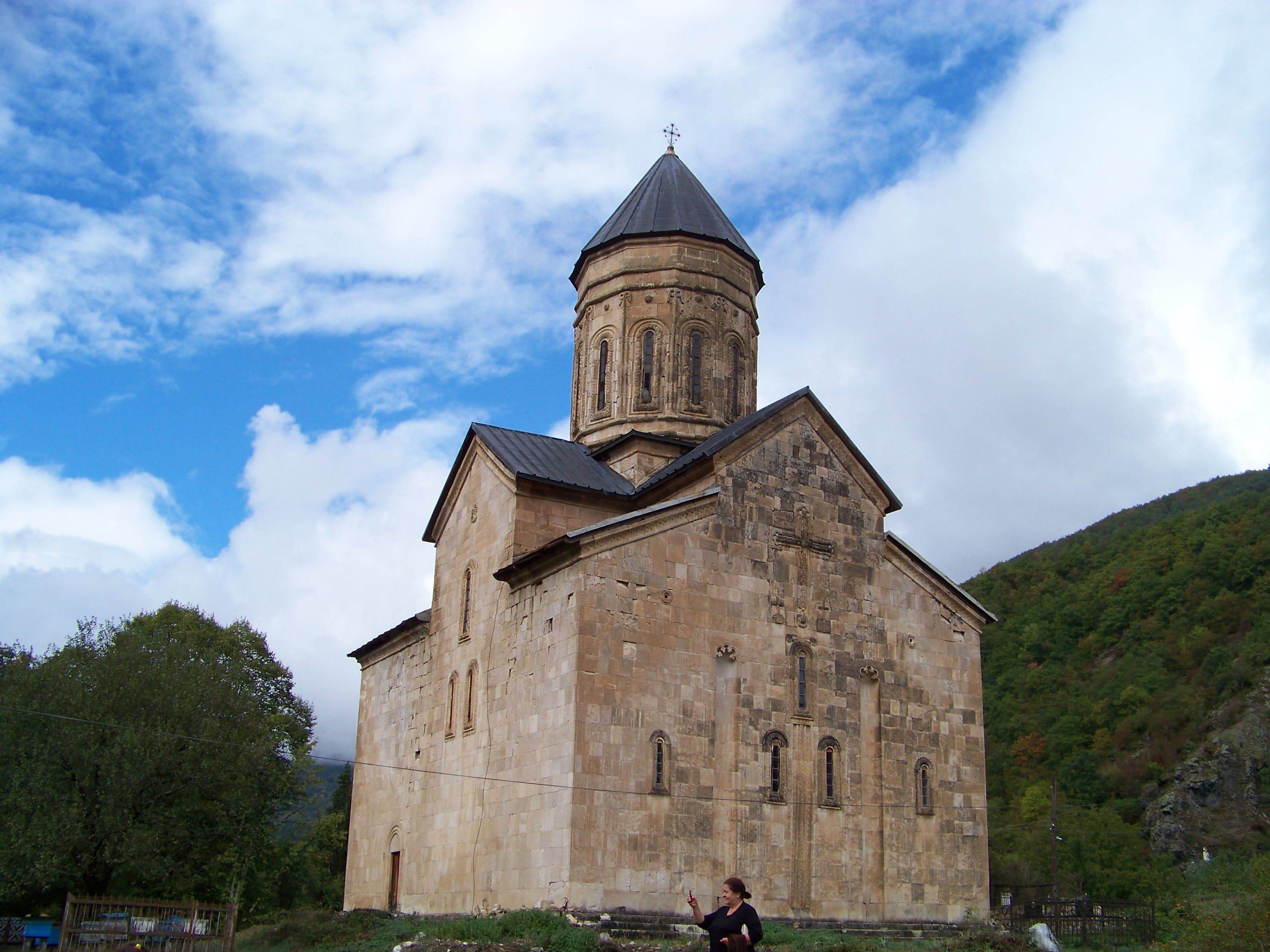
Image of Barakoni Church. Image source · CC BY-SA 4.0
Visit essentials
A quick read before you go
- Etiquette
- Treat walls, paintings, objects, and archaeological surfaces as protected evidence.
Overview
The church was commissioned in 1753 and is attributed to the architect Avtandil Shulavreli. Its carved stone facades and iconostasis belong to a specific late-feudal Georgian monument.
Why this place is sacred
The official page supports the building date and architectural authorship; later activity and road conditions require separate current evidence.
Experience and orientation
Conditions at the threshold take precedence over this profile; closed doors, services, conservation barriers, and resident privacy must be honored.
Context and lineage
Georgian Orthodox Christianity
Traditions and practice
Historical Orthodox use is recorded. This profile publishes no service times, festival claims, or visitor entitlement.
Georgian Orthodox Christianity
HistoricalGeorgian Orthodox Christianity is included only to the historical or current level supported for this exact site.
Perspectives and open questions
Georgia Travel supports exact identity, 1753 construction, architect, and fabric; it does not establish current parish activity.
Plan your visit
Confirm local road and church access before travel, especially in poor weather; no seasonal guarantee is stated.
Respectful visit
Treat walls, paintings, objects, and archaeological surfaces as protected evidence. Do not touch, trace, climb, move stones, or leave new marks.
Location
Map loads as you approach this section.
Pilgrim reflections
A portrait of encounter, not a score
Pilgrims describe what they felt, how present they could become, and whether the place would shape a journey. There are no stars and no ranking of traditions.
No reviewed reflections yet
The first pilgrims can help describe the character of being here.
Share a reflection
Available after an account-backed “Been there.” Every reflection is reviewed before publication.
Nearby sacred places
Explore other sacred places in the region. Proximity does not establish access or travel time; check each place’s guidance.
References
Sources consulted for this page. Source categories describe the publication, not a guarantee that every claim is verified. Traditional accounts and outside interpretations may differ.
- 01Barakoni Church — Georgian National Tourism AdministrationofficialExact identity, 1753 commission, architectural authorship, carved fabric, and visitor context.
- 02Barakoni — Wikipedia contributorsacademicIdentity and historical overview; key claims require cautious framing.
- 03Wikidata record Q807239 — Wikidata contributorsacademicStructured identity, coordinate, and heritage metadata.
- 04Google Maps listing for Barakoni (Barakoni Church of the Mother of God) — Google MapsSource contextWhole-site identity, coordinates, website, and current practical listing only.
- 05File:Barakoni church (3).jpg — Jaba1977academicExact image-subject and reuse-license provenance only; not used for historical claims.
Share a photo
Help visitors recognize Barakoni Church. Every submission is reviewed before publication.