Arthur's Seat
Edinburgh’s volcanic summit, shaped by deep time, archaeology, holy places, and May morning tradition
Understand sacred places, explore living traditions, and learn how to engage respectfully with Pilgrim Map.
Access has not been verified. Check current local guidance before planning a visit.
Edinburgh, Scotland, United Kingdom
Read the sources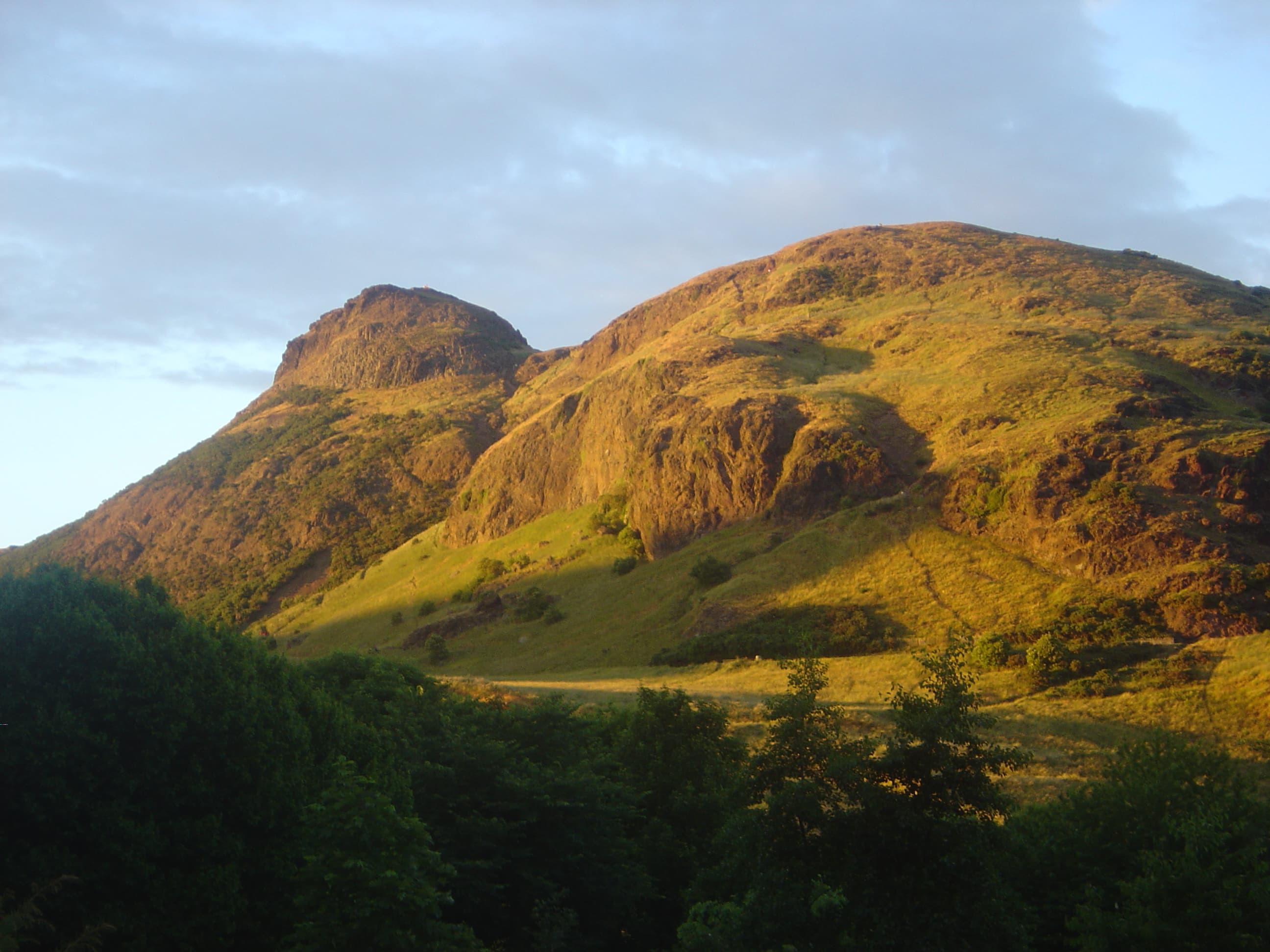
Image of Arthur's Seat. Image source
Visit essentials
A quick read before you go
- Duration
- Three hours for a wider park circuit
- Access
- Walk from the Royal Mile and Holyrood area or approach from Duddingston and Dunsapie where…
Overview
Arthur’s Seat rises behind Edinburgh’s Old Town, yet steep grass, crags, lochs, and an exposed summit separate it from the streets below. British Geological Survey interpretation identifies an extinct volcanic complex revealed by erosion and ice; Historic Environment Scotland manages it within Holyrood Park, a scheduled landscape holding thousands of years of human evidence.
Sacred associations are layered: medieval St Anthony’s Chapel and holy wells mark Christian devotion, while historical May-morning accounts describe pre-sunrise climbs to gather or wash in dew linked with health and beauty. Beltane fire belongs to Edinburgh’s seasonal memory, though the modern Beltane Fire Festival occurs on Calton Hill. Prehistoric defences and a probable hillfort predate these customs, but archaeology does not establish a specific temple or ritual, and the name Arthur’s Seat remains unresolved.
Geology, archaeology, city life, folklore, and public use therefore coexist without one overriding story.
Why this place is sacred
The climb compresses several kinds of transition. Traffic and stone buildings recede; slopes hide the city; then the summit restores it in a broad panorama of coast, hills, monuments, and streets. Weather can move across the exposed rock quickly, changing sound and visibility in minutes.
Archaeology adds human depth. Fortifications and other remains suggest long use of the park’s defensible heights, but their chronology and purpose are not entirely settled. St Anthony’s Chapel, St Margaret’s Well, and later paths place Christian and civic histories beside the prehistoric landscape.
May Day custom gives the hill a calendar. Historical records describe climbing for the dew before sunrise, especially by young women seeking beauty or well-being. The custom can be remembered without claiming that every modern Beltane practice occurred here in antiquity.
Experience and orientation
From the Palace of Holyroodhouse side, paths enter open grass and climb toward increasingly rocky ground. Other routes approach from Dunsapie or Duddingston. Route difficulty varies, and unofficial desire paths increase erosion and can lead onto unstable slopes.
At the summit, wind and crowding are common. Move away from the trig area before pausing, keep clear of edges, and protect loose belongings. Cloud, rain, ice, or wildfire conditions can make a familiar route unsafe.
The park rewards a wider circuit. St Anthony’s Chapel, the lochs, holy-well sites, Salisbury Crags viewpoints where open, and geological exposures give context the summit alone cannot provide. As of the research date, rockfall closures affected Radical Road and climbing areas, while a recent wildfire prompted additional temporary restrictions. Always use the current Historic Environment Scotland notice.
Check official alerts on the day, choose a route within your ability, and allow time to turn back. For a contemplative visit, a lower viewpoint may be more suitable than a crowded summit.
Context and lineage
Geology explains the landform through ancient volcanic activity and later erosion and glaciation. The origin of the name Arthur’s Seat is not established, and direct association with the historical or legendary King Arthur remains speculative.
Prehistoric communities occupied and defended parts of the park. Medieval Christian use left chapel and holy-well associations. Royal management and Victorian landscaping shaped public access. May morning custom and modern outdoor use continue the hill’s place in Edinburgh life.
Traditions and practice
Historical Edinburgh tradition associates Arthur’s Seat with gathering or washing in May Day dew for beauty, health, or good fortune. Beltane associations belong to a wider Scottish seasonal context.
Walking, sunrise visits, nature observation, and personal contemplation are common. The city’s organized Beltane Fire Festival is held on Calton Hill, not Arthur’s Seat.
Pause at a safe viewpoint and identify the boundary between the city and the park. Consider how quickly an urban walk has entered geological time.
Scottish May Day and Beltane Folklore
ActiveArthur’s Seat is historically associated with May morning dew gathering and Edinburgh’s seasonal memory.
Early-morning ascent and washing with dew; modern Beltane performance is centered on Calton Hill.
Christian Landscape of Holyrood Park
HistoricalSt Anthony’s Chapel and holy-well associations preserve medieval Christian layers.
Historical prayer, pilgrimage, and devotional use; present-day heritage visitation.
Natural and Archaeological Stewardship
ActiveThe park is actively managed as protected geology, habitat, archaeology, and public space.
Conservation, path care, research, and responsible access.
Perspectives and open questions
Arthur’s Seat can be understood through geology, archaeology, Christian heritage, Scottish seasonal folklore, and contemporary spirituality. These layers do not form one proven continuous cult.
Scholarly perspective
BGS and archaeological sources describe an extinct volcanic complex, glacial shaping, and a protected landscape with probable prehistoric defenses.
Living and traditional perspectives
May morning dew and Beltane associations are documented parts of Edinburgh and Scottish seasonal custom, though accounts vary over time.
Alternative interpretations
In an alternative contemporary interpretation, Matías De Stefano’s Gaia episode places Arthur’s Seat within a spiritual journey. It does not establish archaeological alignments or ancient ritual continuity.
Open questions
The origin of the hill’s name, the exact chronology of some defenses, and the full character of early ceremonial use remain unresolved.
Plan your visit
Access and arrival
Walk from the Royal Mile and Holyrood area or approach from Duddingston and Dunsapie where current access permits. | Difficulty: Moderate to strenuous, with steep rocky and slippery sections. | Time to summit: About one to two hours round trip on common routes, depending on route and conditions.
Respectful visit
Grip footwear, windproof and waterproof layers, and warm clothing even when central Edinburgh is mild.
permitted: Yes | Stay behind barriers and away from unstable edges; drones require permission from Historic Environment Scotland.
May dew custom involved contact with dew rather than leaving objects. | Leave no ribbons, candles, coins, food, crystals, or stone arrangements.
No fires, barbecues, camping, off-road cycling, unauthorized drones, or cliff-edge ritual. Do not leave offerings at wells, chapel ruins, or summit.
Location
Map loads as you approach this section.
Pilgrim reflections
A portrait of encounter, not a score
Pilgrims describe what they felt, how present they could become, and whether the place would shape a journey. There are no stars and no ranking of traditions.
No reviewed reflections yet
The first pilgrims can help describe the character of being here.
Share a reflection
Available after an account-backed “Been there.” Every reflection is reviewed before publication.
Nearby sacred places
Explore other sacred places in the region. Proximity does not establish access or travel time; check each place’s guidance.

References
Sources consulted for this page. Source categories describe the publication, not a guarantee that every claim is verified. Traditional accounts and outside interpretations may differ.
- 01Geology of Arthur's Seat — British Geological SurveyacademicVolcanic and glacial geology.
- 02Holyrood Park — Historic Environment ScotlandofficialManagement, archaeology, and park context.
- 03Plan Your Visit: Holyrood Park — Historic Environment ScotlandofficialLive closures, rules, access, and visitor safety.
- 04Arthur's Seat SC3719 — Atlas of Hillforts of Britain and IrelandacademicProbable fort and evidence limits.
- 05Beltane — Dictionaries of the Scots LanguageacademicScottish seasonal and dew folklore.
- 06Arthur's Seat — Cairngorm Club JournalacademicHistorical May-dew account.
- 07The Journey of Remembering S2:E6 — Weaving Metatron's Cube Through the Heart — GaiaSource contextContemporary spiritual perspective only.
Share a photo
Help visitors recognize Arthur's Seat. Every submission is reviewed before publication.