Hase-dera
Saigoku temple 8: a working Jūichimen Kannon hall in the Kansai pilgrimage round
Understand sacred places, explore living traditions, and learn how to engage respectfully with Pilgrim Map.
Access has not been verified. Check current local guidance before planning a visit.
Sakurai, Nara Prefecture, Japan
Read the sources
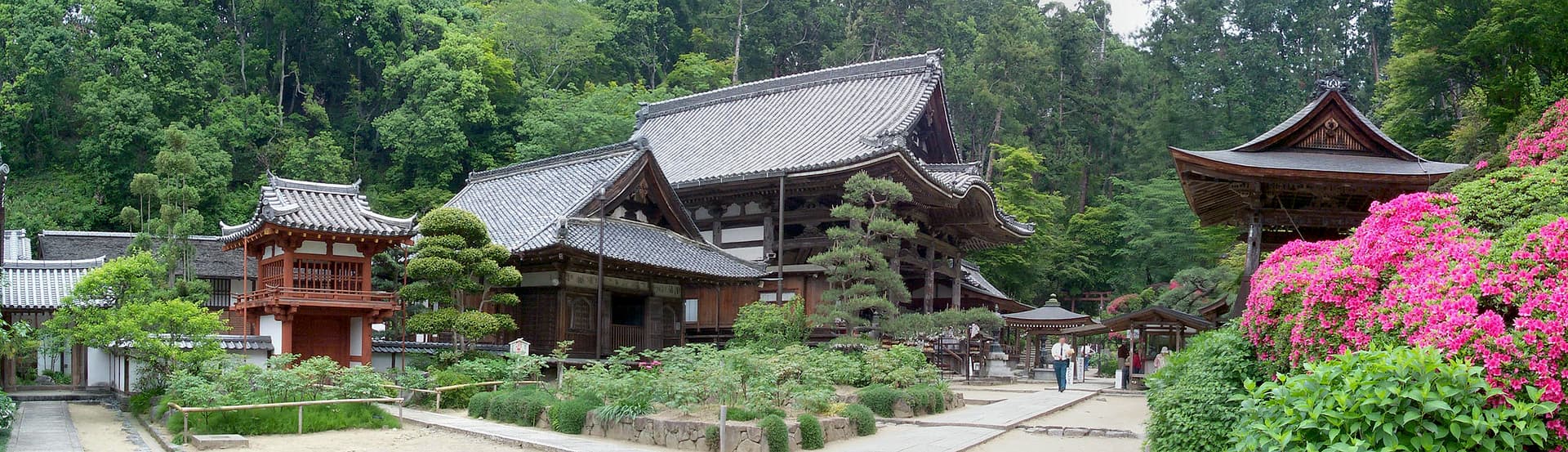
Image of Hase-dera (長谷寺). Image source · CC-BY-3.0
Station 8 of 33
Saigoku Kannon PilgrimageVisit essentials
A quick read before you go
- Duration
- Plan 1.5-2.5 hours including the Noborirō ascent, Main Hall, five-storied pagoda, Hongō…
- Access
- Approximately 15-20 minutes' walk from Hasedera Station (Kintetsu Osaka line) — about 10 minutes…
Overview
Hase-dera is temple 8 of the thirty-three-station Saigoku Kannon Pilgrimage, a route that has organised Kansai Kannon devotion for more than a thousand years, and one of Japan's foundational centers of Kannon devotion. Temple tradition dates its founding to 686 CE under Emperor Tenmu, when Dōmyō Shōnin enshrined a bronze Lotus Sutra plaque on the western hill.
In 727, by Emperor Shōmu's order, Tokudō Shōnin carved the great Eleven-Headed Kannon from a sacred camphor log said to have drifted from Lake Biwa and beached on the Hatsuse River after centuries without finding a worthy artisan. Tokudō prayed for an image that could save all sentient beings; tradition says Kannon manifested through the log. Revered as founder of the Saigoku pilgrimage after a vision of 33 forms of Kannon, Tokudō made Hase-dera its spiritual root.
The roughly 10-meter icon is Japan's largest wooden Kannon; the current 1538 Muromachi reconstruction retains elements of the earlier image. Hase-dera became the Shingon-shū Buzan-ha head temple in 1588, when Shingi Shingon followers expelled from Negoro-ji during Toyotomi Hideyoshi's campaigns regrouped here under Sen'nyo. The lineage descends from Kūkai through Kakuban's Shingi reform, regained formal independence in 1900, and now has approximately 3,000 branch temples. Hase-dera has sustained monastic and pilgrimage activity for about 1,300 years.
Its 1650 National Treasure Main Hall, 399-step covered stone Noborirō, about 7,000 peony plants and other seasonal flowers, and appearances in The Pillow Book and The Tale of Genji join religious, architectural, landscape, and literary memory.
Why this place is sacred
Hase-dera's distinctive encounter joins the Saigoku pilgrimage's spiritual root, Japan's largest wooden Kannon icon, and a National Treasure hall reached by the 399-step Noborirō. The icon's Eleven-Headed Kannon stands on an iwaza rock pedestal and uniquely holds a pilgrim's shakujō in the right hand and a lotus-filled vase in the left, a fusion of Kannon and Jizō iconography sometimes called the 'Hase-dera form.'
The mountain valley, about 7,000 peony plants, seasonal flowers, and roughly 1,300 years of practice frame the approach. Pilgrimages recorded by Sei Shōnagon in The Pillow Book and Murasaki Shikibu in The Tale of Genji give the temple deep literary as well as religious memory.
Experience and orientation
Visitors describe a sense of gradual ascent and revelation: arriving at the foot of the valley, climbing the 399-step covered Noborirō corridor (lined in spring with thousands of peonies), and emerging onto the elevated wooden platform of the Main Hall, where the towering Eleven-Headed Kannon stands. The wide veranda offers panoramic views of the Hatsuse valley.
Context and lineage
Traditionally founded in 686 CE during the reign of Emperor Tenmu, when the ascetic Dōmyō Shōnin enshrined a bronze Lotus Sutra plaque on the western hill. In 727, by order of Emperor Shōmu, Tokudō Shōnin (revered as the founder of the Saigoku pilgrimage) carved the great Eleven-Headed Kannon from a sacred camphor log said to have drifted ashore from Lake Biwa, and the temple was substantially expanded.
Founders: Dōmyō Shōnin (initial bronze plaque, 686) and Tokudō Shōnin (great Kannon image, 727). Temple tradition holds that the great camphor log from which Tokudō Shōnin carved the Eleven-Headed Kannon drifted across Lake Biwa and beached itself on the Hatsuse River, after centuries of being unable to find an artisan worthy to use it.
Traditions and practice
Annual peony festival in April-May; chrysanthemum festival in autumn; daily liturgy in the Main Hall; goma fire rituals; periodic special openings (kaichō) of the Main Hall granting close access to the principal Kannon; monthly Kannon services on the 18th.
Shingon-shū Buzan-ha (Shingon Buddhism, Buzan school)
ActiveHase-dera is the head temple (sōhonzan) of the Buzan-ha sect, formally established in 1588 when followers of the reformed (Shingi) Shingon school, expelled from Negoro-ji during Toyotomi Hideyoshi's campaigns, regrouped at Hase-dera under the monk Sen'nyo. The sect regained formal independence in 1900. As an esoteric Buddhist lineage descending from Kūkai (Kōbō Daishi) via the Shingi reform of Kakuban, it transmits ritual, doctrinal, and meditative traditions through approximately 3,000 branch temples.
Esoteric Shingon goma (fire ritual) and mantric practice; Saigoku Kannon pilgrimage devotion to Jūichimen (Eleven-Headed) Kannon; Annual peony festival (botan matsuri) and seasonal flower observances; Sutra-copying (shakyō) and goshuin inscription; Monastic training of Buzan-ha clergy
Perspectives and open questions
Hase-dera can be understood through distinct scholarly, traditional, and esoteric lenses. Scholarship examines its late seventh-century origins, eighth-century imperial expansion, architecture, institutions, and the distinctive Eleven-Headed Kannon. Tradition venerates Tokudō Shōnin as the originating figure of the Saigoku pilgrimage and the temple as its spiritual root. Esoteric interpretation attends to the icon's eleven heads, staff, vase, and rock pedestal.
Scholarly perspective
Scholarly accounts converge on Hase-dera's late seventh-century origins and eighth-century expansion under imperial patronage. Its Eleven-Headed Kannon uniquely pairs a shakujō with a lotus vase while standing on a rock pedestal; the current 1538 image is a Muromachi reconstruction retaining elements of the earlier icon. The 1650 Main Hall is a National Treasure exemplifying late-medieval and early-Edo Buddhist architecture.
Hase-dera's role in the Saigoku pilgrimage's revival under cloistered Emperor Kazan and its identity as the Shingi-Shingon Buzan-ha head temple after the Negoro-ji exiles regrouped here in 1588 are well established.
Living and traditional perspectives
Tokudō Shōnin is venerated as the originating figure of the Saigoku pilgrimage, having received a vision of the 33 forms of Kannon corresponding to the eventual circuit. Pilgrims understand Hase-dera as the 'root' temple from which the pilgrimage emerged. The drifting camphor log motif frames the principal Kannon as a self-revealing icon — a wood that travels and chooses its sculptor.
Alternative interpretations
Esoteric Shingon interpretation reads the eleven heads as the bodhisattva's eleven-fold capacity to perceive and respond to suffering across all directions and stages of awakening; the unique Hase-dera form, combining staff and vase, is read as Kannon embodying both Jizō's vow to walk through the realms of suffering and the Pure Land's lotus of compassion.
The temple's setting — a long valley, a steep stairway corridor, and an emergent platform — is sometimes read as a built mandala of progressive interior ascent.
Plan your visit
Access and arrival
Approximately 15-20 minutes' walk from Hasedera Station (Kintetsu Osaka line) — about 10 minutes downhill through the temple town and 10 minutes uphill to the entrance. Operating hours: April-September 8:30-17:00; October-November and March 9:00-17:00; December-February 9:00-16:30. Admission ¥500 for middle-school age and older, ¥250 for elementary children; additional fees for special exhibitions and foot-touching practice. Hours may extend during Peony Festival.
Respectful visit
Permitted on the grounds, gardens, Noborirō corridor, and external views of halls. Photography is restricted inside the Main Hall and of the principal Eleven-Headed Kannon — observe posted signs.
Osaisen coins, incense at exterior censers, candles. Goshuin offering is typically ¥300-500. Special foot-touching practice has its own additional offering when available.
Quiet behavior expected throughout the temple; do not touch the principal image except during sanctioned foot-touching practice; refrain from eating on inner platforms.
Current practical details
Address
731-1 Hase, Sakurai, Nara 633-0112, Japan
Phone
Hours
Hours, fees, and access can change — verify on the official source before you travel. Practical details last checked Jun 2026.
Location
Map loads as you approach this section.
Pilgrim reflections
A portrait of encounter, not a score
Pilgrims describe what they felt, how present they could become, and whether the place would shape a journey. There are no stars and no ranking of traditions.
No reviewed reflections yet
The first pilgrims can help describe the character of being here.
Share a reflection
Available after an account-backed “Been there.” Every reflection is reviewed before publication.
Nearby sacred places
Explore other sacred places in the region. Proximity does not establish access or travel time; check each place’s guidance.


References
Sources consulted for this page. Source categories describe the publication, not a guarantee that every claim is verified. Traditional accounts and outside interpretations may differ.
- 01Hase-dera — Wikipedia contributorsencyclopediaDetailed history and sect affiliation
- 02Shingon-shū Buzan-ha — Wikipedia contributorsencyclopediaBackground on Buzan-ha sect
- 03Hase-dera – Sakurai, Nara Prefecture — Henro.orgguideSaigoku pilgrimage guide
- 04Kaikei, Chōkai, and the Sacred Image of Eleven-Headed Kannon at Hasedera — Ars Orientalis (University of Michigan)academicScholarly source on the principal Kannon image
- 05Hasedera Temple — Visit NaraofficialOfficial Nara tourism reference
- 06Hase Temple: A Journey Through 1,300 Years of Heritage — Japan DocumentedacademicFounding figures Dōmyō Shōnin and Tokudō Shōnin
- 07Head Temple, Hasedera - Must-See, Access, Hours & Price — Good Luck TripguideVisiting hours and admission
Pilgrim glossary
- Kannon
- The bodhisattva of compassion, central to many East Asian pilgrimage routes.
- Bodhisattva
- An enlightened being who postpones full nirvana to help others toward awakening.
- Mandala
- A symbolic diagram of the cosmos used in meditation and ritual.
- Sutra
- A canonical Buddhist scripture, often chanted as part of practice.
- Shingon
- An esoteric Japanese Buddhist school emphasizing ritual, mantra, and mandala practice.
- Pure Land
- A Buddhist tradition focused on rebirth in Amida Buddha's western paradise through devotional practice.
Share a photo
Help visitors recognize Hase-dera. Every submission is reviewed before publication.