Nakayama-dera
Saigoku temple 24: a working Jūichimen Kannon hall in the Kansai pilgrimage round
Understand sacred places, explore living traditions, and learn how to engage respectfully with Pilgrim Map.
Access has not been verified. Check current local guidance before planning a visit.
Takarazuka, Hyogo Prefecture, Japan
Read the sources
Station 24 of 33
Saigoku Kannon PilgrimageVisit essentials
A quick read before you go
- Duration
- 1–2 hours; longer for those participating in formal anzan kigan rituals.
- Access
- Approximately a 1-minute walk from Nakayama-Kannon Station on the Hankyū Takarazuka Line; 5…
Overview
Nakayama-dera is temple 24 of the thirty-three-station Saigoku Kannon Pilgrimage, a route that has organized Kansai Kannon devotion for more than a thousand years. A candidate for Japan's first Kannon temple, it is associated with Emperor Kazan's revival of the circuit and is one of the country's foremost safe-childbirth (anzan) prayer destinations. Its central Jūichimen Kannon and two flanking Kannons have 33 heads together, condensing the pilgrimage into one hall.
Tradition attributes its founding in the late 6th or early 7th century to Prince Shōtoku (Shōtoku Taishi, 574–622), who dedicated it to Jūichimen Kannon. After losing his reign and taking Buddhist orders, cloistered Emperor Kazan is said to have rediscovered here or nearby a pilgrimage 'seal' recording the original route attributed to Tokudō Shōnin of Hasedera. His revival in the late 10th to early 11th century made Nakayama-dera a hinge between legendary origin and historical practice.
Nakayama-dera is the head temple (sōhonzan) of its own Nakayama-shū Shingon branch, distinct from Kōyasan Shingon. Its living practice joins substitute-pilgrimage merit, centuries of anzan kigan and imperial-historical patronage, and the hidden Kannon's monthly en-nichi opening on the 18th.
Why this place is sacred
Nakayama-dera joins a possible origin point of Japanese Kannon devotion, a hinge in the Saigoku 33 pilgrimage's revival, and a foremost safe-childbirth sanctuary. Its central Jūichimen Kannon and two flanking Kannons total 33 heads, condensing the whole circuit into one hall and offering substitute-pilgrimage merit. The hidden image opens monthly on the 18th, making sacred access recurrent.
Tradition says Prince Shōtoku founded the temple in the late 6th or early 7th century. After losing his reign and taking orders, cloistered Emperor Kazan reportedly rediscovered here or nearby a pilgrimage 'seal' recording the route attributed to Tokudō Shōnin of Hasedera, then revived the 33-temple circuit.
From the 14th century onward, emperors and powerful clans prayed here for heirs' safe delivery; Toyotomi Hideyoshi and Minamoto no Yoritomo are named patrons. That continuing anzan kigan tradition carries early Buddhist, pilgrimage, and imperial-historical layers into present practice.
Experience and orientation
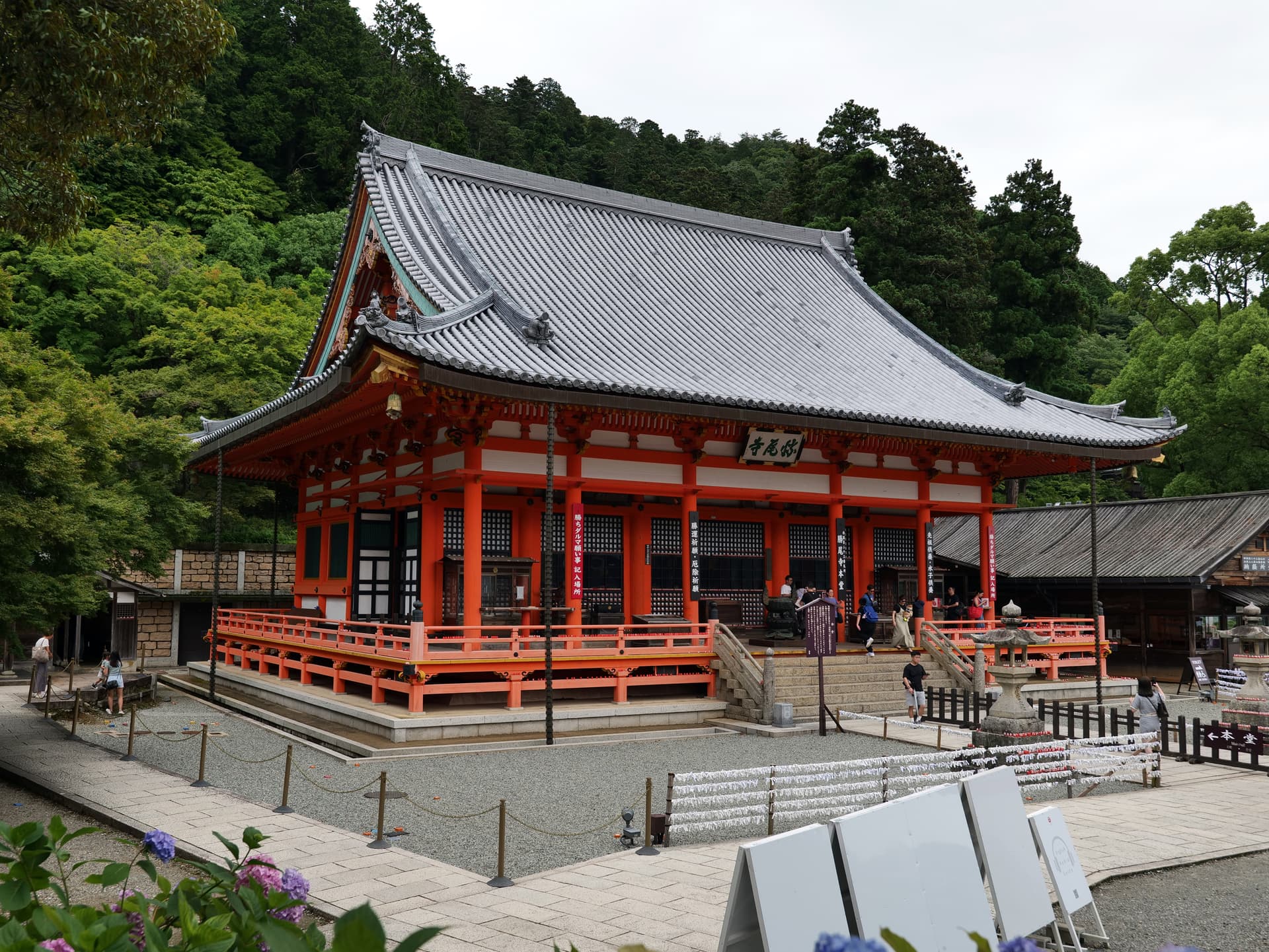
Visitors describe a vivid, colorful precinct with a famously vermilion main gate and pagoda, contrasting with the more austere mountain Saigoku stations. Pregnant women and new parents are conspicuously present, often carrying or wearing blessed hara-obi.
Context and lineage
Late 6th to early 7th century CE — by tradition founded by Prince Shōtoku (Shōtoku Taishi, 574–622); reputed to be the first Buddhist temple in Japan dedicated specifically to Kannon. The Saigoku 33 pilgrimage was reportedly revived here by cloistered Emperor Kazan after he rediscovered the temple's pilgrimage seal (early 11th century). Prince Shōtoku (founding tradition); revival and continued patronage by Emperor Kazan (cloistered emperor, late 10th–early 11th century).
Prince Shōtoku is said to have founded Nakayama-dera in the late 6th or early 7th century, dedicating it to Jūichimen Kannon.
Traditions and practice
Anzan kigan formal prayer service for safe childbirth Hara-obi (maternity belt) blessing, traditionally received on inuno-hi Monthly en-nichi (18th) opening of the hibutsu Jūichimen Kannon Three-Kannon substitute pilgrimage prayer
Shingon Buddhism — Nakayama branch (Nakayama-dera Shingon-shū)
ActiveNakayama-dera is the head temple (sōhonzan) of its own Shingon branch — the Nakayama-shū — distinct from the Kōyasan Shingon mainstream. Tradition holds it was founded by Prince Shōtoku in the late 6th or early 7th century, making it a candidate for the oldest Kannon sanctuary in Japan. Cloistered Emperor Kazan is recorded as having rediscovered the temple's Saigoku-route 'seal' here, reviving the 33-temple pilgrimage in the late 10th to early 11th century.
Anzan kigan — formal prayer for safe childbirth, including hara-obi (maternity belt) blessing; Inuno-hi (Day of the Dog) hara-obi distribution, drawing on the dog's reputation for easy delivery; Monthly en-nichi on the 18th: opening of the hibutsu Jūichimen Kannon; Three-Kannon substitute pilgrimage: praying before the central Kannon and her two flanking statues (combined 33 heads) is said to confer the merit of the full Saigoku 33 circuit; Mail-order ofuda blessings for those who cannot attend in person
Perspectives and open questions
Nakayama-dera's Prince Shōtoku founding is a traditional ascription rather than a strictly documented date, but the temple's medieval historical record — including aristocratic and warrior patronage and the connection with Emperor Kazan's pilgrimage revival — is well attested. Local devotion frames Nakayama-dera as Kannon's foremost women-and-children sanctuary in the Kansai region.
Scholarly perspective
Nakayama-dera's Prince Shōtoku founding is a traditional ascription rather than a strictly documented date, but the temple's medieval historical record — including aristocratic and warrior patronage and the connection with Emperor Kazan's pilgrimage revival — is well attested. The temple's role as Japan's preeminent anzan kigan site is documented in modern Japanese-press references.
Living and traditional perspectives
Local devotion frames Nakayama-dera as Kannon's foremost women-and-children sanctuary in the Kansai region. The hara-obi blessing connects Buddhist compassion with pre-Buddhist pregnancy customs (the dog as a symbol of easy delivery), forming a textbook example of folk-Buddhist syncretism.
Alternative interpretations
Within Nakayama-shū Shingon, the three-Kannon hall (with 33 combined heads) is read as a Mikkyō condensation of the entire Saigoku route — a single hall functioning as a maṇḍala of the 33 stations. The monthly en-nichi opening is interpreted as a renewable thin-time when the bodhisattva's compassion is most accessible.
Plan your visit
Access and arrival
Approximately a 1-minute walk from Nakayama-Kannon Station on the Hankyū Takarazuka Line; 5 minutes from JR Nakayama-dera Station. Easy day trip from Osaka (Umeda) or Kobe (Sannomiya).
Respectful visit
Photography permitted in the outer precinct. Avoid photographing the hibutsu Kannon during the 18th opening unless explicitly allowed; do not photograph individual women in the hara-obi blessing area without permission.
Coin offerings at the offertory box; ritual fees apply for formal anzan kigan services and hara-obi blessings (set at the temple office).
Quiet voices throughout the hondo and the hara-obi blessing area Respect families participating in pregnancy rituals Do not block escalators/elevators reserved for pregnant or elderly visitors
Current practical details
Address
2-chōme-11-1 Nakayamadera, Takarazuka, Hyogo 665-8588, Japan
Phone
Hours
Hours, fees, and access can change — verify on the official source before you travel. Practical details last checked Jun 2026.
Location
Map loads as you approach this section.
Pilgrim reflections
A portrait of encounter, not a score
Pilgrims describe what they felt, how present they could become, and whether the place would shape a journey. There are no stars and no ranking of traditions.
No reviewed reflections yet
The first pilgrims can help describe the character of being here.
Share a reflection
Available after an account-backed “Been there.” Every reflection is reviewed before publication.
Nearby sacred places
Explore other sacred places in the region. Proximity does not establish access or travel time; check each place’s guidance.


References
Sources consulted for this page. Source categories describe the publication, not a guarantee that every claim is verified. Traditional accounts and outside interpretations may differ.
- 01Wish for safe childbirth at Nakayama-dera Temple — All Nippon AirwaysofficialConfirms Prince Shōtoku founding tradition and anzan kigan focus.
- 02Nakayamadera Temple — Takarazuka International Tourism AssociationofficialLocal tourism association — comprehensive English overview of pregnancy rituals, hara-obi, inuno-hi calendar.
- 03Nakayama-dera – Takarazuka — Henro.orgguidePilgrimage reference.
- 04Anzan kigan — The Japan TimesnewsNational-press reference confirming Nakayama-dera as one of Japan's foremost anzan kigan temples.
- 05Saikoku Kannon Pilgrimage Japan Heritage — Saigoku Sanjusankasho ReijokaiofficialConfirms Japan Heritage designation.
- 06Nakayama-dera — Wikipedia contributorsencyclopediaIdentifies Nakayama branch of Shingon-shū; documents Emperor Kazan's revival of the Saigoku 33.
- 07Nakayama-dera — Japan ExperienceguideNotes accessibility (escalators/elevators) and en-nichi 18th of each month.
- 08Saigoku Kannon Pilgrimage: Sohonzan Nakayama-dera — Hyogo Times (Hyogo AJET)guideDetailed pilgrim's-eye-view of practice and the three-Kannon configuration (33 heads).
Pilgrim glossary
- Kannon
- The bodhisattva of compassion, central to many East Asian pilgrimage routes.
- Bodhisattva
- An enlightened being who postpones full nirvana to help others toward awakening.
- Shingon
- An esoteric Japanese Buddhist school emphasizing ritual, mantra, and mandala practice.
Share a photo
Help visitors recognize Nakayama-dera. Every submission is reviewed before publication.