Kiyomizu-dera (清水寺)
Saigoku temple 16: a working Senju Kannon hall in the Kansai pilgrimage round
Higashiyama-ku, Higashiyama-ku, Kyoto, Japan
Plan this visit
Practical context before you go
1.5–3 hours for the precincts; longer if combining with the Higashiyama approach streets (Sannenzaka, Ninenzaka).
From Kyoto Station, city bus 100 or 206 to Gojo-zaka or Kiyomizu-michi, then ~10-minute uphill walk. Opens 06:00 daily; closing varies by season/event. Standard admission ~¥500.
Modest, neat clothing. Allowed in most outdoor areas. No smoking anywhere on the precincts.
At a glance
- Coordinates
- 34.9948, 135.7850
- Type
- Temple
- Suggested duration
- 1.5–3 hours for the precincts; longer if combining with the Higashiyama approach streets (Sannenzaka, Ninenzaka).
- Access
- From Kyoto Station, city bus 100 or 206 to Gojo-zaka or Kiyomizu-michi, then ~10-minute uphill walk. Opens 06:00 daily; closing varies by season/event. Standard admission ~¥500.
Pilgrim tips
- Allowed in most outdoor areas. Forbidden inside the hondō (where the principal image is enshrined) and inside Zuigu-dō / Tainai-meguri. Tripods, monopods, drones, and commercial / wedding / cosplay shoots are forbidden anywhere on the precincts.
Pilgrim glossary
- Kannon
- The bodhisattva of compassion, central to many East Asian pilgrimage routes.
- Bodhisattva
- An enlightened being who postpones full nirvana to help others toward awakening.
Overview
Kiyomizu-dera is station 16 on the Saigoku Kannon Pilgrimage, a Kita-Hossō Buddhism, Saigoku Kannon devotion temple in Kyoto dedicated to Senju Kannon. 778 CE (legendary founding by the monk Kenshin/Enchin); main hall donated by Sakanoue no Tamuramaro in 780. Kiyomizu-dera is built around the Otowa-no-taki ('Sound of Feathers') waterfall, whose three streams have been venerated since at least the 8th century as pure life-giving water.
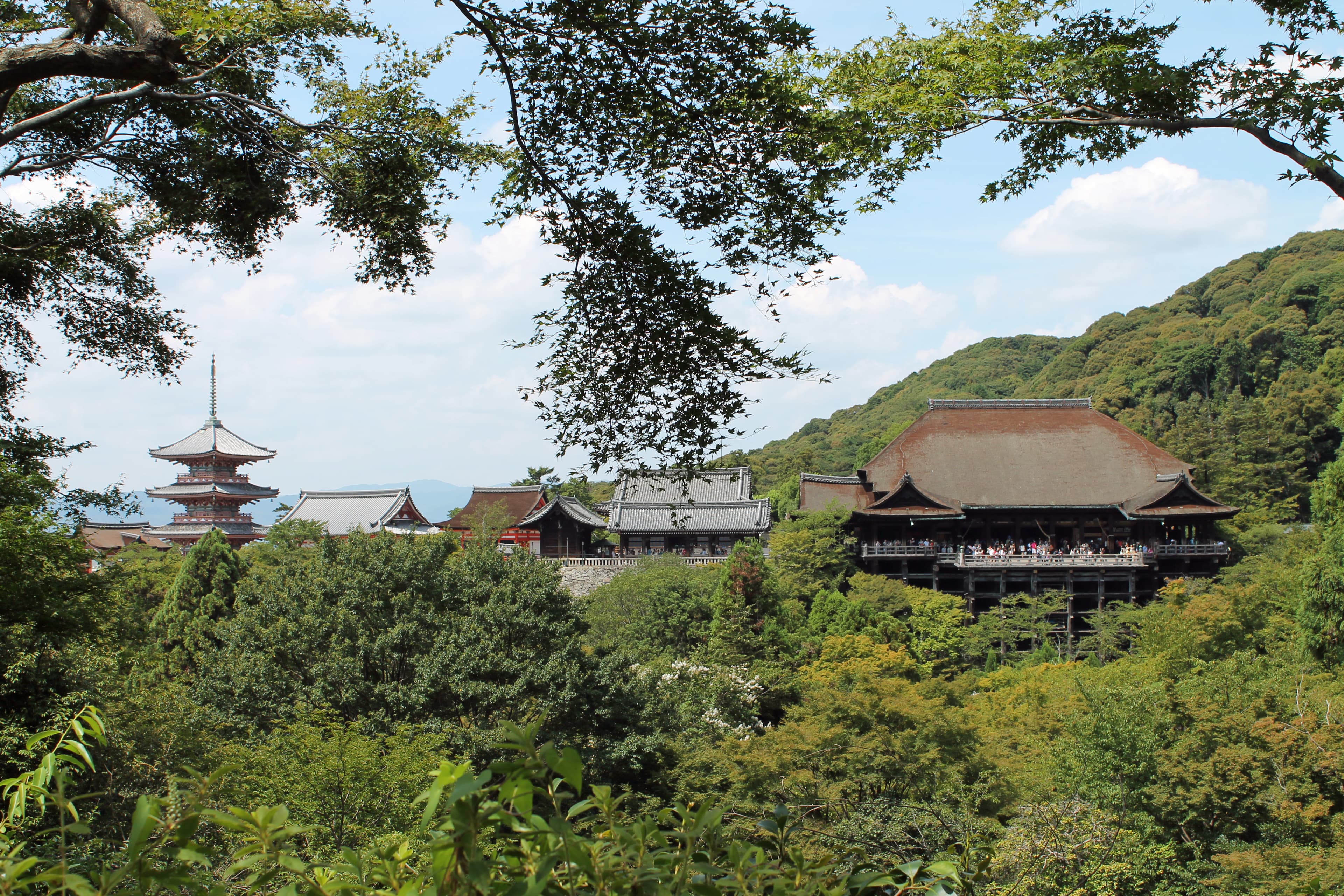
To approach Kiyomizu-dera is to enter a working Senju Kannon hall on the Saigoku Kannon Pilgrimage — temple 16 in a thirty-three station route that has organised Kansai Kannon devotion for more than a thousand years. Kiyomizu-dera is built around the Otowa-no-taki ('Sound of Feathers') waterfall, whose three streams have been venerated since at least the 8th century as pure life-giving water. The hondō stands on a great wooden butai (stage) projecting from the cliff over the falls — a structurally and symbolically dramatic frame for devotion to a thousand-armed, thousand-eyed Kannon who reaches into all corners of suffering.
778 CE (legendary founding by the monk Kenshin/Enchin); main hall donated by Sakanoue no Tamuramaro in 780. Present hondō rebuilt 1633 by order of Tokugawa Iemitsu. In 778 the monk Kenshin (Enchin) was led by a dream to Mt. Otowa, where he met the ascetic Gyōei Kōji practicing under the waterfall.
As a Kita-Hossō Buddhism site, Kiyomizu-dera was a Hossō-school temple under Kōfuku-ji throughout most of its history. In 1965 it became independent under Onishi Ryōkei, founding the Kita-Hossō ('Northern Hossō') sect, with Kiyomizu-dera as its head temple. Three-stream sacred waterfall used in continuous ritual for over 1,200 years Vast hinoki-pillar stage cantilevered over the cliff Hibutsu Senju Kannon shown only once every 33 years Cluster of devotional sites within the precinct: Jishu Shrine for love, Tainai-meguri 'womb' passage at Zuigu-dō, Koyasu Pagoda for safe childbirth
Part of Saigoku Kannon Pilgrimage.
Context and lineage
778 CE (legendary founding by the monk Kenshin/Enchin); main hall donated by Sakanoue no Tamuramaro in 780. Present hondō rebuilt 1633 by order of Tokugawa Iemitsu. Founded by Enchin (also known as Kenshin) of Kōfuku-ji; first lay patron Sakanoue no Tamuramaro. In 778 the monk Kenshin (Enchin) was led by a dream to Mt.
Why this place is sacred
Three-stream sacred waterfall used in continuous ritual for over 1,200 years Vast hinoki-pillar stage cantilevered over the cliff Hibutsu Senju Kannon shown only once every 33 years Cluster of devotional sites within the precinct: Jishu Shrine for love, Tainai-meguri 'womb' passage at Zuigu-dō, Koyasu Pagoda for safe childbirth Kiyomizu-dera is built around the Otowa-no-taki ('Sound of Feathers') waterfall, whose three streams have been venerated since at least the 8th century as pure life-giving water. The hondō stands on a great wooden butai (stage) projecting from the cliff over the falls — a structurally and symbolically dramatic frame for devotion to a thousand-armed, thousand-eyed Kannon who reaches into all corners of suffering. In 778 the monk Kenshin (Enchin) was led by a dream to Mt. Otowa, where he met the ascetic Gyōei Kōji practicing under the waterfall. Gyōei left him sacred wood from which Enchin carved a Senju Kannon.
Traditions and practice
Senju Kannon hibutsu kaichō (revealed every 33 years) Annual sennichi-mairi (1,000-day pilgrimage equivalence) rituals Special night illuminations in spring and autumn
Kita-Hossō Buddhism
ActiveKiyomizu-dera was a Hossō-school temple under Kōfuku-ji throughout most of its history. In 1965 it became independent under Onishi Ryōkei, founding the Kita-Hossō ('Northern Hossō') sect, with Kiyomizu-dera as its head temple.
Hossō (Yogācāra) doctrinal study; Senju Kannon devotional rites; Esoteric and exoteric Buddhist liturgy
Saigoku Kannon devotion
ActiveAs Saigoku 16, Kiyomizu-dera is one of the most heavily visited Kannon pilgrimage stations and a major node in lay Kannon devotion across Japan since the medieval period.
Pilgrim sutra recitation in the hondō; Otowa waterfall rite; Goshuin stamping at the nōkyōjo
Experience and perspectives
The panoramic view from the hondō stage, especially in autumn and during night illuminations Drinking from one of the three Otowa streams (each said to confer one of: longevity, success in studies, or success in love) The total-darkness 'Tainai-meguri' walk at Zuigu-dō A feeling of intense compression of the sacred and the secular (souvenir streets right up to the Niō-mon)
Kiyomizu-dera is one of the best-documented Kannon temples in Japan, with continuous historical records, surviving Edo-period architecture (1633 hondō), and recognized status as a UNESCO World Heritage component. Within Kita-Hossō teaching, the Senju Kannon's thousand arms reach to all beings; the hondō stage extending over Otowa-no-taki is a built metaphor for the bodhisattva's compassionate outreach.
Kiyomizu-dera is one of the best-documented Kannon temples in Japan, with continuous historical records, surviving Edo-period architecture (1633 hondō), and recognized status as a UNESCO World Heritage component. Its founding narrative blends Hossō, ascetic, and warrior-aristocratic strands characteristic of late-8th-century Japanese Buddhism.
Within Kita-Hossō teaching, the Senju Kannon's thousand arms reach to all beings; the hondō stage extending over Otowa-no-taki is a built metaphor for the bodhisattva's compassionate outreach.
Some practitioners read the three Otowa streams as a triad of body, speech, and mind purifications, mirroring Tantric ablutions; the Tainai-meguri is interpreted as a re-birthing rite under the womb of Daizuigu Bosatsu.
Visit planning
From Kyoto Station, city bus 100 or 206 to Gojo-zaka or Kiyomizu-michi, then ~10-minute uphill walk. Opens 06:00 daily; closing varies by season/event. Standard admission ~¥500.
Modest, neat clothing. Allowed in most outdoor areas. No smoking anywhere on the precincts.
Allowed in most outdoor areas. Forbidden inside the hondō (where the principal image is enshrined) and inside Zuigu-dō / Tainai-meguri. Tripods, monopods, drones, and commercial / wedding / cosplay shoots are forbidden anywhere on the precincts.
Saisen, incense, candles. Buying a long-handled cup at Otowa-no-taki to drink from one of the three streams. Goshuin and protective amulets at the nōkyōjo.
No smoking anywhere on the precincts. No eating or drinking outside designated cafes/teahouses. No pets (other than service animals). Be mindful of voice volume; remember the site is a working temple with active Kannon devotion.
Plan your visit
Buy the ¥500 admission ticket at the gate on the day (cash); no advance booking is needed.
Adults ¥500, students ¥200, cash only. During special spring/autumn night-viewing periods the temple reopens in the evening at the same admission.
Buy / book ticketsHours, fees, and access can change — verify on the official source before you travel.
Nearby sacred places
Sacred places within a half-day’s reach. Pilgrims often visit them together: walk one, stay for the other.


References
Sources consulted when researching this page. Independent verification by readers is welcome.
- 01Kiyomizu-dera — Wikipedia contributorshigh-reliability
- 02Kiyomizu-dera Temple — official site — Kiyomizu-derahigh-reliability
- 03Kiyomizudera Temple — Kyoto Travel — japan-guide.comhigh-reliability
- 04Kiyomizu-dera: Kyoto's Temple of Pure Water in Legend and Art — Buddhistdoor Globalhigh-reliability
- 05Historic Monuments of Ancient Kyoto (Kyoto, Uji and Otsu Cities) — UNESCO World Heritage Centrehigh-reliability
Key questions
What pilgrims usually ask
- Why is Kiyomizu-dera (清水寺) considered sacred?
- Kiyomizu-dera is Saigoku Pilgrimage temple 16 in Kyoto, dedicated to Senju Kannon and rooted in centuries of Kannon devotion across Kansai.
- Can I take photos at Kiyomizu-dera (清水寺)?
- Allowed in most outdoor areas. Forbidden inside the hondō (where the principal image is enshrined) and inside Zuigu-dō / Tainai-meguri. Tripods, monopods, drones, and commercial / wedding / cosplay shoots are forbidden anywhere on the precincts.
- How long should I spend at Kiyomizu-dera (清水寺)?
- 1.5–3 hours for the precincts; longer if combining with the Higashiyama approach streets (Sannenzaka, Ninenzaka).
- How do you visit Kiyomizu-dera (清水寺)?
- From Kyoto Station, city bus 100 or 206 to Gojo-zaka or Kiyomizu-michi, then ~10-minute uphill walk. Opens 06:00 daily; closing varies by season/event. Standard admission ~¥500.
- What offerings are appropriate at Kiyomizu-dera (清水寺)?
- Saisen, incense, candles. Buying a long-handled cup at Otowa-no-taki to drink from one of the three streams. Goshuin and protective amulets at the nōkyōjo.
- What etiquette should visitors follow at Kiyomizu-dera (清水寺)?
- Modest, neat clothing. Allowed in most outdoor areas. No smoking anywhere on the precincts.