Imakumano Kannon-ji
Part ofSennyū-ji
Saigoku temple 15: a working Jūichimen Kannon hall in the Kansai pilgrimage round
Understand sacred places, explore living traditions, and learn how to engage respectfully with Pilgrim Map.
Access has not been verified. Check current local guidance before planning a visit.
Higashiyama-ku, Kyoto Prefecture, Japan
Read the sources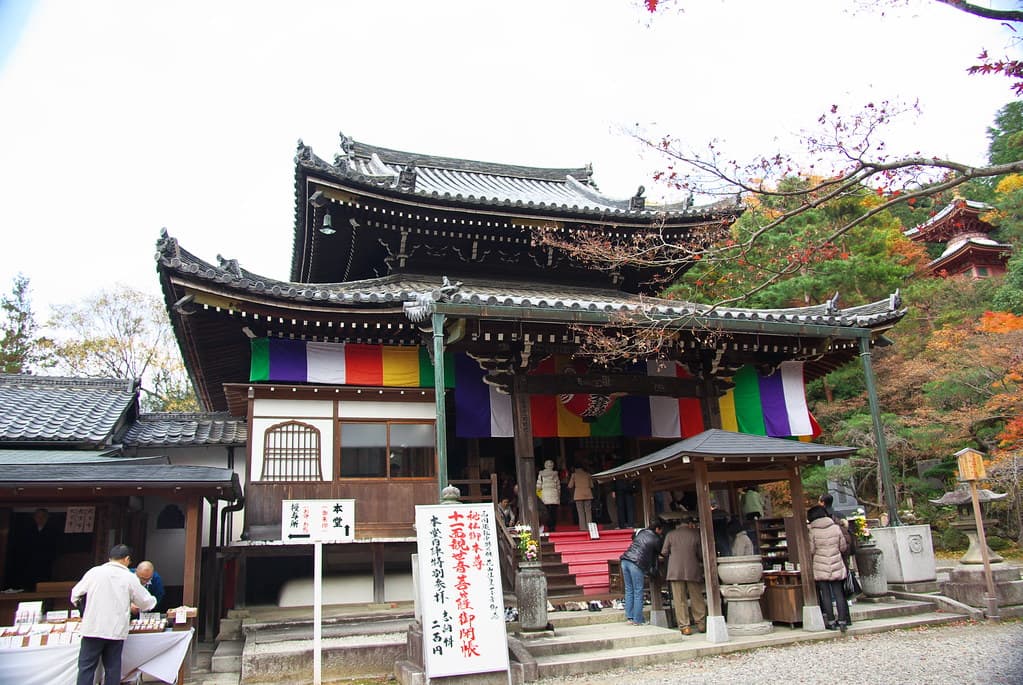
Image of Imakumano Kannon-ji (今熊野観音寺). Image source
Station 15 of 33
Saigoku Kannon PilgrimageVisit essentials
A quick read before you go
- Duration
- 30–60 minutes for the temple itself; allow more if combining with Sennyū-ji.
- Access
- From JR Tōfuku-ji Station or Keihan Tōfuku-ji Station, ~15-minute walk via Sennyū-ji approach.
Overview
Imakumano Kannon-ji is temple 15 of the thirty-three-station Saigoku Kannon Pilgrimage, a route that has organized Kansai Kannon devotion for more than a thousand years. Venerated as zutsū-fūji no Kannon, the 'Kannon who cures headaches,' it receives prayers concerning migraines, neurological disorders, mental confusion, dementia, and other afflictions of the head. The modern Bokefuji Kannon adds prayer for cognitive aging.
Temple legend says Kūkai saw a strange light on Higashiyama in 807 and met Kumano Gongen as an old man, who gave him a 3.5 cm Jūichimen Kannon said to have been carved by Amaterasu. Construction began with Emperor Saga's support in 812 and was completed in the Tenchō era (824–833).
A tatchu of Sennyū-ji, head temple of Shingon's Sennyūji branch, Imakumano joins esoteric Shingon, Kumano-shugen, and Saigoku currents. Its quiet Higashiyama ravine lies behind Sennyū-ji's imperial mausolea, approached across an iconic red 'tori-bridge.'
Why this place is sacred
Imakumano Kannon-ji brings Shingon esoteric, Kumano-shugen, and Saigoku Kannon currents together in a quiet Higashiyama ravine behind Sennyū-ji's imperial mausolea. An iconic red 'tori-bridge' crosses the valley. Here zutsū-fūji no Kannon, the 'Kannon who cures headaches,' receives prayers concerning migraines, neurological disorders, mental confusion, dementia, and other head afflictions; the modern Bokefuji Kannon extends this practice to cognitive aging.
Temple legend says that in 807 Kūkai followed a strange light and met Kumano Gongen in an old man's form. He received a 3.5 cm Jūichimen Kannon said to have been carved by Amaterasu, enshrined it, and built the temple with imperial backing.
Experience and orientation
Quiet seclusion despite proximity to central Kyoto A sense of relief or focused intention after praying at the Bokefuji Kannon The dramatic red bridge entry as a threshold experience Atmospheric autumn maples and spring greenery in the ravine
Context and lineage
807 CE (legendary founding by Kūkai); construction with imperial support from Emperor Saga begins 812; temple completed by the Tenchō era (824–833). Founded by Kūkai (Kōbō Daishi). According to temple legend, in 807 Kūkai saw a strange light on Higashiyama.
Traditions and practice
Headache-cure prayers at the main hall Kannon Saidan rites for the Saigoku pilgrim
Shingon Buddhism (Sennyū-ji-ha)
ActiveImakumano Kannon-ji is a tatchu (sub-temple) of Sennyū-ji, head temple of the Sennyūji branch of Shingon Buddhism. Its founding legend places Kūkai (Kōbō Daishi) himself at the origin of the temple in 807.
Esoteric Shingon ritual (goma, mantra recitation); Kōbō Daishi devotional rites; Healing prayers focused on head, brain, and cognitive ailments
Kumano cult (Kumano Gongen)
ActiveThe 'Imakumano' name marks this site as a 'new Kumano' transplanted into Kyoto. Cloistered Emperor Goshirakawa, who undertook 34 pilgrimages to the Kii Kumano shrines, is associated with grafting Kumano devotion onto the temple, giving it both Shingon and Kumano-shugen character.
Kumano-style devotional offerings; Composite Kannon-Kumano-Gongen veneration
Perspectives and open questions
Scholars treat Imakumano Kannon-ji as an early example of the syncretic 'transplanting' (kanjō) of the Kumano cult into the capital, and as evidence of the close relationship between imperial cloister governments (insei) and Shingon healing devotion in the late Heian period. Within Shingon-Sennyūji-ha tradition, the Jūichimen Kannon's eleven heads represent the bodhisattva's omnidirectional compassion, especially apt for ailments of the head and mind.
Scholarly perspective
Scholars treat Imakumano Kannon-ji as an early example of the syncretic 'transplanting' (kanjō) of the Kumano cult into the capital, and as evidence of the close relationship between imperial cloister governments (insei) and Shingon healing devotion in the late Heian period.
Living and traditional perspectives
Within Shingon-Sennyūji-ha tradition, the Jūichimen Kannon's eleven heads represent the bodhisattva's omnidirectional compassion, especially apt for ailments of the head and mind.
Alternative interpretations
Esoteric readings interpret the eleven heads as a mandala of cognitive faculties; praying here is a way to re-pattern the mind through the bodhisattva's gaze.
Plan your visit
Access and arrival
From JR Tōfuku-ji Station or Keihan Tōfuku-ji Station, ~15-minute walk via Sennyū-ji approach. Open daily roughly 08:00–17:00. Grounds entry typically minimal/free; some halls/treasure rooms charge a small fee.
Respectful visit
Permitted in the grounds. Avoid photographing the principal image inside the hondō and respect any indoor signage.
Saisen, incense, candles, ema. Pilgrim book stamping fees apply at the nōkyōjo.
Maintain quiet around the main hall when prayers are in progress. Avoid stepping on the central path-stones reserved for the Buddha.
Current practical details
Address
Japan, 〒605-0977 京都府京都市東山区泉涌寺山内町32
Phone
Hours
Hours, fees, and access can change — verify on the official source before you travel. Practical details last checked Jun 2026.
Location
Map loads as you approach this section.
Pilgrim reflections
A portrait of encounter, not a score
Pilgrims describe what they felt, how present they could become, and whether the place would shape a journey. There are no stars and no ranking of traditions.
No reviewed reflections yet
The first pilgrims can help describe the character of being here.
Share a reflection
Available after an account-backed “Been there.” Every reflection is reviewed before publication.
Nearby sacred places
Explore other sacred places in the region. Proximity does not establish access or travel time; check each place’s guidance.


References
Sources consulted for this page. Source categories describe the publication, not a guarantee that every claim is verified. Traditional accounts and outside interpretations may differ.
- 01Imakumano Kannon-ji — Wikipedia contributorsencyclopediaFoundation legend (Kūkai 807), Kumano Gongen, Shingon-shū Sennyūji-ha affiliation, Goshirakawa headache cure.
- 02Imakumano Kannon-ji (Kyoto, Japan) — Jivaka Project / Buddhist MedicineacademicScholarly framing of healing tradition.
- 03Imakumano Kannon-ji Temple — The Kansai GuideofficialAccess and pilgrimage information.
- 04Imakumano Kannon-ji, the temple that cures headaches — Kansai OdysseyguideVisitor experience and headache-cure tradition.
- 05Imakumano Kannon-ji — Henro.orgSource contextSaigoku 15 context.
Pilgrim glossary
- Kannon
- The bodhisattva of compassion, central to many East Asian pilgrimage routes.
- Bodhisattva
- An enlightened being who postpones full nirvana to help others toward awakening.
- Mandala
- A symbolic diagram of the cosmos used in meditation and ritual.
- Shingon
- An esoteric Japanese Buddhist school emphasizing ritual, mantra, and mandala practice.
Share a photo
Help visitors recognize Imakumano Kannon-ji. Every submission is reviewed before publication.