Oka-dera
Saigoku temple 7: a working Nyoirin Kannon hall in the Kansai pilgrimage round
Understand sacred places, explore living traditions, and learn how to engage respectfully with Pilgrim Map.
Access has not been verified. Check current local guidance before planning a visit.
Asuka, Nara Prefecture, Japan
Read the sources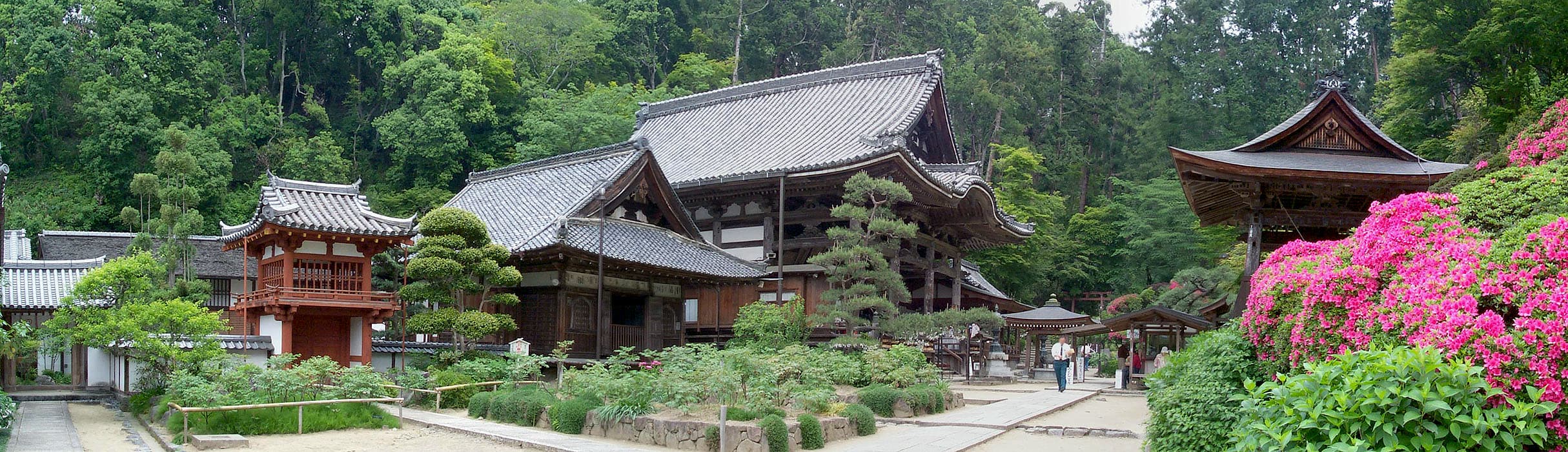
Image of Oka-dera (岡寺). Image source · CC-BY-3.0
Visit essentials
A quick read before you go
- Duration
- Allow 1 to 1.5 hours for an unhurried visit including the Main Hall, Niōmon gate, three-storied…
- Access
- Approximately 25-30 minutes' walk from Kintetsu Asuka Station, or accessible by Asuka community…
Overview
Oka-dera is temple 7 of the Saigoku Kannon Pilgrimage, Japan's oldest pilgrimage circuit, whose thirty-three stations have organised Kansai Kannon devotion for more than a thousand years, and Japan's first dedicated yakuyoke sanctuary. Tradition says Gien (643–728) founded it in 663 CE on the former Okamiya Palace of Prince Kusakabe, Emperor Tenmu's son. Originally Ryūgaiji ('Dragon-Sealing Temple'), it recalls Gien compassionately sealing a malevolent dragon that tormented villagers beneath a stone-capped pond, establishing its evil-warding identity.
The principal Nyoirin Kannon is a 4.85-meter Nara-period clay statue, Japan's largest clay Buddhist image and an Important Cultural Property surviving more than twelve centuries. Oka-dera now belongs to Shingon-shū Buzan-ha, an esoteric lineage emphasizing mantra, mudra, and visualization; its affiliation dates to Edo-period restoration under Hase-dera's influence.
Its Asuka setting—the original capital of unified Yamato Japan and birthplace of Japanese Buddhist civilization—hilltop valley views, wish-fulfilling Kannon devotion, and more than thirteen centuries of worship join archaeological landscape with living prayer.
Why this place is sacred
Oka-dera brings the seventh Saigoku station and Japan's first yakuyoke sanctuary into Asuka's archaeologically dense Yamato landscape. The hilltop overlooks the valley while the 4.85-meter Nyoirin Kannon—an Important Cultural Property and Japan's largest clay Buddhist statue—carries more than twelve centuries of material survival. The stone-capped dragon pond remains on the grounds, holding Ryūgaiji's origin story within physical space. The wish-fulfilling Kannon, long calamity-warding devotion, and more than thirteen centuries of continuous worship keep legend, landscape, and practice together.
Experience and orientation
Visitors describe Oka-dera as quieter and less crowded than the more famous Nara temples, with a contemplative hilltop atmosphere. The ascent through Asuka village to the gate, the sweeping views of the Asuka basin, and the moment of encountering the towering clay Nyoirin Kannon in the dim Main Hall are most often cited as memorable.
Context and lineage
Traditionally founded 663 CE by the monk Gien (643-728); built on the site of the former Okamiya Palace, residence of Prince Kusakabe (son of Emperor Tenmu). Originally named Ryūgaiji ('Dragon-Sealing Temple') in reference to Gien's legend of sealing a malevolent dragon in a pond on the grounds. Founder: Gien (義淵, 643-728), an early Hossō-school monk whose disciples included Rōben and Gyōki.
Temple legend recounts that Gien sealed a malevolent dragon (ryū) — said to have been tormenting the local villagers — into a pond on the temple grounds, capping it with a stone.
Traditions and practice
The yakuyoke goma fire ritual is central, especially during the New Year and through the first three months of the year. The temple also hosts annual ceremonies tied to the Shingon liturgical calendar, including rites for Nyoirin Kannon. The goshuin stamp tradition has been continuous for centuries.
Shingon-shū Buzan-ha (Shingon Buddhism, Buzan school)
ActiveOka-dera is a temple of the Buzan branch of Shingon, an esoteric Buddhist tradition. Its current sectarian affiliation dates to the Edo period when the temple was restored under the influence of Hase-dera (head temple of Buzan-ha). Esoteric Shingon emphasizes mantra, mudra, and visualization practices and is reflected in the temple's role as Japan's first prayer site for warding off misfortune (yakuyoke).
Yakuyoke (evil/misfortune warding) prayer rituals, especially January-March; Goshuin (temple seal) inscription for pilgrims; Saigoku Kannon pilgrimage devotion to Nyoirin Kannon; Goma (fire ritual) and esoteric ceremonies
Perspectives and open questions
Oka-dera can be understood through distinct historical, temple-traditional, and esoteric lenses. Scholarship places Gien's seventh-century foundation and the Nara-period clay image within early Japanese Buddhism. Temple tradition centers the compassionate subduing of the dragon and Japan's primal yakuyoke sanctuary. Shingon interpretation attends to the six-armed Nyoirin Kannon's jewel, dharma wheel, and transformation of desire.
Scholarly perspective
Scholars accept Oka-dera's 7th-century foundation by Gien on the Okamiya Palace site, under its original name Ryūgaiji. The Nara-period Nyoirin Kannon is a major surviving work of early Japanese Buddhist sculpture and Japan's largest clay icon of its kind. The affiliation shifted from Hossō, consistent with Gien's lineage, to Shingon Buzan-ha during Edo-period restoration under Hase-dera's influence.
Living and traditional perspectives
Within the temple's own tradition, the dragon-sealing legend frames Oka-dera as Japan's primal site for yakuyoke — the warding off of evil and misfortune — a function rooted in Gien's compassion subduing a violent natural force and channeling it into protection for villagers. The pond and stone are still venerated as physical traces of this miraculous act.
Alternative interpretations
Esoteric Shingon practice reads the seated Nyoirin Kannon — six-armed, holding the cintāmani wish-fulfilling jewel and the dharma-wheel — as a meditation diagram for transforming desire into enlightened compassion. The temple's hilltop location and pond are sometimes interpreted in geomantic terms as a node where chthonic (dragon) and celestial (Kannon) energies meet and are harmonized.
Plan your visit
Access and arrival
Approximately 25-30 minutes' walk from Kintetsu Asuka Station, or accessible by Asuka community shuttle bus (Kame Bus). Admission approximately ¥400 for adults, ¥300 high-school students, ¥200 junior-high students (subject to change). Open generally during daylight hours; check the official site for seasonal hours.
Respectful visit
Generally permitted on the grounds and gardens; photography of the principal Nyoirin Kannon and inside the Main Hall is typically restricted out of reverence — follow posted signs and staff guidance.
Customary offerings include osaisen coins at the saisen-bako, incense (osenkō) at the censer, and candles. Pilgrims may purchase amulets (omamori) and yakuyoke charms.
Main Hall access is restricted January-March during yakuyoke ritual season and intermittently during memorial services; respect quiet, refrain from loud conversation, do not touch statues.
Current practical details
Address
806 Oka, Asuka, Takaichi District, Nara 634-0111, Japan
Phone
Hours
Hours, fees, and access can change — verify on the official source before you travel. Practical details last checked Jun 2026.
Location
Map loads as you approach this section.
Pilgrim reflections
A portrait of encounter, not a score
Pilgrims describe what they felt, how present they could become, and whether the place would shape a journey. There are no stars and no ranking of traditions.
No reviewed reflections yet
The first pilgrims can help describe the character of being here.
Share a reflection
Available after an account-backed “Been there.” Every reflection is reviewed before publication.
Nearby sacred places
Explore other sacred places in the region. Proximity does not establish access or travel time; check each place’s guidance.

References
Sources consulted for this page. Source categories describe the publication, not a guarantee that every claim is verified. Traditional accounts and outside interpretations may differ.
- 01Oka-dera — Wikipedia contributorsencyclopediaStandard reference for sect, founding, and statue details
- 02Oka-dera – Asuka, Nara Prefecture — Henro.orgguideSaigoku pilgrimage-focused guide
- 03Okadera Temple | NARA-YAMATO Four Temple Pilgrimage — Nara-YamatoofficialOfficial Nara-Yamato Four Temple Pilgrimage page
- 04Okadera | Asuka Village, Nara Prefecture — Discover Asuka WondersguideLocal tourism site; useful for legends and practicalities
- 05Okadera Temple - Saigoku Kannon Pilgrimage — Tale of GenjiguidePilgrimage-focused English guide
- 06Okadera Temple - Must-See, Access, Hours & Price — Good Luck TripguideVisitor practical info
Pilgrim glossary
- Kannon
- The bodhisattva of compassion, central to many East Asian pilgrimage routes.
- Mantra
- A sound, word, or phrase repeated as part of meditation or ritual.
- Mudra
- A symbolic hand gesture used in Buddhist iconography and practice.
- Dharma
- The teachings of the Buddha; also the universal law underlying them.
- Shingon
- An esoteric Japanese Buddhist school emphasizing ritual, mantra, and mandala practice.
Share a photo
Help visitors recognize Oka-dera. Every submission is reviewed before publication.