Onzan-ji
The temple where a son lifted the boundary for his mother
Understand sacred places, explore living traditions, and learn how to engage respectfully with Pilgrim Map.
Access has not been verified. Check current local guidance before planning a visit.
Komatsushima, Tokushima Prefecture, Japan
Read the sources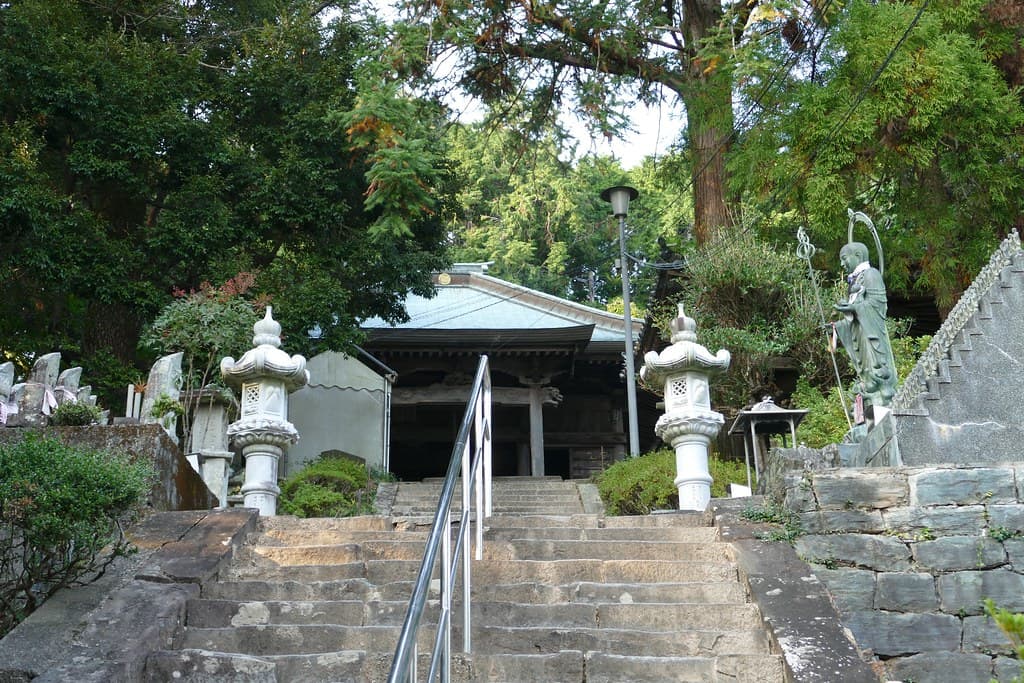
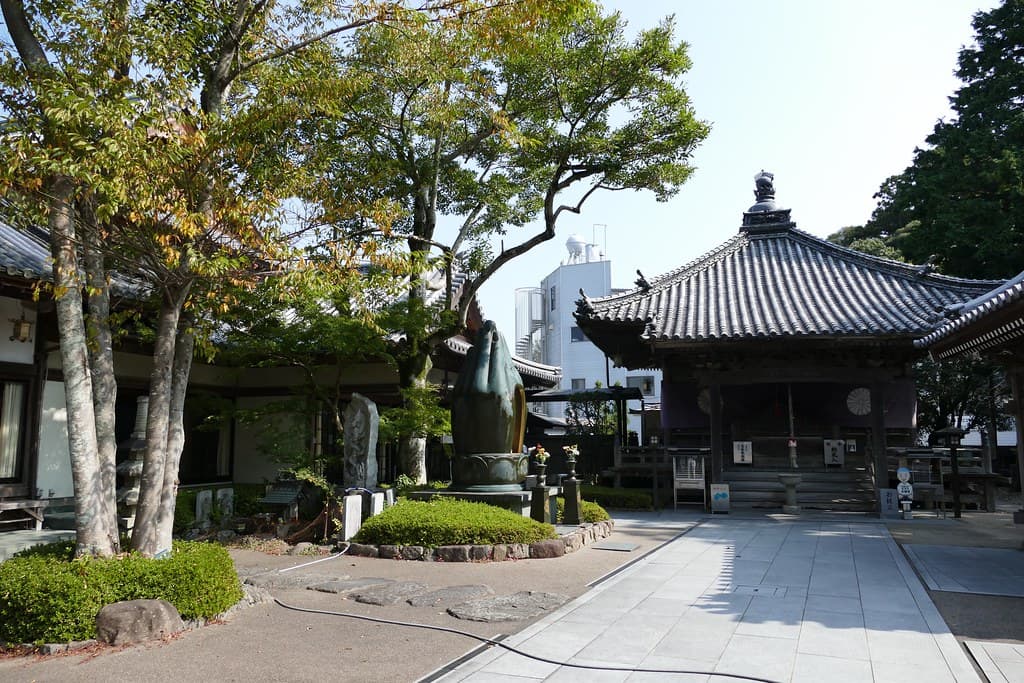
Image of Onzan-ji (恩山寺). Image source
Station 18 of 88
Shikoku 88 Temple PilgrimageVisit essentials
A quick read before you go
- Duration
- 30-45 minutes for a typical visit; longer if doing memorial prayers at the Tamayori Gozen…
- Access
- Address: 18 Yumoto, Tashiro-chō, Komatsushima, Tokushima 773-0008.
Overview
Onzan-ji's wooded slope is shaped by the story of a sacred mountain opening. Around 814-815, while Kūkai practiced here, his elderly mother Tamayori Gozen traveled from Sanuki, today's Kagawa, to see him. The mountain's nyonin kekkai, the women's-entry ban common at esoteric Buddhist sites, stopped her at Hanaorizaka Hill. Kūkai performed a 17-day esoteric ritual to lift the boundary. His mother then ascended, shaved her head, and lived as a nun in his care.
He renamed the temple Onzan-ji, 'Temple of Gratitude Mountain,' for her.
The Hondō's Yakushi Nyorai predates this story. Onzan-ji's first founding is attributed to Gyōki in the Tenpyō era (729-749) as a Bishamonten chapel; Kūkai's reconfiguration around 815 layered a son's filial vow over the older site. Today Daishi-no-Hahadō, the small chapel of Tamayori Gozen, stands in the precinct. A Biranju tree designated a prefectural natural monument is said to mark where the ban was lifted.
Pilgrims write osamefuda for their mothers and remember at the red-railed bridge near the Biranju. Here abstract shugyō, or training, becomes love for someone who raised you. Onzan-ji remains a working Kōyasan Shingon temple with daily services, regular pilgrim flow, and memorial services especially around Higan and Obon. Walkers continuing south cross Hanaorizaka, where legend says the boundary once held.
Why this place is sacred
Most mountain temples in esoteric Buddhism preserve their boundaries. Kōyasan itself maintained the women's-entry ban until 1872. Onzan-ji preserves the opposite: the moment one such boundary was deliberately undone for a single act of filial devotion. Tradition tells that when Tamayori Gozen reached Hanaorizaka and could not pass, Kūkai withdrew into a 17-day esoteric rite — the kind of practice that reshapes karmic and energetic structures. When she ascended, she shaved her head and lived out her remaining years here.
The name Onzan, 'Gratitude Mountain,' is a son's response. The thinness here is not about heightened austerity but about a softening of structure — the rare moment patriarchal mountain practice yielded to a more intimate logic. The Biranju tree, the red-railed bridge near it, and the Daishi-no-Hahadō chapel all hold that softer atmosphere. Pilgrims often report the temple as emotionally tender, the kind of place where they write more, pray more slowly, and think specifically about their parents.
Founded by Gyōki in the Tenpyō era (729-749) as a small chapel enshrining a Bishamonten image he had carved. The original purpose was protection — Bishamonten as guardian of the dharma and of the four directions. Kūkai's reconfiguration around 815 reoriented the site around Yakushi Nyorai (healing) and around the unusual story of his mother.
The temple expanded under Kūkai's patronage and the imperial support that followed. Across centuries it persisted as a Shikoku 88 stop, with the Tamayori Gozen narrative becoming central to its identity by the medieval period. The Daishi-no-Hahadō chapel and the Biranju tree are now the temple's most visited features after the two main halls. Onzan-ji remains a Kōyasan Shingon temple receiving daily henro pilgrims and offering memorial services for parents around Higan and Obon.
Experience and orientation
The approach to Onzan-ji rises through trees. Walkers coming from Tatsue-ji or Ido-ji often arrive a little tired, and the temple's modest scale meets that mood. Past the gate, the precinct opens with the Hondō ahead and the Daishidō to the side, both unhurried. The Tamayori Gozen chapel — the Daishi-no-Hahadō — is small, off to one side, and easy to miss if you do not know to look. Many pilgrims do know.
The Biranju tree, a southern evergreen marked as a prefectural natural monument, stands near a red-railed bridge that has become a customary photo and prayer point. People stop there longer than at most temples. They write osamefuda not only for themselves but for parents, sometimes for a parent who has died, sometimes for one still alive but ill or distant.
The small ceremony of writing a name on a paper slip and slipping it into the wooden box at each hall takes on weight here. The temple's atmosphere reflects this — quieter than the busier coastal temples, warm rather than imposing.
Bow at the gate. Purify hands and mouth at the stone basin. Offer at the Hondō first to Yakushi Nyorai, then at the Daishidō to Kōbō Daishi. After the formal worship, walk to the Daishi-no-Hahadō, the Tamayori Gozen chapel — a small space where many pilgrims write osamefuda specifically for parents and elders. Visit the Biranju tree and the red-railed bridge nearby. Receive your nōkyōchō stamp at the temple office before leaving. Bow at the gate as you depart.
Context and lineage
Tradition holds that Gyōki, the wandering Nara-period monk-engineer, founded a small chapel here in the Tenpyō era (729-749) and enshrined a Bishamonten image of his own carving. About a century later, around 814-815, the young Kūkai practised on this mountain. His mother Tamayori Gozen travelled from Sanuki to visit him and was stopped at Hanaorizaka by the women's-entry ban that protected most esoteric mountain practice sites.
Kūkai withdrew into a 17-day esoteric rite, after which the ban was considered lifted at this particular temple. His mother ascended, shaved her head, and took the tonsure here, living as a nun under his care. Kūkai renamed the site Onzan-ji — 'Temple of Gratitude Mountain' — and reoriented its principal worship toward Yakushi Nyorai, the Medicine Buddha. A Biranju tree, said to mark the lifting of the ban, still stands within the precinct.
Kōyasan Shingon. Onzan-ji is the 18th of the Shikoku 88 in standard order, in Komatsushima City just south of Tokushima. The temple sits within a regional grouping of three legendary East Tokushima temples — Onzan-ji, Tatsue-ji, and Dougaku-ji — though only Onzan-ji and Tatsue-ji are formal henro stops.
Gyōki
Traditional founder of the original chapel
Kūkai (Kōbō Daishi)
Reconfigured the temple around 815, performed the 17-day rite
Tamayori Gozen
Mother of Kūkai, took the tonsure here
Traditions and practice
Goma fire rituals on key Shingon dates. Yakushi-related healing services. Memorial services for parents are particularly significant here, especially around the Higan equinoxes and during Obon in mid-August, when the temple's filial-gratitude framing draws families specifically for ancestor remembrance.
Daily henro flow. Pilgrims worship at the Hondō and Daishidō, then often pause longer at the Daishi-no-Hahadō (Tamayori Gozen chapel) than at many comparable side-halls elsewhere on the route. The Biranju tree and the red-railed bridge are customary photo and prayer points. Memorial osamefuda written for parents are visibly common in the wooden offering boxes here.
If you have living parents you have not thought of recently, this is a good place to think of them. Write an osamefuda with their name and a brief intention. If your parents have died, the same gesture serves as memorial prayer. Read the Heart Sutra at the Hondō and the Daishidō; if you know the Kōbō Daishi mantra ('Namu Daishi Henjō Kongō'), include it. Visit the Daishi-no-Hahadō unhurriedly.
Shingon Buddhism (Kōyasan branch)
ActiveOnzan-ji is dedicated to filial gratitude — a Confucian-Buddhist value redirected through Kūkai's relationship with his mother Tamayori Gozen, who is said to have taken the tonsure here.
Standard henro twin-hall worship; rituals dedicated to ancestors and parents, especially around Higan and Obon; meditation and goma offerings on Shingon liturgical dates. The Daishi-no-Hahadō chapel functions as a memorial focus for parents and elders.
Perspectives and open questions
Onzan-ji's founding legend sits at the intersection of institutional Shingon doctrine and folk-Buddhist accommodation. Different readings emphasise different layers.
Scholarly perspective
Historians of Japanese Buddhism read the Onzan-ji legend as a culturally important narrative through which the Shingon school articulated its accommodation of women. The institutional mainstream maintained nyonin kekkai — most notably at Kōyasan itself, where the ban held until 1872 — while folk-level practice celebrated its lifting here. The result is an ongoing tension within the tradition that Onzan-ji preserves in story rather than resolving in doctrine.
Living and traditional perspectives
Local devotion centres on Kūkai as a model son. That the founder of esoteric Buddhism in Japan would bend doctrinal rule to honour his mother is held up as evidence that on (gratitude to parents) is itself a form of buddha-nature. The Biranju tree is treated as living witness, and the Daishi-no-Hahadō chapel as a maternal hearth within the precinct.
Alternative interpretations
In some Shingon esoteric readings, Tamayori Gozen is iconographically merged with the bodhisattva Marishiten or with Bishamonten consorts. Her chapel here has, at times, been treated as a quiet locus of feminine awakening within otherwise patriarchal mountain practice — a counter-current to the kekkai logic that defined most contemporaneous mountain temples.
Open questions
The historicity of the 17-day rite cannot be verified, and the precise location of the original kekkai gate is unknown. The Biranju tree's age is debated; while called a centuries-old natural monument, dendrochronological studies have been limited.
Plan your visit
Access and arrival
Address: 18 Yumoto, Tashiro-chō, Komatsushima, Tokushima 773-0008. About a 1.5 km / 25-minute walk from Tateiwa Station on the JR Mugi Line. Short taxi from the JR Komatsushima area. Free parking on site. Phone: 0885-33-1218 (verify); standard Shikoku 88 nōkyō hours typically 07:00-17:00.
Komatsushima offers small business hotels and minshuku. Pilgrim-friendly lodging is more common in nearby Tokushima City; some henro choose to stay overnight at Tatsue-ji's shukubo just south.
Respectful visit
Modest casual is fine. Full pilgrim regalia — white hakui, kasa, kongō-zue — is welcomed but not required.
Permitted in grounds. Do not photograph altar interiors without permission. The Biranju tree is one of the most photographed features of the precinct.
Coins, three sticks of incense, one candle, an osamefuda dropped in the wooden box at each hall. Sutras may be copied (shakyō) and offered. The temple specifically welcomes osamefuda written for parents.
No drones, no eating in halls, no climbing on the Biranju tree (a designated natural monument).
Do not climb on the Biranju tree — it is a designated prefectural natural monument. The temple's emotional weight can surprise pilgrims; do not push the experience, and do not perform feeling you do not have.
Current practical details
Address
谷-40 恩山寺 田野町 Komatsushima, Tokushima 773-0008, Japan
Phone
Hours
Hours, fees, and access can change — verify on the official source before you travel. Practical details last checked Jun 2026.
Location
Map loads as you approach this section.
Pilgrim reflections
A portrait of encounter, not a score
Pilgrims describe what they felt, how present they could become, and whether the place would shape a journey. There are no stars and no ranking of traditions.
No reviewed reflections yet
The first pilgrims can help describe the character of being here.
Share a reflection
Available after an account-backed “Been there.” Every reflection is reviewed before publication.
Watch deeper
Films, episodes, and recorded talks for visitors who want more context before or after a visit. Speculative and alternative-history entries are labelled as perspectives, not as sources for established claims.
Nearby sacred places
Explore other sacred places in the region. Proximity does not establish access or travel time; check each place’s guidance.
References
Sources consulted for this page. Source categories describe the publication, not a guarantee that every claim is verified. Traditional accounts and outside interpretations may differ.
- 01Boyouzan Houjyuin Onzanji – Shikoku 88 Temple Pilgrimage — Shikoku 88 ReijokaiofficialOfficial temple association page.
- 02Onzan-ji — Wikipedia contributorsencyclopediaSect (Kōyasan Shingon), principal image, foundation summary.
- 03Onsanji Temple, the 18th temple of the 88 Shikoku Pilgrimage — Shikoku Pilgrimage NewsguideDetailed Tamayori Gozen story and mother-son legend.
- 04Temple eighteen in the Shikoku Ohenro pilgrimage is known as the Temple of Gratitude Mountain — Japan TravelguideSymbolism of mountain name.
- 05Three Legendary East Tokushima Temples: Onzanji, Tatsueji and Dougakuji — East Tokushima TourismguideRegional context and Biranju tree.
- 06Temple 18, Onzan-ji — Shikoku ToursguidePractical visit details.
Pilgrim glossary
- Bodhisattva
- An enlightened being who postpones full nirvana to help others toward awakening.
- Sutra
- A canonical Buddhist scripture, often chanted as part of practice.
- Mantra
- A sound, word, or phrase repeated as part of meditation or ritual.
- Dharma
- The teachings of the Buddha; also the universal law underlying them.
- Shingon
- An esoteric Japanese Buddhist school emphasizing ritual, mantra, and mandala practice.
Share a photo
Help visitors recognize Onzan-ji. Every submission is reviewed before publication.