Dainichi-ji
A jingūji facing its shrine across the road, Temple 13 of the Shikoku 88
Understand sacred places, explore living traditions, and learn how to engage respectfully with Pilgrim Map.
Access has not been verified. Check current local guidance before planning a visit.
Tokushima, Tokushima Prefecture, Japan
Read the sources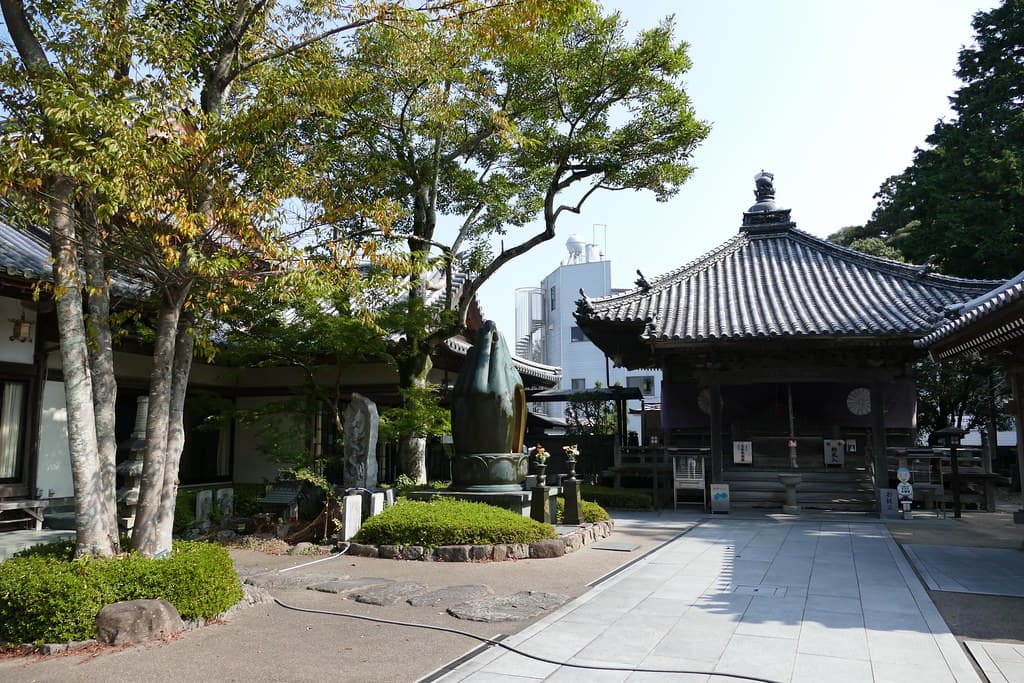
Image of Dainichi-ji (大日寺). Image source
Station 13 of 88
Shikoku 88 Temple PilgrimageVisit essentials
A quick read before you go
- Duration
- 30–45 minutes for the temple itself; allow 60–90 minutes if combining with Awa Ichinomiya Shrine…
- Access
- Located in Tokushima City, Tokushima Prefecture, on flat land beside the Akui River.
Overview
Dainichi-ji's name comes from Dainichi Nyorai, the cosmic Buddha at the heart of Shingon teaching, whom Kūkai is said to have enshrined here in 815 after experiencing a vision of the Buddha appearing in a purple cloud. The temple's present principal image, however, is a Jūichimen Kannon (Eleven-Faced Kannon), traditionally attributed to the eighth-century monk Gyōki. The mismatch tells the story of the place.
For most of its long history Dainichi-ji functioned as the jingūji—the Buddhist counterpart—of the adjacent Awa Ichinomiya Shrine. The Jūichimen Kannon was originally enshrined at the shrine as the honji-butsu (Buddhist counterpart) of its kami. When the Meiji shinbutsu bunri edicts of 1868 forcibly separated Shintō and Buddhism after centuries of integrated practice, the image was moved across the road into Dainichi-ji's Hondō, where it remains.
The two precincts still face each other across the road, and many pilgrims visit both. The arrangement is one of the clearest visible examples of shinbutsu-shūgō—the Japanese tradition of weaving native and Buddhist sanctity into a single sacred field—and of the institutional violence by which the modern state separated the two. Dainichi-ji is a small, atmospheric temple with old trees and a quiet courtyard layout. The Hondō and Daishi-dō face each other in the standard pilgrim arrangement.
A Mizukake Koyasu Jizō statue, washed with water by visitors praying for safe childbirth and child welfare, stands within the precinct. Pilgrims often arrive here after the long descent from Shōsan-ji and feel the change of register—mountain stillness giving way to a quieter, more domestic kind of sanctity. The site is a textbook example of Japanese jingūji history.
Why this place is sacred
Thinness at Dainichi-ji is structural rather than dramatic. The temple is small, the trees are old, and the precinct is shaded most of the day. The Hondō faces the Daishi-dō across a narrow courtyard. Across the road stands Awa Ichinomiya Shrine, its torii visible from the temple gate. Behind the temple rises the hill of former Ichinomiya Castle, and the Akui River—a tributary of the Yoshino—runs along the temple's other side.
The geography forms a triadic configuration: Buddha (Dainichi-ji), kami (Ichinomiya Shrine), and lay community held in a single field.
The deep layer is the relationship. From its 815 founding through 1868, Dainichi-ji and Ichinomiya Shrine were administratively continuous. The shrine's principal image (a Jūichimen Kannon) was held as the kami's Buddhist counterpart. Buddhist services for the shrine were performed at the temple. Lay devotion moved between the two without distinguishing them. The 1868 Meiji separation broke this continuity by force; the Buddhist image was moved across the road, and the two institutions were administratively divided.
Pilgrims today walk between the two precincts in a few minutes and pay respect at both. The very ease of that movement is the temple's particular thinness: a long history of integration that survived its own political dismantling.
Founded in 815 by Kūkai as a Shingon Buddhist temple dedicated to Dainichi Nyorai (Mahāvairocana), the cosmic Buddha at the heart of Shingon esoteric teaching. The original carved image was attributed to Kūkai's hand and enshrined in the Hondō. As Awa Ichinomiya Shrine developed nearby, Dainichi-ji was incorporated as its jingūji, providing Buddhist ritual services for the shrine and managing the kami's Buddhist counterpart image (the Jūichimen Kannon by Gyōki).
The temple was burnt down during the Tenshō era (1573–1592) by Chōsokabe Motochika's forces. Reconstruction came in the early Edo period under Hachisuka Mitsutaka, third lord of the Tokushima domain, with the current Hondō structure dating to the mid-seventeenth century and later Edo-era restoration. The pivotal modern change came with the Meiji shinbutsu bunri edicts of 1868, which forcibly separated Shintō and Buddhist institutions.
The Jūichimen Kannon, originally the Buddhist counterpart of Awa Ichinomiya Shrine's kami, was moved across the road into Dainichi-ji's Hondō, where it became the principal image. The temple has continued in active service as Temple 13 of the Shikoku 88 throughout the modern period.
Experience and orientation
Pilgrims arriving on foot from Shōsan-ji come down out of the mountains across roughly 25 kilometres, often over a second day, and the change of register at Dainichi-ji is significant. The temple sits on flat land beside the Akui River, with the hill of former Ichinomiya Castle behind. The Niōmon is modest. Inside, the courtyard is small and tree-shaded, with the Hondō and Daishi-dō facing each other in the standard pilgrim arrangement.
The Mizukake Koyasu Jizō stands within the precinct; visitors pour water over the small stone statue while praying for safe childbirth and child welfare. A Kannon Bosatsu image is also on site.
The ritual sequence at the Hondō and Daishi-dō follows the standard pattern, with the Jūichimen Kannon mantra at the main hall. Many pilgrims also walk across the road afterward to Awa Ichinomiya Shrine. The shrine has its own torii, sandō (approach), and worship hall; visitors typically bow at the torii, rinse hands and mouth at the temizuya, approach the haiden (worship hall), drop a coin, ring the bell, bow twice, clap twice, bow once, and leave.
The combined visit takes thirty to forty-five minutes for the temple itself and longer if including the shrine. Many henro report that the dual visit—temple and shrine, Buddha and kami—gives this stop a particular quality not found elsewhere on the route.
The temple sits on flat land beside the Akui River, with Ichinomiya Castle hill behind. The Niōmon faces the road toward Awa Ichinomiya Shrine, which stands directly across; the temple courtyard opens to the Hondō and Daishi-dō, with the Mizukake Koyasu Jizō and Kannon Bosatsu images in the precinct. The goshuin office is near the precinct edge. Free parking is available on site.
Context and lineage
In 815, Kūkai was practicing austerities in this area when Dainichi Nyorai—the cosmic Buddha at the heart of Shingon teaching—appeared to him in a purple cloud. He immediately carved a statue of Dainichi Nyorai and built a temple to enshrine it.
When Awa Ichinomiya Shrine was later founded across the road, Dainichi-ji was incorporated within its precinct as the jingūji to manage Buddhist services for the shrine and to hold the kami's Buddhist counterpart image: a Jūichimen Kannon traditionally attributed to the monk Gyōki. The two institutions—temple and shrine—functioned as a single sacred field for over a millennium until they were administratively separated by the Meiji shinbutsu bunri edicts of 1868.
The Jūichimen Kannon was then transferred from the shrine to Dainichi-ji's Hondō, where it became the principal image.
Kōya-san Shingon: the major branch of Shingon Buddhism descended from Kūkai's monastic establishment on Mt. Kōya. Dainichi-ji is administratively part of this branch. The temple's long historical association with Awa Ichinomiya Shrine made it part of the broader jingūji tradition—Buddhist establishments attached to Shintō shrines—that shaped Japanese sacred geography from the medieval period through the Meiji separation. The Shintō layer of the site, formally administered as a separate institution since 1868, remains visibly present across the road.
Kūkai (Kōbō Daishi)
Founder; recipient of the Dainichi Nyorai vision in a purple cloud; carver of the original Dainichi Nyorai image
Gyōki
Traditional carver of the Jūichimen Kannon (now the principal image)
Hachisuka Mitsutaka
Edo-period patron who rebuilt the temple after Tenshō-era destruction
Traditions and practice
The henro sequence at Dainichi-ji follows the standard Shikoku 88 pattern. Pilgrims bow at the Niōmon, purify hands and mouth at the temizuya, and sound the bell once on entry. At the Hondō: osamefuda, candle, three sticks of incense, a small coin, the Heart Sutra, and the Jūichimen Kannon mantra: On Maka Kyaronikya Sowaka. At the Daishi-dō: the same offerings and the Kōbō Daishi mantra: Namu Daishi Henjō Kongō.
Many pilgrims also pour water over the Mizukake Koyasu Jizō for prayers of safe childbirth and child welfare, and continue across the road to Awa Ichinomiya Shrine for additional prayers in the Shintō style.
The nōkyō office is open 7:00–17:00 daily. Periodic Buddhist services are maintained by the resident community. Pilgrim reception is steady throughout the year. The relationship with the adjacent Ichinomiya Shrine continues informally, with many pilgrims and local visitors moving freely between the two precincts.
Plan time for both the temple and the shrine across the road. The combined visit gives a fuller picture of the site than the temple alone. The Mizukake Koyasu Jizō is a quiet point of folk devotion; pouring water over the small stone figure while holding a particular prayer in mind is a contemplative act in its own right. Those uncertain about the chants may simply offer incense and a coin at each hall.
Shingon Buddhism (Kōya-san branch)
ActiveDainichi-ji is named for Dainichi Nyorai (Mahāvairocana), the central cosmic Buddha of Shingon esoteric teaching whom Kūkai is said to have enshrined here. Shingon doctrine identifies Dainichi Nyorai as the dharmakāya itself—the universe as awakened body—making the temple's name a doctrinal statement.
Pilgrims chant the Heart Sutra and the honzon mantra of Jūichimen (Eleven-Faced) Kannon (On Maka Kyaronikya Sowaka) at the Hondō, with the Dainichi mantra still associated with the temple's traditional identity. The Kōbō Daishi mantra is chanted at the Daishi-dō.
Shintō (historical / Ichinomiya Shrine connection)
ActiveFrom its founding through the Meiji period, Dainichi-ji functioned as the jingūji of Awa Ichinomiya Shrine, the highest-ranked Shintō shrine of Awa Province. The Jūichimen Kannon now in the Hondō was originally the honji-butsu of the shrine's kami. After the 1868 Meiji separation edicts, the image was moved across the road to the temple. The neighboring shrine remains active.
Pilgrims often visit both Dainichi-ji and the adjacent Ichinomiya Shrine, recognizing the long-standing shinbutsu-shūgō (Shintō-Buddhist syncretism) at this site. The shrine maintains standard Shintō ritual at its haiden.
Perspectives and open questions
Dainichi-ji is read as Shingon vision-site, as Shintō-Buddhist jingūji, as Meiji-era casualty of forcible separation, and as living testimony to a sacred geography that survived its own dismantling.
Scholarly perspective
Historians treat the 815 founding date as traditional and the Kūkai vision of Dainichi Nyorai as hagiographic. Documentary evidence is strongest for the Hachisuka clan's early Edo reconstruction and the well-documented Meiji-era transfer of the Jūichimen Kannon from Ichinomiya Shrine. The temple is a textbook example of Japanese jingūji history, frequently cited in studies of shinbutsu-shūgō and the 1868 separation edicts.
Living and traditional perspectives
Within Shingon, Dainichi-ji's founding vision of Dainichi Nyorai in a purple cloud is taken as direct revelation of the cosmic Buddha to Kūkai. The transfer of Jūichimen Kannon from the shrine to the temple in 1868 is understood as the rightful gathering of Buddhist images under Buddhist custody after the artificial separation imposed by the Meiji state.
Alternative interpretations
Esoteric reading sees the temple's site as a natural mandala: the Akui River below, Ichinomiya Castle hill behind, and the across-the-road shrine forming a triadic configuration with Dainichi Nyorai (Buddha), kami (native deity), and lay community held in a single field of veneration. The Meiji separation is read as administrative violence that did not, in the end, dissolve the geographical and ritual continuity of the two precincts.
Open questions
Whether the original Dainichi Nyorai statue carved by Kūkai survived the Tenshō destruction is uncertain. The exact date of the Awa Ichinomiya Shrine founding and the original mode of jingūji integration are matters of ongoing local-history scholarship. Whether any of the sub-images now in the Hondō predate the seventeenth-century reconstruction cannot be determined from available sources.
Plan your visit
Access and arrival
Located in Tokushima City, Tokushima Prefecture, on flat land beside the Akui River. By car: free parking on site. By bus: about 30 minutes from JR Tokushima Station on the bus line toward Yorii-naka. On foot (henro trail): a long descent of about 25 kilometres from Temple 12 Shōsan-ji, typically taking a second day. Free entry.
Pilgrim minshuku, ryokan, and small hotels are available in Tokushima City and along the henro route between Temples 13 and 17. Many walking pilgrims complete the cluster of temples 13–17 in a single day or split it across two days. Direct contact details and current availability should be confirmed in advance through the Shikoku Henro Reijōkai or local pilgrim guides.
Respectful visit
Modest casual clothing covering shoulders and knees. Pilgrim white hakui jackets, sedge hats, and kongō-zue staffs are common but optional.
Exterior photography is permitted. Avoid flash and direct images of enshrined statues inside the Hondō and Daishi-dō. Respect any 'no photography' signage. The shrine across the road typically permits exterior photography but not photography of inner sanctuary altars.
Standard pilgrim offerings: osamefuda, candle, three incense sticks, and a small coin at each hall. The Mizukake Koyasu Jizō receives water poured by visitors as a specific offering for child welfare. At the shrine across the road, a small coin and the standard two-bows-two-claps-one-bow sequence is the usual offering.
Ring the bell only on entry. Do not step on door thresholds. Maintain quiet during others' chanting. Be sensitive to the layered history when discussing the Meiji-era transfer of the Jūichimen Kannon.
Photography of enshrined images inside the halls is generally restricted; check posted signage. The Mizukake Koyasu Jizō is a small stone figure—pour water gently. The shrine across the road has its own etiquette (bow at the torii, two bows two claps one bow at the haiden); pilgrims unfamiliar with Shintō practice should observe other visitors first.
Current practical details
Address
Nishichō-263 Ichinomiyachō, Tokushima, 779-3132, Japan
Phone
Hours
Hours, fees, and access can change — verify on the official source before you travel. Practical details last checked Jun 2026.
Location
Map loads as you approach this section.
Pilgrim reflections
A portrait of encounter, not a score
Pilgrims describe what they felt, how present they could become, and whether the place would shape a journey. There are no stars and no ranking of traditions.
No reviewed reflections yet
The first pilgrims can help describe the character of being here.
Share a reflection
Available after an account-backed “Been there.” Every reflection is reviewed before publication.
Watch deeper
Films, episodes, and recorded talks for visitors who want more context before or after a visit. Speculative and alternative-history entries are labelled as perspectives, not as sources for established claims.
Nearby sacred places
Explore other sacred places in the region. Proximity does not establish access or travel time; check each place’s guidance.


References
Sources consulted for this page. Source categories describe the publication, not a guarantee that every claim is verified. Traditional accounts and outside interpretations may differ.
- 01Dainichi-ji (Tokushima) - Wikipedia — Wikipedia contributorsencyclopediaFounding by Kūkai in 815, transfer of Jūichimen Kannon from Ichinomiya Shrine in Meiji period, location between former Ichinomiya Castle hill and Akui River.
- 02Oogurizan Kezouin Dainichiji – Shikoku 88 Temple Pilgrimage — Shikoku 88 Henro ReijokaiofficialFounding legend: Dainichi Nyorai appearing in purple cloud.
- 03Dainichiji – Tokushima City, Tokushima Prefecture, Shikoku • Henro.org — Henro.orgguidePilgrim guide with practical access details.
- 04Customs and Etiquette of the Shikoku Pilgrimage - Henro.org — Henro.orgguideStandard henro etiquette.
- 05Dainichiji Temple & Ichinomiya Shrine | Japan Experience — Japan ExperienceguideConfirms original principal image carved by Gyōki was the Jūichimen Kannon of Ichinomiya Shrine.
- 06Dainichi-ji Temple, the 13th temple of the Shikoku Pilgrimage | Shikoku Henro News — Shikoku Pilgrimage NewsguideHachisuka clan rebuilding in early Edo period.
Pilgrim glossary
- Kannon
- The bodhisattva of compassion, central to many East Asian pilgrimage routes.
- Mandala
- A symbolic diagram of the cosmos used in meditation and ritual.
- Sutra
- A canonical Buddhist scripture, often chanted as part of practice.
- Mantra
- A sound, word, or phrase repeated as part of meditation or ritual.
- Torii
- The traditional Japanese gate marking the entrance to a Shinto sacred area.
- Shingon
- An esoteric Japanese Buddhist school emphasizing ritual, mantra, and mandala practice.
Share a photo
Help visitors recognize Dainichi-ji. Every submission is reviewed before publication.