Jōraku-ji
Walking on flowing rock to meet the future Buddha, Temple 14 of the Shikoku 88
Understand sacred places, explore living traditions, and learn how to engage respectfully with Pilgrim Map.
Access has not been verified. Check current local guidance before planning a visit.
Tokushima, Tokushima Prefecture, Japan
Read the sources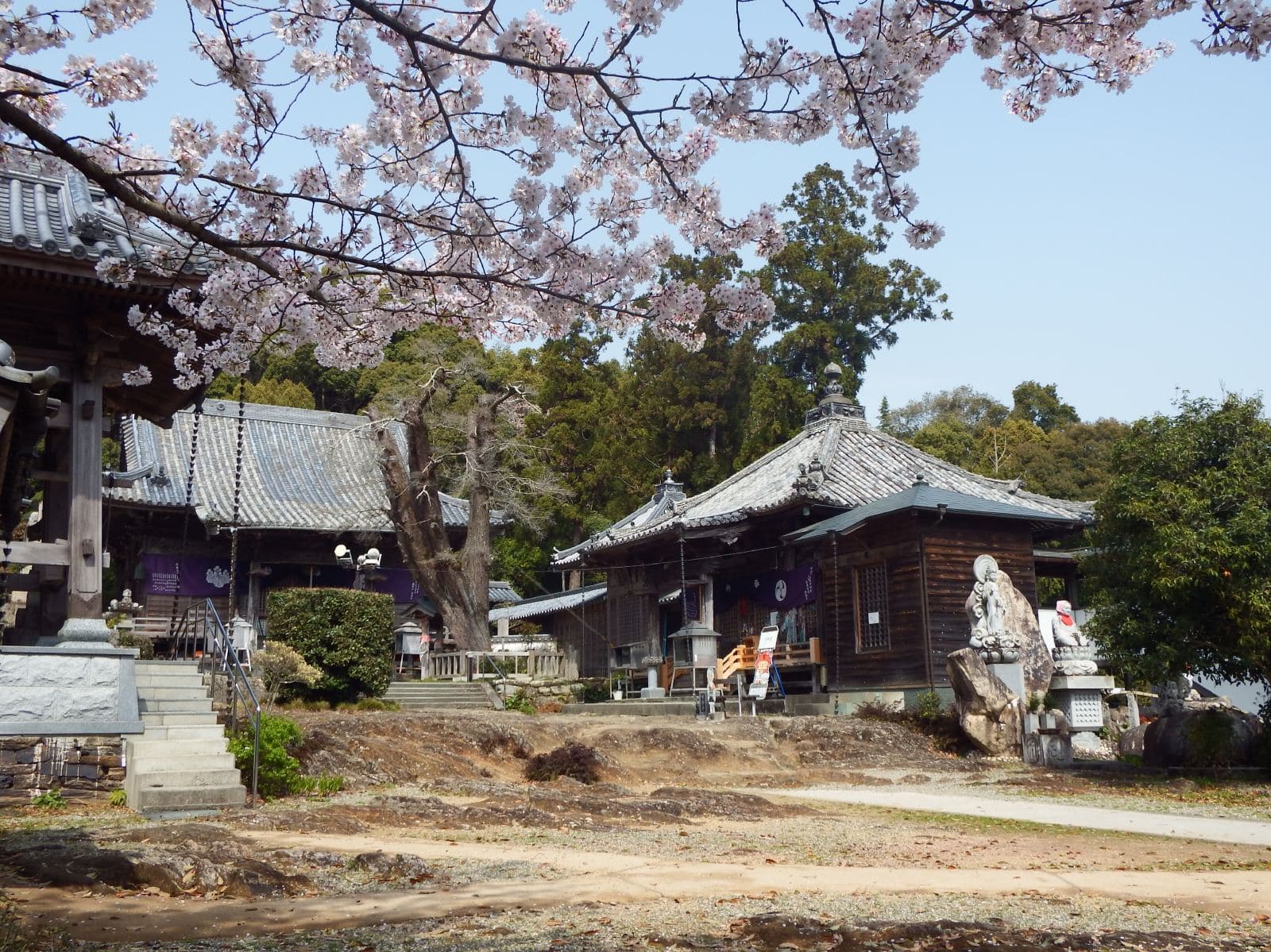
Image of Jōraku-ji (常楽寺). Image source · CC-BY-SA-4.0
Station 14 of 88
Shikoku 88 Temple PilgrimageVisit essentials
A quick read before you go
- Duration
- 30–45 minutes for a thorough visit including ritual at both halls, the rock garden walk, and a…
- Access
- Located in Tokushima City, Tokushima Prefecture, on the south side of the Tokushima rift valley.
Overview
Jōraku-ji means 'Everlasting Peace,' the joy of the Buddha's nirvana realm, and the temple's particular orientation is toward the future. Among the eighty-eight temples of the Shikoku pilgrimage, this is the only one dedicated to Miroku Bosatsu—Maitreya, the Buddha who, according to tradition, will appear 5.67 billion years after Shakyamuni's death to save all sentient beings.
The temple's name and its dedication together evoke a contemplation of immense time, in which present devotion is a small drop within a vast unfolding.
The most distinctive feature of the precinct is geological. Where most temples have a flat courtyard of gravel or paving, Jōraku-ji's precinct is a vast natural bedrock outcrop whose surface has been weathered by wind and rain into long undulations resembling flowing water frozen in stone. This is the Ryūsuigan no Niwa, the Garden of Flowing Rocks. Pilgrims walk across it to reach the Hondō. The surface is uneven and slippery when wet; sturdy shoes are essential.
Standing on rock that visibly flows is unlike standing on any other temple precinct in Japan.
The temple's founding legend is appropriate to the dedication. In 815, when Kūkai was 42 years old and practicing Shingon austerities in the area, Miroku Bosatsu is said to have appeared to him surrounded by many other Bodhisattvas. Profoundly moved, Kūkai carved an image of Miroku into a nearby sacred tree, built a temple, and enshrined the image as the principal Buddha.
The temple grew under his nephew (Chisen) and the monk Kishin, becoming a major complex of seven halls before destruction in the Tenshō era. The current site dates to 1818, when the temple was relocated from its previous position following the construction of a reservoir, and the Hachisuka family rebuilt the principal structures in 1659.
The Araragi Taishi yew tree by the Hondō, eight metres in trunk circumference and ten metres tall, is a focus of folk devotion for healing—particularly diabetes, an enduring local tradition.
Why this place is sacred
Thinness here is unusual. Most temples build their atmosphere through architecture, vegetation, or seclusion. Jōraku-ji builds its atmosphere through geology. The Ryūsuigan no Niwa is not a designed garden in the manner of a karesansui Zen composition; it is the actual living bedrock of the site, weathered over geological time and worn further by the footsteps of pilgrims into long undulations that carry the eye across the precinct.
To walk on it is to feel, in the body, the slow agency of water. The dedication to Miroku adds a temporal dimension: this is a temple oriented toward a Buddha who will appear so far in the future that the geological time of the rock and the eschatological time of the dedication echo each other.
The Araragi Taishi yew anchors the precinct's other dimension—the deep time of a single living being. The tree stands by the Hondō, eight metres around at the trunk and ten metres tall, and has been a focus of folk devotion for generations. People come specifically to pray for healing, particularly from diabetes, and the tree is treated as a participant in the temple's life.
Together the rock and the tree create a particular tonality: stone in apparent motion, life in apparent stillness, both pointing toward time scales the pilgrim cannot directly grasp.
Founded in 815 by Kūkai as a Shingon Buddhist temple dedicated to Miroku Bosatsu (Maitreya), with the principal image carved by Kūkai into a nearby sacred tree following his vision of Miroku surrounded by Bodhisattvas. The temple was conceived as a major Shingon establishment with seven halls, supported by Kūkai's nephew (Chisen, also known as Shinga) and the monk Kishin, who was associated with the revival of Mt. Kōya.
The original seven-hall complex was destroyed by fire during the Tenshō era (1573–1592) Chōsokabe campaigns. The temple flourished as a place of prayer for the Hosokawa clan, lords of Awa, during the Muromachi period. Reconstruction came in 1659 under the Hachisuka family. The temple was relocated to its current site in 1818 following the construction of a reservoir at the previous location, and the present buildings date primarily from that nineteenth-century relocation.
The Ryūsuigan no Niwa as the precinct floor became a defining feature at the new site, and the Araragi Taishi yew tree—presumably already established—became a focus of healing-related folk devotion.
Experience and orientation
Walking pilgrims arrive about two kilometres west of Dainichi-ji, an easy thirty minutes on flat terrain. The Niōmon at Jōraku-ji is modest. The first thing the pilgrim notices on entering the precinct is the floor: not gravel, not paving, but living bedrock whose surface flows in long undulations toward the Hondō. The walk across this surface is necessarily slow. Footing is uneven; the surface is slippery when wet.
Many pilgrims pause halfway across the rock, simply standing still, taking in the unusualness of the place.
The Hondō and Daishi-dō are arranged in the standard pilgrim configuration. At the Hondō, pilgrims chant the Heart Sutra and the Miroku Bosatsu mantra. The Araragi Taishi yew stands beside the hall, its trunk thicker than two pilgrims could reach around together. Many visitors approach the tree specifically, sometimes pressing a hand briefly to the bark with a particular prayer in mind—often for healing from diabetes, an enduring local devotion.
The Daishi-dō follows in the standard sequence with the Kōbō Daishi mantra. The visit takes thirty to forty-five minutes for a thorough engagement including ritual at both halls, the rock garden walk, and the Araragi Taishi visit. Many pilgrims continue immediately to Awa Kokubun-ji (Temple 15), about a kilometre north.
The Niōmon faces the road; the Ryūsuigan rock garden constitutes the courtyard between the gate and the Hondō. The Araragi Taishi yew stands beside the Hondō. The Daishi-dō and the goshuin office are within easy reach of the main hall.
Context and lineage
In 815, when Kūkai was 42 years old (the yakudoshi or 'unlucky age' for men) and practicing Shingon austerities in the area, Miroku Bosatsu—the future Buddha who, according to tradition, will appear 5.67 billion years after Shakyamuni's death—is said to have appeared to him surrounded by many other Bodhisattvas. Profoundly moved, Kūkai carved an image of Miroku into a nearby sacred tree, built a temple, and enshrined the image as the principal Buddha.
The temple grew into a major complex of seven halls under the supervision of Kūkai's nephew (Chisen, also known as Shinga) and the monk Kishin, who was associated with the revival of Mt. Kōya.
Kōya-san Shingon: the major branch of Shingon Buddhism descended from Kūkai's monastic establishment on Mt. Kōya. Jōraku-ji is administratively part of this branch and maintains the standard Shingon liturgy alongside the pilgrim chant sequence. Miroku Bosatsu, the temple's principal image, holds a distinctive position in Shingon eschatology as the next Buddha to appear in this world.
Kūkai (Kōbō Daishi)
Founder; carver of the original Miroku image
Chisen (Shinga)
Kūkai's nephew; reportedly oversaw construction of the original Main Hall
Kishin
Monk associated with the revival of Mt. Kōya; built additional halls at the original Jōraku-ji
Hachisuka family
Edo-period patrons who rebuilt the temple in 1659
Traditions and practice
The henro sequence at Jōraku-ji follows the standard Shikoku 88 pattern, with the particular spatial character of walking across the Ryūsuigan rock to reach the halls. At the Niōmon, pilgrims bow once before crossing the threshold. Hands and mouth are rinsed at the temizuya. The bell is sounded once on entry. At the Hondō: osamefuda, candle, three sticks of incense, a small coin, the Heart Sutra, and the Miroku Bosatsu mantra: On Maitareiya Sowaka.
At the Daishi-dō: the same offerings and the Kōbō Daishi mantra: Namu Daishi Henjō Kongō. Many pilgrims also visit the Araragi Taishi yew to offer a prayer for healing, particularly from diabetes—an enduring local devotion that brings non-pilgrim visitors specifically for this purpose.
The nōkyō office is open 7:00–17:00 daily. Pilgrim reception runs year-round. The Araragi Taishi remains a living focus of folk devotion; local visitors come specifically to pray at the tree even when not on the henro circuit. The temple also receives the cluster-day pilgrims completing Temples 13–17 in a single day given the proximity of the five Tokushima City temples.
Walk slowly across the Ryūsuigan. The unusual sensation of walking on flowing rock is itself part of the temple's teaching, and rushing across the surface misses what makes the visit distinctive. After ritual at both halls, a few minutes by the Araragi Taishi—simply present rather than petitioning—often opens the temple's particular tonality. The combination of geological time (the rock) and biological deep time (the tree) is the contemplative gift of the place.
Shingon Buddhism (Kōya-san branch)
ActiveJōraku-ji is the only temple among the Shikoku 88 whose principal image is Miroku Bosatsu (Maitreya), the future Buddha. In Shingon teaching, Miroku presides over the future Pure Land of Tushita and is the next Buddha to appear in this world. The temple's name—Jōraku, 'Everlasting Peace'—evokes the eternal joy of the Buddha's nirvana realm.
Pilgrims chant the Heart Sutra and the Miroku Bosatsu mantra (On Maitareiya Sowaka) at the Hondō, and the Kōbō Daishi mantra at the Daishi-dō.
Perspectives and open questions
Jōraku-ji is read as Shingon vision-site, as future-Buddha temple, as geological curiosity, and as folk-devotional centre for healing. Each reading sees a different facet of the same precinct.
Scholarly perspective
Historians treat the 815 founding date as traditional. The Hosokawa-clan Muromachi patronage and 1659 Hachisuka rebuilding are documented. The 1818 relocation following reservoir construction is also documented. The Ryūsuigan rock garden is a genuine geological feature—weathered bedrock—rather than an artificial designed garden, distinguishing it from karesansui Zen gardens, which are deliberately composed.
Living and traditional perspectives
Within Shingon, the appearance of Miroku surrounded by Bodhisattvas to Kūkai is taken as direct vision of the future Buddha and his entourage. Jōraku-ji is regarded as a place where the eschatological future of dharma touches the present, and the temple's name—Everlasting Peace—is read as evocation of Miroku's Tushita Pure Land.
Alternative interpretations
Esoteric readings see the Ryūsuigan rock garden as a manifestation of Miroku's slow time—the water-carved bedrock embodying the immense temporal scale (5.67 billion years) before Maitreya's appearance. The Araragi Taishi yew, in similar deep-time contemplation, anchors the pilgrim's body to a being older than any visible structure of the temple. The two together—stone in apparent motion, life in apparent stillness—constitute a body-scale teaching on time.
Open questions
The original founding-era Miroku statue carved by Kūkai did not survive the Tenshō destruction. Whether the Ryūsuigan was already a venerated feature at the temple's founding (and motivated site selection) or only became central after the 1818 relocation is not documented. The age of the Araragi Taishi yew has not been definitively established by available dendrochronological records.
Plan your visit
Access and arrival
Located in Tokushima City, Tokushima Prefecture, on the south side of the Tokushima rift valley. By car: about 2 kilometres west of Temple 13 Dainichi-ji; small free parking. On foot (henro trail): about 2 kilometres from Dainichi-ji and about 1 kilometre south of Temple 15 Awa Kokubun-ji. Nearest train station: JR Tokushima Station, then bus or taxi.
Pilgrim minshuku, ryokan, and small hotels are available in Tokushima City. The cluster of Temples 13–17 within a few kilometres makes a single-day or two-day completion realistic for most walking pilgrims, with overnight stays in Tokushima City or along the route. Direct contact details and current availability should be confirmed in advance through the Shikoku Henro Reijōkai or local pilgrim guides.
Respectful visit
Comfortable closed-toe shoes with good grip are essential for the uneven Ryūsuigan rock surface. Modest casual clothing covering shoulders and knees. Pilgrim white hakui jackets, sedge hats, and kongō-zue staffs are common but optional.
Exterior photography of the rock garden, halls, and Araragi Taishi is welcomed; the Ryūsuigan and the yew are widely photographed. Avoid flash and direct images of enshrined statues inside the Hondō and Daishi-dō. The Araragi Taishi is a venerated tree—respectful photography only, not climbing on or staging on the trunk.
Standard pilgrim offerings: osamefuda, candle, three incense sticks, and a small coin at each hall. Some visitors leave specific prayers for healing at the Araragi Taishi, sometimes in the form of small written ema (votive plaques) or simply pressed hands and silent intention.
Walk carefully on the Ryūsuigan—surface is uneven and slippery when wet. Ring the bell only on entry. Do not carve, climb, or harm the Araragi Taishi yew. Photography of the yew and rock garden is fine; touching the trunk should be done gently if at all.
The Ryūsuigan surface is uneven and slippery when wet. Pilgrims with mobility limits should walk with care, and shoes with good grip are essential. The Araragi Taishi is a venerated living being—do not climb on, carve, or aggressively touch the trunk. Photography of enshrined images inside the halls is generally restricted; check posted signage.
Current practical details
Address
Enmei-606 Kokufuchō, Tokushima, 779-3128, Japan
Phone
Hours
Hours, fees, and access can change — verify on the official source before you travel. Practical details last checked Jun 2026.
Location
Map loads as you approach this section.
Pilgrim reflections
A portrait of encounter, not a score
Pilgrims describe what they felt, how present they could become, and whether the place would shape a journey. There are no stars and no ranking of traditions.
No reviewed reflections yet
The first pilgrims can help describe the character of being here.
Share a reflection
Available after an account-backed “Been there.” Every reflection is reviewed before publication.
Watch deeper
Films, episodes, and recorded talks for visitors who want more context before or after a visit. Speculative and alternative-history entries are labelled as perspectives, not as sources for established claims.
Nearby sacred places
Explore other sacred places in the region. Proximity does not establish access or travel time; check each place’s guidance.


References
Sources consulted for this page. Source categories describe the publication, not a guarantee that every claim is verified. Traditional accounts and outside interpretations may differ.
- 01Jōraku-ji (Tokushima) - Wikipedia — Wikipedia contributorsencyclopediaConfirms Kōya-san Shingon affiliation; Miroku Bosatsu as principal image (only such temple among the 88); Ryūsuigan rock garden.
- 02Jorakuji – Tokushima City, Tokushima Prefecture, Shikoku • Henro.org — Henro.orgguidePilgrim guide; founding legend; Araragi Taishi tree.
- 03Temple 14, Jōrakuji|What to See & Do — Shikoku Tourism Promotion OrganizationofficialRyūsuigan rock garden description and Araragi Taishi tree.
- 04Customs and Etiquette of the Shikoku Pilgrimage - Henro.org — Henro.orgguideStandard henro etiquette.
- 05Jorakuji Temple, 14th Temple of the Sacred Temples of Shikoku | Shikoku Pilgrimage News — Shikoku Pilgrimage NewsguideFounding legend, Hosokawa clan patronage, 1659 Hachisuka rebuilding, 1818 relocation.
- 06Temple 14, Jōraku-ji - Shikoku Tours — Shikoku ToursguideConfirms unusual rock garden as defining feature.
Pilgrim glossary
- Sutra
- A canonical Buddhist scripture, often chanted as part of practice.
- Mantra
- A sound, word, or phrase repeated as part of meditation or ritual.
- Dharma
- The teachings of the Buddha; also the universal law underlying them.
- Shingon
- An esoteric Japanese Buddhist school emphasizing ritual, mantra, and mandala practice.
- Pure Land
- A Buddhist tradition focused on rebirth in Amida Buddha's western paradise through devotional practice.
- Zen
- A Japanese Buddhist school emphasizing seated meditation and direct insight.
Share a photo
Help visitors recognize Jōraku-ji. Every submission is reviewed before publication.